iqbals philosophy shapes
|

Iqbal’s philosophy shapes modern freedom movements

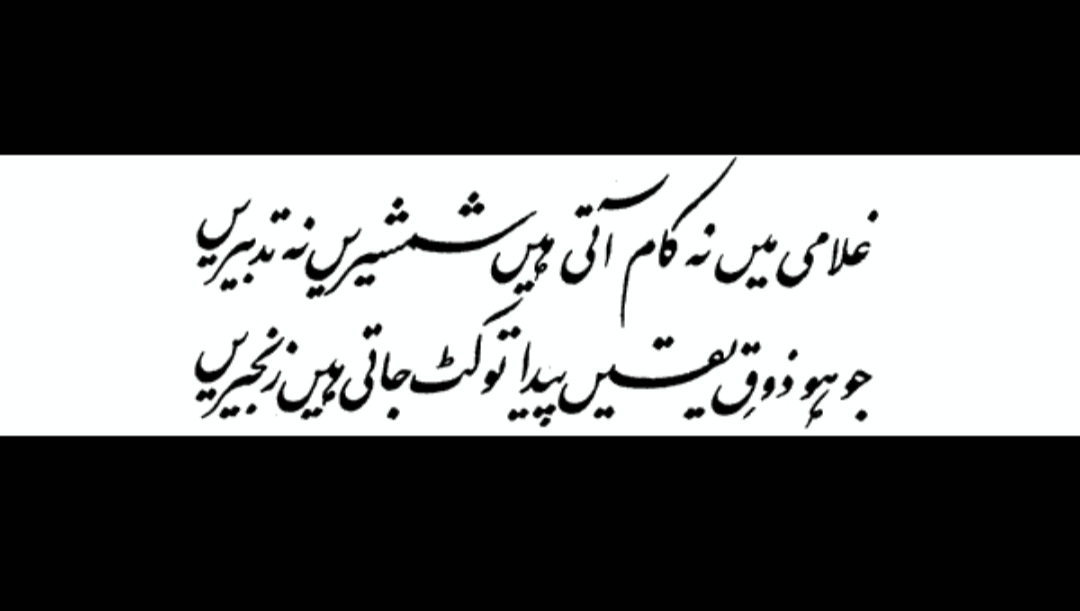
Ghulami Mein Na Kaam Ati Hain Shamsheerain Na Tadbeerain

Jo Ho Zauq-E-Yaqeen Paida To Kat Jati Hain Zanjeerain

(In slavery, neither swords nor plans are effective but when the taste for conviction is forged, the chains are shattered.)

In these timeless couplets, Allama Muhammad Iqbal captivated a fundamental truth about human liberation. It’s that the physical force (shamsheerain) and strategic maneuvering (tadbeerain) are utterly powerless if a nation or an individual is trapped in a mindset of subjugation. True emancipation does not start on the battlefield or at a diplomatic negotiation table. It begins within the human psyche through Zauq-e-Yaqeen. An unshakeable conviction, profound self-belief, and faith in a higher purpose accordingly.  When one examines the contemporary global events, Iqbal’s words understand modern struggles for sovereignty, social justice, and systemic reform.

In the modern world, servitude rarely presents itself through colonial rule or physical iron chains. Instead, modern subjugation often manifests as economic dependency, cultural imperialism, digital surveillance, and ideological defeatism. Entire populations often find themselves caught in systems that dictate their economic choices. They systems that diminish their local heritage, and undermine their self-reliance. Iqbal’s verse applies to this contemporary reality. The verse reveals why so many political reform efforts or heavily funded technological solutions fail to bring real change. When a society suffers from an internal sense of inferiority, no amount of advancement or external assistance can bring genuine autonomy. Strategy and weapons are just instruments. They remain inert without the driving force of genuine conviction. Psychological emancipation must precede material victory. Until a community believes it is worthy and capable of self-determination, external freedom remains an illusion.

What does it mean to cultivate Zauq-e-Yaqeen (the taste of deep certainty) in today’s complex world?

It represents a transition from passive endurance to active self-realization (Khudi). Historically and in present times, the most profound societal revolutions did not succeed purely because they had superior resources. They succeeded because a critical mass of people developed an unshakeable belief in the justice of their cause. Modern historical struggles show that authoritarian regimes with military apparatuses often crumble when faced with non-violent movements engined by absolute moral certainty. In an era of informational dominance, Zauq-e-Yaqeen requires reclaiming intellectual sovereignty. It demands rejecting narrative manipulation and trusting one’s collective identity and ethical values. Developing nations breaking free from debt cycles and foreign leverage do so by encouraging local innovation, education, and confidence in their human capital.

Iqbal’s poetry is not a eulogy for the past. It is an urgent command for the present. The chains of the modern era: political suppression, economic exploitation, or personal despair, cannot be let go of by adopting foreign systems or waiting for political saviors. Real liberation requires an internal awakening. When a society cultivates faith in its intrinsic worth, its moral foundation, and its capacity to shape its destiny, the structural barriers that once seemed insurmountable inevitably begin to shatter. Strategic plans and practical tools then become effective because they are finally guided by an invincible spirit.


 

Similar Posts

  • Fake it till you break it: inside the deepfake era

    Previously, I believed that if one could see something, it could be trusted because seeing is believing. A video was proof. A voice recording was evidence. That belief is gone, and I don’t think we have fully sat with the implications. There is an abnormal shift happening. AI-generated images, voice cloning, face-swapping apps, and similar tools were supposed to expand how people express themselves, but instead they have slowly chipped away at what matters most: the belief that people can express themselves through their images and their words. I attended a workshop under the project titled “Digital Trust and Free Expression in the AI Era” at Department of Media and Development Communication, University of the Punjab, supported by the U.S. Mission to Pakistan in partnership with the Pakistan-U.S. Alumni Network (PUAN) last week. During the discussions on digital trust. I took part in the discussion and shared my thoughts that we are now in a time where we must take this out of the realm of fun tech novelty and place it in the realm of a structural issue in how societies operate. Everyone says deepfakes are a “misinformation” issue, but this is not an adequate way to describe it. Misinformation is something that’s a false statement that can, in theory, be fact-checked. Deepfakes strike at the heart of video and audio credibility which have always been treated as vivid reality. When people realize that any clip can be fabricated, they stop trusting all clips, even real ones. This is what concerns me most. Fake things are believed and real things become deniable. Consider the implications of journalism, courts, political accountability, etc. If a politician is recorded saying something damaging, they can simply claim that it’s a “deepfake” and, depending on how much trust citizen have lost, people may believe them. We are creating a society in which it is possible to negotiate authenticity and in which negotiable authenticity is a gift for those who wish to avoid consequences. I also face a conflict here: I strongly believe in free speech, satire, parody, art and provocation even with synthetic media. The same technology behind de-aged actors, resurrected voices, dubbing, and experimental AI is extremely creative, yet it is all connected to malicious deepfakes. There is no way to ‘clean’ a tool of its worst use-case. A hammer can break windows or build houses. I do not think banning synthetic media is the answer, nor do I support pre-emptive censorship. That path harms legitimate satire, journalism and art under the pretense of ‘preserving truth’. History does not look kindly on institutions that decide what is a “fair” fake. Freedom of expression has never been of consequence or friction, and right now, deepfakes have almost no friction. The reality is there is no cost, disclosure, and accountability in using this technology deceptively. The issue is the imbalance. I believe the solution is not reducing synthetic tools but improving provenance. We need a digital watermarking, which cannot be “easily removed”: cryptographic signatures embedded into cameras, microphones and generative tools at the point of creation, so that the “unverified” label appears by default, not as an afterthought. Not to prohibit any content but to allow people to know what they are seeing before deciding whether to trust it. Platforms have been allowed to operate without responsibility for too long. Convincing fakes can reach millions before correction and corrections never travel as far. This asymmetry is not natural; it is a design choice. Platforms can mark, rate or tag synthetic content at the time of dissemination. Most simply haven’t had to! But, beyond platforms, we must change our own instincts as individuals. The old saying was “pics or it didn’t happen.” The new rule should be: “Who gains from believing this and can I verify it myself? A society that believes everything or worse, believes nothing is in danger. The deepfake age is not the age of AI; it is the consequences of a world where the cost of faking reality is near zero and the cost of establishing truth remains high. Freedom of expression should protect the most challenging and profound exchange of ideas, not the production of fake consent, fake evidence, or fake people. We can have creative freedom and still expect honesty about sources. These are not competing prioritie These are not different objectives/priorities. However, if we pretend it’s a content-moderation footnote, we must make sure we are not waking up in a world where “fake it till you make it” has become ‘fake it till you break it” and by that time, it won’t be just one video or one lie that will break. It will be our fundamental ability to reach a shared understanding of reality. The views, thoughts, and opinions expressed in this blog are solely those of the author and do not necessarily reflect the official policy or position of the U.S. Mission to Pakistan or USEFP/PUAN. The writer, Mahnoor Ashraf Wattoo, is a student of Media and Development Communication at University of the Punjab, Lahore 

  • Online overuse affects mental health

    Spending too much time online has become a common habit for many people but it may negatively affect mental well being and everyday life. A study conducted in Germany found that excessive internet use can lead to higher stress levels irritability and less interest in other important activities. Researchers at the University of Duisburg-Essen surveyed around 900 people to learn about their internet habits. Based on the amount of time they spent online participants were divided into three groups. For two weeks each participant completed a short survey every evening. They reported their mood stress levels desire to use the internet and the total time they spent online that day. The researchers also examined how much people enjoyed using the internet and whether it affected their work hobbies studies or personal responsibilities. The study found that people who spent the most time online were more likely to feel stressed become easily irritated, and ignore other parts of their daily lives. Researchers also discovered that many heavy internet users felt a strong urge to go online because it gave them comfort and enjoyment. According to the researchers the findings show that excessive internet use can influence many areas of life and the risks are greater for people who spend long hours online regularly.

  • |

    Experts reveal how ancient Egyptians built pyramids?

    The centuries-old Egyptian pyramids have long remained a major focus of interest for people and scientists. For years, scientists have been trying to solve the mystery of how such massive pyramids were constructed in ancient Egypt thousands of years ago. Now, a possible answer has emerged. Earlier, it was believed that ropes and sledging systems were used to transport stones to the upper sections of the pyramids. However, evidence discovered near the Nile River suggests that experts of that era had already mastered advanced construction techniques centuries before the construction of the Great Pyramid of Giza in the desert. Archaeologists have excavated a 5,000-year-old cemetery-like site near the eastern bank of the Nile River. Two tombs discovered there have construction styles remarkably similar to those of the Egyptian pyramids built centuries later. The walls of these tombs were thicker at the bottom and gradually became narrower toward the top. This design provided greater stability to the structures. Similar techniques were later used in the construction of step pyramids and other large pyramids. Researchers also discovered evidence of ancient methods used to cut stones and wood which were employed in the construction of the tombs. The tombs were discovered in Egypt’s Jabal al-Tayr region where people have been buried for thousands of years. The style of these tombs resembles the tombs of kings in Abydos, one of Egypt’s oldest cities. This suggests that advanced construction techniques may have been widely known across Egypt even before the construction of the pyramids. Researchers said the tombs provide a glimpse into experimental construction methods that may have eventually led to the construction of the Egyptian pyramids. Experts said preliminary analysis indicates that the construction style of these tombs was quite similar to that of the pyramids associated with Egypt’s First Dynasty. Egypt’s First Dynasty ruled the country around 3100 BC. According to Egypt’s Tourism Minister, Sherif Fathy, the new discovery will help researchers understand how these construction techniques evolved throughout ancient Egyptian history. Earlier, in May 2024, researchers discovered a buried branch of the Nile River beneath the desert that once flowed around more than 30 pyramids thousands of years ago. This discovery helped solve the mystery of how ancient Egyptians transported extremely heavy stones to the pyramid construction sites. The 40-mile-long branch of the river once flowed around the Great Pyramid of Giza and other pyramids. Thousands of years ago, it gradually became buried beneath desert sand and agricultural land. According to the research, the presence of this ancient river explains how 31 pyramids were constructed between approximately 4,700 and 3,700 years ago in a valley that has now become a deserted strip of desert. The valley is located near Memphis, the ancient capital of Egypt and is home to the Great Pyramid of Giza, the only surviving wonder of the ancient Seven Wonders of the World. A study published in the journal Nature Communications reported the discovery of this ancient branch of the river. The research team used radar satellite technology to identify the hidden river channel. Surveys of the area and analysis of samples confirmed the presence of the ancient river. According to researchers, the river was once very powerful but may have gradually become buried under sand because of drought around 4,200 years ago. The Great Pyramid of Giza is located just one kilometer from the bank of this buried river. Around 2.3 million stone blocks were used to build the pyramid with each block weighing between 2.5 and 15 tons. Researchers said the ancient river also provides clues about why pyramids were built at different locations. They explained that the river’s course and flow changed over time which may have led Egyptian rulers to construct pyramids at different locations.

  • AI Cannot Replace Expertise

    By Arooba Younas The surge in the use of Artificial Intelligence by businesses, corporations, and organisations has been illustrated by the latest McKinsey Global Survey on the state of AI. Accordingly, 88 per cent of organisations reported the regular use of AI in at least one business function, a 10 per cent increase from the results of the survey conducted in the preceding year. Indicative of business leaders’ desire to boost productivity and reduce operational costs, companies adopted AI to achieve greater efficiency. The reverberations of AI integration are felt in the splintering of the organisational pyramid, driven by the expansion of what a single individual can accomplish. However, flattening hierarchies is not tantamount to flattening skill hierarchies or democratisation of expertise. Research has shown that Generative AI (GenAI) has the greatest impact on the level of expertise required to perform jobs, resulting in an accelerated learning curve for entry-level workers. Whilst shortening the learning curve and the time it takes novices to gain competence at new tasks, the limits of GenAI in upskilling workers have been revealed in an experiment conducted by researchers from Harvard Business School’s Data Design Institute and Stanford University, involving 78 employees from IG Group, a UK-based fintech company. Dividing the employees into three groups of occupational insiders (professional writers), adjacent outsiders (marketing specialists), and distant outsiders (technologists), the experiment attempted to gauge whether marketing specialists and technologists could match the performance of professional writers in conceptualising and drafting articles for IG Group’s website while receiving GenAI assistance. The results revealed that AI levelled the playing field at the conceptualisation stage. However, when the nature of the task shifted to executing the ideas by putting them in writing, a prominent expertise gap emerged. Both with and without GenAI’s help, the writers produced the best work, with marketers coming close and technologists lagging behind regardless of AI use. The divergence in performance, despite AI support, is a portrayal of the “GenAI Wall”, depicting the point at which GenAI does not sufficiently reduce the expertise gap between occupational insiders and outsiders. This is indicative of GenAI’s limit in how far it can carry workers outside their domain expertise. Without foundational knowledge, it becomes difficult for outsiders to distinguish between effective and flawed suggestions generated by GenAI. As a result, they may rely on its outputs without applying the necessary refinement, critical judgement and contextual understanding. Nonetheless, the experiment has implications for business organisations, particularly for leaders who overestimate the abilities of AI. It can only hasten the competency of individuals who are adjacent to a domain, and not conjure expertise out of thin air. In this regard, work structure, which is already undergoing change, can be rethought along the lines of expertise. A more fluid work environment can be created, where, in lieu of strict job roles, boundaries can blur by converging adjacent specialists. However, the experiment is not an advocacy for hiring fewer novices. Studies have shown a reduction in entry-level role postings, falling by 32 per cent in 2025 compared to 2019-2022. This suggests a myopic conclusion drawn from GenAI’s putative capabilities, for it is beginners who, when assimilated into the company’s culture and learn through practice, become experts. By thwarting the pipeline of learners by letting AI take over early-career work, which actually led to the making of experts, today’s efficiency may be sacrificed for impoverished talent tomorrow. The latter has been represented by the AI boomerang effect – recent AI-related layoffs, which are now being quietly reversed – as reports indicated employers regretting layoff decisions. This is because of AI hallucinations as well as its inadequacy to replace the required context or institutional knowledge, which human employees possessed. Although the IG Group experiment was conducted in a Western context, its implications can be generalised across the world, particularly as the allure of AI has diffused across continents. However, the embracing of AI in the Global South, whether in businesses or other sectors, has to be accompanied by digital literacy, localised governance, and a research ecosystem. This is significant lest the adoption of AI brings with it downsides in the form of overdependence and a putative magic bullet solution to solving complex issues ranging from bad governance to climate-related disasters. Additionally, GenAI’s exposure to the labour market has caused faster materialisation of disruptions rather than productivity gains due to a higher risk of job losses, as AI-driven automation can close clerical and administrative positions, which have historically served as pathways to decent work. Conclusively, GenAI has brought the promise of enabling individuals to bridge their capability gaps. However, AI cannot replace expertise or be an all-encompassing fix because it relies on pattern recognition rather than understanding real-world context. Thus, the future of work is where humans can learn to effectively partner with AI, grounded in human judgement, and not replacing it.   Arooba Younas is a Research Assistant at the Centre for Aerospace and Security Studies (CASS), Lahore. She can be reached at info@casslhr.com.  

  • Faculty development: beyond classrooms 

    By Prof. Engr. Dr. Khuram Pervez Amber The persistent weaker linkage between industries and universities in Pakistan requires strategic interventions from all stakeholders. Pakistan cannot expect systemic industrial growth while its higher education institutions and industrial sectors operate in silos. Number of universities in Pakistan has dramatically increased over the past two decades. At current, there are nearly 280 universities in Pakistan which are producing thousands of graduates every year. But the concerns of industries remain valid that the graduates lack the necessary technical knowledge and skills which are required in the industries. These concerns of industries are particularly reported in disciplines such as engineering, computer science and the applied sciences, where employers frequently report a mismatch between academic preparation and industrial requirements. Although there are some valuable initiatives by the HEC, PEC, and NTC which include mandatory industrial internships of six to eight weeks for the engineering and technology students, the impact of such initiatives is limited due to multiple factors. Another initiative of HEC to strengthen university academia linkage is the establishment of the Office of Research, Innovation, and Commercialization (ORICs) in universities. However, the effectiveness of this initiative has not been successful at the desired level as in many universities, ORICs operate with limited staff and resources, while directors of ORICs are usually on additional charges. Expecting a small office alone to build industrial linkages for an entire university is unrealistic. Currently, out of nearly 260 universities, only 95 universities have established ORICs. In the recent ORIC ranking of HEC, only seven of 95 universities achieved the top category, i.e. “W” category. One of the major unexplored reasons behind this fragile linkage between industry and academia is the limited or no industrial exposure of university teachers. Most university teachers move directly from their bachelor’s degrees into master’s and PhD programs. Through this route, such individuals may become academically qualified teachers, but this route does not make them professionals having knowledge of industrial practices, industrial standards, and industry-oriented innovations. In many cases, a teacher teaches an industrial system which he/she has never experienced. This approach may clear theoretical concepts of students, but such students will certainly struggle when they would face real- life industrial problems after their induction in industry. So why do our university teachers require industrial exposure in their field of research? The answer is simple. A teacher with industrial exposure brings his industrial experience into the classrooms, laboratories, projects, and discussions on daily basis. Industrial experience of such teachers would not only improve the technical understanding of students about various industrial systems but also enhance students’ problem-solving skills. It would further help students to understand industrial expectations. So how could universities help their faculty members to get industrial experience? This could be achieved through implementation of structured industrial placement/professional development programs under ORICs for university teachers particularly working in engineering, technology and applied sciences faculties. Under this program, university teachers can spend six months to twelve months in an industry related to their field of interest/research on a turn-by-turn basis. During this period, such faculty members will keep receiving their monthly salaries as usual. So, what will be the major benefits of this model? There will be significant improvement in the pedagogical skills of faculty members as they will be teaching with practical examples, industrial case studies and real-world problem-solving approaches. During their placement in the industry, faculty members would make connections with the industrial experts/managers/engineers which would help them in future to supervise industry-relevant research, secure collaborative projects and contribute to technology transfer. They would identify operational challenges requiring research-based solutions. Upon returning to universities, they can transform these challenges into student projects, postgraduate research topics and consultancy opportunities. This would help create a healthier research culture focused on solving local industrial problems. University graduates will have problem solving skills that are required by industry. Over time, this model would help bridge the trust deficit that exists between academia and industry. Admittedly, implementing such a policy would not be easy. Challenges such as shortage of faculty, and increased teaching workloads are genuine challenges. There are also cultural barriers within academia, where industrial experience is often valued less than traditional academic achievements. However, these barriers are manageable. HEC and professional bodies such as PEC, and universities can jointly develop and implement structured industrial placement programs for faculty members. The industrial experience can be recognized within promotion criteria of faculty members, accreditation frameworks and quality assurance standards. In the nutshell, to produce industry ready graduates, the industrial exposure of university faculty members is indispensable. Their industrial experience will result in a stronger academia-industry linkage which is essential for economic growth, innovation and technological progress. Until universities and industries begin working together more meaningfully, Pakistan will continue producing degrees faster than opportunities. Prof. Engr. Dr. Khuram Pervez Amber (CEng, MEI, PE, FHEA) The writer is serving as Director QEC at Mirpur University of Science and Technology, AJ&K.

  • Poultry industry linked to foodborne infections

    A new study warns that modern large scale chicken farming may be helping dangerous food poisoning bacteria spread more easily creating new risks for human health. Researchers from the Oxford University found that the rapid growth of industrial poultry farming has created ideal conditions for Campylobacter, a bacteria that causes food poisoning to grow spread and develop new traits. Campylobacter is one of the world’s leading causes of diarrhea and food poisoning. In the UK it causes around three and a half times more stomach illness cases each year than all other monitored foodborne bacteria combined. The researchers said the global chicken population has increased about sevenfold since the 1960s reaching around 31 billion birds. This growth has made it easier for bacteria carried by wild birds to spread among farm chickens. The team studied nearly 2,800 bacterial genomes collected from chickens and wild birds in 30 countries including the UK and the US between 1979 and 2024. Genetic analysis showed that the bacteria had developed changes linked to modern farming conditions. These included genes that help it resist antibiotics and survive more easily in large poultry farms. Researchers warned that rising antibiotic resistance is making Campylobacter infections harder to treat. The study’s lead author Sam Sheppard said the findings provide new evidence that human activities and environmental changes can increase the spread of infectious diseases. He added that understanding how bacteria evolve will be important for reducing future risks of animal to human diseases and antibiotic resistant infections.

Leave a Reply

Your email address will not be published. Required fields are marked *