
martyred terror attack
| | |

15 martyred in terror attack on joint security Che…

At least 15 people, including 14 security personnel, were martyred after terrorists launched a major attack on a joint security checkpost in Tank district of Khyber Pakhtunkhwa during the early hours of Friday.

According to the Inter-Services Public Relations (ISPR), the attackers attempted to storm the checkpost in a coordinated assault. Security personnel immediately responded with heavy fire and successfully prevented the militants from capturing the position.

During the intense gun battle, security forces killed 12 terrorists who were attempting to escape after the failed assault. Officials said the troops displayed exceptional bravery and professionalism while defending the post.

The attackers later rammed an explosive-laden vehicle into the outer wall of the checkpost. The massive explosion caused severe structural damage and resulted in the martyrdom of 12 army personnel, two police officers and one Forest Department official who were performing their duties at the time of the attack.

The blast also damaged parts of the security installation, while emergency teams rushed to the area to assist the injured and secure the site.

Following the attack, security forces launched a large-scale search and clearance operation in the surrounding areas to track down any remaining militants and ensure the area was fully secured. The operation is continuing.

Military officials said Pakistan’s security forces remain fully committed to eliminating terrorism and will continue intelligence-based operations across the country under the Azm-i-Istehkam national counterterrorism strategy.

The military paid tribute to the martyred personnel, describing their sacrifice as a symbol of courage, dedication and unwavering commitment to the defence of the country. Officials said such attacks would not weaken the nation’s resolve to defeat terrorism.

The latest incident comes amid continued efforts by security forces to dismantle militant networks operating in Khyber Pakhtunkhwa and Balochistan through intelligence-led operations. Authorities have intensified counterterrorism efforts in recent months following a rise in attacks targeting security personnel and public installations.

Senior officials condemned the attack and vowed that those responsible would be hunted down and brought to justice. They reaffirmed that operations against terrorist groups would continue until peace and stability are fully restored across Pakistan.

Security experts believe militant groups are attempting to target security installations to undermine ongoing counterterrorism operations. However, officials maintain that such attacks will only strengthen the determination of Pakistan’s security forces to continue their mission against terrorism.

Similar Posts

  • | |

    Doctor suspended after performing laparoscopic sur…

    Islamabad: The Medical Tribunal has upheld a one year suspension of Dr Irfan Ashraf after finding that he performed laparoscopic surgery despite not completing the required training for independent laparoscopic procedures and operated at a healthcare facility that lacked an Intensive Care Unit and other essential facilities needed to deal with serious complications. The Tribunal also upheld a Rs100,000 fine and a ban preventing Dr Irfan Ashraf from performing laparoscopic procedures until he completes proper certified training. The judgment, announced on July 8, 2026, came in an appeal filed by Muhammad Zahid Niaz, whose father Niaz Ahmad died after a chain of medical treatment that began with laparoscopic surgery at Saleem Polyclinic in Mian Channu on December 31, 2016. The case took a serious turn when the disciplinary inquiry examined the actual training record of Dr Irfan Ashraf. The inquiry found that although he had taken part in laparoscopic procedures during his postgraduate training, most of his experience was as an observer or assistant. According to the judgment, Dr Irfan Ashraf had not completed the required number of procedures at the higher training levels needed to show independent surgical ability. The record showed that he had not completed even a single Level V procedure, which represents the stage at which a trainee is expected to perform laparoscopic surgery independently without supervision. The Tribunal said this was not simply a case where a normal surgical complication had occurred. The main concern was that Dr Irfan Ashraf undertook an elective laparoscopic operation without having demonstrated the required independent competence and at a facility that did not have the necessary backup facilities. The patient, Niaz Ahmad, suffered an injury to the common bile duct and hepatic vascular structures during the surgery. He was later taken to Bahawal Victoria Hospital in Bahawalpur for further treatment. He subsequently received treatment at Sheikh Zayed Hospital in Lahore and underwent an interventional radiological procedure at Lahore Medical Complex. Despite prolonged treatment at several hospitals, he died on March 4, 2017. The Punjab Healthcare Commission had earlier investigated the matter. It found that Saleem Polyclinic did not have the required infrastructure, qualified human resources and licensing needed for such surgical procedures. The Commission imposed a financial penalty on the owner of the healthcare establishment and referred the conduct of Dr Muhammad Saleem Akhtar and Dr Irfan Ashraf to the medical regulator for disciplinary action. The medical disciplinary committee later appointed Prof Dr Tanwir Khaliq, an experienced general surgeon, as an independent medical expert. He examined the medical record and assessed the standard of care, the management of laparoscopic complications and the facilities available at the clinic. Prof Dr Tanwir Khaliq concluded that the operation had been performed at a relatively small healthcare facility without an ICU and other essential backup facilities. He also found that Dr Irfan Ashraf was not sufficiently proficient in laparoscopic surgery, particularly when dealing with complications. The Tribunal noted that Dr Irfan Ashraf himself acknowledged that Saleem Polyclinic did not have an ICU or the facilities required to manage serious complications from laparoscopic surgery. The Tribunal also noted that Dr Irfan Ashraf had been working as a Senior Registrar at Bahawal Victoria Hospital, where better surgical support was available. When questioned about why the operation was carried out at the private facility, the explanation was that the patient wanted the surgery there. The Tribunal rejected this reasoning. It said a patient’s preference cannot remove a surgeon’s professional responsibility to determine whether a healthcare facility is safe enough for the planned procedure. The case also raised questions about what doctors tell patients about their professional skills. The disciplinary committee found that Dr Irfan Ashraf had represented himself as independently competent to perform laparoscopic surgery even though his training record did not show that he had completed the required independent procedures. The Tribunal said the evidence supported three major findings against Dr Irfan Ashraf. He performed an elective laparoscopic operation at a facility that could not properly manage foreseeable complications. He represented himself as independently competent despite incomplete training. He also exposed the patient to avoidable risk by choosing a facility without the necessary support instead of a properly equipped tertiary hospital. However, the Tribunal did not hold every doctor involved in the patient’s treatment responsible. Dr Muhammad Saleem Akhtar, the owner of Saleem Polyclinic, received a warning rather than a disciplinary punishment. The Tribunal found that there was no evidence that he personally performed the operation or took part in the surgical decision making. The Tribunal said ownership of a healthcare facility alone was not enough to impose the same disciplinary punishment on Dr Muhammad Saleem Akhtar as the operating surgeon. However, the warning required him to ensure that his facility was not used for procedures beyond its capacity. Dr Khurram Shafiq Khan was also cleared of professional negligence. His involvement came later, after the patient had already suffered complications from the earlier surgery. His role was connected with an embolization procedure to control bleeding from the hepatic artery. After examining his role, the disciplinary committee found no clear connection between the procedure performed by Dr Khurram Shafiq Khan and the patient’s eventual death. The Tribunal found no reason to disturb that decision. Muhammad Zahid Niaz had appealed because he believed the punishment against Dr Irfan Ashraf was too weak considering that his father’s treatment ultimately ended in death. He also wanted stronger action against Dr Muhammad Saleem Akhtar and Dr Khurram Shafiq Khan. The Medical Tribunal, chaired by Justice (Retired) Safdar Saleem Shahid, rejected the request for harsher punishment. The Tribunal said a tragic medical outcome does not automatically mean that every doctor involved was negligent. It explained that medical procedures can have known complications even when reasonable care is taken. The important question is whether a doctor failed to meet the level of skill and care expected from a competent doctor in similar circumstances. In the case of Dr Irfan Ashraf, however, the Tribunal found that the disciplinary committee had enough evidence

  • | |

    Senate, NA leaders vow closer coordination for Par…

    ISLAMABAD: The leadership of Pakistan’s Senate and National Assembly has agreed to strengthen cooperation between the two houses of Parliament, with the aim of promoting democratic stability, improving legislation and ensuring a more effective parliamentary system. Senate Chairman Syed Yousaf Raza Gilani met National Assembly Speaker Sardar Ayaz Sadiq and Deputy Speaker Syed Ghulam Mustafa Shah at his residence in Islamabad on Saturday. The meeting focused on parliamentary affairs, matters of national importance and coordination between the two legislative houses. According to a statement issued by the Senate Secretariat, the participants stressed that closer institutional coordination was essential for strengthening parliamentary democracy and ensuring the smooth functioning of the system. Gilani said effective communication and cooperation between the Senate and National Assembly were necessary to uphold strong democratic traditions and reinforce an effective parliamentary structure. He also emphasised the importance of maintaining close liaison between the two houses, saying institutional coordination would contribute to the stability and effectiveness of Parliament. Sadiq, meanwhile, said collaboration between parliamentary institutions needed to be further strengthened to ensure effective legislation and better respond to public expectations. The leaders also discussed the overall situation in the country and exchanged views on issues of national importance. During the meeting, they agreed on the need to keep national interests at the forefront, uphold the supremacy of the Constitution and work towards greater democratic stability. They further reaffirmed their commitment to promoting mutual respect and effective communication between parliamentary institutions. The agreement comes as Parliament continues to play a central role in legislative and constitutional affairs, making coordination between its two houses important for ensuring that legislation and parliamentary business proceed smoothly. The Senate and National Assembly form the two chambers of Pakistan’s bicameral Parliament, with the National Assembly representing the population and the Senate providing equal representation to the federating units. The Senate chairman’s emphasis on cooperation also reflects a broader focus on strengthening parliamentary institutions and improving their capacity to perform constitutional responsibilities. A day earlier, Gilani inaugurated a newly modernised office complex of the Senate Secretariat at Parliament House. Addressing the ceremony, he described the upgrade as part of efforts to improve institutional capacity and modernise parliamentary operations. He said strong democratic institutions required modern systems, efficient infrastructure and a professional working environment. The upgraded facilities, according to the Senate, are intended to improve service delivery and enable the Secretariat to better support Parliament in carrying out its constitutional duties. With the latest meeting, the parliamentary leadership has signalled that stronger coordination between the Senate and National Assembly will remain a key priority in efforts to consolidate democratic institutions and ensure a stable parliamentary system.

  • | |

    Two suspects, who killed cops in Lahore. killed in…

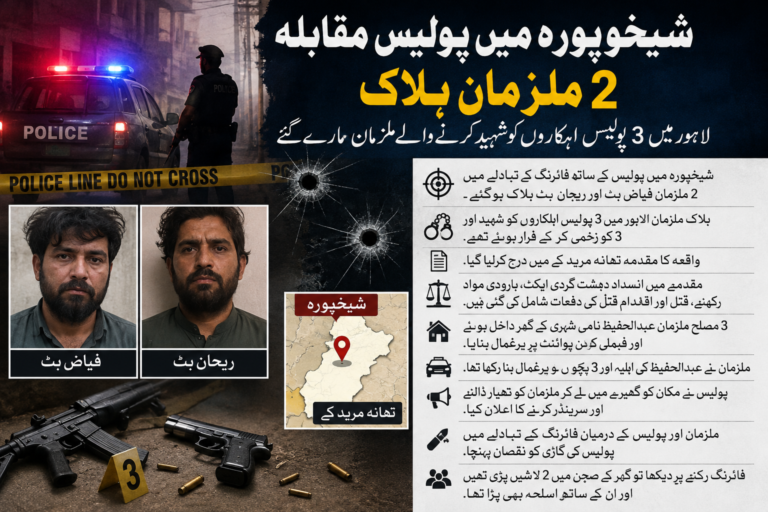
      Two suspected criminals, identified as Fayyaz Butt and Rehan Butt, were killed during an exchange of fire with police in Sheikhupura. A case has been registered at Muridke Police Station in connection with the incident, according to police officials. According to the First Information Report (FIR), the two deceased suspects were allegedly involved in a previous attack in Lahore in which three police personnel were killed and three others were injured. The FIR includes charges under the Anti-Terrorism Act, possession of explosives, murder and attempted murder. The incident occurred after three armed suspects allegedly entered the house of a citizen identified as Abdul Hafeez. According to the FIR, the suspects took the family hostage at gunpoint after forcibly entering the residence. The FIR stated that Abdul Hafeez’s wife and their three children were among those held hostage by the armed men. The situation prompted police to launch an operation to secure the house and rescue the hostages. Police surrounded the house and announced that the suspects should lay down their weapons and surrender. However, according to the FIR, the suspects did not surrender and an exchange of gunfire subsequently took place between the police and the armed men. During the exchange of fire, the police vehicle was also damaged. Police personnel remained positioned around the house while attempting to control the situation and prevent the suspects from escaping. According to the details contained in the FIR, the firing eventually stopped. When police officers entered the premises and inspected the area, they found two bodies lying in the courtyard of the house. Weapons were also found near the bodies. The deceased suspects were subsequently identified as Fayyaz Butt and Rehan Butt. Police officials said the two suspects had allegedly fled from Lahore after the deadly attack on police personnel. The FIR registered in Muridke includes several serious charges, reflecting the nature of the allegations against the suspects. The charges include provisions of the Anti-Terrorism Act, along with sections relating to murder, attempted murder and possession of explosive material. The case will now form part of the investigation into the suspects’ alleged activities and their involvement in the earlier Lahore incident. The hostage situation also raised concerns regarding the safety of the family inside the residence. According to the FIR, the police operation was carried out after the armed suspects allegedly took the family members hostage and refused to surrender. The authorities are expected to investigate the circumstances surrounding the encounter, including the sequence of events leading to the exchange of fire and the deaths of the two suspects. The incident highlights the challenges faced by law enforcement agencies when dealing with armed suspects accused of serious crimes. Police personnel are required to respond quickly in such situations, particularly when civilians are being held hostage. Further details regarding the identities and alleged criminal backgrounds of the suspects, as well as the investigation into the Lahore attack, may emerge as authorities continue their inquiry. The case registered at Muridke Police Station will provide the legal basis for investigating the incident and the allegations against the deceased suspects. Police officials will also examine the weapons recovered from the scene and other available evidence to establish the exact circumstances of the encounter. Authorities have yet to provide further details regarding the condition of the hostages following the operation. The investigation is expected to determine the full sequence of events and establish the suspects’ alleged links to the earlier attack on police personnel in Lahore.

  • | |

    Jibran Nasir says No hope from Sindh government in…

      Jibran Nasir, lawyer for Raza Mir, the father of young businessman Mir Raza who was found dead in Karachi’s Gulistan-e-Johar area, has said that he has no expectations from the Sindh government led by the Pakistan Peoples Party (PPP), urging police officials to perform their duties and calling on the provincial government not to adopt a “double policy” in the case. Speaking to the media after the first meeting of the investigation committee formed to probe Mir Raza’s death, Nasir said the family had made a mistake by identifying an honest police officer who had tried to bring facts to light. “We made the mistake of finding an honest officer,” Nasir said, referring to an officer who had written a letter to the authorities on August 3, informing them about alleged mistakes made by officials working under him. The lawyer alleged that those attempting to bring the facts of the Mir Raza case before the public were being targeted. He said the medical board had been constituted on the orders of the court and criticised what he described as unfair criticism of officials who had performed their duties during the past 11 days. Nasir also defended Dr Samia, saying that targeting her with criticism was unjustified. He maintained that the Sindh government had corrected its earlier mistakes and had moved the investigation in the right direction. According to the lawyer, certain individuals had attempted to quickly portray the case as suicide. He said the government itself had not failed, but rather those who had adopted an incorrect position regarding the case had been proven wrong. Nasir said that after new facts emerged, evidence indicating that Mir Raza had been murdered was acknowledged. He added that those who had initially insisted that the death was a suicide had been proven wrong and that officers who helped move the investigation in the correct direction should be encouraged. Speaking on the occasion, Mir Raza’s father said that if these steps had been taken earlier, there would have been no need for the exhumation of his son’s body. He said the family had provided investigators with all the information they had and only wanted justice for their son. Earlier, Jibran Nasir had written to the Sindh government, stating that Mir Raza’s parents did not want a judicial inquiry. He said the family had complete confidence in the judiciary but believed that the government wanted to make the case controversial under the name of a judicial commission. He also maintained that, under the law, the police had the authority to conduct the investigation. Later, Sindh Home Minister Zia Lanjar said that the decision to establish a judicial commission had been postponed for the time being following a request from Mir Raza’s parents. Mir Raza’s body was recovered from Gulistan-e-Johar on July 29. Following the exhumation of his body, a second post-mortem examination was conducted on August 8. The examination reportedly revealed traces of acid in Mir Raza’s stomach. His lungs were also found to have been severely affected by acid, while signs of acid exposure were reportedly detected on his shirt, hands and feet. Police have sealed a guesthouse near the location where Mir Raza’s body was recovered. Six people working at the guesthouse have reportedly been taken into custody. So far, 21 people, including Mir Raza’s friends and business partners, have been detained for questioning, and their statements have been recorded. Meanwhile, a five-member investigation committee headed by DIG Crime Branch Amir Farooqi held a meeting to review the case. Authorities said Section 201 of the Pakistan Penal Code has also been added to the case, in addition to Sections 365 and 302. Section 201 relates to causing evidence of an offence to disappear or giving false information with the intention of screening an offender. The investigation is continuing as authorities examine the emerging evidence and statements from people connected to the case.

  • |

    How K-pop stars turned concert stages into runways for luxury fashion

    Fashion and music have always crossed paths, but K-pop has taken that relationship to a whole new level. Red carpets and front-row seats used to be where haute couture made its mark, but now concert stages are doing the same job. Every costume change is planned down to the last detail, every embellishment is built to catch the light, and every custom outfit says something about who the artist is. BTS’s ongoing ‘ARIRANG’ tour and ‘BLACKPINK’s’ solo shows have both proven that concert fashion is officially having its moment. What is more, luxury houses are not just dressing these artists anymore, they are designing with them, turning performance costumes into genuine collector’s pieces. For brands, a sold-out world tour means access to a massive, engaged audience eager to study every seam and fabric choice, a crowd that’s often broader than the one watching from the front row at a runway show. K-pop concert looks now blend ready-to-wear, couture and performance-first design, and they have to survive far more than just a photo op. Outfits need to hold up through intense choreography while still fitting the artist’s public image and giving fans something to freeze-frame in fan edits. Stylists are increasingly pulling from designer archives or commissioning fully custom pieces to keep things exclusive. BTS’s Paris tour stop was a masterclass in this. V leaned into Celine’s Parisian tailoring, J-Hope brought youthful energy to Louis Vuitton’s classic menswear, and Jimin wore four custom Dior looks spanning fringed knitwear to Napoleon-inspired jackets. Jin and RM turned to Gucci for leather-and-crystal ensembles, Suga went with a beaded Givenchy suit, and Jungkook wore custom Balenciaga pieces pulled from the label’s latest collections. BLACKPINK’s members have been just as bold. Lisa’s Swarovski-crystal catsuit from her Chicago show later ended up on display at Swarovski’s own crystal museum in Austria. Jennie leaned into archival fashion, wearing vintage Chanel pieces from the Karl Lagerfeld years, while Jisoo and Rosé spotlighted Asian designers, choosing Malaysia’s Ivan Yong and Seoul-based Gyouree Kim respectively. TWICE worked with New York designer Kim Shui for futuristic, metallic-heavy looks, while G-Dragon continues to blur the line between fashion and performance entirely, recently mixing bespoke Chanel tweed with an Amiri sequin suit. Together, these artists are proving that concert wardrobes can be just as fashion-forward as anything seen on a runway.

  • | | |

    PRL and SSGC face Senate anger over missing inform…

    Islamabad: State owned petroleum companies Pakistan Refinery Limited (PRL) and Sui Southern Gas Company (SSGC) faced serious criticism in the Senate after lawmakers expressed dissatisfaction over missing information, failure to follow committee directions and concerns about company management. The Senate Standing Committee on Petroleum questioned the performance and accountability of government owned petroleum companies and considered taking strict action against officials who failed to cooperate with parliamentary oversight. During the meeting chaired by Senator Umer Farooq, the committee reviewed the appointment criteria for chairpersons and managing directors of petroleum companies, the structure of their boards and progress on previous committee recommendations. The committee took serious notice of the absence of the Managing Director of Pakistan Refinery Limited during the meeting. Members expressed concern that PRL, despite being a state-owned company, did not provide the required information to the committee. The committee considered initiating a privilege motion against the Managing Director of PRL for failing to appear and provide necessary details. The Petroleum Division was directed to submit complete information about the boards of directors and senior management of all government owned petroleum companies. The committee said transparency in leadership appointments and company management is necessary because these organisations deal with matters directly linked to the national economy and public interest. The committee also expressed dissatisfaction over the performance of Sui Southern Gas Company and its failure to implement previous recommendations. Members said SSGC had not provided details of its board of directors despite earlier instructions. The committee also raised concerns over remarks made by SSGC that were considered discouraging toward the Senate Standing Committee’s role in discussing important matters. The committee considered moving a privilege motion against SSGC over non compliance with its directions. The Petroleum Division was further directed to review the tenure of board members who have remained in positions beyond the approved period and submit a detailed report. The committee also raised concerns over the absence of performance audits of oil rigs. Authorities were directed to provide the required audit report within seven days so that the committee could review the performance and efficiency of petroleum sector operations. Members said proper audits are necessary to identify problems, improve production and ensure better use of national resources. The committee also reviewed issues related to LPG quotas and licensing. The Oil and Gas Regulatory Authority was directed to hold consultations with all relevant stakeholders and submit a detailed report to the committee. Senators stressed that petroleum companies must improve governance, follow parliamentary instructions and ensure public institutions operate with transparency. The committee said accountability in state owned petroleum companies is essential to protect national interests and improve confidence in the energy sector.

Leave a Reply

Your email address will not be published. Required fields are marked *