rabies still kills

Rabies still kills thousands in Pakistan

Every year millions of people in Pakistan are bitten by dogs, and thousands are believed to die from  rabies a deadly viral disease that can almost always be prevented with timely treatment.

Health experts say Pakistan still does not have a strong nationwide system to track rabies cases. Because of this around 5,000 people are estimated to lose their lives each year after being bitten by rabid dogs.

Rabies is a viral infection that attacks the brain and nervous system.  Once symptoms appear the disease is almost always fatal with a survival rate of less than 1%.

The first signs of rabies usually develop about six weeks after a bite from an infected animal.

Common symptoms include fever headache body aches a sore throat and difficulty swallowing.  As the disease progresses it becomes much more dangerous.

Children living in rural areas and on the outskirts of cities are among the most affected groups.

A study published in the international journal Acta Tropica found that the high number of rabies cases in Pakistan is linked to low public awareness delays in seeking medical care

and weak disease prevention efforts.

Health experts say that immediate medical treatment after a dog bite including wound cleaning and timely vaccination can prevent rabies.

They also welcomed the federal government’s recent in principle approval of the National Rabies Prevention and Control Framework calling it an important step toward improving rabies prevention and saving lives.

Similar Posts

  • |

    Rare 1858 volume returned to Australian library after 150 Years

    A home renovation in Australia recently uncovered a piece of literary history that had been missing for a century and a half. A homeowner in the coastal community of Kiama, located south of Sydney in New South Wales, was tearing down wall structures. Amidst, he stumbled upon a sealed fireplace. Inside an old wooden tea crate behind the brickwork was an antique book that belonged to the town’s local library. The volume, titled Antiquities of Athens, was published in London in 1858. Staff at the Kiama Library realized that the book had been missing since 1870s. Library officials described the return as completely unprecedented. While they occasionally receive books that are a few decades late during estate cleanouts, they had never seen a volume missing for over a century. The book itself is a notable historical work. It was originally authored by British architects James Stuart and Nicholas Revett to document classical Greek architecture. Book No. 506. A part of Kiama Library’s inaugural catalog which comprised roughly 1,000 items when the library first opened its doors in 1872. Despite enduring around 150 years encased inside a chimney cavity, the physical volume appeared in a surprising condition. Mild water exposure near the margins and natural weathering consistent with a century of neglect. However, the pages and original library stamps remained clearly legible. How the book ended up sealed behind a fireplace wall remains open to speculation. During the 19th and early 20th centuries, homeowners used unwanted household items as insulation or filler material when bricking over chimney flues. When Kiama Library manager Michelle Hudson examined the interior cover of the returned tome, she discovered the original set of lending regulations printed inside. Among those provisions was a penalty clause dictating an overdue fee of three British pence per week. Doing the math to adjust that Victorian-era fine for inflation over 150 years results in an eye-watering figure: roughly  $28,000 Australian dollars (approximately $19,500 USD). Luckily for the current homeowner who handed it over, the library has no intention of collecting. In fact, even if staff wanted to hold someone accountable, identifying the original borrower is impossible. The library’s paper borrow ledgers from the 1870s were lost or discarded long ago. It left a complete mystery as to who last checked out the book. The volume provides a fascinating glimpse into Victorian-era social norms and public library regulations. A borrower was forbidden from checking out another book until any previously borrowed item was returned and all associated fines were cleared. Hudson playfully speculated that this rule might explain why the original patron never brought the book back. Once the fine started accumulating, returning it became too costly. Households could borrow up to three books at a time, but only if at least six members of the family were verified as capable of reading. The regulations specifically prohibited lending books to individuals who arrived at the library in a state of intoxication. Modern library policies focus on patron code of conduct rather than testing family literacy rates. However, these antique guidelines serve as a memorable reminder of how public institutions functioned in colonial Australia. Antiquities of Athens will not be re-entering general circulation returning home after a century and a half in exile. Library staff plan to place the volume on permanent display within their local history archive. It is aimed to preserve it as both a physical artifact of Victorian publishing and a symbol of local history. As Hudson quipped, the library is thrilled to have its 506th catalog entry back on the shelves. Also, they have no intention of risking another 150-year wait to see it again.  

  • Marriage can change couples personalities, study reveals

    Marriage is often described as a situation where “those who marry regret it and those who do not marry regret that too.” Now, scientists have revealed a surprising effect that marriage can have on couples. According to researchers, the first two years of marriage can bring significant changes to the personalities of newly married couples. A joint study by the University of Georgia and the University of California found that personality changes during the first two years of marriage can have important long-term effects on marital relationships. According to the study, newlyweds experience noticeable changes in their personalities and these changes can influence their satisfaction with their relationship with their spouse. The research found that during the first 18 months of marriage, husbands tend to become more dependent on their wives and increasingly focus their attention on their wives rather than the outside world. The study also found that wives experienced reductions in anxiety, depression, feelings of inferiority, restlessness and stress. These positive personality changes were observed among couples of different age groups. However, researchers also noted one negative development: compatibility between husbands and wives tended to decrease. The researchers said that, overall, the findings show that men and women undergo significant personality changes soon after marriage and these changes can be important for developing a healthy long-term relationship. The findings of the study were published in the journal Developmental Psychology. Spousal support and stress Earlier, a study conducted by Binghamton University in the United States in April 2024 found that feeling a lack of support from a spouse can increase physical stress. This feeling can raise levels of cortisol, a hormone associated with stress. Cortisol works with parts of the brain involved in regulating mood, motivation and behaviour. Researchers said that people’s perceptions of their spouse’s support become stronger over time allowing them to predict how their partner is likely to behave in different situations. They further noted that support from a spouse is more important than people may expect.

  • Transforming Governance in Sindh’s Public Schools

    The introduction of FRAMES marks an important milestone in Sindh’s journey towards digital governance. Rather than relying on conventional attendance registers that have long served as the primary means of recording staff attendance, the School Education & Literacy Department (SE&LD) has embraced facial recognition technology to create a more transparent, secure and efficient monitoring system. The initiative reflects a broader vision of leveraging technology to improve governance, enhance institutional performance and ultimately create a better learning environment for students. For decades, education departments across Pakistan have struggled with administrative challenges that extend beyond teaching and learning. Manual attendance systems, paper-based reporting, delayed verification processes and fragmented administrative records have often limited the ability of education authorities to monitor schools effectively. In a province with thousands of public schools and a large teaching workforce, ensuring regular attendance and maintaining accurate records through traditional methods has remained a formidable challenge. Recognising these issues, the Government of Sindh has sought to replace outdated administrative practices with a technology-driven solution. FRAMES enables teaching and non-teaching staff to verify their attendance using facial recognition technology. Once authenticated, attendance records are securely captured and transmitted to a central monitoring platform, allowing authorised education officials to access real-time information regarding staff attendance across schools. Unlike conventional attendance registers that require manual compilation and verification, FRAMES introduces automation into one of the most fundamental administrative functions within the education sector. The result is not merely a change in attendance recording but a transformation in how educational institutions are monitored and managed. One of the distinguishing features of FRAMES is its ability to function both online and offline. This capability addresses one of the most practical challenges facing digital governance in developing regions. Internet connectivity remains inconsistent in several rural and remote areas of Sindh, making continuous online operation difficult for many schools. Recognising this reality, FRAMES has been designed using an offline-first architecture. Even when internet connectivity is unavailable, teachers and school staff can authenticate their attendance through facial recognition. The application securely stores attendance records on the device and automatically synchronises the data with the central server as soon as internet connectivity is restored. This intelligent synchronisation mechanism ensures that schools continue to operate without disruption while maintaining the integrity and reliability of attendance records. By eliminating dependence on uninterrupted internet access, FRAMES becomes a practical solution for schools across diverse geographical regions of the province. The importance of this feature cannot be overstated. Many digital initiatives fail because they assume ideal technological conditions that do not always exist in the field. By accommodating connectivity limitations, FRAMES demonstrates a realistic understanding of the operational environment within Sindh’s public education system. Beyond attendance verification, FRAMES represents a broader shift towards data-driven governance. Modern public administration increasingly depends on accurate, timely and reliable data to formulate effective policies. Every authenticated attendance record contributes to a growing repository of administrative information that can assist education managers in analysing attendance trends, identifying operational challenges and making informed policy decisions. Real-time monitoring significantly enhances administrative responsiveness. Instead of waiting for monthly reports or manual inspections, district and provincial authorities can obtain immediate insights into attendance patterns. Persistent absenteeism, staffing shortages or unusual attendance trends can be identified promptly, enabling faster interventions and more efficient resource allocation. The implementation of FRAMES also strengthens institutional accountability. Public institutions derive credibility from transparency, consistency and fairness. Digital attendance verification substantially reduces opportunities for manipulation associated with manual record keeping while creating an auditable electronic record of attendance. Such transparency not only improves administrative efficiency but also reinforces public confidence in government institutions. Across the world, education systems are increasingly adopting digital governance solutions to improve institutional performance. Countries in Asia, Europe and Africa have introduced biometric attendance systems, electronic education management platforms and digital monitoring tools to strengthen accountability within public education. International organisations, including UNESCO and the World Bank, have repeatedly emphasised that effective education governance depends upon reliable information systems capable of supporting evidence-based policymaking. Sindh’s adoption of FRAMES therefore aligns with broader international trends in educational management. While technology alone cannot resolve every challenge confronting the education sector, it provides administrators with the tools necessary to monitor institutional performance more effectively and allocate resources more strategically. The implementation of FRAMES also complements the Sindh Government’s wider digital transformation agenda within the School Education & Literacy Department. In recent years, the department has introduced several technology-based initiatives aimed at improving governance, financial transparency, administrative efficiency and public service delivery. Collectively, these reforms signal a transition from conventional bureaucratic practices towards modern digital administration. However, technological innovation alone is not sufficient to guarantee institutional success. The effectiveness of FRAMES will depend upon careful implementation, continuous evaluation and sustained capacity building. Teachers, head teachers and district administrators must receive comprehensive training to ensure that the system is used correctly and consistently. Technical support mechanisms must remain readily available to resolve operational issues quickly and minimise disruptions. Equally important is the need to strengthen digital infrastructure. Reliable electricity, functional devices and stable internet connectivity remain essential components of successful digital governance. Although the application’s offline functionality addresses connectivity constraints, long-term sustainability will require continued investment in technological infrastructure across public schools. Another important consideration relates to data privacy and cybersecurity. Because FRAMES utilises facial recognition technology, the protection of biometric information must remain a top priority. Clear policies governing data collection, storage, encryption and authorised access will be essential to maintaining public trust. International experience demonstrates that digital governance initiatives are most successful when supported by robust legal safeguards and transparent data protection frameworks. Some observers have expressed concerns regarding the growing use of artificial intelligence and biometric technologies within public institutions. These concerns deserve thoughtful consideration. Technology should always serve the interests of citizens rather than replace human judgement. Accordingly, FRAMES should be viewed as an administrative support system that strengthens institutional accountability without diminishing the role of educational leadership or professional responsibility. Indeed, educational quality ultimately depends upon far more than attendance alone.

  • | | |

    Rabindranath Tagore’s statue in Edinburgh

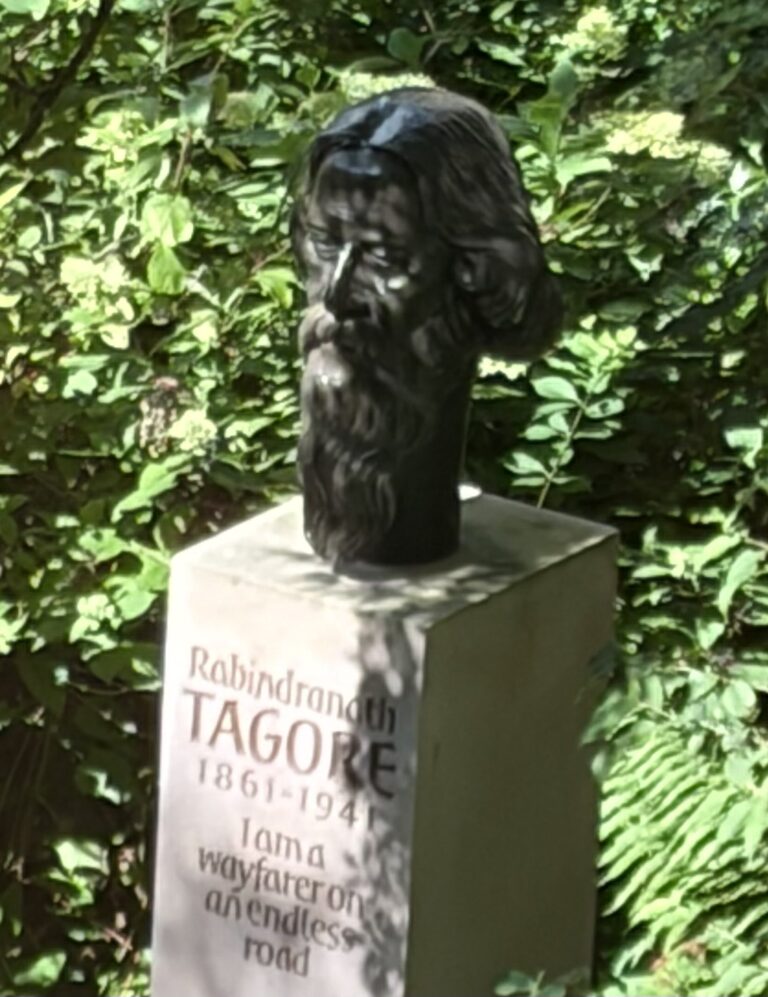
    The Sandeman House garden in Edinburgh holds a bronze statue of Asia’s first Nobel laureate in Literature, Rabindranath Tagore. Inscribed upon the pedestal supporting his likeness are his famous words, “I am a wayfarer on an endless road.” A Cross-Cultural Bridge Travelers often seek out Scotland’s capital for its ancient castles, gothic architecture, and literary heritage tied to the likes of Sir Walter Scott or Robert Louis Stevenson. However, discovering Tagore’s presence in this peaceful courtyard offers a cross-cultural bridge. The statue, unveiled to commemorate the deep-seated connections between Scotland and India. It is particularly the intellectual dialogue between Scottish polymath Patrick Geddes and Tagore himself. This monument serves as a physical testament to a global humanism that transcends geographic boundaries. Tagore’s India Tagore was far more than a celebrated poet and author. He was an uncompromising philosopher, musician, visual artist, and social reformer whose thoughts shaped modern South Asia and beyond. At the heart of his vast body of literature lies a profound critique of borders, nationalism, and sectarian division. Tagore envisioned an India, and indeed a world, defined by radical openness. In his mind, India is a sanctuary where diverse faiths, ethnicities, and cultures could coexist in mutual respect. He rejected narrow chauvinism in favor of an inclusive internationalism, advocating for a world where the mind is without fear and the head is held high. Tagore’s Literary Legacy In the contemporary geopolitical landscape, Tagore’s ideals feel relevant. Across the globe, modern youth face a climate marked by rising social polarization, cultural fracturing, and ideological echo chambers. In response, a growing movement of young activists, writers, thinkers, and students are turning back to Tagore’s literary legacy as a blueprint for unity. They are rediscovering his essays and poetry not merely as historical artifacts, but as active tools to reclaim a society rooted in pluralism and dialogue. By reimagining Tagore’s vision for a modern era, today’s generation is fighting to restore an environment where freedom of thought, artistic expression, and inclusivity thrive over division. His stance on education emphasized learning in harmony with nature and breaking down rigid academic and social silos. Young scholars and community organizers are channeling this exact ethos, utilizing art, literature, and grassroots civic engagement to rebuild cross-cultural bridges in an increasingly fragmented world. Message of Universal Brotherhood   Standing before Tagore’s statue in Edinburgh’s quiet garden, one is reminded that his journey as a “wayfarer” was never meant to be walked alone. His message of universal brotherhood, preserved in stone far from his native Bengal, serves as a timeless compass. For the youth striving to cultivate a more empathetic and open world, Tagore’s endless road remains wide open, inviting everyone to walk forward together.

  • Treasure hunt at Mayo landa in old Lahore

    Behind the 19th-century Victorian red-brick arches of Mayo Hospital exists one of Lahore’s most vibrant bazaars: Mayo Landa. First-time visitors might expect a simple fleece and jacket bazaar through the narrow lanes behind Mayo Hospital. However, it reveals something far richer. Mayo Landa has transformed into a bustling open-air ecosystem where global fashion, imported household goods, rare oddities, and genuine historic antiques intersect at prices that defy modern inflation. The word landa originates from the Punjabi term for roofless or uncovered. It usually refers to the early informal stalls that traders set up along open alleys without permanent shopfronts. The origins of Lahore’s landa market trace back to the pre-partition British colonial era. It is located strategically between the Lahore Railway Station and bustling medical hub of Mayo Hospital (established in 1871). The area naturally became a high-traffic junction for travelers, laborers, and rural migrants. Vendors began setting up wooden crates and blankets to sell low-cost textiles and goods to working-class families who could not afford stuff otherwise. Following the partition in 1947, the market expanded rapidly to accommodate millions of resettling families seeking affordable essentials. Over the decades, small family-run stalls grew into an organized nationwide wholesale network. Today, Mayo Landa operates as a major locality for imported pre-owned items. These are sourced globally from North America, Europe, Japan, South Korea, and Australia. While everyday apparel from heavy winter coats to designer sneakers remains a staple, the modern Mayo Landa experience goes far beyond clothing. Collectors regularly scour the market for genuine heavy-leather jackets, vintage denim, and retro sports gear that would cost hundreds of dollars internationally. Stalls feature everything from Japanese porcelain and European glassware to high-end kitchenware and functional electronics. Antique items are hidden within subtle corner stalls and old storerooms. Victorian brass lamps, mid-century mechanical clocks, classic cameras, old vinyl records, and hand-carved wooden artifacts. Prices are mostly negotiated through traditional haggling. Shoppers can frequently pick up valuable, high-grade collectibles at a fraction of their market value. What makes the backside of Mayo Hospital particularly captivating is its extraordinary cultural overlap and unique spatial atmosphere. Mayo landa alleyways & antique stalls. There roaming doctors & med students in scrubs. Then NCA art students searching for props across the area. Amongst, pashtun traders sorting bales. Hidden under the shade of century-old banyan trees behind the hospital compounds are secretive, multi-room vintage stores disguised as crumbling brick structures. Step inside, and you might find an operational 1920s gramophone playing vintage orchestra records right next to a pile of modern winter coats. Mayo Landa is more than just a flea market to the frequent visitors. It is a living archive of economic resilience, sustainable reuse, and cultural heritage. In a world dominated by fast fashion and mass-produced plastic, this historic corner of Old Lahore offers something rare. It’s the thrill of real discovery backed by over a century of history.  

  • Sindh’s missing universe

    Since Ashura, the mothers of Sindh have been sitting in at Babarloi Bypass through suffocating heat and humidity, with one demand: return our missing and abducted children. For a mother, a child is her entire universe — and for years these women have lived in psychological anguish searching for theirs. Fazila Sarki of Thul vanished nearly seventeen years ago; her father named the local Wadero he says orchestrated it, yet she was never recovered. Priya Kumari of Sangrar is entering her fifth year missing — committees formed, updates promised, and still nothing, as if the earth or sky simply swallowed her. Sindh’s landlords and chieftains have built a parallel state, one that operates above the law. If not, why would fourteen children currently be missing, why would the soil be stained with young blood over trifles, why would mothers go blind from weeping and cemeteries keep expanding? Innocent young women are still declared Kari and honor-killed — denied even a ritual bath, shroud, or funeral prayer, sometimes dumped in rivers. The law exists on paper; hundreds of thousands of officials draw salaries and perks from public taxes to enforce it — yet ordinary people have no protection at any level. The papers are full of these stories daily. The law exists, but it is locked away in books. Are the hands meant to enforce it helpless, or simply indifferent? Sukkur Civil Hospital — the teaching hospital for Ghulam Muhammad Mahar Medical College, and once a lifeline stretching from Balochistan’s Sibi, Nasirabad, and Bhag Nari to Kandhkot-Kashmore, Shikarpur, and Ghotki — has sunk to the level of Shikarpur’s Rai Bahadur Udhodas Hospital. Department heads sit in name only; real control rests with a handful of favorites who have run these institutions into the ground. Road accidents are a daily occurrence on the highways, and while the Orthopaedic Department stays busy, its facilities inspire only regret. With Nasir Shah and veteran politician Khurshid Shah both present, this hospital ought to be a model for Northern Sindh — instead it is anything but. Law and order, and justice, are the pillars any civilized society rests on. Where they hold, life, property, and honor are protected, and social harmony follows. Where they fail, fear, distrust, and unrest take their place — and our own society is proof enough of that; little more needs saying. An educated person lifts not just himself but his society; where ignorance and social ills grow instead, it is education that has failed first. Healthcare here tells the same story: women give birth in Qingqi rickshaws, medicine is scarce, and families buy even a disposable syringe out of pocket — though the budget for it exists. Doctors draw government salaries while absent, some working in Qatar or Saudi Arabia, others running private clinics. A friend recently told me PPHI, on taking over a government health unit, found a stockpile of medicines for heart disease, diabetes, and stomach ailments — worth a fortune, and only months from expiry. What tyranny is greater than this: medicine sitting unused while the needy go without? It is nothing short of an atrocity against the public. Hunger, disease, unemployment, lawlessness, and ignorance have battered Sindh until its people’s capacity for critical thought is paralyzed. The state, along with conscious citizens, politicians, and the well-off, must turn to this crisis — urgently.


Leave a Reply

Your email address will not be published. Required fields are marked *