bangladesh signals interest
|

Bangladesh signals interest in joining Pakistan-Saudi Arabia-Türkiye defence framework


DHAKA: Bangladesh has indicated that it is open to joining the Makkah Joint Defence Agreement signed by Pakistan, Saudi Arabia and Türkiye, as Dhaka looks to broaden its strategic partnerships while maintaining a foreign policy centred on national interests.

According to the state-run Bangladesh Sangbad Sangstha (BSS), Bangladesh Prime Minister’s Adviser for Foreign Affairs Humayun Kobir said the country maintained a positive outlook towards the possibility of becoming part of an economic or defence framework involving Saudi Arabia, Pakistan and Türkiye.

Kobir said any decision regarding participation would be considered in light of Bangladesh’s national interests as well as changing global economic and trade dynamics. He stressed that Dhaka was pursuing a balanced foreign policy under its “Bangladesh First”approach, with national priorities remaining at the heart of its international engagement.

He said Bangladesh was also working to strengthen its bilateral relationship with Pakistan through normal diplomatic channels. According to Kobir, the two countries were particularly focusing on expanding trade and improving people-to-people contacts and connectivity.

The Bangladeshi adviser’s remarks come amid signs of improving diplomatic engagement between Dhaka and Islamabad. He also said Prime Minister Tarique Rahman’s proposed visit to Riyadh, following an invitation from Saudi Crown Prince and Prime Minister Mohammed bin Salman was expected to be finalised after the summer.

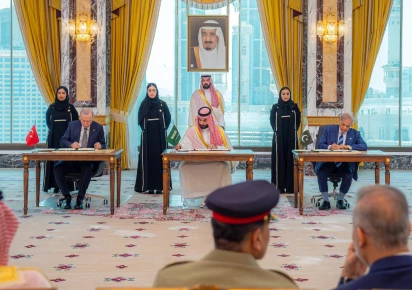
The possibility of Bangladesh joining the defence framework comes shortly after Pakistan, Saudi Arabia and Türkiye signed the Makkah Joint Defence Agreement in Makkah on August 7.

Under the agreement, an armed attack against any one of the three participating countries is to be treated as an attack against all three. The pact also provides a framework for greater defence cooperation, coordination and collective deterrence among the signatories.

The agreement has attracted regional and international attention because of its potential to expand security cooperation among key Muslim-majority countries. Turkish Foreign Minister Hakan Fidan has described the arrangement as technically comparable to NATO’s Article 5 principle of collective defence, while emphasising that the agreement is not aimed at Iran or any other specific country.

Ankara has also suggested that the framework could potentially be expanded to include additional regional states. Egypt has previously been mentioned as a possible participant in the broader security arrangement.

Pakistan has similarly maintained that the agreement is defensive in character and is not directed against any particular country. Islamabad has also indicated that the framework remains open to states that are willing to support its principles and objectives.

Deputy Prime Minister and Foreign Minister Ishaq Dar has said the agreement does not seek to replace existing bilateral or multilateral defence and security arrangements. Instead, he said, it provides an additional platform for cooperation based on mutual respect, shared interests and peaceful resolution of disputes.

Bangladesh’s latest position suggests that Dhaka is carefully assessing emerging regional partnerships while seeking to preserve strategic flexibility. Its potential participation could further broaden the Makkah agreement’s regional significance and strengthen cooperation among Pakistan, Saudi Arabia, Türkiye and other interested countries.

For Bangladesh, however, any decision to join would ultimately depend on how the proposed framework aligns with its national interests, foreign policy priorities and assessment of the evolving regional and global security environment.

Similar Posts

  • | | |

    Israeli rabbi sparks outrage with denial of Palest…

    JERUSALEM: An Israeli chief rabbi has sparked widespread controversy after reportedly denying the existence of the Palestinian people and asserting that Gaza and the occupied West Bank belong exclusively to Jews. Chief Rabbi David Yosef was quoted as saying that there was no Palestinian nation in the past and that Palestinians have no rights to the land. His reported remarks have drawn attention amid the continuing conflict in Gaza and growing international concern over the humanitarian situation. Yosef also reportedly claimed that Gaza and cities in the West Bank belong to Jews and suggested that Gaza would eventually be destroyed and populated by Jewish people. The comments come as Israeli military operations in Gaza continue, with Palestinian officials reporting further deaths and injuries. The conflict has caused widespread destruction, displacement and a severe humanitarian crisis. The remarks have also renewed scrutiny of developments in the occupied West Bank, where tensions between Palestinians and Israeli settlers remain high. According to reports, Palestinian residents and farmers in areas including Hebron have faced incidents involving Israeli settlers. One reported incident involved a Palestinian farmer’s donkey being tied to a vehicle and dragged, resulting in the animal’s death. The latest statements have added to concerns over rhetoric surrounding the future of Palestinian territories. Palestinian leaders and rights advocates have long opposed attempts to deny Palestinian national identity or rights, while the international community continues to debate the political future of Gaza and the West Bank. The comments also come as diplomatic efforts over the conflict remain under intense scrutiny. The humanitarian situation in Gaza has made the question of civilian protection and the future governance of the territory increasingly urgent. For Palestinians, statements denying their existence or connection to their homeland are particularly sensitive, coming after decades of conflict, displacement and political uncertainty. The controversy surrounding Yosef’s remarks is therefore likely to fuel further debate over Palestinian rights, Israeli settlement policies and the prospects for a lasting political settlement in the region.

  • | |

    Houthis claim attack on Saudi Tanker as US Naval b…

    Yemen’s Houthi rebels have claimed responsibility for targeting a Saudi oil tanker in the Red Sea with ballistic missiles, alleging the vessel violated a blockade on Saudi ports announced by the group last week . The Houthi military spokesman identified the ship as the NCC Ghazal, stating it had been “forced to turn back” after ignoring warnings. This attack is the latest in a series of maritime operations by the Iran-aligned group, which previously claimed to have targeted two Saudi tankers, the Encelia and Layla, and to have forced around ten ships to retreat . In a related development, the US Central Command (CENTCOM) announced on Tuesday that it has redirected 18 commercial vessels, disabled two, and boarded two others as part of its ongoing naval blockade against Iran . The intensified maritime operations come amid a complex regional conflict involving US-Iran hostilities, with CENTCOM stating there are more than 20 ships currently supporting military operations in the Middle East . The Houthi actions and the US naval blockade add new layers of tension to the region’s shipping lanes, critical for global energy supplies, and coincide with broader diplomatic efforts to de-escalate the wider conflict.

  • | | |

    China’s Saindak copper mine in Pakistan faces su…

    China’s long-running copper mining project in Pakistan is facing growing operational challenges as repeated militant attacks in Balochistan disrupt supply routes connected to the mine. The Saindak copper and gold mine, located in Balochistan’s Chagai district, is considered one of China’s oldest mining investments in Pakistan and remains its only major copper interest in the country. Analysts say ongoing security issues have created difficulties for transporting materials and maintaining regular operations. The attacks along key routes have raised concerns about what some analysts describe as an “economic blockade,” potentially affecting the movement of supplies required for mining activities and the shipment of copper produced at the site. Copper is a strategically important commodity for China, which is the world’s largest consumer of the metal due to its extensive manufacturing, energy, and technology industries. Any disruption to supply sources can create concerns for industries dependent on stable copper availability. The Saindak project has long been viewed as an important symbol of Pakistan-China economic cooperation. The mine has contributed to Pakistan’s mineral sector while providing China with access to copper resources. However, security challenges in Balochistan have repeatedly affected development projects and infrastructure networks. The province has witnessed several militant attacks targeting government installations, security forces, and economic projects. Officials and security agencies have increased efforts to protect strategic assets and transportation routes, but continued instability remains a major challenge for investors operating in the region. Experts say maintaining security around mining operations is essential not only for the continuity of the Saindak project but also for attracting future foreign investment in Pakistan’s mineral resources. As global demand for critical minerals continues to rise, the stability of resource-rich regions like Balochistan will remain a key factor in determining the future of mining cooperation between Pakistan and international partners.

  • |

    Netanyahu says social media is driving decline in US support for Israel

    Israeli Prime Minister Benjamin Netanyahu has acknowledged that public support for Israel has declined in the United States, attributing the shift largely to the influence of social media and online misinformation. His remarks came during an interview with ABC News, where he also discussed the war in Gaza, Iran’s nuclear programme, and Israel’s relationship with the United States. Netanyahu admitted that attitudes toward Israel among Americans have changed in recent years and said the trend was a matter of concern. He argued that the rapid growth of social media platforms, along with the use of coordinated online campaigns and automated accounts, has shaped public opinion against Israel. According to him, misleading portrayals of the conflict in Gaza have contributed significantly to the fall in support. Recent surveys suggest that American views of Israel have become increasingly critical. A July poll by the Pew Research Center found that unfavorable opinions of the Israeli people have risen compared with previous years, while support for the Israeli government has also declined. The findings reflect growing concern among Americans over Israel’s military operations in Gaza and the humanitarian impact of the conflict. During the interview, Netanyahu said he wanted Israel to continue receiving support from both major political parties in the United States. He described bipartisan backing as an important part of Israel’s national security and argued that the debate surrounding Israel extends beyond the Middle East. He claimed that those who oppose Israel often also oppose American interests and values. The Israeli leader also discussed Iran, saying Israel and US President Donald Trump share the same objective of preventing Tehran from developing nuclear weapons. He said Israel would support any approach that successfully ends Iran’s nuclear programme, whether through diplomacy, economic sanctions, or military action. However, he stressed that decisions regarding American policy ultimately rest with the US president. Netanyahu accused Iran of repeatedly acting in bad faith during previous negotiations, claiming its leaders have used talks to delay action while continuing their nuclear ambitions. Iran has previously rejected such accusations and argued that inconsistent policies and broken commitments by the United States have undermined diplomatic efforts. He also warned Iran against carrying out any future attacks on Israel, saying such actions would be met with a strong military response. Although he believes Iran’s leadership has become weaker in recent years, Netanyahu said the current government remains in power and predicted that it could eventually collapse. Addressing his relationship with President Trump, Netanyahu dismissed suggestions that either leader was directing the other. He described the two countries as close allies and said the United States remains the senior partner while Israel continues to work closely with Washington on security matters. The prime minister also rejected reports claiming he had underestimated the consequences or duration of military action against Iran. He insisted those reports misrepresented his earlier assessments and said President Trump independently viewed Iran’s nuclear ambitions as a serious threat. Netanyahu strongly denied allegations that Israel had committed war crimes or genocide during its military campaign in Gaza. He argued that Israeli forces had taken steps to reduce civilian casualties by issuing warnings through phone calls, text messages, and leaflets urging people to leave areas of fighting. He also accused Hamas of preventing civilians from evacuating. The Israeli leader again ruled out the creation of an independent Palestinian state, arguing that it would pose a security threat to Israel. His comments come despite ongoing international calls for a two state solution. The conflict remains under intense international scrutiny. In November 2024, the International Criminal Court issued arrest warrants for Netanyahu and former Defence Minister Yoav Gallant over allegations of war crimes and crimes against humanity linked to the Gaza conflict. Israel rejects the accusations, while military operations in the territory have continued despite a ceasefire agreement reached in October 2025.

  • |

    Child’s refusal to buckle up leads to flight cancellation in Canada

    A Porter Airlines flight from Victoria to Toronto was cancelled after a young child refused to sit in the assigned seat and fasten the seat belt. The incident happened on flight PD444 at Victoria International Airport in British Columbia. The aircraft had already left the terminal. It was preparing for takeoff when crew members noticed the child standing on the seat. Flight attendants tried to resolve the situation. The child’s parents also attempted to convince the youngster to sit down. However, the child continued to resist. The crew could not proceed with the flight while the safety issue remained unresolved. Aviation safety rules require passengers to remain seated and use seat belts when instructed. The aircraft therefore had to return to the terminal. The family was removed from the plane. Their baggage also had to be taken off the aircraft. Airport and airline staff then had to complete the required travel and security procedures. The process took considerable time. The procedures continued beyond 12:30am. Victoria International Airport closes its main runway at 12:30am every night. Because the runway had already closed, the aircraft could not take off again that night. The cancellation caused further inconvenience for the other passengers. They were forced to spend the night in Victoria. Porter Airlines apologised to the affected passengers for the disruption. The airline arranged alternative flights for them the following day. The incident highlights how even a seemingly minor safety issue can cause major delays when an aircraft is preparing for departure. Airlines are required to ensure that all passengers follow safety instructions before takeoff

  • |

    Does your native language control how you think?

    With over 7,000 distinct human languages spoken across the globe today, humanity communicates through fascinating sentence structures. A compelling debate has captivated thinkers for decades. Does the language you grow up speaking dictate the limits of what your mind can comprehend? This captivating idea lies at the heart of the Sapir-Whorf hypothesis. A theory that continues to provoke vibrant discussions across linguistics, philosophy, and cognitive science. The Power of Vocabulary and Perception The hypothesis was formulated in the early 20th century by linguists Edward Sapir and Benjamin Lee Whorf. It’s often referred to as linguistic relativity or linguistic determinism. They propose that the structure of a native language fundamentally shapes its speakers’ worldview and cognitive capacity. If a concept or object lacks a dedicated word in a person’s language, that person cannot truly perceive, categorize or conceptualize it. Consider how different cultures classify colors. Some languages possess dozens of specific terms for distinct shades. Whereas,  others operate with only a couple of basic terms distinguishing between light and dark tones. According to strong linguistic determinism, a speaker whose native tongue lacks a dedicated word for green would struggle to perceive a green leaf as distinct from yellow. Similarly, emotional vocabularies vary widely across cultures. German famously uses the word Schadenfreude to describe taking pleasure in someone else’s misfortune. According to Sapir-Whorf theory, an English speaker whose language lacks an exact single-word equivalent would supposedly find it difficult to recognize or isolate that specific emotional state within themselves. Why the Concept Fascinates Us? It is easy to see why the Sapir-Whorf hypothesis captured public imagination. The notion that our mother tongue acts as a unique way through which we view reality is deeply romantic. Philosophically, the theory suggests that the world contains thousands of distinct cognitive universes. If language entirely dictated thought, cross-cultural understanding would face profound barriers. It is so as the speakers of different languages would operate inside fundamentally incompatible mental frameworks. In semantic studies, labeling objects and experiences allows humans to organize chaotic sensory input efficiently. Giving a name to a precise group such as distinguishing toddlers, teenagers and senior citizens helps us categorize society into recognizable stages. The hypothesis demonstrated that naming things provides cognitive shortcuts. Such a naming method makes specific distinctions far easier to reference and discuss in daily life. Why Modern Science Rejects Strong Determinism Despite its initial popularity, modern linguistics and cognitive scientists reject strong linguistic determinism. The fundamental flaw in the hypothesis rests on a misunderstanding of the relationship between mind and speech. Language does not produce thought. Rather, human thought drives the creation and evolution of language. When people encounter new experiences, foods or technologies, they do not remain silent simply because they lack pre-existing terminology. Instead, humans spontaneously create new phrases. They adapt existing terms or borrow words from other cultures to describe what they have experienced. An English speaker can easily understand and feel pleasure at a rival’s failure without ever having heard the German word Schadenfreude. While English uses blue for both dark and light shades. Whereas Italian maintains separate primary words (blu and azzurro). English speakers are fully capable of seeing the difference between a midday sky and the deep ocean. Human cognition precedes language. Speech serves as a flexible tool designed to communicate human experiences, not a rigid cage that imprisons cognitive ability. The Lasting Value of Sapir-Whorf   The Sapir-Whorf hypothesis retains great value even if its most radical claim has been disproven. It paved the way for weak linguistic relativity. The claim further explores how language subtly influences cognition, memory and visual attention without imposing hard limits on intellect. Ultimately, Sapir and Whorf inspired generations of researchers to explore the mysterious connection between human culture, language and the mind.

Leave a Reply

Your email address will not be published. Required fields are marked *