armed forces officers

9 Armed Forces officers recommended for civil services in CSS 2025

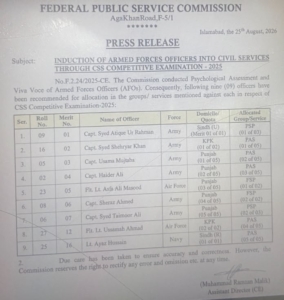
Islamabad – The Federal Public Service Commission (FPSC) has recommended nine officers from the Armed Forces for allocation to various civil service groups under the CSS Competitive Examination 2025.

According to a press release issued by the FPSC, the psychological assessment and viva voce process of the candidates was completed. Following the process, the successful officers were recommended for allocation to different service groups based on merit and the available seats.

Nine officers recommended for civil services

The officers recommended for civil services include personnel from the Pakistan Army, Pakistan Air Force and Pakistan Navy.

  1. Captain Syed Atiq-ur-Rehman — Pakistan Army, Sindh (Urban), Merit No. 1 — Police Service of Pakistan (PSP)
    2. Captain Syed Shehryar Khan — Pakistan Army, Khyber Pakhtunkhwa, Merit No. 2 — Pakistan Administrative Service (PAS)
    3. Captain Usama Mujtaba — Pakistan Army, Punjab, Merit No. 3 — Pakistan Administrative Service (PAS)
    4. Captain Haider Ali — Pakistan Army, Punjab, Merit No. 4 — Pakistan Administrative Service (PAS)
    5. Flight Lieutenant Asifa Ali Masood — Pakistan Air Force, Punjab, Merit No. 5 — Foreign Service of Pakistan (FSP)
    6. Captain Shiraz Ahmed — Pakistan Army, Punjab, Merit No. 6 — Foreign Service of Pakistan (FSP)
    7. Captain Syed Taimur Ali — Pakistan Army, Punjab, Merit No. 7 — Police Service of Pakistan (PSP)
    8. Flight Lieutenant Usama Ahmed — Pakistan Air Force, Khyber Pakhtunkhwa, Merit No. 12 — Pakistan Administrative Service (PAS)
    9. Lieutenant Ayaz Hussain — Pakistan Navy, Sindh (Rural), Merit No. 16 — Pakistan Administrative Service (PAS)

How many officers were allocated to each service group?

According to details released by the FPSC, the distribution of Armed Forces officers among the service groups is as follows:

  • Pakistan Administrative Service (PAS): 5 officers
  • Police Service of Pakistan (PSP): 2 officers
  • Foreign Service of Pakistan (FSP): 2 officers

The FPSC said that every possible precaution was taken to ensure accuracy and transparency in the preparation of the results. However, the Commission reserves the right to correct any errors or omissions at any time.
CSS process for Armed Forces Officers

Under the existing rules, personnel serving in the Pakistan Army, Pakistan Air Force and Pakistan Navy are eligible to join the civil services through the CSS Competitive Examination.

Successful candidates like other applicants are required to go through the written examination, psychological assessment and viva voce stages.

The inclusion of Armed Forces officers in the civil services also aims to benefit from their military experience, discipline and administrative capabilities in areas such as civil administration, policing and diplomacy.

Similar Posts

  • | |

    PTI social media faces internal differences, group…

    ISLAMABAD: Pakistan Tehreek-e-Insaf (PTI) Secretary General Salman Akram Raja has acknowledged that the party is facing internal differences and grouping, saying that the lack of contact with party founder Imran Khan for the past nine months has made decision-making much more difficult. In a post on X, Salman Akram Raja said that, for the first time in the party’s history, there has been no contact with Imran Khan for nine months. He said that issues and disputes that were previously resolved within minutes through the party founder’s guidance now become the subject of long discussions. His remarks suggest that the absence of the jailed PTI founder has created a leadership gap, allowing disagreements within the party to become more visible. Raja also admitted that PTI had faced what he described as a “planned campaign” to weaken the party during this period. According to him, efforts were made from within the party to create problems, but senior leaders remained united and resisted those attempts. “I am grateful to Imran Khan’s senior colleagues who stood firm against these failed attempts,” he said. The PTI secretary general also claimed that another challenge comes from social media, where he said three different groups are active against the party’s interests. According to Raja, the first group consists of people who are formally linked to the media teams of PTI’s political opponents. The second group, he said, includes people within PTI who are seeking party positions and view certain leaders as obstacles to their ambitions. His statement is being seen as a rare public acknowledgment that internal rivalries and competition for positions exist within the party. Raja said the third group includes sincere PTI supporters who genuinely want Imran Khan’s release and the party’s success. He described them as passionate young people and older supporters who may not be fully aware of all developments. He argued that while emotional slogans are easy to raise, developing and following an effective political strategy requires patience, understanding and careful planning. Referring to calls for immediate action, Raja said that a political revolution cannot be achieved simply by gathering “one truck and 20,000 to 30,000 people.” He stressed that successful movements require well-thought-out strategies rather than emotional decisions. He added that every PTI worker wants Imran Khan to be released as soon as possible, but said the party must adopt practical and successful methods instead of relying on slogans alone. Raja’s comments come at a time when PTI has faced repeated speculation about internal divisions, disagreements over strategy and criticism exchanged on social media by supporters of different leaders. While he blamed external forces for trying to weaken the party, his remarks also indicate that internal competition, differences over leadership and disagreements about political strategy have become significant challenges for PTI during the prolonged absence of direct communication with its founder. His statement is likely to fuel further debate about unity within the party as it continues to navigate political and organisational challenges.

  • | | |

    Shehbaz, Bangladesh PM set for first Jakarta meeti…

    Prime Minister Shehbaz Sharif is expected to meet Bangladesh Prime Minister Tarique Rahman next week in Jakarta, Indonesia. The meeting will be the first between the two leaders since Tarique Rahman assumed office as Bangladesh’s prime minister around six months ago. The meeting is being viewed as significant in light of recent regional developments. Both leaders will be in Jakarta to attend the 12th summit of the D-8 Organisation for Economic Cooperation. The nine-member grouping is focused on strengthening economic cooperation among its member states. The three-day summit is scheduled to begin on Monday, August 17. The summit was earlier postponed in April due to the conflict that emerged in the Middle East. Leaders from member countries are now expected to gather in Jakarta for discussions on regional and economic issues. Prime Minister Shehbaz Sharif is also expected to hold a meeting with Iranian President Masoud Pezeshkian on the sidelines of the summit. The Pakistani prime minister is likely to meet other participating leaders as well. His expected engagements include a meeting with Turkish President Recep Tayyip Erdogan. The meetings are expected to provide an opportunity to discuss bilateral relations, regional developments and areas of mutual interest. The expected meeting between the Pakistani and Bangladeshi prime ministers also comes amid efforts to strengthen ties between the two countries. Both sides have shown interest in expanding cooperation in different areas. Pakistan has also decided not to seek special permission from India to use its airspace for the prime minister’s journey to Indonesia. Instead, Prime Minister Shehbaz Sharif’s aircraft will take an alternative route to reach Jakarta. The change in travel route will allow the Pakistani delegation to proceed with its scheduled participation in the D-8 summit without seeking special approval from India.

  • Pakistan sees major progress in Iran-US ceasefire talks

    ISLAMABAD: Significant progress has reportedly been made in Pakistan’s diplomatic efforts to facilitate a ceasefire between Iran and the United States. Federal Interior Minister Mohsin Naqvi on behalf of Field Marshal and Chief of Defence Forces Syed Asim Munir briefed the US Ambassador to Pakistan on important developments in the Iran-US ceasefire process. According to sources, a high-level meeting between Field Marshal Asim Munir and Interior Minister Mohsin Naqvi following the latter’s recent visit to Iran has raised expectations of a major breakthrough. Officials described the meeting as highly significant saying that the atmosphere during the meeting was pleasant and positive. Sources said that the tone of the meeting and the discussions suggested that “good news is likely coming soon.” US Ambassador briefed on key developments A video of Mohsin Naqvi’s meeting with the US Ambassador showed a cordial atmosphere between the two. According to sources, the interior minister briefed the ambassador on behalf of Field Marshal Asim Munir about significant developments aimed at reducing tensions between Iran and the United States and advancing negotiations. Sources said the US Ambassador also showed keen interest in the developments and appeared optimistic during the meeting. Pakistan’s key role in mediation It may be recalled that US President Donald Trump had earlier requested Field Marshal General Syed Asim Munir to play an important role in facilitating a ceasefire between Iran and the United States. Following this, Pakistan’s military and civilian leadership accelerated diplomatic contacts including the recent visit to Tehran by Field Marshal Asim Munir and Interior Minister Mohsin Naqvi. According to analysts, Pakistan’s geographical proximity to Iran and its strategic partnership with the United States give it a unique position to help reduce tensions in the region and facilitate communication between the two sides. Final approval of both sides required Sources while confirming much of the progress clarified that final approval from both Iran and the United States is still pending. According to one source, since the progress remains conditional on the consent of both sides, it would not be appropriate at this stage to disclose all details or key points of the meetings between Pakistani and Iranian officials. So far, no official announcement has been made regarding an Iran-US ceasefire. However, amid the optimistic diplomatic environment and recent contacts, expectations are growing that a major announcement regarding a ceasefire could be made soon if final approval is secured. Islamabad has reiterated its commitment to peace in the region saying that Pakistan will continue to play a constructive role in reducing tensions and promoting regional peace.

  • | | |

    Government cuts petrol and diesel prices after lat…

    The federal government has announced a reduction in petroleum prices, providing some relief to consumers across Pakistan. According to the latest notification issued by the Petroleum Division, the price of petrol has been reduced by Rs2.20 per litre, while high-speed diesel (HSD) has become cheaper by Rs1.50 per litre. After the reduction, petrol will now be available at Rs327.62 per litre, while the price of high-speed diesel has been revised to Rs380.86 per litre. The new prices will come into effect from August 8, 2026, according to the official notification. The government continues to impose taxes and duties on petroleum products, including Rs110 per litre on petrol and Rs96 per litre on high-speed diesel. These charges remain a significant component of fuel prices paid by consumers. The latest reduction follows changes in international oil market trends and fluctuations in global fuel prices. In recent months, petroleum rates in Pakistan witnessed major increases due to uncertainty in international markets, particularly after tensions and conflict-related developments in the Middle East affected oil supply concerns. High-speed diesel prices had reached a record level of Rs520.35 per litre on April 3, after rising from Rs281 per litre following the escalation of tensions between the United States and Iran. Similarly, petrol prices had climbed to Rs458.41 per litre during the same period after starting from around Rs266 per litre in early March. Earlier, Petroleum Minister Ali Pervaiz Malik announced that fuel prices would be adjusted more frequently, including possible daily revisions, due to rapid changes in international oil markets. The government assigned the Oil and Gas Regulatory Authority (OGRA) the responsibility of determining fuel prices based on global trends. The decision to introduce daily fuel price adjustments faced opposition from the All Pakistan Dealers Association, which raised concerns and indicated that it may consider a protest strategy. Petrol remains one of the most widely used fuels in Pakistan, mainly powering private vehicles, motorcycles, rickshaws, and small transport vehicles. Any change in petrol prices directly affects household budgets, particularly for middle- and lower-income groups. High-speed diesel also plays a critical role in the economy as it is widely used in heavy transport, agricultural machinery, power generation plants, and industrial operations. Changes in diesel prices often influence transportation costs and can impact the prices of essential goods. The latest reduction is expected to provide limited relief to consumers, while future fuel prices will continue to depend on international crude oil markets, exchange rates, and government taxation policies.

  • | |

    Federal government freezes ad hoc relief allowance…

    The federal government has decided to keep the 2023 and 2024 ad hoc relief allowances unchanged for its employees, maintaining the existing rates while also outlining the allowance structure for newly appointed staff. According to a notification issued by the Ministry of Finance, the Ad Hoc Relief Allowance-2023 will remain frozen at the level applicable on June 30, 2023, and will not be revised until further instructions are issued. Under the current arrangement, employees in Grades 1 to 16 will continue to receive an allowance equal to 35% of their basic pay, while officers in Grades 17 to 22 will receive 30% of their basic pay under the 2023 relief allowance. The ministry has also announced that the Ad Hoc Relief Allowance-2024 will remain frozen at the rates applicable on June 30, 2026. Employees in Grades 1 to 16 will continue to receive 25% of their basic pay, whereas those in Grades 17 to 22 will receive 20% of their basic pay. The decision means there will be no increase in these allowances until further notice, although eligible employees will continue receiving them at the existing rates. The notification also provides guidance on the applicable allowance rates for newly recruited federal government employees, ensuring uniform implementation across government departments. The Finance Ministry said the revised pay and allowance framework will remain effective unless amended through a future government notification.

  • | | |

    Heavy rains trigger flash floods in Gilgit-Baltist…

    Torrential rainfall has caused widespread destruction across Gilgit-Baltistan, disrupting transportation networks as flash floods and landslides washed away roads, bridges, and vital infrastructure in several districts. The extreme weather conditions have left thousands of people, including tourists, stranded as major routes connecting different parts of the mountainous region were blocked. Authorities have advised travelers to avoid unnecessary journeys due to ongoing risks from floods and landslides. According to officials, several important roads, including the Karakoram Highway, Babusar Road, Baltistan Road, Naltar Highway, Ghizer-Shandur Road, and Astore Valley Road, have been affected by flooding and landslides. The Gilgit-Baltistan Disaster Management Authority (GBDMA) reported that the Karakoram Highway was blocked at multiple locations between Dassu and the Hunza-Nagar areas, creating difficulties for commuters and relief teams. In Skardu’s Rondu subdivision, severe flooding in the Tormak Nallah area damaged important communication bridges, including the Malan Bridge. Several roads, agricultural lands, crops, and other infrastructure were also affected in Kharmang, Ghanche, and Shigar districts. Flooding also disrupted electricity and water supply systems in areas including Astore, Tangir, and Thore in Diamer district. Communication services were affected, while irrigation channels, drinking water schemes, and protective structures suffered damage. Several villages were cut off, and dozens of families were forced to leave their homes due to floods and landslides. Authorities moved vulnerable residents to safer locations and started relief operations in affected areas. The situation also affected Ghizer district, where temporary road closures, localized flooding, and damage to houses were reported. Rising water levels in the Hunza-Nagar River increased risks for residents in Gilgit’s Jutal area. The Pakistan Meteorological Department has forecast further rainfall in the region and warned about the possibility of glacial lake outburst floods (GLOFs) until July 26. The Gilgit-Baltistan Disaster Management Authority, district administrations, Rescue 1122, and other departments are working together to provide emergency assistance. Officials said affected families are being provided with tents, food supplies, medicines, and clean drinking water. Heavy machinery has also been deployed to restore damaged roads, bridges, and other infrastructure. Gilgit-Baltistan Chief Minister Amjad Hussain has directed authorities to speed up relief and rehabilitation activities and remain alert around the clock to protect lives and property. The chief minister also emphasized the need for stronger disaster preparedness, saying that climate change has increased the risks of flash floods, landslides, and glacial lake outburst floods in the region. Authorities are coordinating with the National Disaster Management Authority (NDMA) to improve emergency response measures and monitor glacier-related risks through scientific and technological systems. The ongoing situation highlights the growing impact of climate-related disasters in Gilgit-Baltistan, where communities continue to face increasing threats from extreme weather events.

Leave a Reply

Your email address will not be published. Required fields are marked *