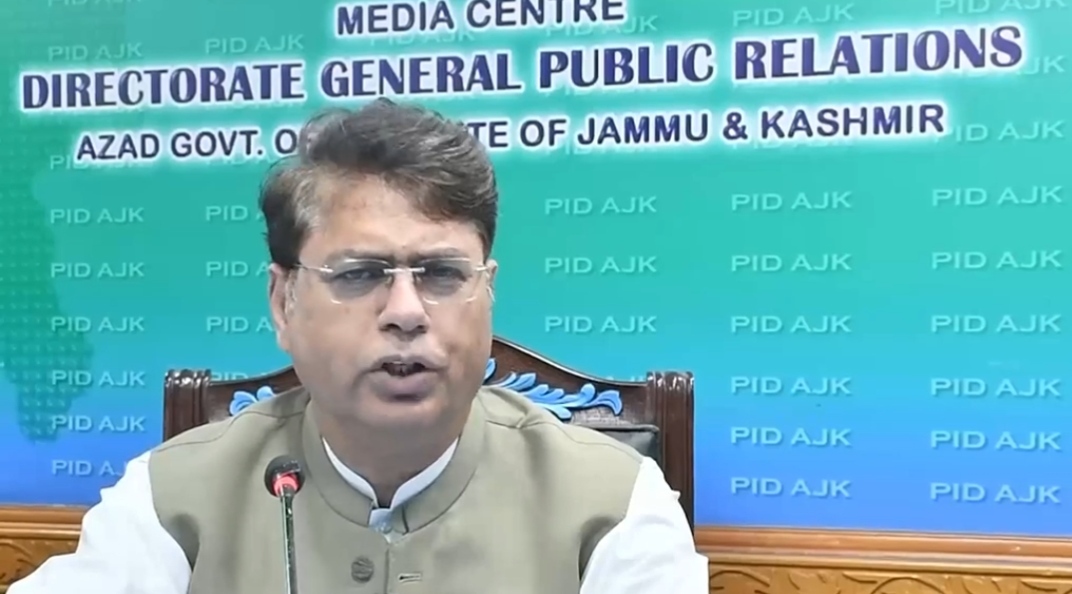
ajk rejects firing
| |

AJK rejects firing allegations against forces

The Government of Azad Jammu and Kashmir (AJK) has strongly rejected allegations that security forces opened fire on protesters or were responsible for civilian deaths during the recent unrest in Rawalakot, describing the claims as false, unverified and part of an organised disinformation campaign.

Responding to a report by the BBC on the recent incidents, the AJK government said armed members of the banned Joint Awami Action Committee opened fire on security personnel in Rawalakot, resulting in the deaths and injuries of several officers. It also alleged that the attackers set multiple vehicles on fire during the violence.

According to the government, security forces acted only to maintain law and order and enforce the law, insisting that civilians were not deliberately targeted during the operation.

The AJK government cited information from the police spokesperson, who said seven security personnel were killed and 143 others were injured in firing allegedly carried out by armed members of the banned Joint Awami Action Committee.

It further claimed that the banned group has a history of violent activities. According to the statement, attacks carried out in 2024 and 2025 resulted in the deaths of four security personnel and left hundreds of others injured.

The government also said two individuals arrested on July 28 and 29 were under investigation. It alleged that one of the suspects claimed a reward of Rs10 million had been offered for the killing of each Ranger, raising questions about the possible funding of the group.

According to the statement, verified videos show armed individuals linked to the banned Joint Awami Action Committee using modern weapons and firing during the unrest.

The AJK government maintained that law enforcement agencies carried out their constitutional responsibilities with restraint and professionalism. It insisted that no action was taken against peaceful civilians and that operations were conducted solely to restore public order.

The government also categorically denied allegations of indiscriminate firing, the use of snipers or claims that bodies of victims were withheld from their families.

It further alleged that the banned Joint Awami Action Committee had previously been involved in blocking roads, stopping or burning cargo vehicles and disrupting the supply of essential goods. According to the statement, law enforcement agencies made efforts to keep roads open and ensure the uninterrupted movement of essential supplies.

The AJK government added that the Joint Awami Action Committee has been declared a banned organisation under the Anti-Terrorism Act and said all legal proceedings against the group are being carried out in accordance with the law.

Similar Posts

  • |

    West Indies spark debate with unusual strategy to stop Babar Azam

    West Indies have come under scrutiny after employing an unusual fielding tactic against Pakistan during the first Test, sparking widespread debate among cricket fans and experts. The incident occurred on the final delivery of an over when Pakistan batter Babar Azam played the ball into the field and attempted to take a single. Instead of collecting the ball immediately and throwing it back, West Indies fast bowler and fielder Shamar Joseph deliberately allowed it to continue rolling toward the boundary. Joseph waited until the ball reached the boundary rope, conceding four runs instead of preventing the boundary. The apparent objective was to ensure Babar remained at the non-striker’s end, preventing him from facing the first delivery of the next over. The move effectively sacrificed three additional runs in exchange for denying Pakistan’s star batter more time at the crease. At the time, Babar appeared to be batting confidently and had shown encouraging signs of returning to his best form, prompting the West Indies to adopt a tactical approach aimed at limiting his influence. The moment was captured on camera and quickly spread across social media, where it generated mixed reactions from fans and former players alike. Many questioned whether the decision reflected the spirit of the game, arguing that intentionally allowing a boundary to avoid bowling to a particular batter was against the traditions of Test cricket. Critics described the tactic as unsporting, saying teams should focus on dismissing batters through skill rather than manipulating the strike in such an unconventional manner. Some supporters of Pakistan also expressed frustration, claiming the strategy highlighted the respect and concern the West Indies had for Babar’s batting ability. However, others defended the decision, pointing out that Test cricket has always involved strategic planning and field placements designed to gain an advantage. They argued that if a team believes facing a certain batter poses a greater threat, using legal methods to keep that player off strike is simply part of the tactical battle that defines the longest format of the game. Supporters of the move also noted that the Laws of Cricket do not prohibit a fielder from allowing the ball to reach the boundary intentionally. As long as no law is breached, they believe captains and players are free to make calculated decisions that improve their chances of success. The incident has reignited discussions about the balance between gamesmanship and sportsmanship in modern cricket. While innovative tactics have become increasingly common across all formats, opinions remain divided over where teams should draw the line between strategic thinking and preserving the spirit of the game. Regardless of the differing viewpoints, the episode has become one of the most talked-about moments of the opening Test, with Babar Azam once again finding himself at the center of attention. Whether viewed as clever strategy or controversial gamesmanship, the West Indies’ decision has added another fascinating chapter to the ongoing contest between the two sides.

  • | |

    Lahore police decide polygraph test for ASI in all…

    Lahore police have decided to conduct a polygraph test on an Assistant Sub-Inspector (ASI) in connection with allegations that a young woman was sexually assaulted at Ghaziabad police station. According to police sources, ASI Imran, who is currently in custody, will undergo the test as investigators continue examining the allegations and conflicting accounts surrounding the incident. Police said the alleged victim has already undergone a psychiatric assessment. The report from the assessment is expected to be received on August 18, while additional medical and forensic examinations have also been conducted. According to the police, ASI Imran has denied the allegations. He reportedly told investigators that he had brought the woman to the police station because she was allegedly involved in begging. He claimed that he did not assault her and instead provided her with food and counselled her before sending her away. Investigators said the initial medical report contains some ambiguity regarding the allegations of sexual assault. Police officials said a detailed report from the Punjab Forensic Science Agency (PFSA) is expected to provide further findings that could help investigators establish what happened. The case is being closely monitored by DIG Investigation Lahore Zeeshan Raza, who said he is personally supervising the investigation. He assured that anyone found responsible would be punished according to the law. Police sources said further tests of the alleged victim have also been conducted, but their results are still awaited. Investigators are expected to consider the medical evidence, forensic findings, statements and other available material before reaching conclusions about the case. The investigation is being conducted under the direction of DIG Investigation Lahore. A team comprising Ghaziabad Investigation Incharge Inspector Nasir Hameed, Gender Cell Incharge Inspector Fatima and Investigation Officer Faryal is working on the case. The decision to conduct a polygraph test on the detained ASI comes as investigators attempt to establish the facts surrounding the allegations. However, the reported initial medical ambiguity means that the final medical and forensic findings will be important in determining the direction of the investigation. Authorities have said that the investigation remains ongoing and that legal action will be taken on the basis of the evidence collected.

  • | | |

    Iran holds fresh talks with Pakistan and Saudi Ara…

    ISLAMABAD: Iran has intensified its diplomatic engagement with key regional partners by holding another round of high-level discussions with Pakistan and Saudi Arabia, as efforts continue to ease tensions and prevent a wider conflict in the Middle East. According to Iranian state media, Foreign Minister Abbas Araghchi spoke by telephone on Monday with Pakistan’s Field Marshal Syed Asim Munir and Saudi Foreign Minister Prince Faisal bin Farhan. The conversations marked the second round of talks between the leaders within 24 hours, reflecting the urgency of ongoing diplomatic initiatives aimed at preserving regional peace and stability. During the discussions, the leaders exchanged views on the latest political and diplomatic developments and stressed the importance of strengthening regional cooperation to resolve tensions through dialogue rather than confrontation. They agreed that political engagement remains the most effective path toward ensuring lasting security across West Asia. The renewed diplomatic outreach comes shortly after US President Donald Trump announced that Washington had suspended planned military strikes against Iran and would resume negotiations with Tehran. While Trump claimed that regional countries had helped establish the framework for renewed talks, Iran rejected suggestions that it had requested a pause in hostilities. Nevertheless, Tehran has continued consultations with influential regional capitals to support diplomatic efforts. The upcoming negotiations between the United States and Iran are expected to focus on Tehran’s nuclear program and the future of the Strait of Hormuz, one of the world’s most strategically important maritime trade routes. The waterway remains under heavy international attention due to its critical role in global oil and liquefied natural gas shipments. Iran has maintained that any military action by the United States, Israel, or any regional country supporting such operations would receive a firm and proportionate response. The warning follows months of heightened confrontation that began after military operations launched by the United States and Israel earlier this year, citing concerns over Iran’s missile capabilities, nuclear ambitions, and support for allied armed groups. The prolonged conflict has disrupted shipping across the Gulf and Red Sea, pushed global energy prices higher, and increased fears of broader regional instability. Although Washington has repeatedly signaled the possibility of military escalation, diplomatic channels remain active as regional powers work to prevent the crisis from expanding further. With fresh talks now on the horizon, Iran’s latest engagement with Pakistan and Saudi Arabia underscores the growing role of regional diplomacy in seeking a peaceful resolution to one of the Middle East’s most challenging security crises.

  • | |

    VC calls for global support to Kashmir cause at UO…

    The University of Okara (UO) commemorated Kashmir Exploitation Day on Wednesday by organizing a seminar and a solidarity walk to reaffirm unwavering support for the people of Occupied Jammu and Kashmir (OJK) in their struggle for the right to self-determination. The event was organized by the Directorate of Student Affairs and attended by a large number of faculty members, administrative staff, and students. The Vice Chancellor of the University of Okara, Prof. Dr. Sajjad Mubin, presided over the ceremony. Addressing the participants, Prof. Mubin highlighted the decades-long suffering of the Kashmiri people and called upon the international community to play its role in ensuring the implementation of the United Nations resolutions on Kashmir. “Kashmir is the lifeline of Pakistan and an issue that remains central to peace and stability in South Asia. The resilient people of Kashmir have made unprecedented sacrifices for their legitimate right to self-determination, and the global community must not remain a silent spectator to their plight,” he said. The VC also paid tribute to Pakistan’s armed forces for safeguarding the country’s sovereignty and territorial integrity. “Our armed forces have rendered unparalleled sacrifices to make Pakistan impregnable. Their commitment to national security enables us to stand firmly with our Kashmiri brothers and sisters in their just struggle,” he added. Speaking on the occasion, the Registrar of the University of Okara, Jamil Asim, said that observing Kashmir Exploitation Day serves as a reminder of the collective responsibility to raise awareness about the humanitarian situation in Indian Illegally Occupied Jammu and Kashmir. “We stand in complete solidarity with the people of Kashmir and reaffirm our support for their internationally recognized right to determine their own future. Universities have an important role in educating the younger generation about issues of justice, peace, and human rights,” he remarked. The Pro VC, Prof. Dr. Muhammad Wajid, and the DSA, Dr. Shoaib Saleem, also addressed the gathering and emphasized the importance of maintaining national unity and continuing moral, diplomatic, and political support for the Kashmiri people. A one-minute silence was observed to honor the sacrifices of the people of Kashmir and to express solidarity with those who have lost their lives during the prolonged conflict. The seminar concluded with a solidarity walk in which the participants carried placards and banners expressing support for the Kashmiri cause and reaffirming Pakistan’s commitment to the right of self-determination for the people of Kashmir.

  • | |

    Pakistan records $6.24 billion net FDI since SIFC …

    ISLAMABAD: Pakistan has attracted approximately US$ 6.24 billion in net Foreign Direct Investment (FDI) from FY24 to July-April FY26 since the establishment of the Special Investment Facilitation Council (SIFC), according to data from the State Bank of Pakistan (SBP). The Minister Incharge of SIFC stated that gross FDI inflows during the same period stood at approximately US$ 10.41 billion, highlighting investor confidence in Pakistan’s investment regime. April 2024: Highest Monthly FDI in 51 Months   According to SBP data released in May 2024, FDI inflows surged 172% year-on-year (YoY) to $358.84 million in April 2024, compared to $131.9 million in April 2023. This marks the highest monthly FDI inflow in 51 months. On a month-on-month (MoM) basis, FDI jumped 39%, up from $258.04 million in March 2024. For the first 10 months of FY24 (July-April), total FDI inflows reached $1.46 billion, compared to $1.35 billion in the same period of FY23. Top Investors & Sectors Country-wise:   1. China: Largest investor with $177.37 million net FDI in April 2024 2. UAE: $51.93 million 3. Canada: $51.89 million Sector-wise:   The Power sector attracted the highest inflows with $194 million in April 2024, followed by other key sectors. Officials say the rise in FDI reflects the impact of SIFC’s facilitation for foreign investors in priority sectors including energy, infrastructure, and technology. Pakistan FDI: $6.24Bn Since SIFC* | April Hits 51-Month High Key points: 172% YoY surge to $358.84M in April 2024, China leading with $177.37M, Power sector top recipient. $6.24Bn net FDI since SIFC launch. Pakistan’s FDI jumps 172% YoY to $358.84Mn in April 2024 – highest in 51 months. China leads with $177Mn. Pakistan’s FDI surges 172% in April. $6.24Bn net inflows since SIFC. Power sector top recipient. _”Pakistan FDI: $6.24Bn Since SIFC | April Hits 51-Month High”_

  • |

    Anger boils over as residents jeer French PM in Gironde

    French Prime Minister Sebastien Lecornu faced a hostile reception in the Gironde region on Monday. Residents booed him during a visit to Le Porge, amid growing anger over the government’s handling of recent wildfires. Lecornu had travelled to the area to meet local officials and discuss reconstruction efforts following a devastating wildfire last month. The visit, however, quickly turned tense. Footage published by BFMTV showed residents jeering as the prime minister arrived. Several locals also criticised him for leaving without engaging freely with the community. Speaking to AFP, 65-year-old resident Tony Veiga said the least Lecornu could have done was actually meet with residents directly. He said the government’s approach made people feel as though they simply didn’t matter. Lecornu’s office responded by saying he had spoken with affected residents and farmers during the visit. Speaking separately with officials in nearby Merignac, the prime minister insisted there was nothing to hide regarding how fire protection efforts had been carried out in recent weeks. According to AFP, much of the anger stems from allegations that authorities prioritised protecting the affluent Cap-Ferret peninsula over ordinary local homes during the firefighting response. Lecornu firmly rejected those claims, denying any preferential treatment had taken place. The backlash adds to broader frustration across parts of Europe currently grappling with wildfire emergencies. Meanwhile, the European Commission has ramped up support elsewhere on the continent, deploying additional firefighting resources to both Belgium and Spain through its civil protection mechanism. Swedish aircraft and helicopters from several European countries have been sent to Belgium to assist with ongoing fire response efforts there. Separately, 104 French firefighters and 36 vehicles have joined operations in Spain to help combat blazes spreading through the region. With wildfires continuing to strain resources across multiple European countries, pressure on national governments to respond effectively is likely to remain high in the coming weeks. For Lecornu, Monday’s frosty reception in Gironde signals that public patience with the government’s crisis response is wearing thin.

Leave a Reply

Your email address will not be published. Required fields are marked *