requiem margalla hills

A Requiem for the Margalla Hills

By Ayesha Khan

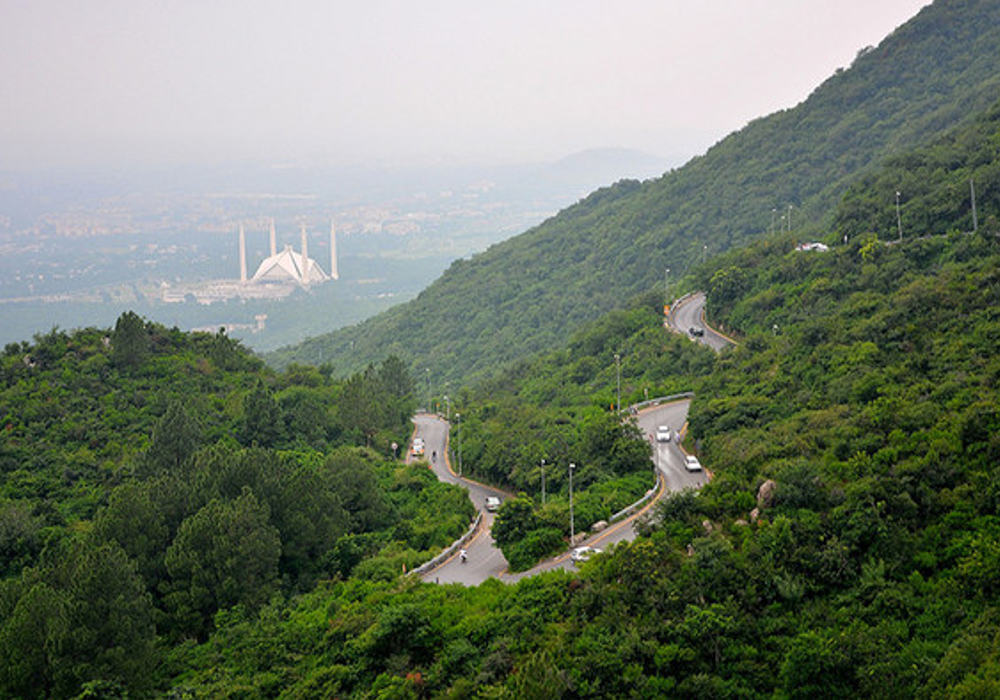
There is a particular grief in watching something die slowly, in full public view, while those paid to save it look away. That is the grief I carry every time I drive along the foothills of Islamabad and see, a little further each year, where the green line ends and the concrete begins.

An old forester once told me the Margallas are the lungs of the capital. Lungs don’t fail all at once. They fail breath by breath. We are now deep into the final breaths of the Margalla Hills National Park (MHNP).  “Yeh daagh daagh ujala, yeh shab-gazeeda sehar; Woh intezar tha jis ka, yeh woh sahar toh Nahin”  (Faiz)

The numbers alone should stop us. Margalla Hills park spans 17,386 hectares. It is one of the largest national parks embedded within any capital city on earth. It is home to leopards that returned from near extinction to 38 species of mammals, to hundreds of bird species, and to a watershed that quietly feeds the city’s water supply. This canopy is not scenery. It is infrastructure. Every mature tree pulls carbon dioxide from Islamabad’s air, cools the capital against the heat-island effect that chokes cities like Lahore and Karachi, and generates the oxygen that lets Islamabad breathe more easily. This is not sentiment. This is measurable ecological service, and it is being dismantled in front of us.

Year after year, the same pattern repeats. A road is widened. A restaurant is licensed. A “temporary” structure becomes permanent. Watchdog surveys confirm what our eyes already suspected. Between 2022 and 2024 alone, grass-covered area in the park fell from 38.47 percent to 31.90 percent. More than 180 illegal structures now sit inside boundaries that were meant to be inviolable. In April 2026, climate experts warned that development creeping into the park’s sensitive foothill zones poses “potentially irreversible risks” — habitat fragmentation, blocked wildlife corridors, a slow strangulation of an ecosystem centuries in the making. Every week, more than 17,000 trekkers and casual sightseers pour onto trails built for a fraction of that number, leaving behind mountains of waste. Add to this the wildfires — the most recent devastating blaze swept through in May 2026 — and you have a park being eroded from every direction at once: fire above, concrete below, waste in between.

The law is clear. The Islamabad Wildlife Ordinance of 1979 exists for precisely this purpose. Pakistan is bound under the Convention on Biological Diversity to conserve representative ecosystems and halt biodiversity loss within protected areas, and MHNP is exactly the kind of site that convention exists to protect. Under the UN Framework Convention on Climate Change and the Paris Agreement, converting a carbon-sequestering forest into concrete runs directly against our own climate commitments. In July 2025, the International Court of Justice issued a landmark advisory opinion declaring that States carry a binding legal duty to prevent significant environmental harm and to protect the right to a clean, healthy environment.

And yet Pakistan continues to draw down international climate finance — from the Green Climate Fund, from the National Disaster Risk Management Fund — under the promise of resilience, adaptation, and protection of exactly these ecosystems. Can we, in good conscience, say the money has bought the forest a single healthy season? Where are the audits — real, independent, published audits — of how this money is spent, by whom, and with what oversight and outcomes?

The harder truth is that this is not a failure of one institution. It is a failure of collective responsibility. It is the quiet collusion of convenience between government approvals, private commercial interests, and institutions across the public and civil society space that choose silence over confrontation. A report is launched. A file is moved. A license is issued. No one says no, because saying no is costly. Inquiries appear and then vanish into silence, with no public finding and no accountability. Individuals questioned for past performance now chair the very funds entrusted with Pakistan’s climate resilience money.

Days ago, the Interior Minister stood before an economic summit and declared that Pakistan’s governance system “has collapsed,” calling for new administrative units to fix what decades of the old order could not. The DG ISPR, more cautiously, agreed that governance “cannot remain static.” I fear that new provinces built on the same unreformed bureaucracy will only multiply the disease. The Margalla Hills are the proof sitting in plain sight, a few kilometers from where that statement was made. We do not lack laws. We do not lack international obligations. We do not lack funding. We lack the will to enforce any of it.

I am a born environmentalist and a development economist by training. I have spent years promoting technology and transparency as the most viable tools for recovery and rehabilitation. Let the Capital Development Authority’s every land-use decision on these hills be published, timestamped, and open to public challenge before a single tree falls. Let every rupee of climate finance be tracked to the meter of forest it was meant to save. Let every public and private sector institution mandated to protect our environment report annually and in public on the state of the Margallas.

Until such a day, I will not be mourning alone on these trails, watching the tree line recede a little further each year. Our future generations will stand and mourn too, maybe not with my quiet grief but with a violent grief at their barren future, wondering how their elders could allow their future to die a slow death from the accumulated cowardice of everyone who could have stopped it but chose convenience instead.

Similar Posts

  • Scientists propose nuclear plan to stop Earth-bound asteroids

    Beijing: Chinese scientists have proposed a new planetary defense strategy to deflect or destroy potentially hazardous asteroids that could collide with Earth. According to the proposed approach, placing a nuclear device inside an asteroid and detonating it could be one of the most effective ways to deal with a major impact threat. According to a report, researchers at the China Academy of Launch Vehicle Technology said that large asteroids have always posed a serious threat to human civilization. In the distant past, asteroid impacts caused mass extinctions and triggered devastating environmental changes. The scientists noted that astronomers have discovered several asteroids hundreds of meters wide passing very close to Earth in recent years prompting increased research into new planetary defense methods. The study suggests that a nuclear explosion could be the most effective strategy for either destroying a large asteroid or deflecting it away from Earth particularly when there is very little time to respond. Under the proposed plan, a spacecraft would first create a deep crater on the asteroid. A nuclear device would then be placed inside the crater and detonated to alter the asteroid’s trajectory or break it into smaller pieces. According to the research, a 100-meter-wide asteroid could be completely destroyed by an explosion with a yield equivalent to 200 times the atomic bomb dropped on Hiroshima. Similarly, detonating a nuclear device at a depth of 20 meters inside an asteroid about one kilometer wide could change its velocity enough for it to safely miss Earth. The researchers said the study could help pave the way for future planetary defense strategies against large near-Earth asteroids.

  • Healthy weight may protect male fertility study

    Male infertility is becoming a growing health concern around the world and new research suggests that excess body fat may be one of the reasons behind the rising number of cases. A study from Aarhus University found that higher levels of body fat can negatively affect male reproductive health and reduce fertility. The researchers followed 1,058 young men, who were about 18 years and 9 months old when the study began. They measured body fat body weight and muscle mass to understand how body composition affects fertility. According to the researchers a healthy body fat percentage for men is generally between 8% and 19%, while 20% or higher is considered elevated. The study found that men with higher body fat had on average a 23% lower sperm count than those with healthier body fat levels. The researchers also found that excess body fat may disrupt hormones that play an important role in sperm production and overall reproductive health. Hormonal changes caused by obesity can reduce both sperm  quality and fertility. Experts say maintaining a healthy weight through regular exercise a balanced diet enough sleep and stress management can support both overall health and reproductive health. Avoiding smoking limiting alcohol and managing long term medical conditions may also help improve fertility. The findings were published in the journal Human Reproduction. The study supports earlier findings from the World Health Organization, which reported in 2023 that about 17.5% of adults worldwide experience infertility at some point in their lives. The WHO also noted that infertility affects people in high middle and low income countries making it a global public health challenge. Researchers say that while infertility can have many causes keeping body fat at a healthy level may be an important step in protecting male fertility and improving reproductive health.

  • |

    China’s Chang’e-7 Moon mission to launch on August 24

    China is preparing to launch a complex, multi-spacecraft mission to the Moon. The mission will land near the Moon’s south pole and search for evidence of water and ice. The mission is scheduled to launch on August 24 from the Wenchang Satellite Launch Center on China’s Hainan Island. According to a statement issued by the China Manned Space Agency, the Chang’e-7 mission will be launched aboard a Long March 5 rocket. The mission will focus on the Moon’s south pole and attempt to determine whether water and ice are present inside the craters as well as their quantity and other related details. Water vapour has previously been detected in this region of the Moon through remote sensing but scientists have not yet been able to measure it directly or obtain samples. Chang’e-7 will also help lay the technological groundwork for China’s crewed lunar mission planned for 2030. The mission will consist of an orbiter, lander, rover and hopper spacecraft. Five days after launch, the spacecraft is expected to enter lunar orbit. The orbiter will then identify and determine the target landing area. Chinese authorities have not yet announced the exact landing date and the landing is expected to take place several months after launch. The hopper spacecraft will make multiple flights over the permanently dark craters near the Moon’s south pole. It will also be equipped with landing legs to allow it to land and analyze the surface of the selected locations. The mission will also carry scientific payloads from several countries. China’s Chang’e-5 mission in 2020 and Chang’e-6 mission in 2024 successfully collected lunar samples and returned them to Earth.

  • Treasure hunt at Mayo landa in old Lahore

    Behind the 19th-century Victorian red-brick arches of Mayo Hospital exists one of Lahore’s most vibrant bazaars: Mayo Landa. First-time visitors might expect a simple fleece and jacket bazaar through the narrow lanes behind Mayo Hospital. However, it reveals something far richer. Mayo Landa has transformed into a bustling open-air ecosystem where global fashion, imported household goods, rare oddities, and genuine historic antiques intersect at prices that defy modern inflation. The word landa originates from the Punjabi term for roofless or uncovered. It usually refers to the early informal stalls that traders set up along open alleys without permanent shopfronts. The origins of Lahore’s landa market trace back to the pre-partition British colonial era. It is located strategically between the Lahore Railway Station and bustling medical hub of Mayo Hospital (established in 1871). The area naturally became a high-traffic junction for travelers, laborers, and rural migrants. Vendors began setting up wooden crates and blankets to sell low-cost textiles and goods to working-class families who could not afford stuff otherwise. Following the partition in 1947, the market expanded rapidly to accommodate millions of resettling families seeking affordable essentials. Over the decades, small family-run stalls grew into an organized nationwide wholesale network. Today, Mayo Landa operates as a major locality for imported pre-owned items. These are sourced globally from North America, Europe, Japan, South Korea, and Australia. While everyday apparel from heavy winter coats to designer sneakers remains a staple, the modern Mayo Landa experience goes far beyond clothing. Collectors regularly scour the market for genuine heavy-leather jackets, vintage denim, and retro sports gear that would cost hundreds of dollars internationally. Stalls feature everything from Japanese porcelain and European glassware to high-end kitchenware and functional electronics. Antique items are hidden within subtle corner stalls and old storerooms. Victorian brass lamps, mid-century mechanical clocks, classic cameras, old vinyl records, and hand-carved wooden artifacts. Prices are mostly negotiated through traditional haggling. Shoppers can frequently pick up valuable, high-grade collectibles at a fraction of their market value. What makes the backside of Mayo Hospital particularly captivating is its extraordinary cultural overlap and unique spatial atmosphere. Mayo landa alleyways & antique stalls. There roaming doctors & med students in scrubs. Then NCA art students searching for props across the area. Amongst, pashtun traders sorting bales. Hidden under the shade of century-old banyan trees behind the hospital compounds are secretive, multi-room vintage stores disguised as crumbling brick structures. Step inside, and you might find an operational 1920s gramophone playing vintage orchestra records right next to a pile of modern winter coats. Mayo Landa is more than just a flea market to the frequent visitors. It is a living archive of economic resilience, sustainable reuse, and cultural heritage. In a world dominated by fast fashion and mass-produced plastic, this historic corner of Old Lahore offers something rare. It’s the thrill of real discovery backed by over a century of history.  

  • |

    Why marginalia is devised for conversation

    For centuries, books were treated as sacred, untouchable artifacts. Readers were taught to open a spine with reverence, turn pages by the edges, and never, under any circumstance, mark the paper. But in the modern reading culture, a quiet revolution has taken root: marginalia is no longer viewed as defacement. Today, it is recognized as a vital form of active intellectual engagement. Marking up a book transforms reading from a passive act of consumption into an active. Reading is a two-way dialogue between the reader and the writer. When you read with a pencil, pen, or sticky tab in hand, your relationship with the text fundamentally shifts. You cease to be a distant spectator observing someone else’s thoughts. In other words, you become a collaborator. Underlining a sentence, drawing an exclamation point next to a surprising plot twist, or a counterargument in the margin forces your brain to process language at a deeper level. It requires you to articulate why a passage resonated or failed. Furthermore, annotated books serve as personal time capsules. When you reopen a novel you marked up five or ten years ago, it offers an unfiltered reflection into who you were at that exact moment in your life. You might find yourself cringing at an old marginal note. Then you agree passionately with a circled phrase, or realizing that a passage you completely ignored years ago now carries personal meaning. The book becomes a physical record not just of the author’s story, but of your own cognitive and emotional evolution. Edgar Allan Poe once wrote: ‘In getting my books, I have been always solicitous of an ample margin … for the facility it affords me of pencilling suggested thoughts, agreements and differences of opinion …’ Practically speaking, marginalia also sharpens critical thinking. Students, scholars, and casual readers alike find that tracking themes through custom color-coded tabs or brief summary notes at the end of chapters drastically improves retention and comprehension. It prevents the common phenomenon of eye-scanning where your eyes move across sentences while your mind wanders elsewhere. Annotation demands presence. Ultimately, scribbling in the margins strips away the artificial pedestal we often place books upon. It reminds us that literature is not meant to sit pristine and untouched on a display shelf. Literature is meant to be wrestled with, questioned, celebrated, and lived in. The next time you open a book that challenges or moves you, don’t hold back. Pick up a pen, claim the empty white space on the page, and join a conversation that has been taking place across centuries.  

  • Indian Yoga teacher sets underwater push up record

    An Indian yoga instructor living in Vietnam has set a new world record by completing 86 push ups underwater on a single breath showing remarkable strength and breath control. The record was achieved by 38 year old Kamal Kloi in a swimming pool in Vietnam. He said his training in calisthenics and special breath holding techniques helped him complete the difficult challenge. This is not his first world record. In 2020, Kamal earned a place in the Guinness World Records by performing 21 yoga poses underwater without coming up for air. •Speaking to guinness World records Kamal said he has always enjoyed taking on unique challenges.  He explained that watching other people achieve world records inspired him to push his own limits and try something different. He added that years of practice physical fitness and breath control training played a key role in helping him achieve this milestone. After carefully reviewing the evidence submitted by Kamal Guinness World Records officially.  confirmed his achievement of 86 underwater push ups in one breath making it a new world record.

Leave a Reply

Your email address will not be published. Required fields are marked *