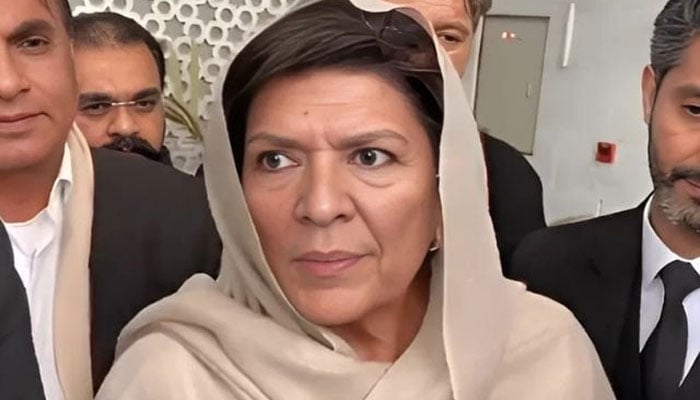
aleema vows peaceful
| |

Aleema vows peaceful fight for Imran’s relea…

Aleema Khan, the sister of Pakistan Tehreek-e-Insaf (PTI) founder Imran Khan, has said the party will continue its peaceful campaign for the release of the former prime minister.

Addressing party workers in the Jandol Munda area of Lower Dir, Aleema Khan urged supporters to remain committed to a lawful and peaceful struggle. She stressed that all political activities should be carried out within the framework of the law.

She called on party workers to work closely with elected representatives and play an effective role in advancing the party’s objectives through democratic means.

Aleema Khan said unity, discipline and peaceful protest remain the movement’s greatest strengths. She encouraged supporters to stay organised and continue their efforts with patience and determination while maintaining respect for the law.

Her remarks came as PTI continues to campaign for the release of its founder and presses ahead with its political activities across the country.

Earlier, Bushra Bibi, the wife of former prime minister and PTI founder Imran Khan, has filed an appeal in the Constitutional Court seeking the suspension of her sentence and release on bail.

In her petition, she requested the court to suspend the sentence handed down by the trial court until the final decision on her appeal. She argued that she should be granted bail on medical grounds.

The petition stated that Bushra Bibi is entitled to relief because she is a woman and is suffering from health problems. It maintained that her medical condition requires proper treatment and care, making her eligible for bail during the legal proceedings.

Similar Posts

  • |

    China missile test deepens pacific’s struggle fo…

    SUVA: A Chinese ballistic-missile test in the Pacific has exposed a growing dilemma for the region’s small island nations: how can they preserve their vision of an “Ocean of Peace” while increasingly finding themselves caught between the military ambitions of major powers? China’s July missile launch, its first known ballistic-missile test into the Pacific since September 2024, has intensified concerns about the region’s rapid militarisation. The test came just hours after Fiji signed a major defence agreement with Australia, its first-ever military alliance. The timing highlighted the competing security interests shaping the Pacific, where the United States and China are increasingly contesting influence. Yet despite widespread concern among Pacific leaders, the region failed to agree on a joint statement condemning the Chinese missile test during a meeting of foreign ministers in Suva last week. Papua New Guinea Foreign Minister Justin Tkatchenko described the launch as “totally inappropriate”, saying that while China remained a close friend and partner of Papua New Guinea, the missile test was not helpful. Beijing had informed Papua New Guinea about the launch beforehand, Tkatchenko said, but did not provide details about where the missile would land. China defended the exercise at the time. Foreign Ministry spokesperson Mao Ning said the test had been conducted safely and urged other countries not to “over-interpret” the event. Pacific caught between major powers The missile launch was the latest in a series of military developments that have transformed the Pacific into an increasingly contested strategic space. Chinese naval deployments and live-fire exercises, including drills in the Tasman Sea, have become more visible. At the same time, US allies have expanded military exercises around Guam and Hawaii, while Washington maintains major military facilities and forces across Hawaii, Guam and the Marshall Islands. For Pacific island governments, the growing military activity creates an uncomfortable contradiction. Many have repeatedly insisted that their region should not become another battleground for global power competition. In September 2025, Pacific leaders endorsed the Ocean of Peace Declaration, pledging to protect the region and strengthen international peace and security. The initiative was intended to put Pacific countries themselves at the centre of discussions about their security rather than allowing outside powers to define the region’s strategic priorities. David Peebles of the Australian National University’s Pacific Security College said Pacific nations had historically resisted security agendas imposed by larger countries. But the growing number of defence agreements is now testing that principle. Defence deals bring benefits — and fears For some Pacific governments, security partnerships offer practical advantages. They can provide surveillance against illegal fishing, disaster-response capabilities, policing assistance, military equipment and training. Australia’s new defence agreement with Fiji, known as the Ocean of Peace Alliance, reflects that approach. But critics fear that a growing network of bilateral security arrangements could gradually draw Pacific nations deeper into the strategic competition between China and the United States. Tuvalu’s permanent foreign secretary, Pasuna Tuaga, speaking in a personal capacity, expressed concern over increasing militarisation, including security arrangements such as the AUKUS partnership between Australia, Britain and the United States. The concern is not simply about military exercises or missiles. Pacific governments also worry that agreements could eventually influence how their territory, waters and critical infrastructure are used. Solomon Islands Foreign Minister Rick Houenipwela, who chaired the Suva talks, stressed that the region’s security agenda must remain “conceived by the Pacific, shaped by the Pacific”. Yet achieving that unity is becoming increasingly difficult. China divides Pacific consensus The failure to produce a common statement on China’s missile test revealed just how sharply interests differ among Pacific nations. Officials familiar with the discussions said Kiribati and Nauru did not support the wording of a proposed statement. Both countries have strengthened relations with Beijing after switching diplomatic recognition away from Taiwan. New Zealand Foreign Minister Winston Peters attributed the failure to reach consensus to foreign influence, although he did not identify any country. The disagreement reflects a broader challenge. Some Pacific governments, particularly those closer to longstanding US military facilities, favour stronger security ties with Washington and its allies. Others remain cautious about becoming involved in military competition between major powers and maintain close economic or diplomatic relations with Beijing. Fiji faces a difficult balancing act Fiji is now at the centre of this debate. The country signed its defence agreement with Australia and participated for the first time in the US-led RIMPAC military exercises last month. At the same time, Fiji has publicly supported the vision of a peaceful Pacific free from major-power confrontation. Foreign Minister Sakiasi Ditoka acknowledged the tension, saying Pacific nations wanted to be free from “all these war-making paraphernalia” while recognising that some security capabilities were necessary to protect them. For Pacific leaders, the challenge is increasingly about finding the right balance. The region does not want to choose sides in a rivalry between Washington and Beijing. But as military exercises expand, defence agreements multiply and missiles are tested in Pacific waters, remaining completely outside that rivalry is becoming harder. The issue is expected to return to the spotlight when Pacific leaders gather in Palau in three weeks for the Pacific Islands Forum summit. The missile test may have lasted only moments, but its political impact could linger far longer — forcing Pacific nations to confront whether their dream of an “Ocean of Peace” can survive amid an increasingly militarised region.

  • | |

    Information Ministry accuses Al Jazeera of biased …

    The Ministry of Information and Broadcasting has accused international broadcaster Al Jazeera of presenting a misleading picture of the recently held Azad Jammu and Kashmir (AJK) Legislative Assembly elections, alleging that its coverage selectively portrayed the electoral process. In an official statement, the ministry said the broadcaster reported from selected polling stations in Muzaffarabad and relied on carefully chosen interviews and timings that did not accurately reflect the overall conduct of the elections. It claimed the reporting created a distorted impression of the voting process and failed to represent the broader electoral environment. The ministry further alleged that such coverage appeared aimed at undermining the credibility of the elections and ignoring what it described as the democratic will expressed by voters across the region. It maintained that the people of AJK had exercised their right to vote despite political tensions. Alongside its criticism of the coverage, the ministry reminded foreign media organisations operating in Pakistan that reporting assignments outside Islamabad, Lahore and Karachi require prior approval under the country’s External Publicity Guidelines. It urged all foreign correspondents to comply with the regulations governing reporting in other parts of the country. The AJK elections, however, remained under intense scrutiny after allegations of irregularities and isolated incidents of violence emerged during polling. Opposition parties accused authorities of interfering in the electoral process, while the ruling coalition exchanged allegations of rigging and misuse of state resources. Human rights organisations also expressed concern over reports of deaths and injuries linked to election-related unrest. They called for transparent and independent investigations into the incidents and stressed that maintaining public order should not come at the expense of fundamental rights, including peaceful assembly and freedom of expression. The elections were held against the backdrop of political unrest that has continued in AJK since last year’s protests over governance reforms and constitutional issues. The controversy surrounding reserved refugee seats in the AJK Legislative Assembly also remained a major political issue during the campaign.

  • |

    PSX jumps 2,100 points on global optimism

    The Pakistan Stock Exchange (PSX) witnessed a strong rally at the start of trading on Wednesday, with investors returning to the market after signs of easing geopolitical tensions in the Middle East lifted global sentiment. The benchmark KSE-100 Index climbed by more than 2,100 points during the opening session, reflecting renewed optimism among market participants. By around 9:30am, the KSE-100 Index was trading at 179,216.20 points, registering a gain of 2,132.98 points, or 1.20 percent, compared with the previous close. Market analysts attributed the sharp recovery to encouraging remarks from officials in Qatar and the United States, which strengthened expectations that diplomatic efforts could help prevent further escalation of the Iran conflict. The improved global outlook encouraged investors to increase buying in key sectors of the local market. The rally was broad-based, with significant buying interest recorded in automobile assemblers, cement manufacturers, commercial banks, fertiliser companies, oil marketing firms, power generation companies and refineries. Among the major gainers were heavyweight stocks such as Attock Refinery Limited (ARL), Mari Energies (MARI), Oil and Gas Development Company (OGDC), Pakistan Petroleum Limited (PPL), Pakistan Oilfields Limited (POL), Pakistan State Oil (PSO), Habib Bank Limited (HBL), MCB Bank, Meezan Bank (MEBL) and United Bank Limited (UBL), all of which traded in positive territory during the early session. Investor confidence also received support from reports that Pakistan has approached China to refinance a $1.3 billion commercial loan. According to reports, the financing is expected to be finalised later this month after both sides complete negotiations on the terms and conditions. Market participants believe the move could help strengthen Pakistan’s external financing position and provide support to the country’s foreign exchange reserves. The strong opening followed a volatile trading session on Tuesday, when the stock market closed significantly lower after investors engaged in widespread profit-taking. Although the KSE-100 Index had reached an intraday high of 178,768.83 points, selling pressure emerged later in the session as traders locked in gains following Monday’s impressive rally. Global financial markets also contributed to the positive sentiment. Asian equities advanced sharply after strong corporate earnings in the United States and continued enthusiasm for technology stocks pushed Wall Street to fresh record highs. Investors were further encouraged by hopes that diplomatic efforts would help keep the Strait of Hormuz open, easing concerns over disruptions to global energy supplies and putting downward pressure on oil prices and bond yields. Japan’s Nikkei index surged around 3 percent, while South Korea’s benchmark gained more than 4 percent. The broader MSCI Asia-Pacific Index outside Japan also posted strong gains, with Chinese blue-chip shares moving higher as investors welcomed improving market sentiment across the region. In the United States, stock futures remained stable after the S&P 500 reached another record high. However, trading in some technology stocks remained mixed. Chipmaker AMD declined in after-hours trading despite reporting earnings that exceeded analysts’ estimates, as investors had anticipated even stronger results. Concerns also persisted over the heavy capital spending required to support artificial intelligence infrastructure, with rising borrowing costs continuing to weigh on parts of the technology sector.

  • | |

    Auqib Nabi earns maiden India call-up as replacement for injured Jasprit Bumrah

    Right-arm pacer Auqib Nabi has been added to India’s squad for the upcoming two-match Test series against Sri Lanka, replacing injured fast bowler Jasprit Bumrah. The series begins in Galle on August 15, followed by a second Test in Colombo on August 23. It marks India’s first assignment in the World Cup Test Championship cycle since a 2-0 home defeat to South Africa in 2025. Auqib, a tall right-arm quick from Jammu and Kashmir, earns his first national call-up after strong performances in domestic cricket. He topped the wicket-taking charts in India’s premier first-class competition, the Ranji Trophy, across the past two seasons. He played a central role in Jammu and Kashmir’s historic Ranji Trophy title win, taking 60 wickets in 17 innings during that campaign, an effort that earned him the player of the tournament award. He also featured for India A against Sri Lanka A during a recently concluded tour, picking up six wickets across two four-day matches. Should he make his Test debut in the upcoming series, Auqib would become the first cricketer from Jammu to represent India in the format. Across his first-class career, Auqib has taken 162 wickets in 43 matches at an average of 18.63, including four ten-wicket hauls in a match and 16 five-wicket innings hauls. Bumrah, meanwhile, has been ruled out after failing to recover in time from a left knee injury sustained during the ODI series against England. He had originally been named in India’s squad for the Sri Lanka tour before the setback. His workload has been closely monitored since he suffered a back injury during the 2024-25 Border-Gavaskar Trophy series in Australia, and the recent ODI series against England marked his first appearance in the format since the 2023 World Cup final. India’s updated squad for the Sri Lanka Tests reads: Shubman Gill (captain), KL Rahul (vice-captain), Yashasvi Jaiswal, Rishabh Pant (wicketkeeper), B Sai Sudharsan, Dhruv Jurel (wicketkeeper), Ravindra Jadeja, Kuldeep Yadav, Manav Suthar, Mohammed Siraj, Prasidh Krishna, Gurnoor Brar, Auqib Nabi, Devdutt Padikkal and Saransh Jain.

  • | |

    Talal Chaudhry hits back at Bilawal over AJK polls

    Islamabad: Minister of State for Interior Talal Chaudhry has criticized PPP Chairman Bilawal Bhutto Zardari over his reaction to the Azad Jammu and Kashmir elections, saying political leaders should accept electoral outcomes with grace instead of complaining after defeat. Speaking at the PML-N’s election review meeting for Poonch Division, Chaudhry said the party’s victories in the first two phases of the AJK local elections reflect the confidence Kashmiris have in the performance of the federal and Punjab governments. He claimed voters supported the PML-N because of its governance and development record, adding that people across Pakistan aspire to the same level of progress achieved in Punjab. The meeting was attended by district and constituency coordinators, along with PML-N candidates from Poonch Division, where party leaders also reviewed campaign preparations and polling strategy for the third phase of the elections.

  • | |

    Monica Barbaro reveals ultimate dating red flag

    Actor Monica Barbaro has opened up about what she believes is the biggest warning sign in modern dating while continuing to attract attention for her relationship with actor Andrew Garfield. The 36-year-old actor shared her views during the red carpet premiere of her upcoming film One Night Only, where she was asked about relationship habits that immediately raise concerns. Barbaro said one of the clearest red flags is when a person shows no curiosity about their date and spends the entire conversation talking only about themselves. She explained that several of her friends have experienced similar situations, describing it as a common complaint in today’s dating culture. According to Barbaro, meaningful conversations require mutual interest. She said it is a warning sign when someone fails to ask even a single question about the other person, as it reflects a lack of genuine interest in getting to know them. The actor added that healthy relationships are built on communication, attentiveness and equal participation in conversations. In her view, a one-sided discussion can reveal important aspects of a person’s personality early in the relationship. Barbaro’s comments come as public interest in her romance with Andrew Garfield continues to grow. The pair first sparked dating speculation after they were seen together around the 2025 Academy Awards, with fans closely following their appearances over the past year. Most recently, Garfield attended the premiere of One Night Only to support Barbaro, further fuelling interest in their relationship. Although the couple has largely kept their personal life private, their public appearances together have continued to attract attention from fans and entertainment media. Barbaro is currently preparing for the release of One Night Only, while Garfield remains active with several upcoming film projects. Their relationship has become one of Hollywood’s most talked-about romances, even as both actors continue to focus on their careers

Leave a Reply

Your email address will not be published. Required fields are marked *