risks marcos 2027
| |

The risks in Marcos’ 2027 P7.2-trillion ‘people-centered’ spending bet

This P7.2 trillion 2027 record-breaking spending bet is billed by government as the “People-Centered Growth for an Inclusive and Resilient Future.”  Essentially, this spending plan is about 6% higher than the national expenditure program (NEP) of 2026 and represents roughly 21.7% of the country’s projected gross domestic product (GDP).  

More crucially, this spending plan is also financially crafted to serve as both a representative development blueprint and political statement of President Ferdinand “Bongbong” Marcos Jr.’s (PBBM) administration before the 2028 presidential elections.  

But beneath the bold promises of social transformation of this record-breaking spending plan lies a complex fiscal matrix that balances ambitious social expenditures against a highly constrained financing environment. 

As claimed, the Marcos administration’s allocation strategy explicitly prioritizes areas designed to directly impact the daily lives of the masses. Branded as a “people-centered” financial paradigm, the Social Services sector captures the lion’s share of the budget at P2.456 trillion. 

Within this pillar, basic and higher education receive a combined budget allocation of P1.326 trillion, with “Basic Education” cornering an allotment of P976 billion or 13.55% of total budget. This massive investment is a response to both chronic classroom shortages and the need for structural educational reforms. 

The healthcare system has an allocation of P358.8 billion funneled into the Department of Health (DOH), specialty hospitals, and the state insurance program, PhilHealth. Concurrently, the Department of Social Welfare and Development (DSWD) is given P241.6 billion to sustain targeted cash transfers and social safety nets for vulnerable populations.

Beyond direct human development, public spending aimed at fueling long-term economic momentum got an allocation of P1.833 trillion. This includes a budget allocation of P1.467 trillion specifically earmarked for infrastructure investments, with P644 billion notably passing through the Department of Public Works and Highways.  

A significant sub-allocation within public works is dedicated to climate resilience and flood control, a vital pivot following severe monsoon and storm disasters that triggered national corruption scandals over infrastructure integrity.  

Food security is strengthened by investing P276.57 million into agriculture and land reform to protect consumers from unstable food prices. 

Ironically, the proposed 2027 agricultural budget falls short of providing a meaningful incentive package. It remains highly inadequate given that the agri-food economy accounts for 33% of GDP and supports 38% of overall livelihoods, according to data from Oxford Economics.

Funding plan

While the spending side paints a picture of robust public investment, the source of financing reveals a narrower, more precarious fiscal landscape. The government anticipates generating P5.21 trillion in revenues for 2027. Unfortunately, this is P1.99 trillion (or 27.64%) short of what is needed to pay for the record-breaking budget. 

This mismatch creates a projected P1.69-trillion fiscal deficit, which is about 5.1% of the country’s economic output or GDP.  To bridge this gap and cover maturing obligations, the government is leaning heavily on a P3.3-trillion gross borrowing program. 

The financing strategy of the budget is met with alarm from public finance experts and opposition lawmakers, noting that nearly a quarter of the entire spending program is effectively debt-funded. However, to tactically minimize exposure to global currency fluctuations and geopolitical shocks, the government is resorting to a conservative 72:28 borrowing mix. This means approximately 72% will be sourced domestically via Treasury bonds and bills, while the remaining 28% will come from international markets and foreign project loans. 

While this domestic bias safeguards the state from external shocks, it means that the country’s cumulative outstanding debt is projected to spiral to a record P21.48 trillion by the end of 2027. Consequently, the mandatory payment of interest and principal or debt servicing has become a massive structural drag, consuming a staggering P1.14 trillion or 15.9% of the total budget, leaving the government with very tight discretionary fiscal room. 

In summary, the 2027 budget is an ambitious attempt to accelerate economic growth while shielding ordinary citizens from global economic headwinds. Funding education, health, and climate infrastructure is undeniably the right path toward sustainable human capital development. However, the structural reality of the budget reminds us that populist, “people-centered” expenditure is only as sustainable as its financing.  

With over a third of the budget pre-committed to debt burden and mandatory local government allotments, execution is everything. If the government fails to eliminate corruption in infrastructure procurement and cannot significantly boost tax revenues, the P7.2-trillion budget risks burying future generations under a mountain of debt rather than lifting them into prosperity. 

Must Read

Should you worry about the Philippines’ P21-trillion debt burden in 2027?


Should you worry about the Philippines’ P21-trillion debt burden in 2027?

The takeaway

The 2027 revenue framework of the budget is built on a set of core economic growth forecasts and macroeconomic assumptions that carry significant structural risks. The foundation of this multi-trillion-peso framework reveals a clear tension between optimistic state targets and a more fragile economic reality.  

The government based its revenue targets on an assumed 5% to 6% GDP growth rate. While faster growth boosts tax collections, achieving this target faces major hurdles. The Congressional Policy and Budget Research Department (CPBRD) warns that the economy is on weaker footing due to low investment, shrinking household spending, and a late-2026 slowdown. If growth misses expectations, as it did in early 2026, revenues will drop, automatically widening the budget deficit.

Also, the structural design of the budget signals a shift toward slower fiscal consolidation. Rather than pursuing aggressive debt reduction, the administration is prioritizing short-term economic growth. This is evident in downgraded medium-term revenue expectations, which Fitch Ratings notes were lowered to 15.5% of GDP from the original 16.5% target outlined in the Medium-Term Fiscal Framework (MTFF).  

Without major new tax measures, the government is relying on enhanced enforcement and digitization initiatives by the Bureau of Internal Revenue (BIR) to boost annual collections by 8%. However, CPBRD data indicate that the overall national tax effort will likely flatten out at around 14.6% of GDP. This stagnation leaves the state highly vulnerable to revenue shortfalls if modernization efforts yield slow results.

Likewise, the entire revenue framework assumes that inflation will stabilize within a predictable target band, keeping consumer prices and interest rates steady. This stability remains highly vulnerable to both internal and external shocks. Lawmakers recognize that volatile global fuel prices, domestic agricultural disruptions, and geopolitical tensions, such as conflicts involving major global powers, could quickly upset these calculations. Continued inflationary pressures or a weaker Philippine peso present a dual risk: they erode domestic consumer spending, which is the primary driver of Philippine GDP, while simultaneously driving up the import costs of essential fuel and raw materials.

Finally, to bridge the widening gap between traditional tax collections and the P5.21-trillion goal, the framework relies heavily on non-tax revenues, specifically an aggressive P101.5-billion government asset privatization target. 

Policy institutions like the Philippine Institute for Development Studies (PIDS) have raised concerns over this strategy, pointing out a lack of public clarity regarding which state assets will actually be sold. Furthermore, relying on lump-sum asset sales serves as a temporary fiscal band-aid. It offers a one-time cash injection that cannot sustainably fund recurring national debt servicing or mandatory state operations over the long term. – Rappler.com

(You may reach the writer at densomera@yahoo.com)  

Below are other articles by the author you may have missed:
Similar Posts

  • | | |

    DPM Dar boosts Pakistan-ADB partnership

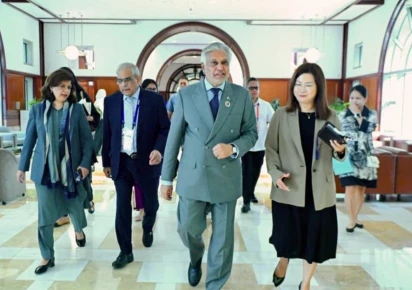
    Deputy Prime Minister and Foreign Minister Ishaq Dar visited the headquarters of the Asian Development Bank (ADB) in Manila on Wednesday to review the bank’s partnership with Pakistan and discuss ways to strengthen future cooperation. The visit took place on the sidelines of the 33rd ASEAN Regional Forum Ministerial Meeting, where Pakistan is participating in a series of high-level diplomatic engagements with regional and international partners. Upon his arrival at the ADB headquarters, Dar was welcomed by senior officials of the bank. He signed the visitors’ book before holding discussions on the institution’s evolving development agenda and its ongoing collaboration with Pakistan. The meeting focused on expanding cooperation in several important sectors, including infrastructure, energy, climate resilience, education, economic reforms and sustainable development. Both sides also discussed future opportunities to support Pakistan’s economic growth and development priorities. Dar later attended a working luncheon hosted by Pakistan’s Executive Director to the ADB, Nashita Mohsin. The event was attended by Pakistani professionals serving in senior leadership positions across different departments of the bank. During the interaction, Dar appreciated the contributions of Pakistani professionals working at the ADB. He said their expertise and leadership have strengthened the institution’s work while enhancing Pakistan’s image at the international level. He also congratulated Nashita Mohsin on assuming her responsibilities as Pakistan’s Executive Director to the Asian Development Bank and expressed confidence that she would further strengthen Pakistan’s engagement with the institution. On the sidelines of the ASEAN forum, Dar also met Bangladesh’s Foreign Minister Khalilur Rehman. The two leaders reviewed the positive momentum in bilateral relations and discussed ways to expand cooperation between the two countries. Both sides welcomed the steady improvement in diplomatic ties and appreciated the growing engagement in trade, communication and people-to-people contacts. They noted that the launch of direct flights earlier this year has further improved connectivity and created new opportunities for cooperation. The two ministers reaffirmed their commitment to maintaining the positive momentum in bilateral relations and agreed to continue close engagement in areas of mutual interest. Dar and Rehman also exchanged views on regional and international developments, including issues affecting South Asia and broader global challenges. They emphasized the importance of dialogue and cooperation in promoting regional peace, stability and economic development. Earlier, Dar arrived in Manila with a Pakistani delegation to participate in the 33rd ASEAN Regional Forum Ministerial Meeting. During the visit, he is expected to attend the forum’s plenary session and hold several bilateral meetings with foreign ministers from participating countries. The ASEAN Regional Forum brings together foreign ministers and senior diplomats from ASEAN member states and major global powers to discuss regional security, economic cooperation, energy security, food security, geopolitical developments and other international issues. Representatives from the United States, China, Japan, India, Australia, South Korea, Russia, the United Kingdom and the European Union are also participating in the meeting.

  • |

    Oil prices rise as Hormuz tensions escalate

    Oil prices climbed on Monday as uncertainty over a possible diplomatic breakthrough between the United States and Iran increased, while a sharp slowdown in tanker movements through the Strait of Hormuz heightened concerns about disruptions to global crude supplies. Brent crude futures gained as much as 1% during early trading to reach $89.40 per barrel. The benchmark was later up 72 cents, or about 0.8%, at $89.20 a barrel by 0229 GMT. US West Texas Intermediate (WTI) crude also moved higher, rising 44 cents to $82.83 per barrel. Both international benchmarks posted gains of more than 5% last week after a series of attacks involving energy and shipping assets in and around the strategically important Strait of Hormuz. The incidents have intensified fears that further escalation could affect one of the world’s most important oil transit routes. Market sentiment was further affected by developments over the weekend, when Iranian Foreign Minister Abbas Araqchi said Tehran had yet to decide whether it would resume negotiations with Washington. US President Donald Trump, meanwhile, told Americans to prepare for somewhat higher gasoline prices as the conflict continues. Analysts said the renewed uncertainty had brought geopolitical risk back into crude markets after oil prices had previously come under pressure on expectations that diplomatic efforts could ease tensions. “Oil prices have now rebounded almost completely from the lows seen in early August, as hopes for a more permanent resolution between the US and Iran have faded and geopolitical risk premiums have returned to the market,” said Priyanka Sachdeva, head of market insights at Phillip Nova in Singapore. Sachdeva cautioned, however, that the rally could lose momentum unless there is evidence of a further deterioration in the situation. She said the market would need to see renewed aggression in the Strait of Hormuz, particularly significant damage to oil tankers or energy infrastructure, before prices were likely to move substantially higher. Hormuz shipping activity slows Concerns over physical supply disruptions increased after ship-tracking data showed a marked decline in vessel traffic through the Strait of Hormuz over the weekend. According to data from Kpler, only five commodity vessels crossed the strategic waterway on Saturday, while no such transits were recorded on Sunday. This compared with 31 commodity vessel crossings during the previous weekend. The slowdown is significant because the Strait of Hormuz is a critical route for international energy shipments. Any prolonged disruption could increase transportation risks, raise insurance costs and place additional upward pressure on crude prices. The United Arab Emirates also accused Iran of attacking another vessel operated by Abu Dhabi National Oil Company (ADNOC) while it was passing through the strait on Friday, according to the Emirati state news agency WAM. The UAE had earlier blamed Iran for two separate incidents involving ADNOC-operated vessels on Thursday evening. The latest incidents have added to concerns among traders that the conflict could increasingly affect commercial shipping and energy infrastructure, rather than remaining confined to military and diplomatic confrontation. Markets remain focused on escalation risks The Strait of Hormuz remains particularly important to global oil markets because a substantial volume of crude and petroleum products moves through the waterway. Any sustained interruption could therefore have consequences well beyond the region. For now, traders are closely monitoring developments involving US-Iran diplomatic contacts, attacks on shipping and the movement of tankers through the strait. While the latest price gains reflect a higher geopolitical risk premium, analysts remain cautious about predicting a prolonged rally. If shipping activity resumes and diplomatic channels reopen, some of the premium built into crude prices could quickly unwind. Conversely, additional attacks on tankers, oil facilities or other critical infrastructure could trigger a stronger market reaction and push prices higher as traders reassess the security of regional supplies.

  • | | | |

    SBP holds interest rate at 11.5pc amid growth conc…

    The State Bank of Pakistan (SBP) has kept its policy rate unchanged at 11.5 per cent, maintaining the existing monetary policy stance amid concerns over economic growth. The decision was announced on Monday by SBP Governor Jameel Ahmed following a meeting of the Monetary Policy Committee (MPC). The central bank’s decision was largely expected by financial market analysts. Most experts had predicted that the SBP would maintain the current rate to support macroeconomic stability while monitoring economic conditions. Market surveys conducted by brokerage firms showed that more than 90 per cent of respondents expected the policy rate to remain unchanged. Only a small number of analysts had anticipated a possible increase. The decision comes as Pakistan continues to balance economic stability with the need to encourage business activity and investment. Higher interest rates can help control inflation and support financial stability, but they can also increase borrowing costs for businesses and consumers. The SBP had reduced its policy rate by 50 basis points to 10.5pc in December 2025. It later raised the rate by 100 basis points to 11.5pc in April 2026. Since then, the central bank has maintained the rate at 11.5pc. Business groups have continued to call for a significant reduction in borrowing costs. They argue that lower interest rates could help businesses expand operations, increase investment and support economic activity. However, the central bank has opted for a cautious approach. Policymakers appear focused on maintaining overall economic stability while assessing inflation, growth and other financial indicators.

  • Chiang Rai Leaders Back New Festival Tourism Project to Bring Visitors

    CHIANG RAI – Provincial Administration in Chiang Rai took a big step to boost local travel on July 8, 2026. Deputy Governor Norasak Suksomboon welcomed a team of researchers to the City Hall. The experts came from Thammasat University’s Lampang Center to discuss a major new plan. They met to talk about a project that […]

Leave a Reply

Your email address will not be published. Required fields are marked *