netanyahu defends israel
| |

At UN, Netanyahu defends Israel as delegates walk out

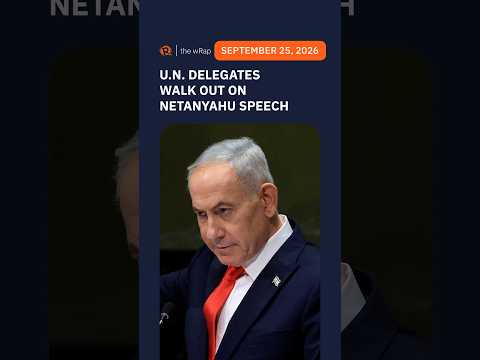
UNITED NATIONS – Israeli Prime Minister Benjamin Netanyahu mounted a forceful defense of Israel’s actions in the region at the UN on Thursday, September 24, seeking to counter growing international isolation ahead of elections he could lose, as dozens of delegates streamed out.

The walkout underscored the competing pressures facing Netanyahu, who is battling mounting criticism abroad over the Gaza war while campaigning for reelection at home ahead of an October 27 vote.

At UN, Netanyahu defends Israel as delegates walk out

The divisions over Israel’s conduct were on display as Netanyahu began speaking, with dozens of delegates walking out in protest. He called them “moral cowards,” while supporters in the gallery chanted in Hebrew: “The people of Israel live.”

People, Person, Adult
WALKOUT. Delegates walk out as Israel’s Prime Minister Benjamin Netanyahu addresses the 81st United Nations General Assembly at UN headquarters in New York City, US, September 24, 2026. Reuters

Netanyahu used his address to berate New York Mayor Zohran Mamdani for calling him a war criminal, Western European leaders for what he called succumbing to “antisemitic mobs,” and to accuse both Qatar and Turkey of spreading lies about Israel.

“You tried to stop me from coming here. You tried. You tried to silence me. Well, you can’t silence me. You can’t silence the truth,” Netanyahu, Israel’s longest-serving leader, said of Mamdani.

Mamdani campaigned for office on a promise to have Netanyahu arrested for alleged war crimes should he visit the largest US city but later said he determined he lacked the legal authority to do so. This week, Mamdani described Netanyahu as “the architect of a horrific genocide against Palestinians.”

Making his first visit to New York since Mamdani took office in January, Netanyahu said: “Here’s a simple truth: Israel didn’t commit genocide. Israel prevented genocide.”

He accused Mamdani of supporting Hamas militants, something Mamdani has denied.

“To all those spreading these lies about my country and about our brave soldiers, whether they sit in this hall or in the office of the antisemitic mayor of New York, I say this: Shame on you!” Netanyahu said.

In a statement, Mamdani said: “As he has done time and again, Prime Minister Netanyahu used his speech to repeat baseless lies meant to sanitize his genocide of Palestinians. Yet no lie can change the fact that he remains the subject of an International Criminal Court arrest warrant alleging war crimes and crimes against humanity.”

Qatar also rejected the accusation that it was seeking to turn public opinion against Israel, with its foreign ministry spokesperson saying on X that Netanyahu’s repeated attacks on Doha sought to divert attention from responsibility for policies on the ground.

Political future on the line

With general elections less than five weeks away, Netanyahu spoke for about 40 minutes in what amounted to a campaign-style speech, broadcast live in evening prime time on all four of the main Israeli television channels.

Ahead of his speech, Netanyahu’s government paid to place 500 pro-Israel and anti-Iran billboards and dozens of trucks carrying messages in support of Israel across Manhattan, Netanyahu’s office said in a statement.

With opinion polls showing Netanyahu’s bloc trailing rivals ahead of the election, he used the speech to showcase what he described as Israel’s fight on seven fronts, including the war with Iran that began with joint US-Israeli strikes in late February.

As in past UN appearances, Netanyahu used props, holding up a pager linked to an attack that killed and wounded Iran-backed Hezbollah members in Lebanon and a Starlink satellite internet receiver he said he would leave for the Iranian delegation.

“So when they inevitably defect, they too will be able to freely tell their story on social media,” he said, adding that it was only a matter of time before the Iranian authorities would be toppled by the people.

Street protests in New York

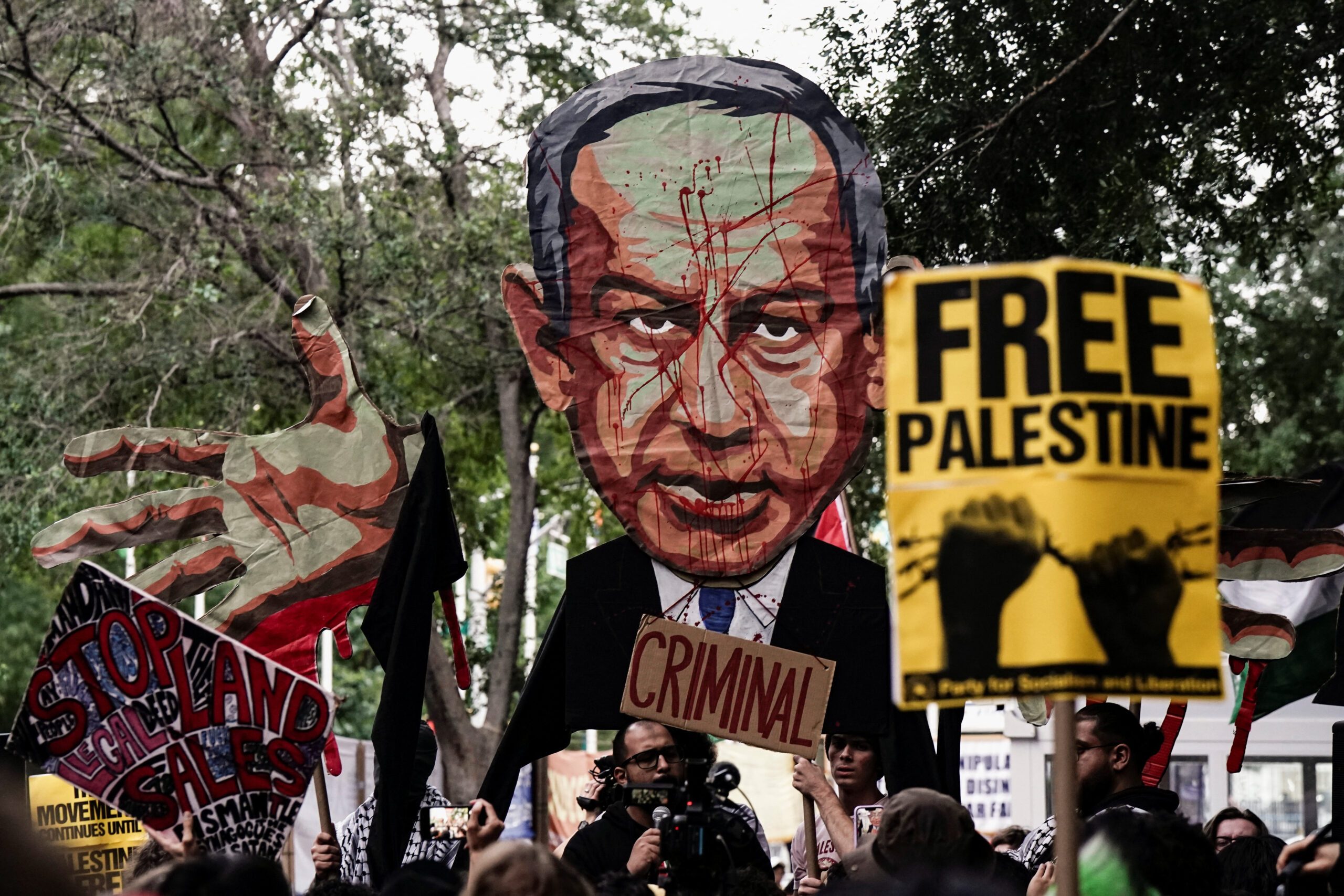
Several hundred protesters gathered near the United Nations, with dozens blocking traffic and chanting, “Stop arming Israel, let Gaza live” and “Stop arming Israel, let Iran live.” Police detained them.

Netanyahu was making a short visit to the US for his UN address and, unusually, without a planned meeting with US President Donald Trump, whom he praised during his speech.
Parade, Person, Protest
PROTEST. A cutout depicting Israeli Prime Minister Benjamin Netanyahu is held up as pro-Palestinian demonstrators protest against Israeli Prime Minister Benjamin Netanyahu on the sidelines of the 81st United Nations General Assembly in New York, US, September 24, 2026. Reuters

“We will continue to defend our state. We will continue to win because we have no other choice. In this battle against the barbarians, we’ve had no greater partner than President Trump. I thank him. I thank him for his bold leadership,” he said.

Deepening isolation

Israel has faced deepening diplomatic isolation since launching its war in Gaza in response to the Hamas-led attacks on Israel nearly three years ago.

Netanyahu is unable to travel to many countries because of an International Criminal Court arrest warrant issued against him and his then-defense minister as well as the then-military commander of Hamas in 2024.

Earlier this month, once-steadfast allies Britain, France and Canada announced sanctions targeting Israeli settlements in the occupied West Bank, which drew a muted response from Washington.

“The leaders of these countries have chosen to succumb to the antisemitic mobs. They’ve chosen weakness. They’ve chosen appeasement,” Netanyahu said.

He played down worsening violence in the occupied West Bank by Israeli settlers, describing it as “a handful of young juvenile delinquents, about 150 in number, who throw stones, who chop down olive trees.”

“Occasionally … they lit some fires. I can’t stand that. I won’t stand for vigilantism. We’re a country of law.” – Rappler.com
Similar Posts

  • |

    India files charges against 13 in medical exam paper leak case

    India’s federal investigation agency has filed charges against 13 people accused of involvement in the leak of question papers for the country’s national medical entrance examination, following weeks of protests over the scandal. The Central Bureau of Investigation (CBI) said the accused include subject experts linked to the National Testing Agency, intermediaries who allegedly distributed leaked papers, and individuals associated with coaching institutes. The charges include criminal conspiracy, cheating, breach of trust, and destruction of evidence. All 13 accused are currently in custody, according to the investigation agency. The case relates to the National Eligibility cum Entrance Test (NEET), which was taken by nearly two million students in May. The examination was cancelled after allegations emerged that questions had been leaked in several areas. A fresh test was later conducted on June 21. The controversy triggered nationwide protests led by students and young activists, with thousands gathering in New Delhi and other cities demanding accountability. The demonstrations intensified after protesters marched towards parliament and faced clashes with police. The unrest eventually led to the resignation of Education Minister Dharmendra Pradhan, who stepped down after mounting pressure over the handling of the examination crisis. India’s Supreme Court has also intervened in the matter, ordering authorities not to take strict action against protesters and directing the release of detained minors. The court further instructed officials to preserve surveillance footage related to alleged police action during demonstrations. In response to the controversy, Prime Minister Narendra Modi’s government has introduced proposed amendments to public examination laws. The changes seek tougher punishments, including longer prison sentences and heavier fines for those involved in exam fraud. Under the proposed rules, those found guilty could face imprisonment of up to 10 years and fines reaching 50 million Indian rupees.

  • | |

    World Cup conspiracies weaponised as Javier Milei blames foreign leftists for online backlash

    Following Argentina’s defeat by Spain in the World Cup final, President Javier Milei has alleged that a coordinated, foreign-funded anti-Argentina campaign was launched to undermine his nation and its football team. The far-right libertarian president claimed during a radio interview that the US Democratic party, alongside the governments of Mexico and Brazil, financed widespread online hostility, fan racism accusations, and rumours of favorable treatment towards Lionel Messi’s squad. Milei specifically targeted Brazilian President Luiz Inácio Lula da Silva, alleging that Brazil provided the largest share of funding for these attacks, a statement he reiterated while attending a campaign launch for far-right senator Flávio Bolsonaro in São Paulo. The president’s claims come amidst online friction and high-profile international criticism, including an Instagram post by actor Samuel L. Jackson urging fans not to support Argentina due to historical racism in the country. Whilst digital communications researchers acknowledge a genuine surge of transnational hostility online, experts note there is no public evidence supporting Milei’s claims of an organised international funding plot. Instead, political analysts view the narrative as a calculated tactic to stoke culture wars and divert public attention away from domestic corruption scandals, rising unemployment, and the severe impact of his austerity measures, which have pushed the administration’s popularity to its lowest level since taking office.

  • | |

    Moroccan footballer dies while trying to reach Ceuta

    Moroccan footballer Faten Ben Omar Al-Azizi has reportedly died after drowning while attempting to reach Ceuta, the Spanish-administered territory on the North African coast. According to local media reports, Al-Azizi had previously represented Moghrib Atletico Tetouan, and news of her sudden death has left Morocco’s football community in shock, particularly football circles in Tangier and northern Morocco. Reports suggest that the footballer attempted to make the dangerous journey to Ceuta by sea, but the trip ended in tragedy. She lost her life after encountering difficulties during the crossing, highlighting the severe risks faced by people who attempt to reach the Spanish territory through irregular migration routes. The incident comes amid growing attempts by migrants in northern Morocco to reach Ceuta by sea. Rough waters, strong currents and other dangers along the route have led to several deaths in recent weeks, with many people risking their lives in the hope of reaching European territory. Following Al-Azizi’s death, her former teammates, friends and members of the Moroccan football community expressed deep sorrow and paid tribute to her. Those who knew her described her as a hardworking, talented and kind-hearted person who made a positive impression on those around her. Her death has also drawn attention to the dangers associated with irregular migration routes in the region, where difficult sea conditions can quickly turn attempts to cross into deadly tragedies.

  • |

    Thailand’s ancient monastery earns Unesco World Heritage status

    A historic Buddhist monastery in southern Thailand has been added to the Unesco World Heritage List, giving the country another globally recognized cultural landmark and providing stronger support for its long term preservation. The recognition marks an important milestone for Thailand as it is the first World Heritage site located in the country’s southern region. The newly listed site is Wat Phra Mahathat Woramahawihan, located in Nakhon Si Thammarat province. The Thai Foreign Ministry announced that it is now Thailand’s ninth World Heritage site. Officials said the designation will help improve conservation efforts through closer cooperation between national authorities and local communities, ensuring the monastery remains protected for future generations. The announcement was celebrated at the monastery with traditional ceremonies. Monks gathered to chant blessings while officials and visitors took part in the event by striking a ceremonial gong. Local media described the atmosphere as one of pride and celebration as the centuries old temple received international recognition. According to Unesco, the monastery has served as one of the region’s leading Buddhist centers since it was established in the eighth century. Over the centuries, it has become an important place of worship, education, and cultural exchange. The temple complex is home to impressive stone stupas, a large reclining Buddha statue, and numerous standing and seated golden Buddha figures. Visitors can also see detailed sculptures and artistic depictions of guardian deities throughout the site. The monastery reflects a rich blend of religious and cultural influences that shaped Southeast Asia over many centuries. Because of its location on the Thai peninsula between the Pacific and Indian oceans, it became a meeting point for traders, pilgrims, and scholars from across the region. Unesco noted that traditions and architectural styles from Brahmanism, Hinduism, Mahayana Buddhism, and Theravada Buddhism, along with influences from India, Sri Lanka, and Myanmar, are all visible in the site’s design and religious practices. These different cultural traditions have been woven into the monastery’s buildings, ceremonies, and daily rituals, making it a valuable symbol of the region’s shared history. The site’s historical importance and unique cultural identity were key reasons behind its inclusion on the prestigious World Heritage List. Thailand hopes the international recognition will also strengthen its tourism industry. World Heritage status often attracts more international visitors, helping local economies while raising awareness about the importance of preserving cultural landmarks. Tourism remains one of Thailand’s most important economic sectors, although visitor numbers have not yet fully recovered to levels seen before the Covid-19 pandemic. Government figures show that tourist arrivals during the first half of this year were more than three percent lower than during the same period in 2025. Officials believe the addition of another World Heritage site could encourage more travelers to explore destinations beyond Thailand’s traditional tourist hotspots. Wat Phra Mahathat Woramahawihan now joins a distinguished list of Thai World Heritage sites that includes the Historic City of Ayutthaya, the Thungyai Huai Kha Khaeng Wildlife Sanctuaries, and the Ancient Town of Si Thep. The latest recognition highlights Thailand’s rich cultural heritage while reinforcing efforts to preserve one of the country’s most significant religious and historical treasures for generations to come.

  • |

    Women allege rape, abuse at UK Army teen college

    Four former female recruits have accused the UK’s Army Foundation College (AFC) in Harrogate of fostering a culture of sexual abuse, harassment and misogyny, with one woman alleging she was raped by several fellow recruits when she was 17 years old. The women, who attended the military training college over the past five years, shared their experiences publicly for the first time. They said they faced sexual violence, harassment and degrading treatment while undergoing training at the college, which prepares teenagers for military service. One former recruit said she accepted an invitation to another recruit’s room, believing it was harmless. She alleged that several male recruits sexually assaulted and raped her over the course of several hours. The traumatic incident forced her to leave the Army within weeks, saying she could no longer continue her training after the attack. Another former recruit alleged that a fellow trainee trapped her inside a room before sexually assaulting her. She said she managed to escape after struggling with the attacker. A third former recruit’s mother said her daughter endured repeated sexual harassment throughout her training and even blocked her dormitory door at night because the room’s lock was broken and she feared male recruits entering. A fourth woman claimed some instructors openly made sexist remarks, rated female recruits based on their appearance and entered female dormitories without warning. She alleged that such behaviour encouraged disrespectful attitudes toward women among male trainees. Official data obtained through freedom of information requests revealed that police received 16 reports of sexual offences linked to the college during the year ending in June. The reported incidents included allegations of sexual assault, exposure and voyeurism. Separate Ministry of Defence figures showed that 176 complaints involving inappropriate sexual behaviour were recorded at the college between January 2018 and June 2025. Most complaints involved junior soldiers, while dozens concerned permanent staff members. The British Army described the allegations as extremely serious and distressing, stating that criminal or unacceptable behaviour has no place in the armed forces. It said several reforms have been introduced to improve victim support and strengthen the handling of serious offences, including specialist investigations conducted outside the normal chain of command. The Army also said it encourages anyone who has experienced or witnessed misconduct to report it and maintained that the college remains committed to providing a professional, safe and supportive environment for all recruits. However, concerns have grown over the safety of young recruits following previous convictions involving Army personnel for sexual offences and wider reports highlighting sexual misconduct within the armed forces.

  • | |

    Iranian photojournalist Yalda Moayeri sentenced to…

    An Iranian court has reportedly sentenced prominent photojournalist Yalda Moayeri to 15 years in prison in absentia, in a case involving allegations of activities against Iran and working in the interests of Israel and the United States. According to reports, the case was brought under an Iranian espionage-related law introduced in 2025. The allegations reportedly include giving interviews to foreign media outlets and providing photographs to organizations allegedly connected with the United States and Israel. Authorities also accused Moayeri of using her journalistic work and material published online to advance what they described as the interests of Israel and the United States. However, Reuters reportedly noted that the contents of the court documents could not be independently verified. The court handed down the 15-year sentence while Moayeri was not present at the proceedings. She has reportedly been given 10 days to appeal the decision. In addition to the prison sentence, the court ordered the confiscation of her cameras, mobile phones and other electronic equipment. The ruling also reportedly restricts her from participating in cultural and media activities, holding public office and posting on social media. Moayeri has disputed the circumstances of the proceedings. She said she was unable to attend the trial because she had not received formal notification about the hearing. According to her account, when she went to Tehran’s Revolutionary Court, she was not given complete case documents, while a colleague had to copy details of the charges by hand. The photojournalist also said Iranian security forces raided her Tehran home in February and confiscated her mobile phone, laptop, cameras and other equipment. A press freedom organization reported that personnel affiliated with the Islamic Revolutionary Guard Corps searched her home on February 3 and seized electronic devices. Moayeri has previously faced legal action in Iran because of her journalistic work. She was arrested in September 2022 while covering nationwide protests that followed the death of Mahsa Amini in police custody. Her arrest occurred during the protests that became associated with the “Woman, Life, Freedom” movement. She was released on bail in December 2022. She has continued documenting political developments and protests in Iran. In early 2026, her photographs from protests were published by the French newspaper Le Monde, while reports indicated that authorities subsequently searched her home and continued legal proceedings against her. The latest sentence has drawn attention because of its potential implications for press freedom and the ability of journalists to document events in Iran. The case remains subject to appeal, while independent verification of the Iranian court’s allegations remains limited.

Leave a Reply

Your email address will not be published. Required fields are marked *