protest erupts washington
| | | | |

Protest erupts in Washington over Netanyahu visit

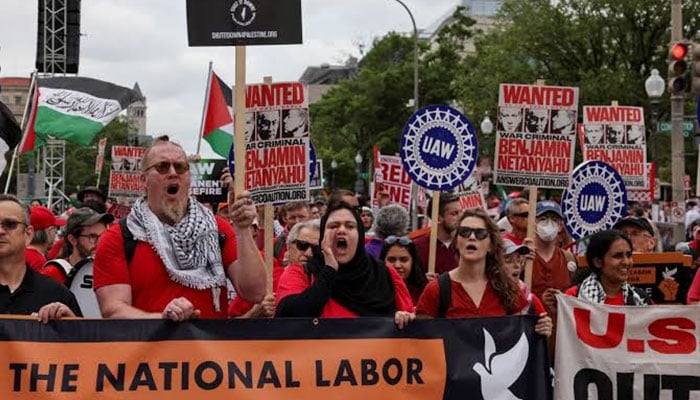
WASHINGTON: Israeli Prime Minister Benjamin Netanyahu’s visit to Washington has sparked a fresh wave of protests, with demonstrators taking to the streets to oppose U.S. support for Israel and demand that the Israeli leader be arrested.

Pro-Palestinian protesters gathered in the U.S. capital carrying Palestinian flags and banners criticising Washington’s backing of Israel. The demonstrations came as Netanyahu arrived in the United States for a scheduled meeting with President Donald Trump.

At the heart of the protest was a demand that U.S. authorities enforce the International Criminal Court’s arrest warrant against Netanyahu. Demonstrators argued that the United States should not provide protection to an Israeli leader facing allegations before the international court.

The protest reflects the wider political and public debate in the United States over Washington’s relationship with Israel and its approach to the conflict in Gaza.

Trump rules out Netanyahu arrest

The demonstrations gained additional attention because Trump has already made his position clear.

The U.S. president has said Netanyahu will not be arrested while he is in the United States, directly rejecting calls for his detention. Trump has also strongly defended Israel and Netanyahu in connection with the ongoing regional conflict.

Netanyahu’s visit comes at a particularly sensitive moment. His meeting with Trump on Tuesday is the first between the two leaders since their joint war against Iran, with tensions reportedly emerging over how the conflict should be handled.

Protest adds pressure ahead of Trump meeting

The Washington demonstration adds another layer of political pressure surrounding Netanyahu’s visit. Protesters say U.S. support for Israel should be reconsidered and that international legal proceedings should not be ignored.

The issue of Netanyahu’s potential arrest has also become prominent in U.S. politics. New York Mayor Zohran Mamdani has said his administration is examining whether the city could enforce the ICC warrant if Netanyahu visits New York for the United Nations General Assembly in September.

For now, however, Trump’s administration has made clear that Netanyahu will not face arrest during his stay in the United States.

With protests continuing and the Trump-Netanyahu meeting attracting international attention, the visit is likely to keep the debate over Gaza, U.S.-Israel relations and international accountability firmly in the spotlight.

Similar Posts

  • | |

    Punjab PMS officers oppose plan to create 101 AAC …

    LAHORE: The Provincial Management Service (PMS) Officers Association has strongly opposed the Punjab government’s proposal to create 101 new Additional Assistant Commissioner (AAC) posts, describing the move as unnecessary and harmful to the existing administrative structure. The association argued that the AAC posts had been abolished years ago and their revival was not justified, particularly after the establishment of the Punjab Enforcement and Regulatory Authority (PERA), which was created to strengthen enforcement and regulatory functions across the province. During an executive committee meeting chaired by Association President Qamar Zaman Qaisrani, members unanimously decided to raise their concerns with senior government officials. A delegation of the association is expected to meet the Punjab services secretary and the additional chief secretary to seek a review of the proposed decision. The association warned that if its concerns remain unaddressed, PMS officers across Punjab will begin a province-wide protest campaign. As part of the first phase, officers plan to wear black armbands while performing official duties to register their protest against the government’s decision. PMS officers believe the creation of the new posts would place a significant financial burden on the provincial treasury. According to the association’s estimates, establishing one Additional Assistant Commissioner post, including official facilities, office infrastructure, staff, transport and operational expenses, would cost approximately Rs46.8 million. They claim that creating all 101 posts would require nearly Rs4.73 billion initially, in addition to recurring expenditures on salaries, allowances and other administrative costs. The association further expressed concerns over what it described as long-standing issues within the provincial bureaucracy. These include delays in promotion boards, alleged discrimination in transfers and postings, and the appointment of junior officers to positions traditionally reserved for senior officials. Former administrative secretary Yawar Mehdi also commented on the proposal, saying that efforts to improve public service delivery were welcome if they genuinely strengthened governance. However, he stressed that introducing additional administrative positions should not weaken the existing civil service structure or negatively affect the career progression of Provincial Management Service officers.

  • |

    Nimra Khan clarifies marriage status after viral Instagram reel

    Pakistani television actress Nimra Khan has addressed speculation about her marriage after an emotional Instagram post sparked rumours that she and her husband had separated. The actress, who enjoys a strong social media presence with more than 4.7 million followers on Instagram, clarified the situation after fans began questioning her relationship status following a recent reel that many interpreted as a sign of personal turmoil. Nimra, who announced her marriage in June 2026, had shared photos from her wedding and nikah ceremony in Paris with her followers. The images were widely celebrated by fans, making her recent social media activity all the more noticeable. The rumours began after Nimra posted a reflective Instagram reel featuring a heartfelt message about resilience and self-worth. In the video, she encouraged people to remain strong even when life becomes difficult, others stop understanding them, or they feel alone. She expressed that a person should never abandon themselves, regardless of the challenges they face. According to the actress, once someone learns to become their own source of strength, no obstacle or criticism can truly defeat them. She added that it is important for people to realise they are enough for themselves and should value their own inner strength. While the message resonated with many of her followers, others assumed it hinted at problems in her personal life. The speculation intensified when some social media users noticed that her wedding photographs were no longer prominently visible on her Instagram profile. One follower commented on the post, asking if everything was alright and suggesting that the actress had removed her wedding pictures, fuelling rumours that her marriage had ended. Responding directly to the comment, Nimra dismissed the divorce speculation and assured her followers that there was no reason for concern. She explained that everything was fine and clarified that she had not deleted her wedding photographs. Instead, she had simply moved them lower on her Instagram profile. According to the actress, the decision was made to protect her personal life from the effects of the “evil eye,” a belief commonly held in many cultures that excessive public attention or envy can bring misfortune. Nimra also thanked the fan for expressing concern and offering prayers, appreciating the support shown by her followers. Her clarification quickly put an end to the growing rumours, with many fans expressing relief and sending messages of love and good wishes. The incident once again highlighted how emotional or motivational social media posts are often interpreted as reflections of a celebrity’s private life, leading to widespread speculation. In Nimra’s case, a message intended to inspire self-confidence and emotional resilience was mistakenly linked to her marriage, prompting the actress to publicly clear the air. With her response, Nimra Khan has reassured fans that her marriage remains intact and that there is no truth to the divorce rumours circulating online. Her explanation also served as a reminder that not every inspirational post on social media reflects a personal crisis, and appearances on social platforms do not always tell the full story.

  • |

    Pakistan targets 90% clean electricity by 2035, says Awais Leghari

    Federal Minister for Power Awais Leghari outlined Pakistan’s long-term strategy to transform its electricity sector, setting an ambitious target of raising the share of clean energy in the national power mix to 90 percent by 2035. The announcement came during the Solar, Storage and Flexibility 2026 Conference, where the minister also highlighted key policy hurdles, including restrictions under Pakistan’s International Monetary Fund (IMF) programme that are delaying the introduction of a market-based electricity pricing mechanism. Speaking at the conference on Tuesday, Leghari said the government was pursuing a major shift in energy policy by moving away from a traditional generation-focused model towards a system centred on grid flexibility, energy security, battery storage and domestic manufacturing. He said the new approach is designed to reduce Pakistan’s dependence on imported fuels, shield consumers from volatile global energy prices and maximise the benefits of the country’s rapidly expanding solar sector. The minister said Pakistan has witnessed remarkable growth in rooftop solar installations, with nearly 38 gigawatts of distributed solar capacity now installed through private consumer investment. He described the rapid adoption of rooftop solar as one of the country’s biggest energy success stories but cautioned that it has also created new challenges for the national power system. According to Leghari, Pakistan generates significant amounts of electricity from solar energy during daylight hours, yet the absence of sufficient battery storage infrastructure prevents that surplus electricity from being utilised during evening peak demand. He stressed that without modern storage systems, the country would continue to struggle with balancing electricity supply and demand despite having abundant renewable energy resources. Referring to disruptions in Re-gasified Liquefied Natural Gas (RLNG) supplies earlier this year, the minister said the episode exposed Pakistan’s continued dependence on imported fuels. He noted that the interruption in fuel supplies led to electricity shortages and load shedding even though ample solar power was available during the daytime, highlighting the urgent need for large-scale energy storage. “Battery storage is no longer an optional technology—it has become a strategic national asset that is essential for ensuring Pakistan’s energy sovereignty,” Leghari said. He noted that clean energy sources, including hydropower, nuclear, wind and solar, currently contribute approximately 55 percent of Pakistan’s total electricity generation. However, he warned that achieving the government’s renewable energy targets would require significant investment in battery storage systems, transmission infrastructure and power market reforms. The minister emphasised that expanding renewable generation alone would not be sufficient unless supported by a modern electricity network capable of storing and transmitting clean energy efficiently. To support the country’s long-term energy transition, Leghari announced a three-point strategy. The plan includes expanding battery energy storage systems across the national grid, encouraging local battery manufacturing and assembly to reduce reliance on imports while creating employment opportunities, and introducing regulatory reforms aimed at providing long-term certainty and confidence for domestic and foreign investors. During a question-and-answer session following his address, the minister also disclosed that Pakistan’s commitments under the IMF programme currently limit the government’s ability to introduce a fully flexible, market-based electricity tariff system. He explained that the government has been in discussions with the IMF for several months regarding the introduction of a time-of-use tariff, under which electricity prices would vary according to the actual cost of power generation at different hours of the day. Such a system, he said, would encourage consumers to shift electricity consumption to off-peak periods, reduce pressure on the national grid and help integrate renewable energy more efficiently.

  • | |

    SBP reserves fall $229m, gold prices rise

    The State Bank of Pakistan’s (SBP) foreign exchange reserves fell by $229 million in the week ending July 24, 2026, to $17.03 billion, mainly due to external debt repayments. Pakistan’s total liquid foreign exchange reserves stood at $22.4 billion during the week. The SBP held $17.03 billion, while commercial banks maintained net reserves of around $5.4 billion. Meanwhile, the Pakistani rupee edged up against the US dollar, closing at Rs277.81 in the interbank market on Thursday compared with Rs277.82 a day earlier. The dollar remained stable in early Asian trading after the US Federal Reserve kept interest rates unchanged. Gold prices in Pakistan also increased, following gains in international markets. The All-Pakistan Gems and Jewellers Sarafa Association said the price of 24-carat gold rose by Rs1,000 to Rs427,436 per tola. The price of 10 grams increased by Rs857 to Rs366,457. Internationally, spot gold gained 0.8% to $4,098.98 per ounce, while US gold futures for August delivery rose 1.4% to $4,097.70. The Federal Reserve maintained its current interest rates on Wednesday, while softer US inflation data reduced market expectations of a rate hike in September. Analysts, however, warned that the ongoing conflict in the Middle East could put renewed pressure on inflation. Silver prices moved lower in the domestic market, declining by Rs76 to Rs6,215 per tola. Interactive Commodities Director Adnan Agar said the gold market remained range-bound. Bullion traded between $4,028 and $4,120 before settling near $4,107, which he described as a “danger zone.”

  • | | |

    Oil prices jump as US-Iran tensions rattle markets

    Oil prices climbed sharply on Wednesday as fresh military developments involving the United States, Iran and Saudi Arabia raised fears of further escalation in the Middle East. Brent crude futures rose $3.30, or 3.9%, to $87.39 a barrel. US West Texas Intermediate (WTI) crude also gained $3.05, or 3.8%, to $82.31 a barrel. The latest increase came after the United States and Saudi Arabia carried out strikes against Iran-backed groups in Iraq. The developments followed Iran’s reported missile attack targeting US forces in the region. The renewed tensions have increased concerns about oil supplies from the Middle East. Investors are now watching closely for signs that the conflict could spread further across the Gulf. US officials said American forces intercepted ballistic missiles launched by Iran towards US military positions in the Middle East. Washington described the incident as an attempted surprise attack. Iran’s Islamic Revolutionary Guard Corps later said it had launched several ballistic missiles at a US air base and the US Central Command facility in Jordan. Saudi Arabia also confirmed that its forces had conducted targeted strikes against Iran-backed groups in Iraq. Riyadh said the strikes were carried out jointly with the US Central Command. Saudi authorities linked the operation to drone attacks targeting energy facilities in the kingdom. The developments have added to concerns over the security of critical oil infrastructure in the region. Market analysts said the latest escalation has reduced expectations of a quick easing of tensions in the Persian Gulf. Any disruption to oil production or transportation routes could put additional upward pressure on crude prices. US oil inventories have also provided support to the market. Crude stocks fell by around 3.3 million barrels during the week ending July 24, according to data cited from the American Petroleum Institute. Official inventory figures from the US Energy Information Administration are expected later on Wednesday. Traders will closely examine the data for further signs of changes in demand and supply. Meanwhile, OPEC+ could provide another boost to oil prices. Sources said the producer group is likely to pause planned increases in oil output for three months starting in October. The possible pause would come after OPEC+ completes its scheduled return of barrels that had previously been removed from the market through voluntary production cuts. For now, traders remain focused on developments between Washington and Tehran. Any further military escalation could increase concerns over regional oil supplies and push crude prices higher.

  • 145 Killed in First Three Days of New Year Holidays in Thailand

    BANGKOK, Jan 2 – The death toll from road accidents during the so-called “seven dangerous days” of the New Year holiday period has climbed sharply, with 145 fatalities and 769 injuries reported in the first three days alone. Authorities announced the grim statistics on Friday, revealing Bangkok as the deadliest province and Phuket as the […]

Leave a Reply

Your email address will not be published. Required fields are marked *