aurangzeb reviews pakistans
| | |

Aurangzeb reviews Pakistan’s economic progress i…

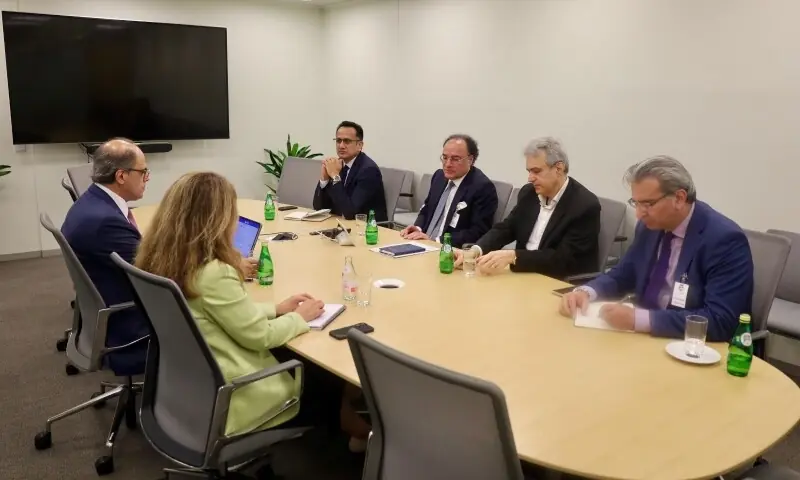
Finance Minister Muhammad Aurangzeb held a series of high-level meetings with senior officials of the International Monetary Fund (IMF) in Washington to review Pakistan’s economic performance and discuss the progress of the country’s reform agenda.

The meetings included discussions with IMF First Deputy Managing Director Dan Katz, Deputy Managing Director Nigel Clarke, Middle East and Central Asia Department Director Jihad Azour, and IMF Mission Chief for Pakistan Iva Petrova.

During the talks, the finance minister presented an overview of Pakistan’s recent macroeconomic performance. He highlighted improvements in fiscal management, stronger external accounts, higher foreign exchange reserves, record inflows of overseas workers’ remittances, and a healthier current account position. He also noted that the government had met its revenue collection targets, which he said reflected the positive impact of ongoing economic reforms.

The discussions also focused on Pakistan’s progress under the IMF-supported Extended Fund Facility (EFF) and the Resilience and Sustainability Facility (RSF). Both sides reviewed measures aimed at strengthening economic stability and ensuring long-term, sustainable growth.

Aurangzeb briefed IMF officials on reforms in taxation, the energy sector, public debt management, tariff rationalisation, and the government’s privatisation programme. He also discussed efforts to broaden financing sources, improve the investment climate, and restore Pakistan’s access to international capital markets.

The meetings further covered issues related to human capital development, increasing women’s participation in the economy, addressing demographic challenges, encouraging technology-led growth, and promoting private sector investment and export-driven development.

The finance minister reaffirmed the government’s commitment to maintaining fiscal discipline and implementing structural reforms. He said Pakistan would continue pursuing policies aimed at strengthening economic stability, improving investor confidence, and achieving long-term economic transformation.

During his visit to Washington, Aurangzeb also met John Jovanovic, President and Chairman of the Export-Import Bank of the United States, to discuss expanding economic cooperation between the two countries.

The meeting focused on financing long-term development projects and increasing bilateral trade in agricultural commodities, including cotton and soybeans, as well as cooperation in the hydrocarbons sector. The two sides also explored opportunities to facilitate greater access to US financing, technology, equipment, and services for priority projects in Pakistan.

Officials agreed to identify short-term investment opportunities, appoint focal persons from both sides, and prepare a strategic cooperation framework. The proposed framework is expected to be finalised and signed on the sidelines of the United Nations General Assembly session in September 2026.

Similar Posts

  • | |

    Kendall Jenner, Jacob Elordi heat up London romance

    Kendall Jenner and Jacob Elordi have once again attracted attention after sharing a romantic moment during a dinner date in London. The couple were seen leaving China Tang at The Dorchester this week while walking hand-in-hand along Park Lane. Their relaxed appearance together has added to growing interest in their relationship. Jenner looked elegant for the evening in a pale blue sleeveless pencil skirt that highlighted her model figure. She paired the outfit with a black snakeskin-style clutch and matching stilettos. The model kept her dark hair loose over her shoulders and completed her look with nude lipstick and sunglasses. Elordi, meanwhile, opted for a sophisticated pinstriped suit with a black tie and orange-tinted sunglasses. The actor was seen holding Jenner’s hand as they walked away from the hotel, giving photographers another glimpse of the couple’s growing closeness. The pair are currently in London as Elordi prepares for the premiere of his upcoming film The Dog Stars. The movie also features Josh Brolin, Margaret Qualley and Guy Pearce. Their latest appearance comes amid continued reports about the couple’s relationship. Recent speculation claimed that Elordi had arranged a luxury penthouse stay for himself and Jenner at Claridge’s, reportedly costing around £60,000 per night. According to reports, the actor wanted to give Jenner a memorable experience with views across London. The reported luxury stay further fuelled public interest in their romance. Jenner and Elordi’s relationship became more widely known earlier this year after they were reportedly seen kissing at Justin Bieber’s Coachella afterparty. Their connection had already attracted attention after they were spotted together on several occasions. Since then, the pair have reportedly spent time together during trips abroad, including visits to Hawaii and Japan. Their appearance holding hands in Tokyo also became a popular topic on TikTok and other social media platforms. The romance rumours had begun earlier, with Jenner and Elordi reportedly seen having an animated conversation at the Vanity Fair Oscar Party in March. Their interaction prompted speculation that the two were becoming more than friends. Neither Jenner nor Elordi has publicly discussed their relationship in detail. However, their repeated public appearances and affectionate moments have continued to fuel interest among fans and entertainment followers.

  • |

    Indian activist held over shocking protest comments

    Indian political commentator and social activist T.G. Mohandas has been detained by police over controversial remarks about students taking part in a protest. Police reportedly took Mohandas into custody from his residence on Sunday evening. A cybercrime police team reached his home with local police officers. He was present when the team arrived. Authorities are investigating remarks made by Mohandas in a video shared on his YouTube channel. Police also collected information about his YouTube account and digital devices allegedly used to record and upload the video. A complaint has reportedly been registered against him. The complaint alleges that the videos published on his channel were capable of disturbing public order. It also accused him of creating fear and unrest through his statements. The controversy began after Mohandas commented on a student protest in Delhi linked to an alleged examination paper leak. In the video, he made offensive remarks about female protesters and claimed that the demonstrations could lead to incidents of sexual violence. He further made a derogatory statement about women participating in the protest. His comments triggered criticism because they appeared to blame or demean potential victims of sexual violence. Mohandas also spoke about how authorities should respond to the demonstrations. He said that if he were in government, he would impose a curfew to disperse the protesters. He further suggested that force could be used if demonstrators refused to leave. His remarks included references to people potentially being killed or permanently injured during a violent crackdown. The comments have drawn attention from law enforcement authorities. Police are now examining the video and other digital material connected to the case. Officials are also questioning Mohandas as part of the investigation. The authorities are expected to determine whether his statements and online content violated laws relating to public order and the spread of fear or unrest. The case has sparked wider discussion over the limits of political commentary and responsibility for statements made on social media. The investigation is continuing, while further details about the allegations and possible legal action are awaited.

  • | |

    Australia defends social media ban for under-16s

    The Australian government has defended its ban on social media use by children under the age of 16, despite new data showing that most teenagers continue to access restricted platforms months after the law came into effect. The legislation, introduced in December, was designed to protect children from the harmful effects of social media on their mental and physical health. The policy attracted international attention, with Australia becoming the first country to implement such a nationwide restriction on underage social media users. A recent report by Australia’s online safety regulator found that more than eight in ten teenagers under the age of 16 were still using social media platforms three months after the restrictions became operational. The findings have highlighted the challenges governments face in enforcing digital regulations. Despite the report, Australian authorities insisted that the policy remains an important step toward creating a safer online environment for children. Officials said the law has already influenced public discussion about online safety and encouraged greater awareness among parents, educators and technology companies. Assistant Minister for Productivity, Competition, Charities and Treasury Andrew Leigh said the government never expected complete compliance immediately after the law came into force. He explained that many public safety laws require time before they achieve widespread compliance. Leigh said the government considers the legislation successful because it has changed the national conversation about children’s use of social media and encouraged stronger action to protect young users from harmful online content. He noted that millions of social media accounts had already been closed or restricted since the implementation of the law. According to the minister, this demonstrates that the legislation is already having an impact, even if some teenagers continue to access online platforms. The government also stressed that technology companies have a major responsibility to ensure compliance with the new rules. Officials said digital platforms must strengthen age verification systems and take effective measures to prevent underage users from creating or maintaining accounts. Regulatory authorities are continuing to assess how well social media companies are implementing the restrictions. They are also examining additional measures that could improve enforcement and ensure technology firms meet their legal obligations. Experts say the latest findings illustrate the complexity of regulating online platforms, particularly as social media has become deeply integrated into the daily lives of young people. They note that effective enforcement will require cooperation between governments, parents, schools and technology companies.

  • |

    Solar boom needs battery storage, grid reforms to sustain momentum

    Islamabad: Pakistan’s rapid expansion of solar energy has already generated billions of dollars in savings, but experts and policymakers on Tuesday warned that battery storage, grid modernization and supportive policies are now essential to sustain the country’s clean energy transition. Speaking at the Solar, Storage and Flexibility 2026 Conference, Federal Minister for Power Awais Leghari said Pakistan’s energy mix is already 50% clean and is targeted to reach 90% by 2035. He stressed that local manufacturing of battery storage systems and the introduction of a daytime Time-of-Use (ToU) tariff would be key to integrating growing solar generation into the national grid. Addressing the conference, PPP Vice President Senator Sherry Rehman said solar energy has already saved Pakistan US$12 billion, with another US$6.3 billion in savings expected this year. She said the country now faces an energy management challenge rather than a generation shortfall, calling for major investments in battery storage, smart grids and modern transmission infrastructure. Rehman said one in every five Pakistani households now uses solar energy and urged international climate finance to prioritize distributed renewable energy, battery storage and affordable financing for households and small businesses instead of focusing mainly on large utility-scale projects. She also opposed the proposed 18% GST on solar equipment, saying it would have slowed Pakistan’s clean energy transition, and called for targeted subsidies, microfinance and supportive regulations to expand access to renewable energy, particularly in underserved and off-grid communities. Renewable energy experts noted that Pakistan has installed an estimated 38 gigawatts of distributed solar capacity, while imports of lithium-ion Battery Energy Storage Systems (BESS) surged 220% in 2025, signalling rapidly growing demand for energy storage. Global renewable energy leaders, including Global Solar Council CEO Sonia Dunlop and Renewable Energy Council Asia Pacific representative John Grimes, described Pakistan’s consumer-led solar revolution as a model for other countries but stressed that a comprehensive battery storage policy and modern electricity grid are now critical to maintaining the momentum.

  • |

    Mustafa Kamal calls for more administrative units

    MULTAN:Federal Minister for Health Mustafa Kamal has once again called for the creation of additional administrative units in Pakistan, arguing that the country’s existing governance structure is no longer capable of effectively addressing its growing challenges. Speaking at a ceremony in Multan, Kamal said Pakistan currently operates through a federal government and four provinces, but the system needs major restructuring to improve governance and service delivery. He said Pakistan is larger than around 180 countries in terms of population and administrative needs, making it necessary to consider creating more administrative units to ensure better management and development. Reflecting on his political career, Kamal said he became Karachi’s mayor 21 years ago and was elected as a member of the provincial assembly 12 years ago. He added that political leaders often remain caught up in a continuous race without fully understanding whether the existing system is delivering the desired results. The federal minister also focused on the country’s healthcare challenges, saying that simply constructing more hospitals would not solve Pakistan’s health crisis. He pointed out that hospitals across the country remain overcrowded, while the government must focus more on preventive healthcare and improving public health infrastructure. Kamal said effective healthcare begins with measures such as ensuring adequate gaps between births and completing childhood vaccination schedules. He warned that a large number of children remain vulnerable to waterborne diseases due to inadequate sanitation and unsafe water supplies. He also highlighted the lack of an effective sewage treatment system in Pakistan, saying poor sanitation continues to contribute to the spread of preventable diseases. He stressed the need to address the root causes of health problems instead of relying solely on hospitals and medicines after people fall ill. Discussing population growth and maternal health, Kamal said Pakistan’s birth rate stands at around 3.5 percent, while the population growth rate is approximately 2.5 percent. He claimed that around 11,000 mothers die every year in the country, describing the situation as a serious public health concern. The minister said Pakistan also faces a major shortage of trained nurses. According to him, the country needs around 900,000 nurses, while international demand for Pakistani-trained nursing professionals could reach 2.5 million. He said the government should focus on developing professional skills so that trained workers can contribute to the national economy and earn valuable foreign exchange for the country. Kamal also addressed concerns surrounding medicine prices and availability. He clarified that the federal health minister alone does not have the authority to decide whether medicine prices should increase or decrease. He said the Drug Regulatory Authority of Pakistan (DRAP) has deregulated the prices of certain medicines, while decisions regarding price reductions fall within the broader domain of the federal cabinet. He added that a cabinet committee is currently examining the issue of reducing medicine prices. The minister further pointed out that although Pakistan manufactures a large number of medicines locally, the pharmaceutical industry still relies heavily on imported active pharmaceutical ingredients (APIs). He said shortages of some medicines have also created difficulties for patients, with certain drugs disappearing from the regular market and becoming available through agents at significantly higher prices. Kamal’s remarks came a day after Interior Minister Mohsin Naqvi also called for the creation of new administrative units, describing such reforms as essential for the country’s development. Addressing an event in Islamabad, Naqvi reportedly said the existing system had failed to deliver effectively and argued that new administrative units or provinces could provide a way forward. The repeated calls from senior federal ministers for additional administrative units have renewed debate over whether Pakistan needs a major restructuring of its administrative and governance framework to improve public service delivery, strengthen local administration and address the growing demands of its expanding population.

  • |

    World No. 1 Sinner withdraws from US Open

    NEW YORK: World No. 1 Jannik Sinner has withdrawn from the US Open after failing to recover fully from a right knee injury, dealing a major blow to the tournament just days before the final Grand Slam of the season. The five-time Grand Slam champion confirmed on Friday that he would not compete at Flushing Meadows despite making every effort to return to competitive tennis. “Even though I have been working hard with my team and my medical staff, we have now had to make the difficult decision that I will not be able to compete at the US Open this year,” Sinner said in a statement. The 24-year-old Italian explained that he had recently returned to court in Monte Carlo with his team but realised that his knee still required additional recovery time. “I’m very sad and disappointed, as New York has a special place in my heart,” Sinner said, adding that he had been eagerly anticipating the tournament and the atmosphere created by its fans. Sinner has not played competitively since lifting the Wimbledon trophy on July 12. His injury had already forced him to withdraw from the US Open preparation events in Cincinnati and Montreal, raising doubts about whether he would be fit enough to defend his position among the tournament favourites. His absence will be particularly significant given his remarkable 2026 campaign. Sinner has recorded 44 victories against just three defeats this season and has collected six titles, including his Wimbledon triumph. The Italian was also expected to arrive in New York with strong motivation after winning the US Open in 2024. However, his title defence will now have to wait. Sinner’s withdrawal also changes the dynamics of a tournament that had been building toward another chapter in his growing rivalry with Carlos Alcaraz. Alcaraz, Sinner’s biggest contemporary rival, announced on Thursday that he would return to competition at the US Open after spending more than four months on the sidelines with a wrist injury. The Spaniard lost last year’s US Open final to Sinner, making his return one of the most anticipated storylines of this year’s tournament. With Sinner now absent, Alcaraz will have an opportunity to strengthen his position in the Grand Slam race. Sinner’s 2026 season has not been without setbacks. At the French Open, he arrived as the overwhelming favourite but suffered a surprise second-round exit while struggling in a severe heatwave. For now, the Italian will remain in Europe and concentrate on rehabilitation. His target is to return for the Asian swing, with tournaments in Beijing and Shanghai among his planned objectives. For the US Open, however, one thing is certain: the defending 2024 champion and current world No. 1 will be watching from afar, leaving the Grand Slam field wide open for a new champion.

Leave a Reply

Your email address will not be published. Required fields are marked *