house approves 115
|

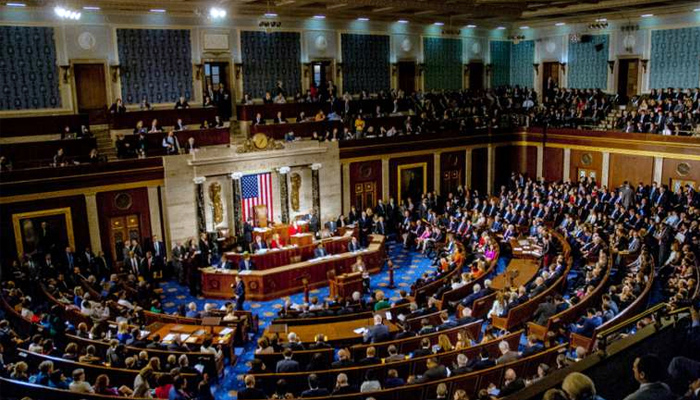
US House approves $1.15 trillion defense budget package

The US House of Representatives has passed a $1.15 trillion defense budget bill by a narrow vote of 216 to 212. Supported by a majority of Republicans and six Democrats, the legislation includes provisions to deepen defense ties and military technology integration with Israel.

The bill faced internal pushback, with Congressman Thomas Massie raising concerns over integrating US military technology and supply chains with Israel.

The passage follows a major funding request from the Trump administration, which asked Congress for nearly $87 billion in supplemental appropriations to support ongoing operations against Iran.

Appropriations Committee, US Secretary of Defense Pete Hegseth stated that military action against Iran has cost $37.5 billion so far, including projected costs through September 30. Hegseth urged lawmakers to maintain robust military spending, arguing that failing to provide the full defense budget represents the single greatest threat to national security.

Similar Posts

  • Europe’s Natural Gas Crisis: Why Russian Gas Sales Are Surging Again

    BRUSSELS – Europe desperately wanted to break free from Russian gas after the invasion of Ukraine. But the harsh reality on the ground is much more complicated than many politicians admit. Today, massive amounts of Russian gas are still flowing heavily into European homes and businesses. European leaders publicly pledged to cut off all these […]

  • |

    Iran says regional states seek new security and economic cooperation 

      TEHRAN/BAGHDAD: Iranian Parliament Speaker Mohammad Bagher Ghalibaf said Saturday that Tehran had received messages from neighbouring countries expressing interest in developing new regional security arrangements and expanding economic cooperation. In a statement on X, Ghalibaf argued that US policies had placed the security of its regional allies at serious risk, particularly because of Washington’s support for Israel. He said the situation had prompted countries in the region to reconsider their security arrangements. Ghalibaf said a “homegrown, independent” regional security order would be the most effective way to establish lasting peace and stability in the Middle East. His comments came amid heightened tensions between Iran, the United States and Israel and growing concerns over regional security. Meanwhile, the Iranian army said its military doctrine was gradually shifting from a defensive posture toward a more offensive strategy. Army spokesman Brigadier General Mohammad Akraminia told state news agency IRNA that the change had developed during what he described as the recent 12-day and 40-day wars. According to Akraminia, the shift was reflected in Iran’s faster and broader responses to attacks, including pre-emptive military operations. He also said the Iranian army had prepared a reward plan in case US forces launched a ground invasion of Iran. Under the plan, members of the armed forces or civilians legally possessing hunting weapons would receive 5 billion tomans, estimated at around $26,000, for killing or capturing US troops entering Iranian territory. The reward would reportedly rise to 10 billion tomans, or approximately $53,000, if a woman carried out the action. Akraminia further claimed that the weapon used in such an operation would be purchased by the army for twice its value and preserved in a military museum under the owner’s name, with a replacement weapon provided to the individual. He also pointed to the Makkah Joint Defence Agreement as evidence of what he described as declining US influence in the region, calling it a regional security mechanism established without US participation. In Iraq, President Nizar Amidi said some vessels carrying Iraqi oil had been permitted to pass through the Strait of Hormuz following requests from Baghdad. Speaking at the eighth Baghdad Dialogue conference, he stressed that developments in the strategic waterway had consequences not only for Iraq but for the global economy. Amidi said Iraq faced difficulties transporting its oil because it lacked a national tanker fleet. He added that Baghdad was determined to remain outside the ongoing conflict between Iran and the United States, despite being among the countries most affected by regional instability. The Iraqi president also said Baghdad would not allow its territory to be used to attack another country and reiterated that weapons should remain under state control. Separately, US President Donald Trump said Friday that Iran was not yet prepared to reach what he considered the “right deal” with Washington. He said the United States was closely monitoring developments in the conflict while maintaining pressure on Tehran. The tensions have also disrupted oil shipments through the Strait of Hormuz, with concerns over the security of the waterway affecting international energy markets. US Treasury Secretary Scott Bessent is expected to announce what Washington has described as its toughest-ever sanctions on Iran, while urging China to cooperate. China remains a major buyer of Iranian oil and has called for diplomacy to resolve the crisis.

  • |

    Akshay Kumar goes full villain, says ‘Haiwaan’ role has no grey shades

    Akshay Kumar is stepping into unfamiliar territory with his upcoming thriller “Haiwaan” taking on a fully negative character for the first time. The role marks a clear departure from his usual on-screen image. The actor recently opened up about his first look and the nature of his character in the film. He made clear there is nothing sympathetic or conflicted about the role he is playing. Kumar explained that his character matches the film’s title exactly, with absolutely no shades of grey involved. He described the role as being completely and unapologetically evil from start to finish. He admitted that taking on such a character felt like an entirely new experience for him. Kumar said he had always wanted to play a psychopath on screen, something he had not attempted in his career so far. He also pointed out that his recent projects have spanned a wide range of genres. From comedy and horror to action and drama, Kumar said he has been consciously exploring different creative directions. Director Priyadarshan also spoke about how Kumar’s distinctive look for the film came together. He revealed that the idea for the beanie actually originated on the sets of a completely different project. Priyadarshan explained that he spotted Kumar casually wearing the beanie during the shoot of “Bhooth Bangla” and instantly loved the look. That casual moment ended up shaping the actor’s final appearance for “Haiwaan.” The director also shared that he had not expected Kumar to accept the role when he first narrated the story. He assumed the actor might turn it down, given how different it was from his usual choices. To his surprise, Kumar showed genuine interest right away. The film also features Saif Ali Khan, Saiyami Kher and Shriya Pilgaonkar in key roles alongside Kumar. Together, the cast brings a mix of star power to what’s shaping up to be a darker, more intense project. “Haiwaan” is currently scheduled for a theatrical release on September 11. With Kumar stepping into unfamiliar villain territory, the film is already generating curiosity ahead of its release.

  • |

    Nicaraguan President Daniel Ortega proposes extending presidential terms to seven years

    Nicaraguan President Daniel Ortega has submitted a proposed constitutional reform to the country’s government-controlled National Assembly that would extend presidential terms from six to seven years. The legislative body is expected to formally approve the changes in September, further cementing the rule of the 80-year-old leader, who has governed the Central American nation continuously since 2007. The proposed constitutional overhaul also includes explicit provisions to disqualify opposition figures whom the regime labels as “traitors” or “coup plotters” from seeking public office. The move follows previous constitutional amendments passed by the assembly, including the elimination of presidential term limits in 2014 and the extension of terms from five to six years in 2024. That same year, the legislature formally designated Ortega’s wife and vice-president, Rosario Murillo, as “co-president”, establishing a direct path of succession in the event of Ortega’s permanent absence. Human rights organisations and international bodies, including the United Nations, continue to raise alarms over the steady dismantling of democratic institutions in Nicaragua. Following anti-government protests in 2018 that resulted in more than 300 deaths at the hands of security forces, the regime carried out widespread arrests ahead of the November 2021 presidential election. Dozens of potential opposition candidates were detained, forced into exile, or stripped of their Nicaraguan citizenship and property, leaving Ortega to secure re-election without viable political competition.

  • | |

    Jeff Hiller earns Emmy nod and unexpected ChatGPT comparisons

    Actor Jeff Hiller has earned his second career Emmy nomination for a performance that lasted just seven minutes, but it is the unexpected comparison to ChatGPT that has amused him the most. Hiller received a nomination for Outstanding Guest Actor in a Drama Series for his appearance as Larry in Apple TV+’s science-fiction drama Pluribus. The actor recently addressed the reaction during an appearance on The Daily Show, where he admitted he never expected viewers to compare his character to artificial intelligence. “I’ve heard this. A lot of people have said, ‘You’re just like ChatGPT,’” Hiller said while discussing audience reactions to his role. Reflecting on his performance, he joked that his original intention had been very different from how viewers interpreted it. “I was trying to convey extreme love for her. And instead, I did ChatGPT. Anyway, I got an Emmy nomination for it. Sometimes you aim for one target, you hit another,” he said. In Pluribus, created by Vince Gilligan, Hiller portrays Larry, a cheerful biker who shares a memorable conversation with Carol, played by Rhea Seehorn, in the fourth episode of the series. The show is set in a world where a mysterious virus has transformed most of humanity into a blissfully content hive mind. Carol is among the few people who remain unaffected, and her interaction with Larry becomes one of the episode’s defining moments. The scene, in which Carol questions Larry about the intentions of the hive mind, ultimately earned Hiller widespread praise and an Emmy nomination despite his limited screen time. Speaking about his chances of winning at this year’s ceremony, Hiller remained characteristically humorous. “I’m not gonna win,” he joked before revealing the acceptance speech he believes would fit the unusual journey of his performance. “Suck it!” he quipped, laughing at the idea that his role had resonated with audiences in such an unexpected way. The nomination marks another milestone in Hiller’s career. It is his second Emmy nomination in two years, following his success for portraying Joel in the final season of HBO’s critically acclaimed comedy Somebody Somewhere. Since then, Hiller has continued to build an impressive television résumé with guest appearances in series including Elsbeth, Ghosts and Widow’s Bay, further establishing himself as one of television’s most dependable character actors. His latest recognition also highlights the impact a brief but memorable performance can have, with just seven minutes on screen proving enough to leave a lasting impression on both viewers and Emmy voters. The 77th Primetime Emmy Awards nominees were announced earlier this month, with Hiller among the contenders in the guest actor drama category. The ceremony will honour the year’s best performances across television. While Hiller insists he is not expecting to take home another Emmy trophy, his humorous response to being compared with ChatGPT has become one of the lighter moments of this year’s awards season, showing that even an unconventional audience reaction can become part of an actor’s success story.

  • |

    IRGC claims destruction of US Aircraft on ground a…

    Iran’s Islamic Revolutionary Guard Corps has claimed that its attacks have destroyed US aircraft on the ground at bases throughout the region, according to a statement published by Iran’s semi-official Fars news agency. The IRGC spokesman said the attacks resulted in the destruction of “17 reconnaissance and operational drones, one F-15 fighter jet inside a hangar, one P-8 aircraft, one C-17 transport aircraft, and 8 refuelling aircraft.” The claims come amid escalating tensions between Iran and the US, with both sides trading military strikes in the Middle East. The US has conducted strikes on Iranian targets, while Iran has launched attacks on US allies in the Gulf region and targeted US military assets. The IRGC’s statement is part of Iran’s ongoing efforts to showcase its military capabilities and assert its role in the conflict. The claims have not been independently verified, and the US has not yet responded to the IRGC’s assertions. However, the destruction of US aircraft would represent a significant escalation in the conflict, potentially drawing the US into a wider confrontation with Iran. The US has enforced a naval blockade in the Strait of Hormuz, while Iran has targeted vessels that violated its rules on navigating the vital waterway. The IRGC’s claims come as diplomatic efforts continue to de-escalate the situation. Iran has urged dialogue to resolve Saudi-Yemen tensions, while Qatar and Egypt have discussed regional stability and de-escalation efforts in a Doha meeting. The Yemeni Houthis’ spokesman has also met with a Saudi delegation, indicating ongoing diplomatic engagement despite the military escalation. The international community has urged restraint, with the UN warning of catastrophic consequences if the violence continues. However, the situation remains volatile, with both sides showing little willingness to de-escalate. The IRGC’s claims of destroying US aircraft are likely to further inflame tensions, raising the stakes in the conflict and increasing the risk of a wider war. As the situation continues to evolve, the international community will be watching closely for any signs of further escalation. The US has warned that Iran will pay “many times over” for any US troop deaths, while Iran has vowed to defend its territory against any aggression. The conflict has already disrupted global energy supplies and threatened economic stability, and the situation remains precarious. The coming days will be critical in determining whether diplomatic efforts can prevent a full-scale war or whether the region will slide further into chaos, with devastating consequences for the region and the global economy. The world hopes for a diplomatic breakthrough that can bring an end to the violence and restore stability to the region. The IRGC’s claims, if confirmed, would represent a significant development in the conflict, underscoring the need for urgent diplomatic intervention to prevent further escalation. The focus remains on finding a peaceful resolution to the crisis, with all parties urged to exercise restraint and engage in meaningful dialogue. The international community continues to support efforts to de-escalate tensions and promote regional stability, but the path to peace remains fraught with challenges. The coming weeks will be critical in shaping the future of the Middle East and the broader global order, with the conflict serving as a stark reminder of the dangers of unchecked escalation and the importance of diplomacy in resolving disputes.

Leave a Reply

Your email address will not be published. Required fields are marked *