books

  • |

    Subjective aesthetics versus literary brilliance

    Litigation over artistic quality reveals more about the critic’s personal taste and ideological leanings than it does about the intrinsic value of the literature itself. A prominent Bangladeshi academic initiated a debate across literary circles when a short video clip went viral online. In this brief excerpt from a presentation delivered at a university literary festival, the scholar dismissed the acclaimed author Shahidul Zahir. He claimed that Zahir does not even qualify as a third-rate artist. He  labeled him instead as a third-class writer whose language is thoroughly uninteresting. He similarly critiqued another modern Bengali prose writer, Akhteruzzaman Elias. For this case, he dismissed his writing style as endlessly monotonous. This judgment raises critical questions about literary aesthetics and the metrics used to evaluate global literature. Does a critic’s subjective boredom justify reducing a writer’s work to a low rating? Analytically, the fiction of Shahidul Zahir demonstrates the exact qualities that define world-class literature. Shahidul Zahir was never a conventional storyteller who somehow aimed to comfort his audience. Rather than offering comfortable narratives, his work exposes uncomfortable truths beneath established historical accounts. His portrayal of wartime violence, political opportunism, and societal compromise during and after the 1971 Liberation War forces readers to confront disturbing realities. Zahir connects the grim details of local life with magical and surreal elements. He utilizes oral storytelling traditions. He also combined surreal metaphors with layered depictions of the human condition. His narratives have bizarre occurrences such as animals acting as caretakers or war collaborators feeding human flesh to animals appear surprisingly believable against the background of ordinary towns like Sirajganj or Old Dhaka. His surrealism reflects real-world atrocities that were often equally unimaginable far from being mere fantasy. The academic’s critique centered primarily on two claims. Firstly, Zahir’s writing is dull. Secondly, his portrayal of the 1971 war is historically inaccurate. However, a closer look at these claims exposes significant flaws in the critic’s premise. The critic in question strongly favors traditional, highly formal, Sanskritized prose (sadhu bhasha) and rejects everyday spoken dialect (cholito bhasha) for serious discourse. In contrast, Zahir’s prose relies on the living, informal, and at times raw language spoken by everyday people. Therefore, rejecting an author because their prose reflects the authentic cadence of public speech reveals an elitist preference rather than an objective literary standard. The scholar accused Zahir’s acclaimed novella Jibon O Rajnoitik Bastobota (Life and Political Reality) of presenting stereotypical representations. He further pointed the supposed depiction of war collaborators wearing skull caps. Yet, nowhere in the actual text does such a detail exist. The critic appeared to project his own assumptions onto the text rather than reading what was actually written. Zahir’s novella accurately captures the painful political reality of post-liberation Bangladesh, where former wartime collaborators were gradually integrated back into mainstream power structures. Literary scholars often define world literature as creative work that responds to the global dynamics of modern capitalism and political change. Zahir’s novels illustrate how global economic forces interact unevenly with local feudal structures. In his masterpiece Shei Raate Purnima Chhilo (It Was Full Moon That Night), Zahir explores the rise of a powerful rural leader under state-sponsored political reform. The narrative illustrates how modern capitalist development mixes with lingering feudal mentalities. This mentality then creates a system where local elites hold unchecked power. Zahir constructs a portrait of a society caught between tradition and modern governance. Furthermore, Zahir’s treatment of the 1971 war connects local experiences with international geopolitics. In his stories, wartime memories constantly surface like fresh grass breaking through soil. His words speak about how national liberation was simultaneously a local struggle for survival and an event influenced by global Cold War tensions. The argument that a nation must produce literature directly accessible or marketed to Western readers in order to be considered world-class relies on a flawed premise. Global literary status should not depend solely on English translation or commercial visibility. Countless profound authors around the globe write within their local contexts. Such marvelous authors produce works that match the thematic depth of international figures like Franz Kafka or Gabriel García Márquez. As a matter of fact, dismissing Shahidul Zahir as third-class overlooks the artistic, historical, and linguistic power of his work. His fiction stands as an extraordinary accomplishment in modern literature. He is the one that challenges, provokes, and immortalizes the complex human experience far beyond the boundaries of narrow critique.  
  • |

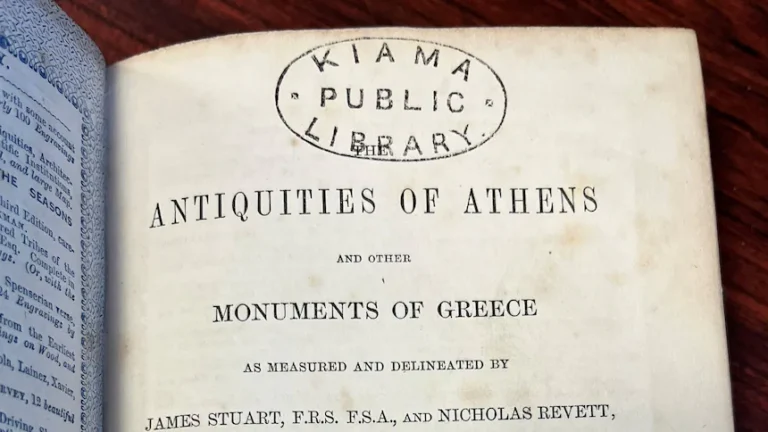
    Rare 1858 volume returned to Australian library after 150 Years

    A home renovation in Australia recently uncovered a piece of literary history that had been missing for a century and a half. A homeowner in the coastal community of Kiama, located south of Sydney in New South Wales, was tearing down wall structures. Amidst, he stumbled upon a sealed fireplace. Inside an old wooden tea crate behind the brickwork was an antique book that belonged to the town’s local library. The volume, titled Antiquities of Athens, was published in London in 1858. Staff at the Kiama Library realized that the book had been missing since 1870s. Library officials described the return as completely unprecedented. While they occasionally receive books that are a few decades late during estate cleanouts, they had never seen a volume missing for over a century. The book itself is a notable historical work. It was originally authored by British architects James Stuart and Nicholas Revett to document classical Greek architecture. Book No. 506. A part of Kiama Library’s inaugural catalog which comprised roughly 1,000 items when the library first opened its doors in 1872. Despite enduring around 150 years encased inside a chimney cavity, the physical volume appeared in a surprising condition. Mild water exposure near the margins and natural weathering consistent with a century of neglect. However, the pages and original library stamps remained clearly legible. How the book ended up sealed behind a fireplace wall remains open to speculation. During the 19th and early 20th centuries, homeowners used unwanted household items as insulation or filler material when bricking over chimney flues. When Kiama Library manager Michelle Hudson examined the interior cover of the returned tome, she discovered the original set of lending regulations printed inside. Among those provisions was a penalty clause dictating an overdue fee of three British pence per week. Doing the math to adjust that Victorian-era fine for inflation over 150 years results in an eye-watering figure: roughly  $28,000 Australian dollars (approximately $19,500 USD). Luckily for the current homeowner who handed it over, the library has no intention of collecting. In fact, even if staff wanted to hold someone accountable, identifying the original borrower is impossible. The library’s paper borrow ledgers from the 1870s were lost or discarded long ago. It left a complete mystery as to who last checked out the book. The volume provides a fascinating glimpse into Victorian-era social norms and public library regulations. A borrower was forbidden from checking out another book until any previously borrowed item was returned and all associated fines were cleared. Hudson playfully speculated that this rule might explain why the original patron never brought the book back. Once the fine started accumulating, returning it became too costly. Households could borrow up to three books at a time, but only if at least six members of the family were verified as capable of reading. The regulations specifically prohibited lending books to individuals who arrived at the library in a state of intoxication. Modern library policies focus on patron code of conduct rather than testing family literacy rates. However, these antique guidelines serve as a memorable reminder of how public institutions functioned in colonial Australia. Antiquities of Athens will not be re-entering general circulation returning home after a century and a half in exile. Library staff plan to place the volume on permanent display within their local history archive. It is aimed to preserve it as both a physical artifact of Victorian publishing and a symbol of local history. As Hudson quipped, the library is thrilled to have its 506th catalog entry back on the shelves. Also, they have no intention of risking another 150-year wait to see it again.  

  • |

    Silence is the gateway to self-knowledge

    In a world governed by the constant impulse to broadcast every thought, quiet reflection has become a rare commodity. Modern culture often treats silence as an uncomfortable void. It is termed as a gap in conversation that must be immediately filled with idle chatter, opinions, or background noise. However, a insightful cultural piece by The Marginalian revisit Kahlil Gibran’s classic masterpiece, The Prophet. It reminds us that embracing silence is not an act of withdrawal, but a necessary passage toward understanding who we truly are. When Kahlil Gibran wrote The Prophet in 1923, he addressed human struggles that remain relevant today. In his discourse on speech, Gibran suggests that incessant talking often springs from a subtle internal distress. We speak most compulsively when we lose touch with the quiet rhythm of our own thoughts. When we can no longer sit comfortably with our internal world, language transforms from genuine connection into a mere distraction. Thus, rendering itself as verbal pastime designed to drown out silence. Gibran offers a vivid metaphor for this dynamic. He writes that thought is a bird of space that can spread its wings inside a cage of words. Yet, it remains incapable of real flight. By reducing complex feelings into rigid verbal formulas, we often constrain the depth of our experiences. Excessive talk can obscure deeper understanding rather than clarify it. It might replace genuine contemplation with superficial noise. Why do so many people flee from quiet moments? According to Gibran, chatter frequently serves as a shield against the intimidating clarity of solitude. In the stillness of being alone, external distractions vanish. This silence forces us to stand face-to-face with our unvarnished selves: our fears, insecurities, unresolved longings, and raw truths. When Gibran’s prophet-protagonist is asked to address the matter of talking, he responds: You talk when you cease to be at peace with your thoughts; And when you can no longer dwell in the solitude of your heart you live in your lips, and sound is a diversion and a pastime. And in much of your talking, thinking is half murdered. For thought is a bird of space, that in a cage of words may indeed unfold its wings but cannot fly.In a world governed by the constant impulse to broadcast every thought, quiet reflection has become a rare commodity. For many, this exposure feels uncomfortable, triggering an urgent desire to keep a conversation going. It takes genuine courage to endure the silence long enough to hear what our inner world is actually trying to tell us. Gibran’s perspective on self-knowledge carries a warning against over-categorizing human identity. He cautions against treating the human soul as a static math problem or a territory that can be fully mapped and measured. Rather than declaring, “I have found the absolute truth,” Gibran suggests a humbler, more open attitude: “I have found a truth” He describes the human spirit not as a straight line or a single rigid structure, but as a boundless sea unfolding like a lotus with countless petals. When we attempt to define our entire identity through fixed labels or rigid verbal definitions, we risk placing artificial boundaries around a psyche that is naturally vast and evolving. Real self-knowledge isn’t about arriving at a final conclusion about who we are… it is about maintaining a curiosity toward our own inner evolution. Reclaiming Quiet in a Hyper-Connected Age In an epoch characterized by constant connectivity, Gibran’s reflections serve as an urgent invitation to recalibrate our relationship with quietness. Silence is not the absence of sound. Rather, it is a space where creative intuition, emotional healing, and genuine self-awareness take root.  

  • | |

    Modern fiction Is turning to non-human storytellers

    In contemporary literature, narrative perspective is being handed over to dogs, octopuses, whales, birds, and endangered wildlife. Talking animals have long been a fixture of children’s fables and folklore.  However, today’s literary fiction is doing something far more ambitious. Authors are adopting animal vantage points to grasp  profound existential questions, ecological grief, and the bewildering complexity of human society. Why readers and writers alike are suddenly captivated by animal narrators? This interest reveals much about our current cultural moment and the unique psychological role that fiction plays in times of global crisis. One of the most compelling reasons for the rise of animal storytellers is their ability to cut through human cynicism. We live in a world saturated with social media fatigue, and moral ambiguity. So, human characters often arrive with heavy psychological baggage. Readers may instantly judge a human narrator based on their socio-economic background, political leanings, or lifestyle choices. An animal narrator, by contrast, operates outside these human constructs. Whether it is a rescue dog observing a broken family or a pelican observing coastal transformation, an animal offers a clean perception. Their observations are rooted in immediate sensory experience: hunger, instinct, weather, fear, affection, and loyalty. Non-human narrators re-open channels of emotional honesty by stripping away political pretense. They allow readers to engage with burdening themes like grief, isolation and love. In literary theory, the concept of defamiliarization refers to the art of making the familiar look strange so that readers can see it clearly for the first time. Human beings have become accustomed to concrete jungles, light pollution, plastic waste, and digital distraction. To us, these phenomena are simply the backdrop of daily life. When we view through the eyes of a non-human entity, modern human habits suddenly appear bizarre. A bird that’s trying to navigate glass skyscrapers. Whale interpreting the deafening sonar of industrial ships. Forest mammal trying to cross a highway. They all illuminate the bizarre artificiality of human civilization. By shifting the vantage point, authors force readers to step outside their anthropocentric bubble. Thus, readers recognize how dramatically human choices disrupt the living ecosystem. We live in an era marked by accelerating biodiversity loss and climate instability. We own a reality that frequently induces emotional paralysis or denial in human populations. Directly reading about ecological devastation in news reports can lead to apathy or fatigue. Fiction narrated by animals offers a way to process ecological mourning on a deeply personal level. The abstract concept of climate change transforms into an immediate tragedy when the perspective is of an animal suffering habitat destruction. The non-human perspectives give dignity to  creatures that are seen as collateral damage in human progress. It transforms passive statistics into active, feeling individuals whose survival matters to the reader. At its core, the novel has always been an engine for cultivating empathy. For centuries, that empathy was restricted to other human beings of different cultures, genders, or eras. Modern fiction is taking the logical next step by stretching the boundaries of empathy beyond our own species. How do you depict a mind that experiences the world primarily through smell, echolocation, or instinct rather than human logic? Successful books navigate this by taking an imaginative leap with scientific understanding. Thereby, resisting the urge to turn animals into simple humans in fur or feathers. In doing so, they remind us that human intelligence is not the only valid way of experiencing reality. The surge in animal-led fiction reflects a growing realization that human stories do not exist in a vacuum. Our reluctance to listen to non-human perspectives has come at a high cost. Modern literature is not retreating from reality into fantasy. It is confronting our reality with clarity. It is reminding us of the wild world we share and the urgent need to preserve it.  

  • |

    Writers are embracing flaws to fight AI prose

    In an era where generative artificial intelligence can generate essays in seconds, the digital world is quietly witnessing a linguistic backlash. Readers are increasingly attuned to the invisible fingerprint of large language models. Perfectly balanced sentences, predictable three-item lists, flawless grammar and fondness for the em dash. In response, a movement of novelists, journalists, essayists, and even corporate creators are opting an anti-AI literary counterculture. These writers are actively reintroducing human idiosyncrasies ranging from unorthodox metaphors to intentional typos to declare that a human is behind the keyboard. The hallmark of standard AI-generated text is not necessarily bad grammar. In fact, it is often too clean. Text-generation algorithms default to statistically probable phrasing. It’s resulting in a distinctively smooth, neutral tone that rarely takes stylistic risks. Over the past few years, certain visual and structural patterns have become clear red flags for readers. Excessive dependence on em dashes. Relying on clinical or dramatic transitions like “In conclusion,” “Delve,” or “Navigating the landscape of…” Prose that seems lacking the natural rhythm, pauses, and unpredictable detours of spontaneous speech. To break free from these algorithmic habits, authors are adopting techniques anchored in absolute negation. Novelist Laura Brooke Robson, author of Love Is an Algorithm, noted that she actively altered her sentence structures to avoid robotic cadence. Instead of relying on conventional metaphors, she intentionally sought out unexpected punctuation. For creators, avoiding the default traps of language models has surprisingly made their writing more original and lively. This counterculture goes beyond simply avoiding specific punctuation marks. Writers are cultivating a distinct aesthetic centered on authenticity, vulnerability, and friction. After years of detached or objective styles, creators are leaning back into intimate first-person storytelling. Specific personal experiences, odd sensory details, and messy real-life observations serve as proof of lived experience. They prove to be something synthetic text generators cannot genuinely claim. Minor human flaws, casual slang and even subtle typos are being viewed as authentic signatures. Some digital platforms and creators have even experimented with tools that preserve raw keystrokes to signal genuine human origin. Instead of smoothing out every transition, writers are introducing erratic pacing, quirky similes, and inventive vocabulary. Authors create an experience that keeps the reader engaged. Deliberately reassuring them that the text wasn’t produced by an automated model. Can Artificial Intelligence Just Copy It? Skeptics of this trend point out an obvious paradox! If large language models are capable of processing complex prompts, they can just as easily be instructed to “write with typos,” “use casual grammar,” or “tell a quirky story in the first person.” From a purely technical perspective, intentional mistakes does not make prose impossible for a machine to imitate. However, proponents of the movement emphasize that outsmarting algorithms was never the primary goal. Instead, the anti-AI counterculture is an artistic statement about human craft and intention. Writing is fundamentally an act of personal communication between two minds. When readers engage with text, they are seeking the author’s unique perspective, effort, and creative voice. Ultimately, this movement signals how society values written communication. As machine-generated text becomes ubiquitous, hyper-polished prose is losing its premium status. What readers increasingly crave is not frictionless perfection, but the warmth and oddity of a human voice.  

  • |

    How intentional attention can transform the ordinary

    The human mind often defaults to a posture of constant vigilance in the world dominated by endless news, digital noise, and social anxiety. We scan our environments for threat, hardship, and dysfunction. We maintain psychological defense mechanism sharpened by evolution and modern technology. The poet and educator Ross Gay demonstrated in his literary project, The Book of Delights that there exists a quiet, radical counter-practice. It’s the deliberate development of wonder on daily basis. It all began as a personal experiment on his forty-second birthday and turned into a meditation on how we inhabit time, space, and community. This educator wrote a short essay every single day for a year. He would capture a specific moment or observation that brought him joy. The resulting body of work reveals that gladness is something that simply happens to us even if it’s rare. When we think of joy or delight, we frequently imagine grand milestones. We suppose a long-awaited promotion, a dream vacation, or a monumental life event. Gay’s yearlong experiment turns this perspective upside down. His essayettes focus on the fleeting occurrences that populate everyday existence. For instance, the taste of fresh fruit picked directly from a vine. It can be warmth of two strangers sharing a brief smile on a crowded bus. We can’t neglect the simple relief of taking off uncomfortable shoes after a long walk. Gay discovered a psychological shift that he likened to developing a delight radar. When you know you must document joy before the day ends, your mind begins to actively search for it throughout your waking hours. You stop treating small encounters as background noise and start recognizing them as vital happenings. Attention itself becomes an act of appreciation. Crucially, this practice does not require ignoring life’s harsh realities. True gladness is not toxic positivity or the denial of suffering. Gay’s reflections frequently touch upon systemic injustice, racial prejudice, grief, aging, and personal loss. What makes his work so resonant is its insistence that delight and sorrow exist side by side. Noticing beauty amidst difficulty is not an act of escapism; it is a form of emotional resilience that sustains us through hard times. Another significant insight from Gay’s experiment is that delight is inherently contagious. Unlike physical resources that diminish when shared, human gladness expands when communicated. Gay illustrates how pointing out a pleasant detail to someone else creates a sweet bond of togetherness whether it’s about a casual interaction with local vendor or an unexpected moment of humor with neighbor. In a world that frequently feels fragmented and polarized, taking note of small wonders acts as a bridge. It reminds us of our shared vulnerability and our common capacity for appreciation. When we point to pastel sunset, a blooming flower breaking through sidewalk concrete or a delicious cup of coffee, we are essentially saying: Look, isn’t it incredible that we get to experience this together? You do not need to publish a book of essays to incorporate this mindset into your daily routine. Small, consistent habits can rewire how you perceive your day-to-day environment. You need two minutes before bed to write down one specific, physical thing that brought you comfort or pleasure during the day. Specificity matters instead of writing good lunch, detail the aroma of the spices or the crunch of fresh bread. Shift your focus away from digital screens periodically to notice physical textures, sounds, and scents around you. Acknowledge the feel of sunlight on your skin or the rhythm of rain against a windowpane. Tell someone when they make your day slightly better. A genuine compliment or a warm word of thanks multiplies the delight for both giver and receiver. Allow yourself to pause for ten seconds when something pleasant happens. Savoring a moment briefly allows the brain to encode positive experiences more deeply. Ultimately, practicing willful gladness is a choice to honor the gift of being alive.  

  • | |

    Decoding the genius of Agatha Christie

    When readers open a detective novel by Agatha Christie, they often expect hidden motives and a dramatic reveal. Yet, behind the elaborate plots and suspenseful twists lies something far deeper. It is a masterclass in human psychology. Christie is celebrated globally as the Queen of Crime. However, her legacy rests on her profound grasp of human nature, emotion, and behavior. Beyond “Who [has] done it?” At first glance, a classic crime novel centers on a simple formula: a crime is committed, evidence is gathered, and a perpetrator is exposed. However, Christie’s narratives stand apart because she recognized that every criminal act is fundamentally driven by internal human conditions. It can be jealousy, greed, fear, desperate love, betrayal or pride. Her stories serve as an investigation into what happens when everyday human emotions turn into extraordinary actions. Christie demonstrated that a person’s surface appearance rarely tells the whole story. In her fictional world, a polite neighbor or a charming gentleman could conceal dark secrets. Christie challenged her readers to look beneath pleasant facades and observe the subtle tension between public personas and private motives. A Tale of Two Detectives Nothing illustrates Christie’s psychological acuity better than her two iconic sleuths. The meticulous Belgian detective Hercule Poirot and the observant villager Miss Jane Marple. Their methods and personal backgrounds could not be more distinct.  Yet, both figures share an uncanny reliance on psychological insight rather than physical evidence alone. Poirot prioritizes method, order, and intellectual analysis. He famously encourages paying attention to the little grey cells of the brain. Poirot understands that people inevitably reveal their true character through body language and small inconsistencies. Poirot allows suspects to expose themselves by asking precise questions and observing subtle emotional shifts. In contrast, Miss Marple operates from the quiet routine of the small English village of St. Mary Mead. Despite her gentle demeanor and knitted shawls, Miss Marple possesses a sharp mind shaped by decades of watching human behavior in a small community. She operates on the principle that human nature is universal. People react to passion, greed, and fear in remarkably similar ways. Her ability to draw parallels between a suspect’s behavior and local village gossip allows her to solve complex murder cases. The Art of Patience In a fast-paced world where hasty judgments and decisions are common, Christie’s stories offer a lesson in the value of patience, active listening, and careful observation. Her detectives succeed precisely because they resist early conclusions. They listen to what is said and  what is left unsaid. This approach reflects many real-world disciplines, including psychotherapy, journalism, and conflict resolution. So, understanding another person requires suspending immediate judgment and noticing subtle nuances. Christie turns her audience into active participants in a process of empathetic inquiry. For generations of fans, revisiting Christie’s novels or watching cinematic adaptations is more than an intellectual exercise. It is a warm, comforting ritual. Many readers recall discovering her books during youth or sharing screen adaptations with family members. The nostalgic atmosphere of early 20th-century trains, country manors, and seaside resorts provides a captivating backdrop for timeless human dramas. Decades after her death, Agatha Christie remains one of the most widely read authors in human history. Her popularity persists not because audiences simply enjoy detective stories, but because the complexity of human nature never grows old. Her work continues to remind us that behind every smile, silence, or stray comment lies a story waiting to be understood.  

  • | |

    Analysing Pakistan’s system collapse through Orwell’s 1984

    Pakistan’s Interior Minister, Mohsin Naqvi, publicly conceded that the nation’s existing governance structure has collapsed. The minister admitted that the administrative machinery can no longer resolve the country’s compounding socio-economic crises. The phrase strategically slipped through while addressing the Pakistan Economic Summit in Islamabad. He warned that adhering to the status quo would drag the nation into the same stagnant cycle  ten years from now. Amidst, he called upon political parties to set aside differences, decentralize power, and establish new administrative units to avert total destabilization. Yet, this public declaration does not occur in a vacuum. It arrives amidst mounting public resentment, economic desperation, and an escalating crackdown on political dissent, particularly in regions like Azad Jammu & Kashmir and urban political centers where mass protests against state austerity and police overreach have intensified. On the surface, the minister’s statement sounds like a candid plea for political reform and democratic unity. Beneath it, lies a far more insidious dynamic. One that mirrors the political theology of George Orwell’s classic dystopian novel, 1984. Big Brother and the Permanent State In Orwell’s 1984, the state of Oceania is governed by a dual reality. On the visible surface sits the Outer Party and its administrative ministries: the Ministry of Peace (which wages war), the Ministry of Plenty (which manages scarcity), and the Ministry of Truth (which manufactures lies). But behind these facade institutions resides the true, unquestionable entity: the Party itself, epitomized by the omnipotent figure of Big Brother. The purpose of the ministers, bureaucrats, and politicians is not to serve the citizenry, but to safeguard the survival of the core entity at all costs. When applied to the political landscape of Pakistan, the Interior Minister’s declaration functions as a quintessential display of Orwellian doublethink. The ability to hold two contradictory beliefs in one’s mind simultaneously and accept both of them. The visible civilians admit powerlessness, yet the hidden apparatus of establishment and the deep-state continues to wield absolute authority. The state apparatus operates under an unwritten constitutional clause: individual rights, democratic mandates, and administrative cohesion may be sacrificed, so long as the core, permanent security apparatus remains untouched and supreme. Echoes From 1971 to Kashmir This pattern of preserving an unseen core entity while allowing civilian institutions to decay is not a novel phenomenon. Rather, it is the recurring motif of the region’s post-colonial history. During the 1971 crisis in East Pakistan, the political leadership and the military high command operated under the illusion that they were protecting the sacred unity of the state. In reality, the democratic mandate of the majority population in Bengal was suppressed to protect the ideological and structural hegemony of the West Pakistani establishment—the ruling entity. The state prioritized the preservation of its central ruling elite over the actual people, ultimately leading to the violent birth of Bangladesh. Similarly, in the context of Kashmir, both regional state apparatuses have historically treated the territory not as a community of citizens with self-determination, but as a hyper-militarized buffer zone. The rights of the local population are routinely suspended under emergency clauses, security regulations, and administrative crackdowns. Kashmir becomes a national security theater where the state justifies its authoritarian measures by pointing to a existential enemy, much like Oceania’s perpetual, shifting wars with Eurasia and Eastasia. The System Has Collapsed Minister Naqvi cautions that the system is broken and warns against civil unrest. The message carries an implicit subtext: the civilian government is simply the expendable skin of the state. The real state must be shielded from public wrath. Public dissent erupts over inflation, human rights abuses, or rigged mandates. However, the state’s reaction is not to adapt to the popular will, but to enforce compliance through force. The plea for political parties to sit together is less about democratic reconciliation and more an invitation to absorb the blame for a crisis created by the underlying apparatus. Ultimately, Orwell’s warning in 1984 was not merely about surveillance or censorship. Instead it was about the total erasure of individual agency in service of an unaccountable entity.  The region remains bound to protecting a shadowy establishment at the expense of its people.  

  • | |

    The immortal king: Gilgamesh

    The Epic of Gilgamesh chronicle a ruler whose reach eclipsed his own era. King Gilgamesh of Uruk was celebrated across the Fertile Crescent for his unmatched strength, towering city walls, and unyielding ambition. He was a mythical hero, two-thirds god and one-third man. The Influence of King Gilgamesh Over ancient kings and foreign lands, his influence was absolute. Monarchs who succeeded him across Sumer, Akkad, and Assyria measured their own majesty against his legacy.  Moreover, those realms seek to embody his wisdom and claim a dominion as legendary as the one he forged before the great waters swept the earth. He Who Saw the Deep.. He saw what was secret, discovered what was hidden, He brought us a tale of the days before the Flood. The Ancient Mesopotamia In recent archaeology, the shadow of Mesopotamia’s heroic past continues to reemerge in unexpected ways. Modern researchers conducting glacial surveys on Turkey’s Mount Ararat have begun mapping shrinking ice fields to retrieve core samples. Historically, Mount Ararat is the high peak linked with ancient flood mythologies.  This pioneering study seeks to extract a continuous chronicle of human activity, ancient agriculture and metal smelting preserved in ice layers spanning thousands of years. The studies offer a direct physical record of the environmental world that ancient Mesopotamian civilizations inhabited. Search For The Unknown This convergence of epic poetry and modern science reveals that the search for what was hidden remains as vital today as it was in antiquity. The ancient scribes etched Gilgamesh’s story into clay tablets. They recorded a hero who traveled to the ends of the earth to seek secrets of mortality and natural catastrophe. The story of the great deluge, brought back by Gilgamesh from the edge of the known world. It functioned both as a sobering warning and as a testament to the fragile line between human pride and nature’s fury. The Truth Today, scientists analyze ice layers and ancient cuneiform archives across the Middle East. Furthermore, we are reminded of the power of memory. Kings and empires inevitably turn to dust. Yet, the insights gathered by those who dare to look into the deep endure across millennia remain forever. Gilgamesh’s journey teaches us that true power lies not in martial conquest or monumental stone. Rather, it’s in the wisdom preserved for generations that follow. True power is a truth as resonant in our modern era as it was in the ancient halls of Uruk.    

  • | | |

    Reason, passion and desire

    We often like to view ourselves as unified, consistent individuals guided by singular motives. Yet, almost everyone has experienced an intense internal conflict. It’s wanting to spend on a impulse buy while knowing it defies financial logic. Or feeling overcome with regret immediately after giving in to a temptation. Over two millennia ago, the ancient Greek philosopher Plato set out to explain this psychological friction in Book IV of his masterwork, the Republic. Plato proposed that our psyche is composed of three distinct yet interacting forces rather than treating the human mind or psuche (soul) as a monolithic entity. Plato developed the concept of the tripartite soul. Further, he offered a framework that remains remarkably relevant to modern understandings of human behavior, self-control and moral choice. The Three Components of the Psyche Plato divides the human mind into three primary elements, each responsible for different aspects of our drives and behavior. 1. The Appetitive Element (To Epithumetikon) The appetitive part is the largest and most primal component of human nature. It encompasses our basic instinctual desires, including physical appetites for food, drink, comfort, and sensual pleasure, as well as material wants. Because these cravings are immediate and self-interested, the appetitive drive is inherently impulsive. Left unchecked, it seeks gratification regardless of long-term consequences. 2. The Spirited Element (To Thumoeides) The spirited element represents our emotional drive, passion, and sense of honor. It is the source of courage, pride, and righteous indignation when we witness or experience injustice. Unlike raw bodily appetite, the spirited part is closely tied to our moral identity and self-image. When functioning healthily, spirit acts as an ally to reason. It generates feelings of shame or self-directed anger when we surrender to harmful appetitive urges. 3. The Rational Element (To Logistikon) The rational element is the calculating and reflective mind. It seeks truth through logic, forethought, and critical reflection. What sets rationality apart from the other two components is its scope. While appetite and spirit focus on fulfilling specific, immediate goals, the rational mind evaluates what is best for the entire person in the long run. The Conflict Within: Why the Soul Divides To demonstrate that these three elements are truly distinct, Plato relies on an early formulation of the principle of non-contradiction: a single entity cannot simultaneously move in opposite directions in the exact same respect. Therefore, when a person experiences contradictory impulses such as feeling an intense thirst yet consciously choosing not to drink due to illness or health concerns, different parts of the mind must be in opposition. A classic illustration of this psychological war is the story of Leontius. While walking, Leontius felt a compulsive curiosity to look at execution corpses lying on the ground. Simultaneously, he felt disgust and moral repulsion. Eventually, his base appetite won out, causing him to rush over while angrily cursing his own eyes. This reaction demonstrates the spirited part of the soul becoming angry at the appetitive part for overriding rational judgment. From Conflict to Harmony Plato’s goal was not to suggest that humans should eradicate desire or emotion altogether. Instead, he argued that mental health and moral integrity, what he called justice of the soul, require a proper hierarchy. Reason must govern, serving as the wise leader that understands the big picture. Spirit must protect and enforce reason’s guidance with courage and conviction. Appetite must operate within temperate limits established by reason.   When these three components function in balance, an individual achieves psychological harmony. Conversely, when base desires or untamed emotions usurp the throne, inner turmoil and destructive behaviors follow. Plato’s tripartite framework ultimately serves as a timeless reminder that self-mastery is not about suppressing who we are, but about bringing our competing drives into a balanced, reason-guided unity.