فیچرڈ

  • | |

    Shehbaz govt outlasts political forecasts

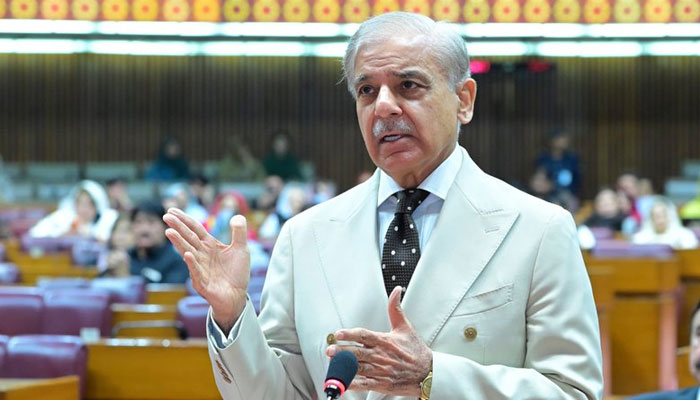
    ISLAMABAD: More than two years after Prime Minister Shehbaz Sharif’s coalition government took office, repeated predictions about its imminent collapse have yet to materialize, even as fresh deadlines continue to dominate Pakistan’s political debate. Since the Pakistan Muslim League-Nawaz (PML-N)-led coalition assumed power following the February 2024 general elections, political commentators, television analysts, and social media personalities have frequently forecast the government’s downfall. The expected timelines have varied—from 90 days to six months and beyond—but each prediction has ultimately passed without bringing the anticipated political change. Over time, different events have been presented as potential turning points, including IMF reviews, the federal budget, economic challenges, coalition disagreements, opposition campaigns, and speculation surrounding Pakistan’s political establishment. As one deadline expired, another quickly emerged, keeping the narrative alive despite the government’s continued survival. The latest claim suggests the government has been given six months to create new provinces. However, constitutional experts argue that such a proposal is highly unlikely within that timeframe. Under Pakistan’s Constitution, altering provincial boundaries requires a constitutional amendment approved by a two-thirds majority in both houses of Parliament as well as the consent of the relevant provincial assembly. Given the current political landscape and the absence of broad political consensus, analysts believe such a move faces significant constitutional and political hurdles. Political observers note that earlier forecasts were largely driven by concerns that the coalition lacked the strength to withstand inflation, IMF-linked reforms, and mounting economic pressures. Yet the government has managed to navigate successive economic and political challenges, prompting critics to repeatedly revise their predictions rather than abandon them. Speculation has also been fueled by statements from several political figures and commentators who have periodically hinted at major political developments or institutional changes. Although such claims have often generated widespread public discussion, none of the predicted political upheavals have occurred. In recent weeks, the Pakistan Peoples Party (PPP) has intensified its criticism of the federal government, particularly amid growing tensions with its coalition partner during the Azad Jammu and Kashmir election campaign. While the PPP has adopted a tougher political tone, analysts caution that electoral rhetoric and coalition disagreements do not necessarily signal the immediate collapse of the federal government. Rumors about possible alternatives to the current leadership have also surfaced repeatedly. Claims that a new political figure was being prepared to replace Prime Minister Shehbaz Sharif, along with speculation about the removal of senior cabinet members, have circulated over the past year. However, none of those predictions have been borne out by subsequent developments. Analysts say the recurring cycle of political forecasts reflects a broader trend in Pakistan’s political discourse, where speculation often outpaces reality. While acknowledging that every government faces political and economic challenges, they note that repeated predictions of the coalition’s imminent fall have consistently failed to match events on the ground, leaving each passing deadline followed by yet another countdown.

  • | | |

    Punjab University introduces AI Chatbot amid recor…

    LAHORE: Punjab University has witnessed a significant increase in applications for its undergraduate programs, receiving more than 25,000 additional confirmed applications compared to last year, reflecting growing student confidence in the institution’s academic standards. According to a university spokesperson, the university received 147,909 applications for undergraduate admissions this year, of which 113,182 were finalized. In comparison, during the first phase of admissions in 2025, the university received 120,395 applications, with 87,831 successfully completed. Vice Chancellor Dr. Muhammad Ali said the record rise in applications demonstrates that Punjab University continues to be the preferred choice for students seeking quality higher education. He noted that the increasing number of applicants highlights the trust students and their families place in the university’s academic reputation. Dr. Ali said the university remains committed to providing students with the best possible opportunities to develop academically while enhancing their research, extracurricular, and professional skills. He emphasized that the institution aims to produce capable, responsible, and ethical graduates who can make meaningful contributions to society, industry, and the country’s development. In a first for the university, Punjab University has also introduced an AI-powered chatbot to assist applicants during the admission and entry test process, making information and guidance more accessible while improving the overall admissions experience.

  • | |

    YDA Sindh pushes healthcare reform agenda

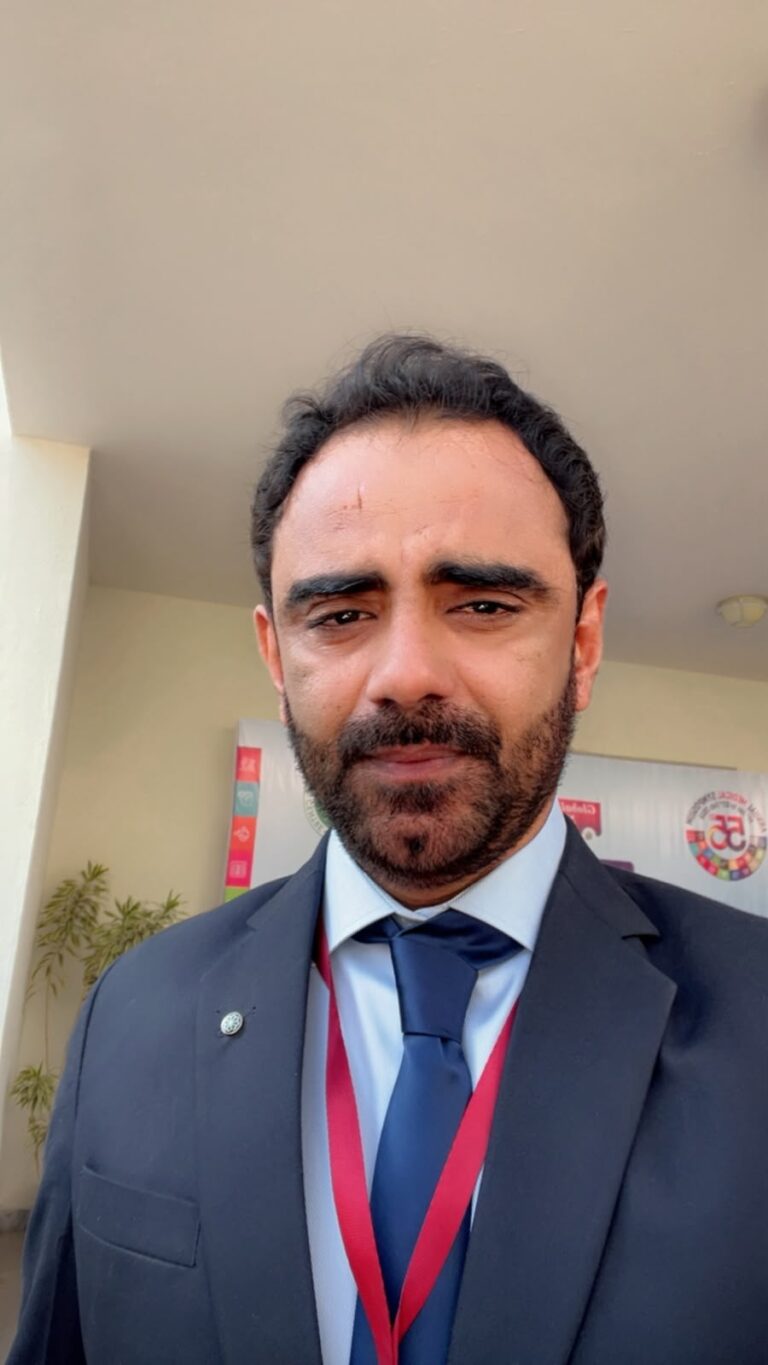
    KARACHI: The Young Doctors Association, YDA, is often seen by the public as violent, irresponsible doctors who take to the streets. But rarely does anyone see the other side of the coin. Behind the protests is a group of young doctors — the young blood of our healthcare system — fighting for their basic rights and for better patient care. Like whistleblowers in every society, they are rarely welcomed when they speak the truth. The Young Doctors Association is no exception. To the common man, YDA means protests, strikes, and chaos in hospitals. What often goes unnoticed is the reason behind it. These are young doctors, the backbone of emergency wards in Sindh, who are demanding dignity, security, and resources. In this context, Chairman of the Young Doctors Association Sindh Chapter, Dr. Farrukh Rauf paints a realistic picture of a system buckling under patient load, with too few specialists and even fewer resources to go around. From JPMC Member To Sindh Chairman YDA was formed in 2013 following an incident in which a female doctor was injured by relatives of a patient who had died. Since then, Dr. Farrukh Rauf has been associated with Young Doctors Association. He started as a member, was later elected General Secretary and then President of the JPMC unit, served as Senior Vice President of YDA Sindh, and is now serving as Chairman of the Sindh chapter. Dr. Farrukh Rauf, Chairman YDA Sindh, is a consultant orthopedic surgeon at Jinnah Postgraduate Medical Centre. He is currently the only surgeon at JPMC who performs orthopedic tumor and cancer surgeries — a super-specialty that only 4 to 5 surgeons practice across Karachi. Surgeons with his expertise in the private sector often draw salaries of over Rs. 20 lakh, but he continues to serve at a public institution out of commitment to suffering humanity. Dr. Rauf has been associated with JPMC for the last 17 years, where he also completed his post-graduation. He serves as General Secretary of the Pakistan Orthopedic Association and is an internationally certified trainer/instructor for HOPE – Hospital Preparedness for Emergencies — a certification he received from Nepal. There are only 4 to 5 such certified trainers in all of Sindh. “Condition Is Still Very Critical” Dr. Farrukh Rauf said that despite the Sindh government’s interest in the healthcare sector, the condition is still very critical, which is truly reflected in the overcrowded corridors of JPMC, Lyari and Civil Hospitals, where patients lie on floors and doctors work 36-hour shifts. On the issue of shortages at Civil, JPMC, and NICVD, Dr. Farrukh offers a mixed assessment. “There is no shortage of life-saving drugs,” he said. “Yes, ICU facility is very limited owing to patient burden. Seeing the overflow of patients, more equipment is needed.” He acknowledged the Sindh government’s efforts but stressed the scale of the problem. “Though the Minister of Health, Dr. Azra Pechuho, is addressing the concerns, however, there is a huge gap and lack of equipment for patients.” At tertiary hospitals like JPMC and Civil, where critical cases from across Sindh land every day, the mismatch between patient inflow and available ICU beds and machines remains a key pressure point for young doctors on duty. He traced the problem back to medical education itself. “The number of medical colleges has increased manifold in the last 10 years, but the standard of education has deteriorated. There is a dearth of quality doctors.” YDA’s Key Milestones According to Dr. Farrukh Rauf, Chairman YDA Sindh, the situation in government hospitals across Sindh, especially in Karachi, has improved only because of constant struggle. “Owing to YDA’s struggle and efforts, salaries of young and mid-career doctors were revised. Previously, they were lower than in all other provinces,” he said. He added that security was one of the biggest issues YDA flagged early on. “Doctors were facing serious security issues. There was no health risk allowance, which is being introduced now owing to the YDA movement.” The gains, he notes, came after years of protests at JPMC, Civil Hospital Karachi, and other tertiary centers where patient load far exceeds available staff and basic facilities. YDA Beyond Protests And Karachi The Young Doctors Association, once seen as a Karachi-centric pressure group, now claims a presence across the province. “I had established YDA units in all districts of Sindh including Umerkot, Thar, Ghotki. Now almost in twenty districts YDA is active for the rights of doctors and patients,” Dr. Farrukh said. In Karachi, the association is active in Civil, Lyari, JPMC and NICH. “We seek and welcome active participation from other government hospitals,” he added. The work has expanded beyond protests. YDA runs a welfare committee that coordinated flood relief last year, and an academic committee that offers career counseling, FCPS guidance, and surgical workshops. “We have constituted a welfare committee which offers coordinated help on disasters like floods last year. There is an academic committee which offers career counseling, how to give high-level exams, and workshops on surgical procedures,” he said. On training, Dr. Farrukh said YDA is pushing for reforms in the PGT system. “We are trying to get PGT seats equal in number to the number of graduates.” Violence And Security Gaps For Dr. Farrukh Rauf, the frustration in wards often boils over into violence against doctors. But he says the anger has a root cause. “Most of the people get provocative owing to the absence of ICU or urgent facility for their patient,” he said. “It is necessary to expand ICUs and facilities to handle the high influx of patients which overburdens doctors.” He was blunt about administrative failures too. “There are security lapses also on the part of the administration.” The Way Forward Dr. Farrukh argues the solution is not in Karachi’s tertiary hospitals alone, but in strengthening the entire pyramid. “We need a proper primary healthcare network across the province, like in developed countries,” he said. “Patients who can be treated at the UC or Tehsil level should not be coming to

  • | |

    VC calls for global support to Kashmir cause at UO…

    The University of Okara (UO) commemorated Kashmir Exploitation Day on Wednesday by organizing a seminar and a solidarity walk to reaffirm unwavering support for the people of Occupied Jammu and Kashmir (OJK) in their struggle for the right to self-determination. The event was organized by the Directorate of Student Affairs and attended by a large number of faculty members, administrative staff, and students. The Vice Chancellor of the University of Okara, Prof. Dr. Sajjad Mubin, presided over the ceremony. Addressing the participants, Prof. Mubin highlighted the decades-long suffering of the Kashmiri people and called upon the international community to play its role in ensuring the implementation of the United Nations resolutions on Kashmir. “Kashmir is the lifeline of Pakistan and an issue that remains central to peace and stability in South Asia. The resilient people of Kashmir have made unprecedented sacrifices for their legitimate right to self-determination, and the global community must not remain a silent spectator to their plight,” he said. The VC also paid tribute to Pakistan’s armed forces for safeguarding the country’s sovereignty and territorial integrity. “Our armed forces have rendered unparalleled sacrifices to make Pakistan impregnable. Their commitment to national security enables us to stand firmly with our Kashmiri brothers and sisters in their just struggle,” he added. Speaking on the occasion, the Registrar of the University of Okara, Jamil Asim, said that observing Kashmir Exploitation Day serves as a reminder of the collective responsibility to raise awareness about the humanitarian situation in Indian Illegally Occupied Jammu and Kashmir. “We stand in complete solidarity with the people of Kashmir and reaffirm our support for their internationally recognized right to determine their own future. Universities have an important role in educating the younger generation about issues of justice, peace, and human rights,” he remarked. The Pro VC, Prof. Dr. Muhammad Wajid, and the DSA, Dr. Shoaib Saleem, also addressed the gathering and emphasized the importance of maintaining national unity and continuing moral, diplomatic, and political support for the Kashmiri people. A one-minute silence was observed to honor the sacrifices of the people of Kashmir and to express solidarity with those who have lost their lives during the prolonged conflict. The seminar concluded with a solidarity walk in which the participants carried placards and banners expressing support for the Kashmiri cause and reaffirming Pakistan’s commitment to the right of self-determination for the people of Kashmir.

  • | |

    Lower Kohistan marks Youm-e-Istehsal Kashmir with …

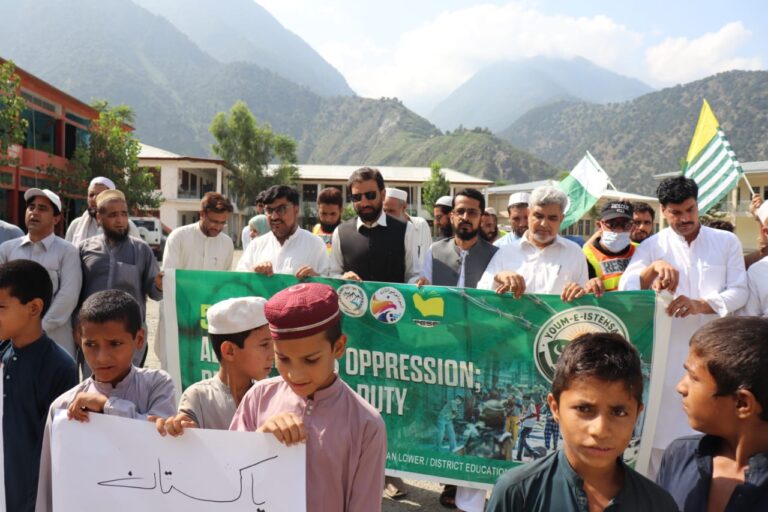
    LOWER KOHISTAN: The District Youth Office Lower Kohistan, in collaboration with the district administration and the education department, organised a ceremony at Government Model Girls High School (GMGHS), Pattan, on Wednesday to observe Youm-e-Istehsal Kashmir and reaffirm solidarity with the people of Indian Illegally Occupied Jammu and Kashmir (IIOJK). The event was attended by district administration officials, education department representatives, teachers, students, youth, and members of the local community. Participants paid tribute to the courage and resilience of the Kashmiri people and reiterated Pakistan’s continued support for their internationally recognised right to self-determination. Students presented speeches highlighting the historical significance of Youm-e-Istehsal Kashmir and staged thought-provoking tableau performances portraying the sacrifices, determination, and ongoing struggle of the people of Kashmir. The performances received appreciation from the audience for effectively conveying the message of peace, resilience, and national solidarity. Director Youth Affairs Khyber Pakhtunkhwa Abbas Khan Afridi said that the youth of the province had an important role in promoting awareness about the Kashmir issue and strengthening the values of unity, peace, and justice. He said the observance of Youm-e-Istehsal Kashmir reflected the nation’s unwavering commitment to standing with the people of Kashmir and supporting their legitimate right to self-determination. He urged young people to remain informed, responsible, and actively engaged in promoting truth, human rights, and national cohesion. The organisers said the event formed part of the Directorate of Youth Affairs Khyber Pakhtunkhwa’s continued efforts to engage young people in constructive civic activities while fostering patriotism, national unity, and awareness of issues of national importance.

  • | |

    Mufti Muneeb-ur-Rehman criticizes Pakistan’s…

      Renowned Islamic scholar Mufti Muneeb-ur-Rehman has strongly criticized Pakistan’s judicial and economic systems, stating that a justice system that fails to deliver justice even after forty years cannot be considered a true system of justice but rather a system of oppression. He made these remarks while addressing a public ceremony in Karachi, where he spoke about the country’s pressing legal and economic challenges. During his speech, Mufti Muneeb-ur-Rehman expressed concern over the prolonged delays in the judicial process. He argued that when people have to wait decades for justice, the very purpose of the legal system is defeated. According to him, justice delayed for such an extended period effectively becomes justice denied, leaving citizens frustrated and deprived of their fundamental rights. He emphasized that a judicial system should provide timely and fair decisions so that public confidence in the rule of law remains intact. The scholar also urged those in positions of authority to focus on resolving Pakistan’s domestic problems instead of concentrating solely on international issues. He remarked that while government leaders often discuss and engage with global affairs, the country’s internal challenges require immediate attention. He specifically called upon policymakers and those holding power to prioritize the welfare of the people by addressing the nation’s economic difficulties. One of the major issues highlighted by Mufti Muneeb-ur-Rehman was the problem of Independent Power Producers (IPPs). He appealed to the government to find a practical and sustainable solution to the IPP issue, which has been widely debated due to its impact on electricity prices and the country’s financial stability. According to him, resolving this matter would help reduce the economic burden on both the government and ordinary citizens. Speaking about the national economy, Mufti Muneeb-ur-Rehman painted a concerning picture of Pakistan’s financial condition. He stated that after distributing the constitutionally allocated shares to the provinces and making payments on interest obligations, the federal government is left with very limited financial resources. This situation, he suggested, reflects the severity of the country’s fiscal challenges and highlights the urgent need for comprehensive economic reforms. He stressed that policymakers should adopt measures that promote financial stability, reduce unnecessary expenditures, and improve revenue generation without placing excessive burdens on the public. The event also featured an address by Maulana Bashir Farooqi, who criticized the government’s approach toward eliminating the interest-based financial system. He argued that the authorities are not demonstrating sufficient seriousness in transitioning toward an Islamic banking framework. According to him, meaningful reforms require not only policy changes but also practical steps to prepare financial institutions for such a transformation. Maulana Bashir Farooqi announced that his organization is willing to provide training for approximately 100,000 employees working in conventional banks. He explained that this initiative aims to equip banking professionals with the knowledge and skills necessary to operate within an interest-free Islamic banking system if the government decides to pursue such reforms. He maintained that the availability of trained professionals would facilitate a smoother transition and strengthen the implementation of Islamic financial principles in the country’s banking sector. The speeches delivered at the Karachi ceremony underscored concerns regarding Pakistan’s judicial efficiency, economic management, and financial policies. Both religious leaders called on the government to prioritize domestic reforms, strengthen public institutions, address long-standing economic challenges, and work toward a system that better serves the interests of the people.

  • | |

    Sindh Cabinet approves toll tax for heavy commerci…

      The Sindh provincial cabinet, chaired by Chief Minister Syed Murad Ali Shah, has approved the imposition of a toll tax on heavy commercial vehicles using the Mehran Highway. The decision was made during a cabinet meeting as part of the provincial government’s broader strategy to establish a sustainable financial system for the maintenance and development of road infrastructure across Sindh. According to the cabinet’s decision, the toll tax will apply exclusively to heavy and commercial vehicles traveling on the 135-kilometer-long Mehran Highway. Private passenger vehicles will not be subject to the new toll under the current policy. Officials stated that commercial transport vehicles place greater pressure on road infrastructure due to their size and weight, making it appropriate for them to contribute to the highway’s maintenance through toll payments. During the meeting, cabinet members received a detailed briefing on the ongoing development of the Mehran Highway. Officials informed the cabinet that the project to expand the highway into a dual carriageway is currently underway at an estimated cost of Rs41 billion. The project is intended to improve road safety, increase transportation efficiency, reduce travel time, and accommodate the growing volume of traffic, particularly heavy commercial vehicles that regularly use the route for the movement of goods. The briefing also highlighted the expected financial benefits of the toll collection system. It was estimated that the toll tax would generate approximately Rs2.14 billion in annual gross revenue. After deducting operational and administrative expenses associated with collecting the toll, the government expects a net annual income of around Rs1.48 billion. These funds are intended to support the regular maintenance, repair, and future upgrading of the highway, ensuring that it remains in good condition for years to come. The cabinet further approved a schedule of toll charges based on different categories of vehicles. Under this system, toll rates will vary according to the type, size, and classification of each vehicle. Heavy trucks, trailers, buses, and other commercial transport vehicles will be charged according to predetermined rates. Officials explained that this category-based approach is designed to make the toll system fair and proportionate, with larger vehicles contributing more because of the greater wear and tear they cause to road infrastructure. In another significant administrative decision, the Sindh cabinet approved the restoration of the traditional name of the provincial department responsible for road construction and public infrastructure. The department, which had previously been renamed the Works and Services Department will once again be known as the Communication and Works Department. The government stated that the name change is intended to align Sindh’s administrative structure with that of the federal government and other provinces, where the department is commonly known by the same title. Speaking after the cabinet meeting, Chief Minister Syed Murad Ali Shah emphasized that the Sindh government is committed to introducing a self-sustaining financial model for the long-term maintenance of highways and road networks. He said that relying solely on government budget allocations is not sufficient to meet the increasing costs of maintaining modern transportation jobs infrastructure. According to him, the introduction of toll collection on major highways will provide a stable source of revenue that can be reinvested directly into road maintenance and improvement projects. The Chief Minister added that better roads are essential for economic growth, trade, and public safety. By ensuring a reliable funding mechanism for highway upkeep, the government aims to enhance transportation services, reduce infrastructure deterioration, and improve connectivity throughout the province. The approval of the toll tax and the continuation of the Mehran Highway expansion project represent important steps toward achieving these long-term development objectives while promoting a more efficient and financially sustainable road network in Sindh.