cuban president accuses
|

Cuban president accuses US of attempting to seize island amid economic pressure

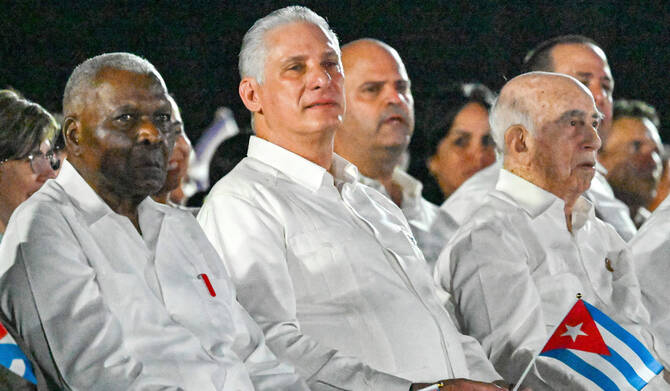
Cuban President Miguel Díaz-Canel has denounced Washington’s escalating pressure campaign against Cuba as a “genocidal policy”, alleging that the United States is seeking to “appropriate” the nation.

Speaking in Pinar del Río during the 73rd anniversary of the Moncada Barracks assault, Díaz-Canel stated that “Cuba is today waging a historic battle … against the walls of a genocidal policy whose objective is to suffocate an entire people in order to appropriate the country”.

He further described the US blockade as “a weapon of war” that “causes deaths” and accused Washington of attempting to trigger a “social explosion with the sole aim of installing governments aligned with its imperial interests”.

The sharp condemnation comes amid severe energy shortages, rolling blackouts, and financial distress brought on by expanded US sanctions, an oil blockade, and recent restrictions targeting Cuba’s overseas medical missions program.

While Washington maintains that Cuba poses a regional security threat, Díaz-Canel called for national unity and the implementation of recent economic reforms, reaffirming that Cuba’s political model remains non-negotiable.


Similar Posts

  • |

    Indian youth protest alleged exam irregularities in Jharkhand

    Thousands of students and unemployed young people marched toward the state legislature in India’s eastern Jharkhand state on Monday. The protesters were demanding action over alleged irregularities in civil services recruitment examinations. Police used water cannons to disperse the demonstrators as they moved toward the state assembly in the state capital, Ranchi. The protesters accused authorities of failing to ensure transparency in government recruitment exams. They also raised concerns over alleged question paper leaks. The demonstrations began on July 25 and have grown in size in recent days. Thousands of young people had earlier gathered at a stadium in Ranchi as the campaign gained momentum. The protesters are demanding major changes to the state’s examination system. They have also called for the cancellation of certain examinations and a federal investigation into the alleged irregularities. On Monday, demonstrators moved toward the legislature despite heavy security arrangements. Some protesters climbed over police barricades while carrying placards and Indian flags. They chanted slogans and called for action against those responsible for the alleged examination problems. The protests reflect growing frustration among students and unemployed youth in Jharkhand, one of India’s less economically developed states. The state government has held talks with representatives of the protesters. Officials have said that many of their demands have already been accepted. The government has also indicated that it is willing to continue discussions to address the remaining concerns. The demonstrations in Jharkhand come amid wider anger among Indian youth over alleged corruption in recruitment examinations. Similar protests were held in New Delhi in recent weeks. Those demonstrations focused on alleged irregularities and paper leaks involving national-level examinations. The protests eventually contributed to the resignation of India’s Education Minister Dharmendra Pradhan last month, following controversy surrounding alleged leaks in a national medical entrance examination. The growing demonstrations have highlighted concerns over unemployment and limited job opportunities for young people. Students and job seekers argue that examination irregularities can damage their career prospects after years of preparation. The protests also reflect broader concerns about transparency in public recruitment and the credibility of competitive examinations.

  • |

    Germany weighs tougher rules on sick leave

    BERLIN: Germany is considering tougher rules for workers taking sick leave, but researchers warn that stricter requirements may not address the deeper reasons behind the country’s high absenteeism. German employees took an average of around 22 sick days in 2024. The figure is among the highest reported internationally. The government’s proposed changes are part of a wider effort to improve productivity. Germany is dealing with an ageing population and years of weak economic growth. Under the proposed changes, employers could require workers to provide a medical certificate from the first day of absence. Telephone-based sick notes could also be scrapped. However, researchers say the debate should focus on why workers are becoming ill rather than simply making it harder to take sick leave. Healthcare, education and social services are among the sectors reporting the highest levels of absenteeism. Workers in these fields often face heavy workloads. They also deal with staff shortages, emotional pressure and difficult working conditions. BKK data shows that women working in healthcare and social work took an average of 27 sick days in 2024. Teachers recorded around 24 days. The figures were lower in several other sectors. Workers in finance averaged about 18 days, while employees in communications recorded around 16 days. Researchers say mental health is an important part of the problem. Mental health-related cases represent a relatively small share of total sickness cases. However, they often result in much longer absences. Data from AOK shows that sick-leave days linked to mental health problems have increased by 47% since 2014. Mental health conditions are now one of the biggest causes of prolonged absence after respiratory illnesses. Experts say burnout and exhaustion can develop without reaching the level of a diagnosed mental disorder. Healthcare workers and teachers are particularly exposed to these pressures. They carry significant responsibilities while dealing with emotional and sometimes physical challenges. Teachers have reported violence and aggressive behaviour in schools. A 2024 survey found that almost half had experienced psychological or physical violence among pupils at their schools. More than one-third also reported feeling emotionally exhausted several times a week. Nursing faces similar difficulties. Germany has a shortage of healthcare workers, but studies indicate that wage growth has remained limited in some hospitals and public institutions. Researchers describe the situation as an imbalance between effort and reward. Workers face high demands but may receive relatively low pay, limited career opportunities and insufficient recognition. Studies have linked such conditions to mental health problems and long-term sickness absence. However, experts caution against blaming Germany’s absenteeism solely on workplace stress. Sick leave is affected by many factors. These include the age of the workforce, working conditions, social attitudes and differences in healthcare systems. Germany also has generous sick-pay provisions. Workers can generally receive full wages during the initial period of illness. Several other European countries, however, report even higher levels of sick leave among full-time employees. Researchers have also found little evidence of widespread abuse of sick-note rules. A study by DAK and the IGES Institute found that the sharp rise in recorded absences in 2022 was largely linked to improved electronic reporting and unusually high levels of respiratory infections and Covid-19. Sick-leave levels have since stabilised. Researchers also found no clear evidence that telephone sick notes introduced during the pandemic caused the increase. The government’s proposal has faced opposition from labour representatives. The Verdi services union has described the plan as creating a culture of distrust towards employees. Doctors have also warned that tougher certification requirements could put additional pressure on already busy medical practices. The government has defended its approach. It says employers would have the option of requiring certificates from the first day of illness while allowing companies to retain existing arrangements. The debate is therefore moving beyond the question of whether German workers take too many sick days. Researchers argue that reducing absenteeism in the long term may require better staffing, improved working conditions, stronger career prospects and greater support for workers facing emotional pressure.

  • | |

    AJK poll body issues strict election warning

    The Azad Jammu and Kashmir (AJK) Election Commission has warned political parties and election candidates against violating the electoral code of conduct ahead of the upcoming general elections. The commission said strict action would be taken against anyone found using government resources or machinery for election campaigning. An AJK Election Commission spokesperson said federal and provincial ministers could participate in election campaigns but would not be allowed to use official protocol, vehicles or government resources for political purposes. The commission also prohibited the announcement of new development schemes, financial packages and public welfare projects during the election campaign. Any such announcement would be treated as a violation of the electoral code. The spokesperson warned that vehicles, equipment and relief supplies provided by the federal or provincial governments could be confiscated if they were used for electoral purposes. Legal action would also be taken against those responsible for violations. The warning came during a meeting in Mirpur chaired by AJK Chief Election Commissioner Ghulam Mustafa Mughal to review preparations for the upcoming polls. Senior officials from the Election Commission, district administrations and police departments attended the meeting. Officials briefed the chief election commissioner on security and administrative arrangements in Mirpur, Kotli and Bhimber. Mughal expressed satisfaction with the preparations and stressed that the elections must be conducted in a peaceful, free, fair and impartial manner. He said all relevant institutions would have to work together to ensure the smooth completion of the polling process and counter rumours surrounding the elections. The chief election commissioner said security agencies were responsible for protecting polling stations, voters and election staff. He added that security forces had begun arriving at polling stations ahead of the phased voting process. Mughal also rejected concerns that holding elections in phases could allow results from one division to influence voting in another. He said AJK had its own political and local dynamics and that the phased polling arrangement would not affect the integrity of the election process. The AJK Election Commission had earlier announced that polling would begin on July 27 and take place in three phases. Voting in Mirpur Division is scheduled for July 27. Muzaffarabad Division and 12 refugee constituencies will vote on August 2, while polling in Poonch Division will be held on August 10.

  • |

    Kristen Stewart’s video misused to spread false claims about Robert Pattinson reunion

    A clip of Kristen Stewart is making rounds online. It comes with a caption falsely claiming she wants to rekindle things with ex-boyfriend Robert Pattinson. The caption even suggests she would leave her spouse to make that happen. The video itself is from an old interview. In it, Stewart discusses something entirely unrelated to Pattinson. She talks about the value of public embarrassment. She says she considers herself lucky to have had moments of falling flat on her face publicly. A healthy dose of humiliation, she adds, keeps a person grounded. Despite this, the clip was recirculated with a fabricated caption. It claims Stewart broke down in tears, confessing that cheating on Pattinson remains her biggest regret. The caption alleges she still thinks about him. It even claims she’d divorce her husband for one more chance at being with him. The claim falls apart quickly. For starters, Stewart is not married to a husband at all. She came out publicly as gay in February 2017. In April 2025, she married screenwriter Dylan Meyer. The two have since spoken openly about their relationship. Recent interviews show Stewart in a happy place, both personally and professionally. She has collaborated with Meyer on creative projects, while continuing to focus on her work behind the camera as a director. Friends close to the couple have described their marriage as steady, with both partners actively supporting one another’s careers. The misleading video appears to be piggybacking on an old, real story from Stewart’s past. Back in 2012, she publicly apologized after being caught in an affair with Rupert Sanders. Sanders directed her in Snow White and the Huntsman. At the time, Stewart was still in a relationship with Pattinson. She addressed the situation publicly and expressed sincere regret. That moment became widely publicized and has followed her in tabloid coverage for years since. Nothing in her recent interviews or public statements supports the idea that she wants to reunite with Pattinson. There is also no indication of her considering ending her marriage over it. The viral claim appears to be a case of an old clip stripped of context, then paired with an entirely invented narrative to drive engagement. Such recycled clips are a common tactic online, where old footage is repurposed with misleading captions to spark outrage or attract clicks, often at the expense of the public figure’s actual words and intent.

  • | |

    Sohail Afridi warns rulers to ‘open their eyes?…

    PESHAWAR: Khyber Pakhtunkhwa Chief Minister Sohail Afridi has warned Pakistan’s rulers and decision-makers to “open their eyes” before September 27, saying the situation could become increasingly difficult to control if justice, constitutional supremacy and the rule of law are not restored. Speaking to reporters while attending a protest outside the Supreme Court, Afridi also expressed concern over reports about the health of Pakistan Tehreek-e-Insaf founder Imran Khan. The chief minister said serious concerns were emerging about Khan’s health and called for the matter to be treated with urgency. He said neither he nor Khan had attempted to use the former prime minister’s health for political relief. Afridi demanded that Khan’s family be allowed to be present and that his treatment be conducted under the supervision of his personal doctors. The KP chief minister referred to the treatment of former Prime Minister Nawaz Sharif during Imran Khan’s government. He said Khan had allowed Sharif to travel abroad for medical treatment on humanitarian grounds, despite questions that had been raised at the time regarding medical certificates. According to Afridi, Khan was now being deprived of basic human rights and justice, which he described as a matter of serious concern. Afridi also criticized what he described as politically motivated cases against Khan. He alleged that his political opponents had themselves faced corruption allegations and accused them of misusing national resources. These claims represent Afridi’s political position and were not independently established in his remarks. The KP chief minister also spoke about the judiciary, saying Pakistan’s justice system was facing a major test. He urged judges to stand up for justice and said that one judge taking a principled position could encourage others to do the same. Afridi argued that the public was looking toward the judiciary for relief and justice. He questioned where citizens would turn if judges failed to perform their constitutional responsibilities. The chief minister further warned about growing anger among young people, saying he could see what he described as a “revolution” in the eyes of the country’s youth. He cautioned that continued injustice and rising hatred could eventually create a situation in which even Imran Khan might struggle to persuade people to respond with affection or restraint. Afridi urged the rulers and decision-makers to understand the seriousness of the situation before September 27 and move the country toward justice, constitutional supremacy and the rule of law. He warned that failure to address these concerns could make the situation increasingly difficult to manage, adding another strong political message to the ongoing tensions surrounding Imran Khan and his supporters.

  • | |

    ‘Fear and censorship cannot silence the public?…

    Lawyer and social activist Jibran Nasir has criticised the country’s political and economic situation, alleging that pressure, censorship and coercive measures have failed to change public opinion about PTI founder Imran Khan. Speaking to anchorperson Ameer Abbas, Nasir said authorities had been unable to alter public sentiment toward Imran Khan despite what he described as years of pressure and attempts to control political discourse. He argued that if public opinion had genuinely changed, millions of people would not have voted for Imran Khan and his political movement in the February 8 general elections. Nasir questioned how the authorities could claim to change broader public thinking about the economy, Constitution and rule of law when they had not been able to change people’s views about a single political leader. He also criticised what he described as restrictions on political expression and media freedom. Nasir alleged that force, state pressure, censorship and arrests were being used to control political developments. According to Nasir, suppressing criticism does not resolve underlying public grievances. He said people who speak about alleged injustices are sometimes portrayed as creating unrest rather than being allowed to raise their concerns. He warned that continued reliance on pressure could increase frustration among citizens instead of resolving political differences. Nasir further claimed that people were now more aware of political developments and could not easily be persuaded through fear or restrictions. He said arrests, cases and harsh measures had not succeeded in changing the position of a significant section of the public. The lawyer maintained that political issues could not be permanently controlled through force. He called for greater space for political expression and a process through which public grievances could be addressed. His comments come amid continued political tensions between the government and PTI. The party has repeatedly raised concerns over the treatment of its leadership, legal cases against its members and restrictions on political activities.

Leave a Reply

Your email address will not be published. Required fields are marked *