second phase ajk
| | |

Second phase of AJK elections kicks off

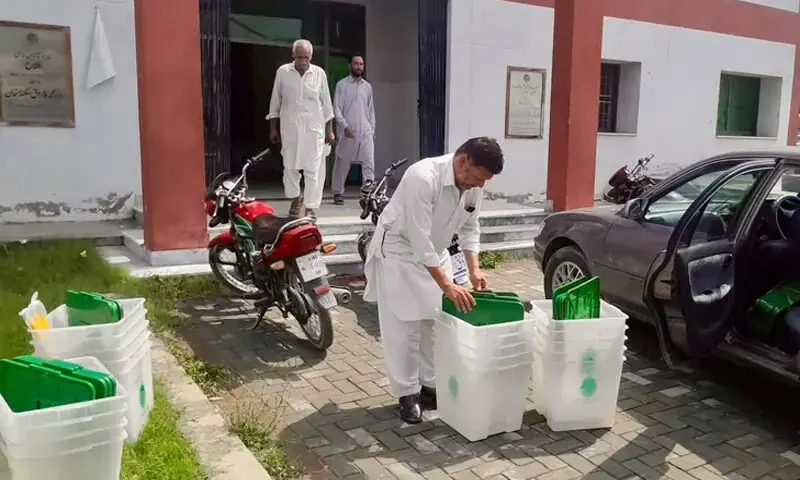
The second phase of the Azad Jammu and Kashmir (AJK) general elections began on Sunday with polling underway in Muzaffarabad division and all 12 refugee constituencies located across Pakistan.

Polling started at 8am and will continue until 5pm without any break. Election officials opened polling stations early in the morning, while voters began arriving to cast their ballots. Security personnel were deployed across sensitive areas to ensure a peaceful voting process.

This phase of the elections covers nine constituencies in Muzaffarabad division. These include five constituencies in Muzaffarabad district and two each in Neelum and Jhelum Valley districts. At the same time, polling is also being held for 12 refugee constituencies representing refugees from the Kashmir Valley and Jammu region.

More than 340 candidates are contesting the elections in this phase. According to election authorities, 207 candidates are in the race for the nine seats in Muzaffarabad division, while another 137 candidates are contesting the refugee constituencies.

More than 809,000 registered voters are eligible to vote in Muzaffarabad division. The refugee constituencies have over 438,000 registered voters. Thousands of election staff have been deployed to conduct polling and oversee the voting process.

Authorities have established 1,483 polling stations across Muzaffarabad division. Among them, 533 have been declared highly sensitive, 741 sensitive and 209 normal. In addition, 1,057 polling stations have been set up for refugee constituencies in different provinces.

The refugee constituencies are spread across Punjab, Khyber Pakhtunkhwa, Sindh, Balochistan and Islamabad. Polling arrangements have been completed in all regions where registered refugee voters are residing.

In Rawalpindi and Islamabad, around 27,000 registered voters are casting their votes for three refugee seats. Election officials have established 175 polling stations, while enhanced security has been provided at sensitive locations.

In Gujrat, Wazirabad and Mandi Bahauddin, nearly 2,000 police personnel have been deployed to maintain law and order during polling. More than 50,000 registered voters are expected to elect their representative in the constituency.

Polling is also taking place in Karachi and several districts of Sindh for two refugee constituencies. Election officials have made arrangements to facilitate voters across the province.

In Balochistan, polling stations have been established in Quetta, Pishin, Qila Saifullah, Hub, Loralai, Sibi, Mastung, Zhob and Barkhan for refugee voters. Similar arrangements have been made in Khyber Pakhtunkhwa, particularly in Swat and Mansehra, where polling is being held for another refugee seat.

The second phase of the elections is taking place amid heightened political tensions between the Pakistan Peoples Party (PPP) and the Pakistan Muslim League-Nawaz (PML-N). Relations between the coalition partners have remained strained since the first phase of polling, with both parties accusing each other of electoral irregularities in several constituencies.

Senior leaders from both sides held multiple meetings in recent days in an effort to resolve the dispute. However, the talks failed to produce an agreement before the second phase of voting. The PPP has demanded legal action and re-polling in selected constituencies, while the PML-N has rejected allegations of organized rigging and maintained that the election results reflect the will of the voters.

Meanwhile, Prime Minister Shehbaz Sharif met PML-N President Nawaz Sharif to review the political situation and discuss developments related to the AJK elections. Senior party leaders also attended the meeting and discussed the coalition’s future strategy.

Similar Posts

  • Two Former Convicts Confess To Murder Of Missing Russian Siblings In Chonburi

    SA KAEO / CHONBURI, Thailand — Two men wanted in connection with the disappearance of two Russian siblings in Chon Buri province have been arrested and have reportedly confessed to killing and burying the youths, marking a grim breakthrough in a case that has gripped the nation. Two Men Arrested In Pattaya As Search Intensifies […]

  • | |

    Tamil Nadu CM Vijay’s wife withdraws divorce petition

    CHENNAI, August 7, 2026: Sangeetha, the wife of popular actor and Tamil Nadu Chief Minister C Joseph Vijay, has withdrawn her divorce petition filed before a family court. According to Indian media reports, Sangeetha appeared before the court through video conference on Friday and informed the judge that she no longer wished to pursue the divorce case. Based on her statement, the court allowed her to withdraw the petition and disposed of the case. According to the court order, Sangeetha had formally submitted an application seeking withdrawal of the petition. The court recorded her statement, while Vijay’s lawyer raised no objection to the withdrawal. The court also allowed Sangeetha to file a fresh petition in the future if necessary. Sangeetha had filed for divorce in February 2026. In her petition, she had alleged that Vijay was involved in a relationship with a female actor. She claimed that she became aware of the alleged relationship in 2021. According to her, Vijay had promised to end the relationship but allegedly failed to do so. The petition further alleged that Vijay gradually excluded Sangeetha from his personal and professional life. She claimed that he continued to appear publicly and travel abroad with the actress. Sangeetha also stated that photographs of Vijay and the actress were repeatedly shared on social media. She alleged that Vijay neither denied nor objected to the circulation of the pictures. According to the petition, Sangeetha said the situation caused severe emotional distress and humiliation to her and their two children, Jason Sanjay and Divya Sasha. She also alleged that Vijay withdrew previously available facilities, imposed financial restrictions and limited her movements. Sangeetha further claimed that Vijay’s behaviour and social media controversies surrounding him in 2024 caused her significant emotional trauma. She maintained that their marriage had effectively ended and existed only on paper. She alleged that the relationship had subjected her to prolonged emotional distress, humiliation and suffering.

  • | |

    Bilawal Bhutto declares AJK elections a historic v…

    Pakistan Peoples Party (PPP) Chairman Bilawal Bhutto Zardari has called the upcoming Azad Jammu and Kashmir (AJK) elections a landmark moment for the region. Addressing a political rally in Mirpur, Bilawal said the elections were not an ordinary political contest. He described them as among the most important elections in AJK’s history. He said the decisions taken by voters would play a key role in determining the future direction of the region. Bilawal said previous PPP leaders, including Zulfikar Ali Bhutto, Benazir Bhutto and President Asif Ali Zardari, contributed to securing political and constitutional rights for the people of AJK. He said he wanted to continue that legacy by working for greater empowerment and opportunities for the people of the region. The PPP chairman said his party’s agenda focuses on strengthening self-governance, creating employment opportunities and giving people more control over decisions related to their future. While speaking about Gilgit-Baltistan, Bilawal recalled his party’s promises of greater political rights, employment opportunities and increased autonomy for the people there. He said the same vision was being presented for AJK, with a focus on improving governance and expanding public participation. Bilawal added that the people of Kashmir should have access to rights and opportunities similar to those available to citizens in other parts of the region. He urged voters to make decisions carefully, saying the upcoming elections would shape the political and social future of Azad Jammu and Kashmir. The AJK elections are expected to witness strong competition among political parties, with campaigns focusing on development, governance, employment and regional empowerment.

  • | |

    PSX closes higher despite volatile trading

      The Pakistan Stock Exchange (PSX) witnessed a positive trading session on Tuesday, with the benchmark KSE-100 Index gaining 1,116 points to close at 177,083 points. The index remained volatile throughout the trading session and moved within a range of 1,755 points. It reached an intraday high of 178,768 points before easing from its peak as investors adjusted their positions. Trading activity remained strong, with approximately 710 million shares changing hands in 25 billion rupees worth of transactions. The high trading volume reflected continued investor participation and active buying and selling across various sectors. Despite the rise in the benchmark index, the overall market capitalisation declined by around 120 billion rupees, falling to 19,833 billion rupees by the end of the session. The market’s performance reflected a mixed trend, as investors continued to monitor economic developments and market conditions while actively repositioning their portfolios.

  • | |

    Congo tightens grip on mineral exports with ban on…

    The Democratic Republic of Congo has prohibited exports of copper concentrate and cobalt concentrate, according to a government order reviewed on Thursday, marking the latest step in an ongoing push to force more mineral processing to happen inside the country and capture a larger share of the value generated by its mining sector. News of the ban sent benchmark three month copper prices on the London Metal Exchange up by as much as 1.8 percent to $14,369.50 a metric ton, the highest level since January 29, when the metal touched an all time peak of $14,527.50. Prices stood at $14,300 as of 0930 GMT following the report. Congo holds the position of the world’s largest cobalt supplier and ranks among the top sources of copper and other minerals critical to the global energy transition. The government is using that leverage to encourage the build out of domestic processing capacity rather than allowing raw or partially processed materials to leave the country. The order, dated June 29 and signed jointly by Mines Minister Louis Kabamba Watum, Foreign Trade Minister Julien Paluku Kahongya and Economy Minister Daniel Mukoko Samba, states plainly that exporting copper and cobalt concentrates is now prohibited. The prohibition took effect immediately, though the order allows for one year export waivers to be granted under unspecified strategic circumstances. The same order also establishes a new tax structure covering economically significant mining by products, with a three month transition period built in before the new rules take full effect. Officials said the export ban aims to push mining companies toward marketing or exporting higher value processed mineral products rather than raw concentrate. This marks the fourth time Congo has restricted concentrate exports, following similar bans imposed in 2013, 2019 and 2023, each of which included waivers in cases where domestic smelting capacity could not keep pace with output. The new order formally repeals the 2023 measure and its associated exemptions, replacing it with a broader regulatory framework governing both mineral exports and taxation of significant by products recovered during processing. Congo already exports the vast majority of its copper in refined form. During the first quarter of 2026, the country shipped 696,725 tons of copper cathodes, compared with just 53,926 tons of copper concentrate containing roughly 18,863 tons of copper metal, according to official figures. Over the same period, Congo exported 51,940 tons of cobalt hydroxide containing about 17,054 tons of cobalt metal. Christian Geraud Neema, a mining analyst with the nonprofit China Global South Project, said the new ban is unlikely to significantly disrupt most mining operators since the bulk of Congo’s copper and cobalt already undergoes domestic refining before export. He said the operation most likely to feel the impact is the Kamoa Kakula venture, jointly owned by Ivanhoe Mines, China’s Zijin Mining and the Congolese government, which still exports some volume of concentrate under existing exemptions. Neither Ivanhoe nor Zijin responded immediately to requests for comment, and the Congolese chamber of mines also did not respond. The newly introduced tax regime applies broadly across mineral categories, extending to trace and ultra trace minerals recovered during the refining process. These by products will be taxed using a 55 percent valuation coefficient, with royalties applied alongside those already charged on the primary mineral being extracted. The policy fits into a broader pattern across resource rich African nations seeking to move beyond raw material exports and capture more manufacturing and processing value domestically, a shift that has gained momentum as global demand for energy transition minerals like copper and cobalt continues to grow.

  • |

    At least 18 migrants die as thousands cross into Spain’s Ceuta enclave

    At least 18 migrants have died while attempting to reach the Spanish enclave of Ceuta after thousands crossed the border from Morocco in one of the largest migration surges seen in the region in recent years. The humanitarian situation continued to worsen on Friday as migrants kept arriving by sea while clashes broke out between Moroccan security forces and groups gathered near the border. Hundreds of migrants were seen on hills overlooking Ceuta as Moroccan authorities used tear gas to disperse crowds trying to move toward the Spanish territory. Despite the security operation, many people continued to swim across the narrow stretch of water separating Morocco from Ceuta. At the same time, large numbers of migrants who had already entered the enclave chose to return to Morocco on foot. Rachid Sbihi, who heads a local association representing Spain’s Civil Guard officers, described the situation as a serious humanitarian emergency. He said thousands of migrants, including many unaccompanied children, were sleeping in parks, streets and public spaces because reception centres had reached capacity. Emergency teams and military personnel sent to the area have mainly focused on treating the injured and providing humanitarian assistance as authorities struggle to manage the crisis. According to local officials, many of the 18 victims drowned while trying to swim into Ceuta. Others reportedly died during a stampede near the breakwater at Tarajal beach as large crowds rushed toward the border. Rescue teams continued searching the coastline while personal belongings including shoes, clothing and flotation devices were scattered along the shore. Many migrants said they left Morocco in search of better economic opportunities in Europe. One migrant, 33 year old Ahmed Karim, said unemployment and limited prospects at home had driven many people to take the dangerous journey. He explained that many dream of reaching Europe or the United States but see few legal opportunities to do so. Moroccan authorities strengthened security along the border by deploying additional police officers, using water cannons and firing warning shots into the air to stop more crossings. Human rights groups said migrants who were detained near the border were transported further into Morocco, although many others continued arriving in the area hoping to enter Ceuta. Morocco’s ambassador to Spain, Karima Benyaich, expressed hope that those who had crossed into Ceuta would voluntarily return. She said Morocco supports safe and orderly migration but did not comment on what had triggered the sudden movement of thousands of people toward the Spanish territory. Officials in Spain linked the surge to a recent Supreme Court ruling stating that migrants who reach Spain by swimming cannot automatically be returned, unlike those who cross by land or climb the border fence. The Spanish government argued that people smuggling networks had exploited public misunderstanding of the ruling to encourage migrants to attempt the dangerous crossing. Some Moroccan rights activists questioned that explanation, saying many migrants were unlikely to have known about the legal decision. Spanish Prime Minister Pedro Sánchez was expected to visit Ceuta after local authorities requested military assistance. His government’s migration policies have come under criticism from opposition politicians, who argue that recent measures granting residency and work permits to certain undocumented migrants have encouraged more people to head for Spain. The government rejected those claims, insisting the current crisis is unrelated to its immigration reforms. The unrest also spread to Melilla, Spain’s other North African enclave, where groups of migrants attempted to cross the border and clashed with Moroccan police. Rights groups reported injuries among security personnel and dozens of arrests. Spanish officials have not yet confirmed how many migrants entered Ceuta, although media reports estimate that between 30,000 and 49,000 people crossed into the territory within a single day, placing enormous pressure on a city with a population of about 84,000.

Leave a Reply

Your email address will not be published. Required fields are marked *