deadly quake rocks
|

Deadly 7.4 quake rocks Colombia, 111 killed

BOGOTA: A powerful 7.4-magnitude earthquake has killed at least 111 people and injured 87 others in western Colombia, leaving communities grappling with widespread destruction and fears that more victims remain trapped beneath collapsed buildings.

The earthquake struck on Monday, with its epicentre near San José del Palmar in the Chocó region. The powerful tremor was felt across a wide area and caused buildings to collapse in several locations.

Emergency crews have been working through piles of concrete, bricks and debris as they search for survivors. Authorities warned that the death toll could rise as rescue teams reach areas where communication and access remain difficult.

The disaster has caused severe damage in cities including Pereira, Cali and Manizales, while infrastructure and public services have also been affected. Rescue workers have been using heavy machinery alongside manual searches to reach people believed to be trapped under the rubble.

Colombian authorities have mobilised emergency resources and launched a large-scale response operation. The government has also declared a national disaster as officials assess the full extent of the destruction.

The earthquake has left families anxiously waiting for news of relatives who remain missing, while hospitals and emergency services continue treating the injured.

As rescue operations continue, authorities are urging residents to remain alert for possible aftershocks and avoid entering damaged structures.

With 111 lives already lost, the focus remains firmly on finding survivors and bringing urgent assistance to communities devastated by the powerful quake.

Similar Posts

  • | |

    Another Reko Diq-Sized mining project in Pakistan,…

    ISLAMABAD: The United States has expressed strong confidence in Pakistan’s mineral sector, with a senior US Embassy official revealing that the Trump administration is prepared to support another mega mining project on the scale of  to invest in Pakistan despite security concerns, viewing the country’s vast mineral wealth as strategically important for future global industries. During a background briefing with journalists on Wednesday, the embassy official said Washington considers Pakistan a key partner in the global race for critical minerals that are essential for advanced technologies, clean energy, artificial intelligence, semiconductors and defence manufacturing. According to the official, the US government is encouraging American investors to explore Pakistan’s untapped mineral resources, ranging from large-scale copper and gold projects to smaller mining ventures worth only a few million dollars. US Prepared to Finance Another Mega Project The official said the US administration is ready to support another project comparable to the multibillion-dollar Reko Diq development if geological surveys and feasibility studies demonstrate strong commercial potential. He added that financing support could be extended through US institutions such as the Export-Import (Exim) Bank and the Development Finance Corporation, both of which are playing a growing role in securing global supply chains for critical minerals. The official noted that American companies are not only interested in major mining investments but are also examining opportunities to acquire, develop and expand smaller mining operations across Pakistan. Reko Diq Progress Continues Despite Delays Discussing the Reko Diq copper and gold project, the official acknowledged that work is progressing, although at a slower pace than initially anticipated. He explained that project costs are currently being reassessed, after which developers will return to financiers to finalize the remaining funding package. The first phase of the Reko Diq project is estimated to cost around $7.7 billion, while the US Exim Bank has already offered $1.25 billion in financing. However, the overall financial structure remains under discussion. The project has experienced delays due to rising construction costs and security concerns in Balochistan, prompting project stakeholders to revise cost estimates more than once. Earlier this year, Barrick Gold, which owns a 50 percent stake in the project, also reviewed development timelines because of increasing costs and security-related challenges. Major Economic Benefits Expected The embassy official said Reko Diq has the potential to transform Pakistan’s economy once it becomes fully operational. According to the estimates shared during the briefing, the project could generate nearly $2 billion in annual free cash flow. Of this amount, around $500 million would go directly to the Government of Balochistan, while another $500 million would benefit Pakistan’s state-owned enterprises. The official further stated that Pakistan’s mining sector currently contributes roughly 3 percent to the country’s economy, while Reko Diq alone could increase national GDP by approximately 0.5 percentage points, highlighting its significance for long-term economic growth. Critical Minerals Becoming Strategic Priority The US official emphasized that critical minerals have become a top strategic priority for Washington as demand continues to rise across technology, renewable energy and defence sectors. Pakistan possesses commercially attractive reserves of copper, antimony, tungsten and several other minerals considered essential for future industries. He said American companies believe Pakistan has enormous untapped potential, particularly as global demand for copper is expected to rise sharply over the coming decades. The official added that US firms are actively seeking long-term supply agreements for minerals extracted from Pakistani mines, while some investors are interested in purchasing and developing smaller mining assets. Investment Opportunities Across Pakistan Besides Balochistan, American investors are also exploring mineral opportunities in Khyber-Pakhtunkhwa, particularly for copper deposits, while rare earth mineral prospects in Gilgit-Baltistan have also attracted attention. The official said the United States is searching globally for around 60 critical minerals needed for emerging technologies, many of which are found in Pakistan. He noted that several companies have already begun exploration and extraction activities in different regions of the country. Security Remains the Biggest Challenge Despite strong investment interest, the official acknowledged that security remains one of the most significant obstacles facing mining projects in Pakistan. He said US companies fully understand the risks associated with operating in regions such as Balochistan and Khyber-Pakhtunkhwa but remain willing to invest if appropriate security arrangements are provided. The official stressed that the Pakistani government should continue strengthening security measures and facilitating investors to ensure long-term success of mining projects. He added that American companies are encouraged to partner with local firms, which possess valuable experience in navigating operational and security challenges in remote mining areas. US Calls for Transparent Investment Environment The embassy official also urged Pakistan to maintain a transparent, predictable and competitive investment climate to attract greater foreign investment into the mineral sector. He noted that Pakistan’s participation in the US Critical Minerals Initiative earlier this year reflects growing cooperation between the two countries in securing future mineral supply chains. According to the official, if exploration and investment continue at the current pace, Pakistan’s mining industry could emerge as one of the country’s strongest economic sectors over the next 10 to 20 years, creating employment, increasing exports and significantly boosting national revenues.

  • | | | |

    Iran targets US bases across Gulf

    The conflict between Iran and the United States intensified on Wednesday after Iran claimed it carried out a new wave of drone attacks on US military bases in Jordan, Bahrain and Kuwait. The latest attacks marked another major escalation in the ongoing regional conflict that has continued for months. Iranian military officials said attack drones targeted Al-Azraq Air Base in Jordan, Sheikh Isa Air Base in Bahrain and Camp Doha in Kuwait. According to Iranian authorities, the strikes focused on military warehouses, logistics facilities, aircraft maintenance centers and ammunition depots used by US forces. Jordan confirmed that its air defense systems intercepted several missiles and drones after they entered the country’s airspace. Officials said four missiles were destroyed while two landed in remote desert areas. No casualties or property damage were reported. Air raid sirens also sounded in Jordan’s southern port city of Aqaba. Videos circulating on social media showed smoke rising over the area. Authorities urged residents to remain alert but confirmed that the situation was under control. Bahrain’s military said its air defense systems successfully intercepted several incoming aerial threats after warning sirens were activated across the country. Officials did not report any casualties or major damage. Iran also claimed it launched a large number of drones against Camp Doha in Kuwait. Iranian media said the attack targeted US ammunition storage sites and military logistics equipment. Kuwait had not issued an official response at the time of reporting. The latest attacks came only a day after Iran launched missile strikes against US-linked military facilities in Jordan and Bahrain, increasing fears that the conflict could spread further across the Gulf region. Meanwhile, US Secretary of State Marco Rubio said Washington remains prepared to negotiate with Iran if Tehran shows genuine willingness to engage in serious talks. Speaking during a regional meeting in Manila, Rubio said the United States continues to support diplomacy but believes Iran is not currently committed to meaningful negotiations. He warned that Iran must not be allowed to threaten international shipping through the Strait of Hormuz. Rubio said any attempt to control one of the world’s busiest shipping routes would create a dangerous precedent and threaten global trade. The security situation has already affected international energy markets. Global oil prices climbed again as fears grew over possible disruptions to oil supplies from the Gulf. Brent crude traded above $91 per barrel, while fuel prices also increased in international markets. The crisis worsened after Yemen’s Houthi movement announced a naval blockade targeting Saudi Arabia. The move forced several oil tankers carrying Saudi crude to change their routes in the Red Sea because of growing security concerns. French shipping company CMA CGM announced an emergency surcharge on cargo shipments starting August 1. The company said the worsening security situation around the Strait of Hormuz has significantly increased fuel and transportation costs. At the same time, US forces carried out another round of airstrikes inside Iran. American military officials said the strikes targeted command centers, drone storage facilities, aircraft hangars, logistics sites and maritime capabilities. The operation marked the 11th consecutive night of US military attacks. Iranian media reported explosions in Tehran, Bushehr, Chabahar, Konarak and parts of Ilam province. Officials said a missile strike damaged an electrical substation supplying power to the Bushehr nuclear power plant. Electricity was restored after several hours, and authorities reported no casualties. US President Donald Trump said 18 American service members have been killed since the conflict began, including four who died in recent Iranian attacks on US military bases in Jordan and Iraq. He said the United States would continue protecting its forces and allies in the region. Iran also claimed it targeted infrastructure linked to a major American technology company operating in Bahrain. However, the claim has not been independently verified. The conflict began in late February following US and Israeli strikes on Iran. Since then, military operations have expanded across several countries in the Middle East. Despite ongoing mediation efforts by regional countries, including Pakistan, no ceasefire agreement has been reached

  • | |

    Iran cannot be subdued, people are forcing enemies…

    TEHRAN: Iranian Parliament Speaker Mohammad Baqer Qalibaf has said that Iran cannot be subdued, claiming that the country’s people are standing united against external pressure and forcing their opponents to retreat. Qalibaf made the remarks while congratulating General Mohsen Rezaei on his appointment to the Supreme National Security Council. He described Rezaei’s inclusion in the council as evidence of the confidence placed in him by Iran’s Supreme Leader. According to Qalibaf, Iran is currently passing through one of the most sensitive periods in its history. He said recent developments had demonstrated to the international community that attempts to bring Iran under pressure would not succeed. The Iranian parliament speaker said national unity remained strong across the country, with the public, military and diplomatic institutions standing together under the leadership of Supreme Leader Mojtaba Khamenei. Qalibaf further claimed that the Iranian people were demonstrating resilience in the face of their adversaries and were now putting pressure on the opposing side to back down. His comments come amid heightened tensions surrounding Iran and the United States, with disagreements over regional security, military threats and the strategic Strait of Hormuz continuing to dominate international attention.

  • |

    Pakistan seal seven-wicket win over County Select XI

    BECKENHAM: Pakistan produced a strong second-half turnaround on Saturday, defeating the Professional County Club Select XI by seven wickets in their three-day practice match at the Kent County Cricket Ground. Chasing 262 runs for victory on the final day, Pakistan made the target look comfortable, reaching 265-3 in just 57.1 overs. The result provided an encouraging boost for the visitors ahead of their three-match Test series against England. The star of Pakistan’s successful chase was Saud Shakeel, who delivered a composed unbeaten century. Coming in at No. 3 after opener Azan Awais was dismissed for just one, Saud took control of the innings and finished with 100 not out from 147 balls, hitting 10 fours and three sixes. He found an ideal partner in Imam-ul-Haq, with the experienced opener producing an attacking 80 from 88 deliveries. Imam struck 13 boundaries and combined with Saud for a crucial 127-run partnership, effectively taking the game away from the hosts. Mohammad Rizwan added a useful 33, while Awais Zafar remained unbeaten on 30 to complete the chase. Earlier, the PCC Select XI resumed their second innings at 128-3, holding a 195-run lead. Pakistan’s bowlers, however, quickly turned the pressure into wickets. The hosts managed only 66 additional runs before being dismissed for 194. Falconer top-scored with 56, while Saif Zaib and Manny Lumsden contributed 24 each. Spinner Ali Usman was Pakistan’s standout bowler, finishing with an impressive five wickets for 42 runs. Ubaid Shah claimed two wickets for just nine runs, while Salman Ali Agha, Sajid Khan and Mohammad Ali took one apiece. The comeback victory comes at an important moment for Pakistan. With their first Test against England scheduled to begin in Leeds on August 19, the performances of Saud, Imam and the bowling attack offer Pakistan plenty of confidence. After struggling earlier in the match, Pakistan finished strongly — exactly the kind of response they will hope to carry into the Test series. Brief Scores Pakistan beat PCC Select XI by seven wickets PCC Select XI: 305 (S. Zaib 65, M. Fisher 62*, C. Falconer 59, T. Haines 51; M. Ali 3-23, M. Abbas 3-37) & 194 (C. Falconer 56, J. Rew 40; A. Usman 5-42, U. Shah 2-9) Pakistan: 238 (A. Shafique 61; S. Bashir 4-76) & 264-3 (S. Shakeel 100*, I. ul-Haq 80 retired not out) Result: Pakistan won by 7 wickets.

  • | |

    West Indies take 29-run lead after bowling out Pak…

    Pakistan were dismissed for 282 runs in their first innings on the third day of the opening Test against the West Indies, leaving the hosts with a 29-run first-innings lead. Despite a determined century from captain Shan Masood, Pakistan failed to build on a solid overnight position as the West Indies bowling attack wrapped up the innings effectively. Resuming the day at 199 for 3, Pakistan appeared well placed to post a competitive total. However, the batting lineup struggled against disciplined bowling, losing wickets at regular intervals. Apart from Shan Masood and Imam-ul-Haq, none of the remaining batters managed to make a significant contribution. Shan Masood led the innings with a composed 109 runs, anchoring Pakistan’s batting effort with patience and confidence. His century proved to be the standout performance for the visitors and demonstrated his ability to perform under pressure in challenging conditions. Imam-ul-Haq also made an important contribution, scoring 63 runs and sharing a valuable partnership with the captain that gave Pakistan a strong foundation. After the dismissal of the top-order pair, Pakistan’s middle and lower order failed to capitalize on the platform. Regular breakthroughs from the West Indies bowlers prevented the visitors from reaching a larger total, and the innings came to an end after 80.1 overs. The West Indies bowling attack was led by Justin Greaves, who delivered an outstanding spell to claim five wickets. His consistent line and length troubled Pakistan’s batters throughout the innings and played a key role in restricting the total. Veteran fast bowler Kemar Roach and pace bowler Shamar Joseph picked up two wickets each, while Jayden Seales added one wicket to complete the innings. With a 29-run lead, the West Indies gained a slight advantage heading into their second innings. However, the match remains evenly balanced, and Pakistan’s bowlers will now aim to make early breakthroughs to keep the contest alive. As the Test progresses, both teams will look to capitalize on every opportunity in what promises to be an intriguing battle. Pakistan will be encouraged by Shan Masood’s excellent century but will also recognize the need for stronger contributions from the rest of the batting lineup if they hope to secure victory in the series opener.

  • | |

    Hurricane Lala triggers flash flooding across Hawa…

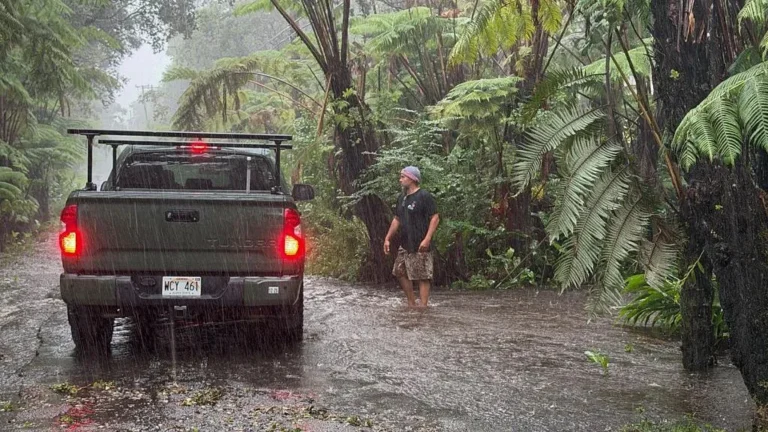
    Hawaii is grappling with widespread flash flooding after Hurricane Lala skirted the Big Island as a category one storm, bringing powerful winds and heavy rain that officials say may have swept some homes off their foundations. Tens of thousands of properties across the islands have lost power, and officials have urged residents to brace for life threatening conditions, including mudslides, as the storm continues tracking westward south of Hawaii. Lala strengthened into a hurricane on Saturday, with wind speeds reaching a peak of 91 miles per hour, or 147 kilometers per hour, and forecasters say the storm could dump as much as 35 inches, or 89 centimeters, of rain in some areas. Hawaii Governor Josh Green said Saturday that one person died in a weather related car accident on Big Island, where numerous roads have been affected by the storm. Hawaii County officials said that as of 1:00 a.m. local time Sunday, two areas on Big Island had experienced flash flooding, warning that several occupied homes may have been swept off their foundations. Big Island Mayor Kimo Alameda said the county’s civil defense agency launched a search and rescue operation to locate residents whose homes may have been carried away by floodwaters. He described the rescue effort as especially difficult given the combination of rushing water, debris, boulders blocking roads and darkness. Footage released by Hawaii’s Department of Transportation shows roads submerged under fast moving water and blocked by fallen trees. Green urged residents to prepare for what he called an incredible amount of water and pleaded with people to stay off the roads during the storm, delivering the warning in a video posted to social media. The governor said 190 flights have been postponed as a result of the storm. At Ellison Onizuka Kona International Airport, Big Island’s largest airport, 40 percent of flights were grounded Saturday according to flight tracking service FlightAware, while roughly 80 percent of flights were canceled at Hilo International, the island’s other major airport. The National Weather Service issued its most severe warnings for areas in Big Island’s southeast, the region that came closest to the hurricane’s center, saying major rainfall flooding could prompt widespread evacuations and rescues as rivers and tributaries rapidly overflow their banks in multiple locations. Nearly 115,000 customers had lost power across Hawaii as of Sunday morning local time, according to the tracking service PowerOutage. Green said three hospitals also lost electricity but continued operating on backup generators. In Maui, some residents have been without water service since Saturday afternoon. A county statement said crews who responded to assess the situation were forced to turn back due to worsening weather and multiple downed trees, adding that repair work would resume once conditions allow safe access. Meteorologist Jennifer Myers, who lives in Hilo on Big Island’s eastern coast, said landslides have already cut off some roads while falling trees have torn down power lines in the area. Describing the view from her apartment overlooking the Wailuku River where it meets Hilo Bay, she said the water level had risen dramatically and that the bay, normally blue, had turned a deep red from sediment and runoff pouring into it. The hurricane ultimately did not make landfall on Big Island as some forecasts had suggested was possible, instead passing within 30 miles, or 48 kilometers, of the island’s South Point. Tropical storm warnings remain in effect across all eight of Hawaii’s major islands, including Big Island, Maui, Molokai, Kahoolawe, Oahu, Lanai, Kauai and Niihau. Big Island had previously been under a full hurricane warning. The National Hurricane Center said damaging winds and heavy rain will continue across Big Island overnight before spreading westward to the smaller islands on Sunday. Officials had repeatedly urged residents to prepare ahead of the storm’s arrival. Social media posts from local community groups showed residents filling sandbags to protect their homes and asking about store hours in the early hours of Saturday. Hawaii County’s Civil Defense Agency said public shelters remain open across every district on Big Island.

Leave a Reply

Your email address will not be published. Required fields are marked *