destructive earthquake hits
|

Destructive earthquake hits Western Colombia

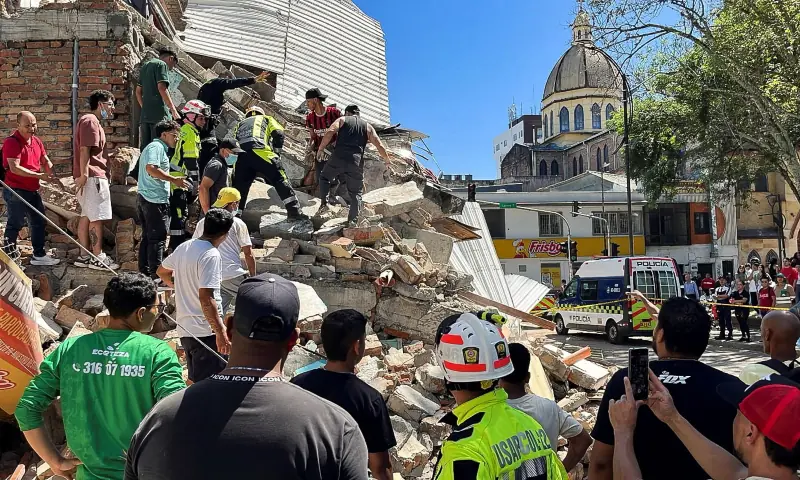
An omnipotent earthquake hit western Colombia in the early morning hours, leaving destruction, multiple fatalities and dozens of collapsed structures across several municipalities. Emergency responders and local residents are rushing  to pull survivors from beneath piles of heavy rubble.

In the heart of the country’s coffee-growing region, Pereira Mayor Mauricio Salazar confirmed that 18 residents lost their lives due to the tragic event. Salazar stated,

“The situation is critical.”

He addressed Caracol Radio regarding the growing casualty toll and structural collapse.

Reports from neighboring municipalities highlighted the widespread reach of the disaster. In nearby Manizales, Mayor Jorge Eduardo Rojas reported three fatalities resulting from the shaking. Along Colombia’s Pacific coastline, the key port city of Buenaventura also suffered casualties. Mayor Ligia del Carmen Cordoba confirmed one death after a building caved in, trapping several individuals inside.

Cali, one of the nation’s largest urban centers, was among the hardest hit. The municipal authorities have yet to confirm official death tolls there, though. Mayor Alejandro Eder informed Caracol Radio that at least 30 buildings had completely collapsed. The collapse happened even with rescue crews actively operating at 10 high-priority sites across the city.

Speaking earlier to Blu Radio, Mayor Eder detailed the urgency of the ongoing efforts:

At this point, two people have already been rescued alive, one elderly woman and one young girl. There are more people trapped, he explained, emphasizing the scale of the emergency. He noted further, We have at least 12 critical points and 25 collapsed structures that we are responding to.

In order to handle the overwhelming strain on local resources, the city requested emergency disaster support from authorities in Bogota and Medellin.

Cali resident Juan Carlos Osorio described the immediate aftermath while sifting through wreckage:

The building completely collapsed. It sounded like a bomb. It was horrible, Osorio told Caracol Television. He added, All of us neighbors are working together, forming human chains. We need heavy equipment. There are many people trapped.

The immense intensity of the tremor shook neighboring nations including Ecuador, Panama, and Venezuela. However, Colombian officials confirmed that there was no threat of a tsunami. In the capital city of Bogota, the morning quake caused widespread alarm. They’re prompting frightened residents to run into the streets in their pajamas as emergency sirens echoed.

Bogota Mayor Carlos Galan reassured the public via Blu Radio that damage within the capital appeared relatively minor, consisting primarily of cracked building facades. Elsewhere, news footage revealed severe structural damage, including multi-story buildings with their outer walls completely sheared off.

In Choco province, the governor posted on X that multiple injuries and severe structural damage occurred in the departmental capital of Quibdo. News outlets broadcast images of destruction across cities in the coffee-growing region, known locally as Eje Cafetero.

66-year-old Eje Cafetero resident Martha Estrada told reporters, “There is no electricity or cell phone coverage. It was strong, really strong. Things fell in my house,” recounting the blackout and sudden movement inside her home.

Cali’s mayor, Alejandro Eder, re-emphasized that the city was managing major damage and noted that officials were deploying drones to assess structural integrity across neighborhoods. He reiterated that at least 20 buildings had collapsed with individuals trapped inside, driving the urgent appeal for specialized rescue reinforcement from Bogota and Medellin.

Residents in Bogota also recalled the intensity of the event, with 29-year-old content creator Valeria Polo remarking,

The quake was very, very strong.

To safeguard air travel, Colombia’s civil aeronautics agency announced on X that six regional airports temporarily suspended operations. The affected terminals serve Pereira, Manizales, Quibdo, Armenia, Cartago, and Buenaventura, allowing inspection crews to verify runway and building safety.

Geographically, Colombia experiences frequent seismic activity because it is situated across three ranges of the Andean mountains. Historically, however, landslides have proven to be the country’s most lethal natural hazards, such as the 1985 Armero disaster that claimed approximately 25,000 lives. Major earthquakes have also left dark marks on the region; in 1999, a 6.2 magnitude earthquake struck the coffee region, resulting in over 1,000 fatalities in Armenia and Pereira.

De La Espriella, a right-wing politician who has not previously held elected office, released a video filmed aboard a flight to Bogota following the disaster. He announced that he was suspending his scheduled activities to personally oversee emergency coordination efforts from the national capital.


This natural disaster follows severe regional seismic activity earlier in the summer, when twin earthquakes measuring 7.2 and 7.5 magnitude struck Venezuela on June 24, leaving over 6,000 dead and causing catastrophic damage along the coast near Caracas.

Similar Posts

  • | |

    Seven law enforcement personnel martyred during re…

    Azad Jammu and Kashmir (AJK) Information Secretary Muhammad Rashid Hanif has said that seven law enforcement personnel, including police and Rangers officials, were martyred during the recent unrest in the region. In a televised address on Monday, Hanif said the casualties occurred during clashes linked to ongoing protests by the now-proscribed Joint Awami Action Committee (JAAC). The committee has been demonstrating in the region for several weeks over its demand to abolish 12 seats in the AJK Legislative Assembly reserved for refugees from Indian-held Kashmir. The unrest intensified after clashes between protesters and security personnel in Rawalakot and Mirpur last week. The incidents reportedly resulted in multiple casualties and increased tensions across the region. Hanif stated that weapons allegedly recovered from JAAC members were presented during a previous press conference by a police official on July 27. He claimed that seven law enforcement personnel were killed using similar weapons, while 45 personnel suffered serious injuries and several others sustained minor injuries. The AJK information secretary also alleged that police and Rangers vehicles were damaged and burned during the unrest. He claimed that the incidents indicated the presence of armed elements within the banned organization and accused them of attempting to challenge the state’s authority and disrupt peace. Responding to allegations made by JAAC regarding events in Rawalakot and surrounding areas between July 27 and July 31, Hanif rejected the claims and described them as part of a misinformation campaign. He said the security institutions of AJK had shown restraint and professionalism while handling the law and order situation. Hanif denied allegations of unprovoked firing by security forces and rejected claims that bodies were being withheld. He stated that the government currently had no bodies in its custody and accused the organization of spreading misleading information through social media. He further alleged that JAAC activists had been involved in blocking and damaging vehicles carrying essential supplies and food items. The information secretary also highlighted previous incidents involving casualties among law enforcement personnel, claiming that one police official was martyred in 2024 and three others in October 2025 during unrest-related incidents. Meanwhile, the AJK government criticized international media reports regarding the clashes, describing some coverage as biased and incomplete. Officials said reports should have included the government’s position and verified information before publication. The Ministry of Information and Broadcasting also criticized coverage of the AJK elections by some media outlets, alleging selective reporting from specific polling locations. The situation in AJK remains tense as authorities continue security measures while political and public disputes over electoral representation and governance issues continue. The government and protest groups have presented conflicting accounts of the events, and further developments are expected as investigations proceed.

  • | |

    Interior Minister Talal Chaudhry says government&#…

      ISLAMABAD: Minister of State for Interior Talal Chaudhry has asserted that the ruling coalition will complete its full five-year constitutional term, even as he acknowledged that political speculation intensifies after the two-and-a-half-year mark. The minister addressed a range of pressing political questions, from the possibility of an opposition alliance to the stability of the current government. Chaudhry began by offering a pragmatic observation about Pakistan’s political rhythm. “After two and a half years, the countdown for any government effectively begins,” he said. However, he quickly dispelled any notion that this countdown implies an early end for the present administration. “The five years will be completed in full,” he emphasized, “and the coalition will continue to function in exactly the same manner as it does today.” He expressed complete confidence that the ruling alliance, led by the Pakistan Muslim League-Nawaz (PML-N), remains cohesive and resilient against any internal or external pressures. When questioned about the Pakistan Peoples Party (PPP) – a key coalition partner – Chaudhry delivered a nuanced response. He acknowledged that the PPP possesses a certain political awareness, or “ehsas”, regarding its current position within the alliance. He went further to state that this awareness will only deepen with time. “The PPP has this feeling today, and more feeling will also come,” he remarked, suggesting that as the government progresses, all partners will increasingly recognize the mutual benefits of remaining united. He framed this evolving consciousness not as a threat, but as a natural part of political maturity within a multi-party democratic setup. One of the most emphatic parts of Chaudhry’s interview was his categorical dismissal of any potential alliance between the PPP and the Pakistan Tehreek-e-Insaf (PTI). He stated, “There is no possibility of an alliance between the PPP and the PTI,” calling such speculation unfounded and politically motivated. He further reassured the public and investors alike that the government faces no existential threat from the opposition. According to the minister, the opposition remains fragmented and lacks the numerical strength or public mandate to destabilize the elected administration. Chaudhry then elevated his argument beyond mere political expediency, framing the continuity of the coalition as a national imperative. “It is in the best interest of Pakistan and the entire political system that the current alliance continues to function as it is,” he declared. He warned that any premature disruption of the government would create a dangerous power vacuum at a time when the country is grappling with economic stabilization, security challenges, and the need for institutional reforms. He called on all political stakeholders to prioritize national unity over partisan scores. The minister also took the opportunity to defend the government’s performance on key issues, including inflation management, anti-terrorism operations, and diplomatic engagements. While conceding that difficulties persist, he argued that the government has set the foundation for long-term recovery and that the opposition’s role should be constructive criticism rather than obstructionism. He urged political parties to rise above personal rivalries and focus on the greater good of the nation. In his concluding remarks, Talal Chaudhry made it clear that while the government is not afraid of early elections, it is also not shirking its responsibilities. “We were elected for five years, and we will serve for five years,” he said firmly. He expressed confidence that the public will ultimately judge this administration on its tangible achievements, not on opposition rhetoric. He dismissed the “two-and-a-half-year countdown” as a political cliché rather than a prophecy, reiterating that the coalition will not only survive but thrive until the very last day of its term. Overall, the interview projected an image of a self-assured government determined to see through its tenure, while subtly reminding its coalition partners – especially the PPP – that their long-term political futures are best secured within the existing fold. Whether this confidence will translate into political reality remains to be seen, but for now, Chaudhry’s message was unambiguous: the alliance is stable, the system is strong, and the government is here to stay.

  • | |

    Sindh records 76% drop in terrorism incidents in 2…

    KARACHI: Sindh Chief Minister Murad Ali Shah chaired a high-level meeting on the Counter Terrorism Department (CTD), where officials reviewed the province’s security situation, operational performance, investigations, infrastructure and future requirements. Sindh Home Minister Zia-ul-Hassan Lanjar, Chief Secretary Asif Hyder Shah, Home Secretary, Inspector General of Police Javed Alam Odho, Additional IG CTD Zulfiqar Larik and other senior officials attended the meeting. The meeting was informed that banned militant and insurgent organisations continue to pose a security challenge to Sindh. However, officials said terrorist incidents in the province had declined significantly during 2026. According to Home Minister Zia-ul-Hassan Lanjar, Sindh reported 37 terrorism incidents in 2025. The number fell to nine in 2026, representing a decline of around 76 per cent. The Sindh police chief told the meeting that seven of the nine terrorism cases reported this year had been traced and their investigations completed. Officials said the CTD conducted 918 intelligence-based operations across the province during 2026. These operations resulted in the arrest of 87 suspected terrorists, while four militants were killed in separate encounters. The briefing said the CTD had dismantled several militant networks allegedly involved in attacks on police personnel and sensitive installations. During a follow-up operation in Karachi, the department arrested a key suspect and an associate. Weapons and explosive material were also recovered from their possession. The suspects are allegedly wanted in several cases involving the targeted killing of police officers. According to the IG Sindh, more than 2,000 kilograms of explosive material were recovered during operations against militant networks. Four militants affiliated with banned insurgent organisations were also killed in encounters. The home minister said several planned attacks on law enforcement agencies and important installations had been foiled. He added that the CTD had also dismantled a network allegedly involved in attacks on railway tracks in northern Sindh. The operation helped prevent planned acts of sabotage, officials said. The meeting also reviewed progress in the investigation into the Karachi Training Centre attack. The police chief told the chief minister that nine suspects had so far been arrested in the case. A Joint Investigation Team has also been formed to conduct a detailed probe. Officials said several investigative sessions had been held during the inquiry and a number of alleged facilitators had been identified. The investigation is still under way. The meeting was also briefed on the performance of the CTD Fusion Centre. Officials said the centre had significantly improved the collection and analysis of intelligence as well as digital investigations. Hundreds of social media accounts allegedly linked to extremist activities have also been blocked or reported, according to the briefing. The Sindh home minister proposed additional resources for modern intelligence software and digital forensic tools. He also called for strengthening crime analytics platforms and systems equipped with artificial intelligence to improve the department’s ability to identify and respond to emerging security threats. The meeting was further informed that major projects for the development of CTD infrastructure across Sindh were under way. Officials said construction of a separate CTD complex in Sukkur had also begun under the province’s Annual Development Programme.

  • | |

    PTI chairman Gohar Khan’s mother passes away

    Pakistan Tehreek-e-Insaf (PTI) Chairman Barrister Gohar Khan’s mother has passed away. Gohar Khan confirmed the news through a post on his social media account. He shared the information with his followers and expressed grief over the death of his mother. According to the PTI chairman, his mother’s funeral prayers will be offered on Saturday at 4pm. The prayers will be held in Dagar village in Buner district. Gohar Khan also informed people about the location of the funeral so that relatives, friends and well-wishers could attend. The death of his mother comes as a personal loss for the PTI leader. Political figures, party colleagues and supporters are expected to extend their condolences to him and his family. Gohar Khan has remained active in national politics and is among the prominent leaders of the PTI. He has represented the party on several important political and legal matters. The funeral prayers will be held in Dagar at 4pm on Saturday. Family members and local residents are expected to attend the funeral. Further details about the burial arrangements have not been shared so far.

  • |

    US issuing final opportunity for nuclear agreement with Tehran before extreme military action

    US President Donald Trump has issued a final ultimatum to Iran, stating that Tehran has one last opportunity to negotiate a diplomatic resolution with Washington before facing severe military force, which he referred to as decapitation. Speaking from the Oval Office, the American leader confirmed he had paused planned air strikes following direct requests from Persian Gulf nations, including Saudi Arabia, Qatar, and the United Arab Emirates, who urged Washington to allow diplomacy one final window. The framework for the proposed negotiations relies on a two-stage approach, with the initial phase requiring the immediate and unconditional reopening of the Strait of Hormuz to international shipping. The subsequent phase will address the complete denuclearisation of Iran, referencing commitments previously outlined in a joint memorandum signed in June. Trump further dismissed any personal domestic political considerations regarding the timeline, emphasising that his decision to delay military action was driven by a desire to prevent widespread loss of life while pursuing a durable diplomatic outcome.

  • |

    Romanian forces execute controlled detonation on Danube to safeguard nuclear energy supply

    Romanian naval forces detonated 180 kilogrammes of explosives to clear a massive rock obstruction in the drought-stricken Danube River, attempting to channel essential cooling water towards the country’s sole remaining functional nuclear reactor at Cernavoda. The blast was designed to clear the riverbed and facilitate the construction of a temporary dam to boost water volume heading to the facility. The intervention follows Romania’s declaration of a nationwide state of emergency for August after record-low water levels forced one reactor to shut down entirely. Romanian Defence Minister Radu Miruta defended the costs of the operation, emphasising that maintaining operational capacity at the facility even for a few additional days far outweighs the financial expenditure. Regional energy strains are mounting simultaneously in neighbouring Hungary, where severe water depletion at the Paks nuclear power station has drastically cut output. Prime Minister Peter Magyar warned that a complete plant shutdown could occur next week without weather relief, urging regional coordination and energy restraint to avoid a wider crisis as low rainfall continues across Eastern Europe.

Leave a Reply

Your email address will not be published. Required fields are marked *