khan church still
| |

DI Khan church still guards colonial memories

There are some places we pass every day without realising how much history they hold. They remain untapped until some visitors put their eyes on them.

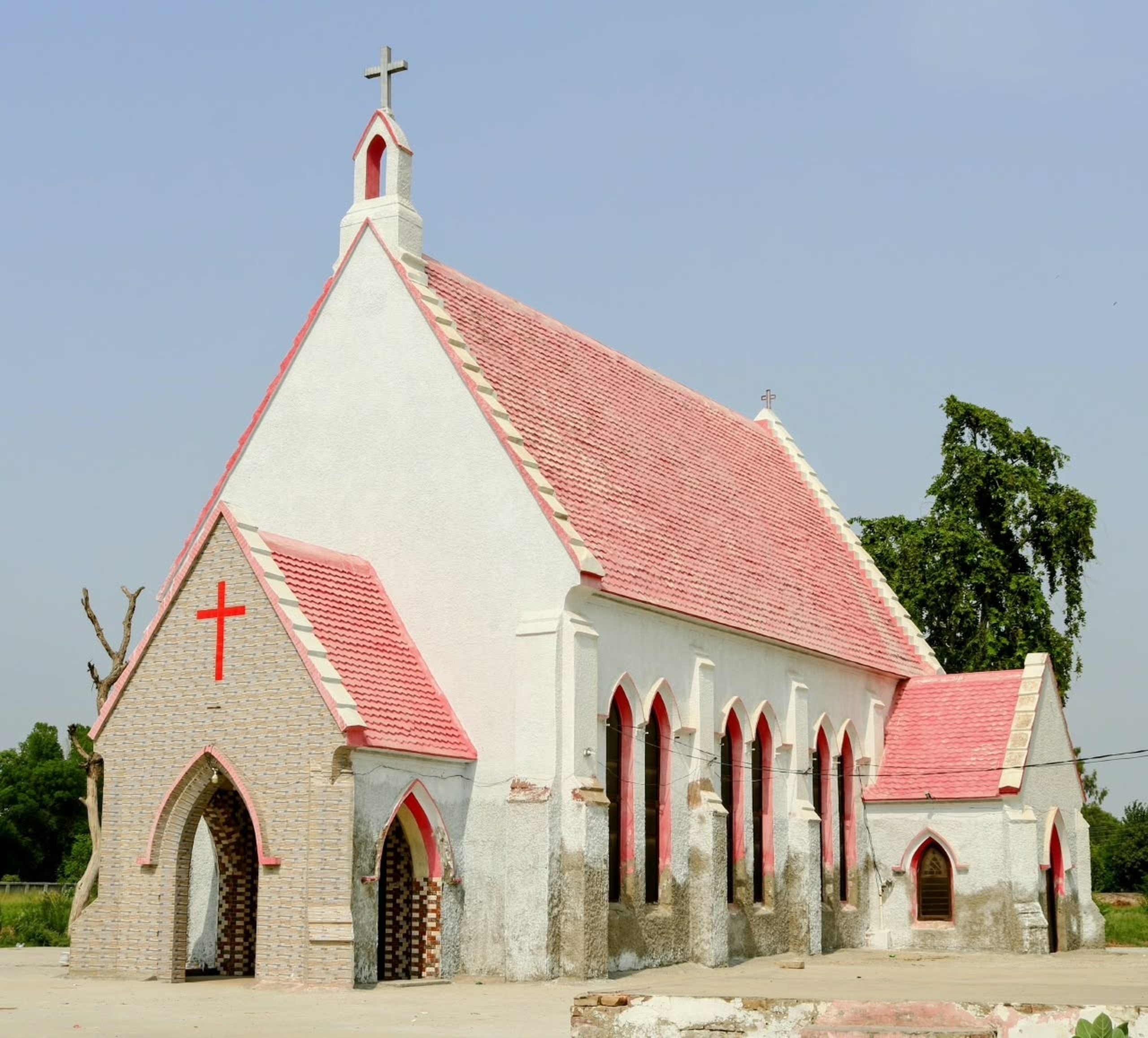
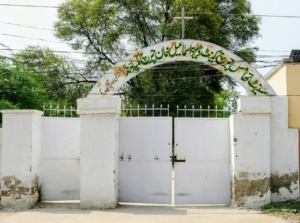
During summer vacations, I travelled to Dera Ismail Khan, a district situated in southern Khyber Pakhtunkhwa. It takes six hours from Lahore to arrive in this historic city. During my stay there, I came across one such place that immediately captured my attention, and I thought to write about it. It was St Thomas Church, sacred place of worship for Christian community. A large cross standing at the entrance, old rusty walls, and an ambience of spiritualism. But the Church showcased more than that. Its walls contain historical accounts of colonial past, the military campaigns led by British soldiers in this area and a grave of one Lieutenant Governor of Punjab.
 

St Thomas Church was built in 1856 during British rule in the Indian subcontinent. It is one of the oldest churches in present-day Pakistan.
It has survived political changes, the Partition of 1947, and the passing of time. Even today it stands as a symbol of the rich and diverse heritage of Dera Ismail Khan. The church is not only a place of worship but also a reminder that different faiths and communities have long been part of the history of this region.

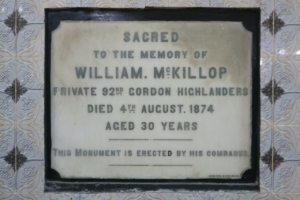
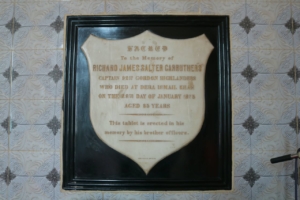
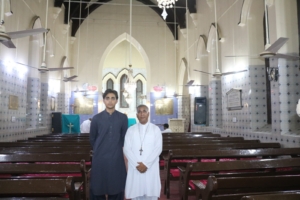
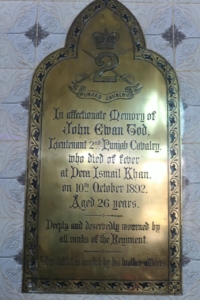
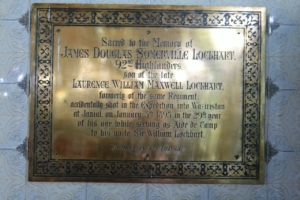
As we walked inside, we met the old priest and caretaker of the church named Chand. He welcomed us warmly and narrated the remarkable history of this place. There are memorials of British soldiers who lost their lives in this region during military campaigns. The priest stood in front of each tablet inscribed on the church wall and briefed about it. One memorial narrates the names, ranks and units of one hundred and 69 British military officers and other ranks who were killed or died due to injuries or disease in Waziristan military campaigns launched between 1919 to 1921.
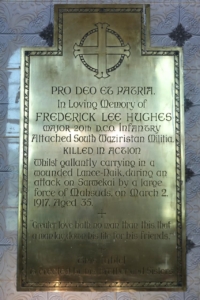


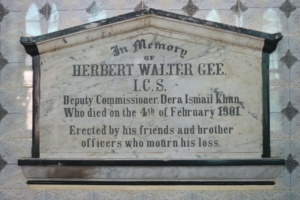
Another memorial lists details of sixty-eight officers and other ranks who met a similar fate during the 1936-1938 Waziristan military campaigns. Similarly, one tablet erected by friends and fellow officers mourns the death of Herbert Walter Gee, ICS, deputy commissioner of Dera Ismail Khan, who died in 1901. There are other memorials as well, erected by colleagues in memory of the fallen officers. I thought that these names contain historical accounts year by year about what happened in this part of the world at that time. Every sentence of the Priest carried a new story, such as how the church has witnessed a lot of happenings through generations and that it still serves the small Christian community living in Dera Ismail Khan.
As we stepped outside, believing our visit had come to an end, the priest said, “Wait. I have to show you one more thing.”

He took me to the back of the building, where I saw a large white grave standing quietly among the dusty bushes.

Here rests Lieutenant General Sir Henry Marion Durand (1812-1871).

Durdand – a quite familiar name for the people of Pakistan and Afghanistan.

Sir Durand was a career British military officer, diplomat, and administrator. He served in the East India Company Army, took part in several military campaigns, and later became the Lieutenant Governor of Punjab from 1870 to 1871. His son Sir Mortimer Durand is the one who drew the contours of the border between British India and Afghanistan in 1893. A man who once held such an important position now lies in silence behind an old church, while many people living nearby are unaware that his grave even exists.
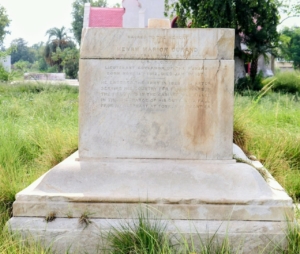
Henry Marion Durand died in 1871 at the age of 58 from a tragic accident. He was visiting Nawab of Tank Shahnawaz Khan along with his daughter when he fell from an elephant. The elephant was passing through the gateway by the town of Tank with the Nawab on the same elephant and an official (Chaprassy). The gate was too low to cross an elephant with howdah. The howdah struck the walls of crossing and the elephant got frightened resulting in the fall of Durand. He remained unconscious for a few days and never recovered. He was buried beside St. Thomas’ Church in Dera Ismail Khan. The British suspected some conspiracy into this incident. One of descendent of Nawab Shahnawaz Khan says that The British launched an enquiry into it. But the daughter of Durand gave testimony in favour of the Nawab that it was just an accident and there was no fault on his part. However, as a punishment, the British authorities stripped the powers of Nawab Shahnawaz Khan in 1875 and sent him to Lahore under strict watch. He passed away in 1881 while under surveillance.
Standing beside the grave of Sir Henry Durand, I felt as if I had stepped into a forgotten chapter of history. The name engraved on the stone reminded me that many important events and personalities of the past remain connected to places that we often overlook. How easily history can fade from people’s memories, even when it is standing right in front of us.

As I left St Thomas Church, I felt that I had walked through a chapter of history that few people ever get to read. Sir Henry Durand ruled Punjab from this soil, and his son later sat across a table in Kabul and drew the line that still separates Afghanistan and Pakistan today. That line appears in newspapers and political debates all the time. Yet the grave of the man whose name it carries lies quietly behind a church in Dera Ismail Khan.
Similar Posts

  • Royal Thai Air Force Clarifies Nighttime F-16 Flights Along Border

    BANGKOK, Thailand — The Royal Thai Air Force has issued a formal clarification regarding nighttime F-16 fighter jet operations observed along the Thai-Cambodian border, confirming that the flights were part of standard monthly training exercises designed to maintain continuous operational readiness. Thai Gripen and F-16 Jets Strike Cambodian Military Targets Ahead of Ceasefire The official […]

  • | |

    Lahore police bar women from stations after sunset

    Lahore Police have directed that no woman should remain at any police station after sunset, introducing a new measure that officials say is aimed at ensuring the safety and dignity of women. The directive was issued by Deputy Inspector General (DIG) Operations Muhammad Faisal Kamran during a crime review meeting with officers of the City Division. He instructed police personnel to treat women with respect and ensure that female complainants as well as women taken into custody are not kept at police stations after Maghrib. According to the directive, police officers must adopt procedures that protect women’s privacy and dignity while dealing with complaints or investigations. The decision comes in the wake of growing concerns over crimes against women and follows the arrest of a Lahore police Assistant Sub-Inspector (ASI) accused of sexually assaulting a 19-year-old woman with a mental health condition. According to police, the woman had left her home and did not return for several hours. Her family later learned from a local resident that a plain-clothes police officer had taken her away on a motorcycle. The victim later alleged that the officer took her to another location and sexually assaulted her. Following the allegations, police registered a case against the accused officer. DIG Investigation Syed Zeeshan Raza ordered an immediate and transparent investigation, directing investigators to proceed strictly on merit. The incident also led to disciplinary action within the police department, with 78 police officials reportedly suspended as authorities launched an internal review of the case. While police officials say the new directive is intended to safeguard women, some critics argue that restricting women’s presence at police stations does not address the root problem. They contend that law enforcement agencies should instead focus on ensuring police stations remain safe and accessible for women at all hours.

  • |

    Marc Padeu is reimagining renaissance masterpieces

    In the global art world, classical European masterpieces have long held a dominant position in defining sacred aesthetics, grand narratives, and historical gravity. However, Cameroonian visual artist Marc Padeu is challenging this historical monopoly by taking the iconic compositions of Old Masters such as Caravaggio, Diego Velázquez, and Titian. He’s transplanting them directly into the lush, everyday landscapes of rural Central Africa. Padeu’s striking large-scale canvases reimagine classic biblical motifs and European artistic traditions against the backdrop of cocoa plantations and rural villages in Cameroon. Far from being a mere imitation of Western techniques, Padeu’s work represents a deliberate re-centering of world history, spiritual heritage, and local identity. A Dual Spiritual and Cultural Inheritance Born and raised in Cameroon, Padeu grew up navigating two distinct spiritual and cultural realities. The formal structure of Catholic devotion and the indigenous customs of Bamiléké animism. This dual background permeates his paintings, where sacred rituals and everyday agricultural labor exist side by side. In Padeu’s compositions, classical Christian iconography such as the baptism of Christ, the martyrdom of saints or solemn biblical gatherings is integrated into scenes of fieldworkers harvesting cocoa pods along riverbanks. Rather than treating these scenes as contradictory, Padeu views them as a natural reflection of human experience. He points out that the original stories of the Bible were ultimately rooted in the lives of ordinary people engaging in daily, unvarnished labor. Extending the Legacy of the Old Masters When Padeu incorporates the compositions, dramatic lighting, and gestures of European Renaissance masters, his objective is not passive homage or simple satire. Instead, he describes his creative philosophy as an extension of the art historical narrative. By placing Black African figures at the center of classical visual compositions, Padeu reframes European iconographic conventions as a shared human language. His paintings suggest that spiritual gravity, dignity and monumental art belong just as naturally to a Cameroonian cocoa harvest as they do to a 16th-century Italian cathedral. The Art of Patience and Global Recognition Padeu’s meticulous process reflects a deliberate rejection of fast-paced contemporary art production: Deliberate Pace: He completes rarely more than ten paintings per year. Long Incubation: Months are spent conceptualizing each piece before a brush ever touches the canvas. Global Reach: His recent solo exhibition in London highlights his growing prominence on the international stage.   Padeu’s ultimate creative ambition is both subtle and transformative. Rather than shaping his art to explain Africa to Western audiences, his goal is to present the wider world through an African lens. His work offers a perspective rooted firmly in the soils, traditions, and realities of Cameroon.

  • | |

    IHC seeks answers over delay in judicial appointme…

    ISLAMABAD: The Islamabad High Court (IHC) has asked the federal government to explain the constitutional implications of keeping Prime Minister Shehbaz Sharif’s advice on judicial appointments pending with President Asif Ali Zardari. Justice Arbab Muhammad Tahir issued notices to the president, the federal government and the attorney general on Monday while hearing a petition challenging the delay in approving appointments to the superior courts. The court also directed the respondents to submit separate concise reports detailing when the prime minister’s advice was sent to the president and what action had been taken on it. The case has been fixed for hearing on August 11. The petition was filed by lawyer Luqman Zafar through his counsel Zahid Asif Chaudhry, who questioned the prolonged delay in completing the constitutional process for judicial appointments. The Judicial Commission of Pakistan, headed by Chief Justice Yahya Afridi, had recommended 19 additional judges and the confirmation of five judges for the high courts during meetings held on July 20 and 21. The recommendations were subsequently forwarded by the prime minister to President Zardari for approval under Article 48 of the Constitution. During Monday’s proceedings, the petitioner’s lawyer argued that the use of the word “shall” in Article 48(1) placed a constitutional duty on the president to act on the prime minister’s advice. He maintained that although the president could return the advice for reconsideration within the prescribed period, the Constitution did not permit an indefinite delay. The counsel further argued that the delay was affecting the administration of justice at a time when the superior courts were already struggling with a growing backlog of cases. According to the petitioner, prolonged vacancies could also undermine the public’s constitutional right to timely access to justice. Justice Tahir directed that notices be served through all available modes. Additional Attorney General Rashid Hafeez was also asked to ensure that the respondents provide the court with clear timelines regarding the submission and handling of the judicial appointments summary. The presidential delay has already had consequences for the high courts. Four additional judges of the Peshawar High Court whose confirmation had been recommended by the Judicial Commission ceased to hold office on August 4 after their terms expired without formal notifications. A similar situation arose in the Sindh High Court, where an additional judge left office after his extended tenure ended on July 29. The oath-taking ceremony for the newly recommended judges had originally been scheduled for July 27 but was postponed indefinitely after the president neither approved the summary nor returned it for reconsideration. With the matter now coming under judicial scrutiny, the Islamabad High Court is set to examine whether the continued delay in acting on the prime minister’s advice is constitutionally permissible.

  • Police Find 14-Year-Old Searched US School Shootings Prior to Mass Shooting

    BANGKOK – A tragic shooting at a Nonthaburi school has left the local community in deep shock. Police are now actively investigating the online history of the 14-year-old student suspect. Investigators strongly believe the teenager also killed his grandparents before heading to the school campus. Officers found their bodies after breaking into their locked home […]

  • | |

    Mufti Muneeb-ur-Rehman criticizes Pakistan’s…

      Renowned Islamic scholar Mufti Muneeb-ur-Rehman has strongly criticized Pakistan’s judicial and economic systems, stating that a justice system that fails to deliver justice even after forty years cannot be considered a true system of justice but rather a system of oppression. He made these remarks while addressing a public ceremony in Karachi, where he spoke about the country’s pressing legal and economic challenges. During his speech, Mufti Muneeb-ur-Rehman expressed concern over the prolonged delays in the judicial process. He argued that when people have to wait decades for justice, the very purpose of the legal system is defeated. According to him, justice delayed for such an extended period effectively becomes justice denied, leaving citizens frustrated and deprived of their fundamental rights. He emphasized that a judicial system should provide timely and fair decisions so that public confidence in the rule of law remains intact. The scholar also urged those in positions of authority to focus on resolving Pakistan’s domestic problems instead of concentrating solely on international issues. He remarked that while government leaders often discuss and engage with global affairs, the country’s internal challenges require immediate attention. He specifically called upon policymakers and those holding power to prioritize the welfare of the people by addressing the nation’s economic difficulties. One of the major issues highlighted by Mufti Muneeb-ur-Rehman was the problem of Independent Power Producers (IPPs). He appealed to the government to find a practical and sustainable solution to the IPP issue, which has been widely debated due to its impact on electricity prices and the country’s financial stability. According to him, resolving this matter would help reduce the economic burden on both the government and ordinary citizens. Speaking about the national economy, Mufti Muneeb-ur-Rehman painted a concerning picture of Pakistan’s financial condition. He stated that after distributing the constitutionally allocated shares to the provinces and making payments on interest obligations, the federal government is left with very limited financial resources. This situation, he suggested, reflects the severity of the country’s fiscal challenges and highlights the urgent need for comprehensive economic reforms. He stressed that policymakers should adopt measures that promote financial stability, reduce unnecessary expenditures, and improve revenue generation without placing excessive burdens on the public. The event also featured an address by Maulana Bashir Farooqi, who criticized the government’s approach toward eliminating the interest-based financial system. He argued that the authorities are not demonstrating sufficient seriousness in transitioning toward an Islamic banking framework. According to him, meaningful reforms require not only policy changes but also practical steps to prepare financial institutions for such a transformation. Maulana Bashir Farooqi announced that his organization is willing to provide training for approximately 100,000 employees working in conventional banks. He explained that this initiative aims to equip banking professionals with the knowledge and skills necessary to operate within an interest-free Islamic banking system if the government decides to pursue such reforms. He maintained that the availability of trained professionals would facilitate a smoother transition and strengthen the implementation of Islamic financial principles in the country’s banking sector. The speeches delivered at the Karachi ceremony underscored concerns regarding Pakistan’s judicial efficiency, economic management, and financial policies. Both religious leaders called on the government to prioritize domestic reforms, strengthen public institutions, address long-standing economic challenges, and work toward a system that better serves the interests of the people.

Leave a Reply

Your email address will not be published. Required fields are marked *