ecc approves rs4188bn
| | |

ECC approves Rs4.188bn PASSCO compensation package

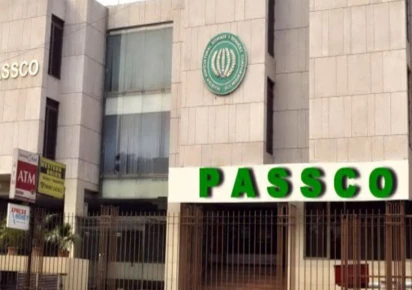
The Economic Coordination Committee (ECC) has approved a Rs4.188 billion compensation package for employees of the Pakistan Agricultural Storage and Services Corporation (PASSCO).

The decision is part of the government’s plan to wind up PASSCO. The process is also linked to the disposal of the corporation’s wheat stocks. The government has set December 2026 as the deadline for completing the process.

The ECC directed that the winding-up process must be independently reviewed. A third party will validate the process to ensure transparency and compliance with the approved plan.

The committee also stressed the need to dispose of PASSCO’s wheat stocks as soon as possible. Officials said the early disposal of the stocks would help implement the employee compensation package on time.

The Ministry of National Food Security and Research assured the ECC that the process would be completed by December.

The government began work on the closure of PASSCO in 2025. The Prime Minister’s Office had directed the finance minister to oversee the process in consultation with the relevant ministry.

A meeting chaired by the finance minister later decided that a severance package should be prepared for PASSCO employees. The package was designed along the lines of the voluntary separation scheme approved for employees of the Utility Stores Corporation.

PASSCO’s Board of Directors subsequently approved the revised compensation package. The scheme covers regular employees as well as contractual and daily-wage workers.

It includes severance compensation and several terminal benefits. These include leave encashment and a farewell grant. The package also provides maintenance support for widows and retired employees through PASSCO’s Benevolent Fund.

The ECC had previously approved the winding up of PASSCO. It also approved the creation of a Special Purpose Vehicle called the Wheat Stock Management Company (WSMC) Public Limited. The federal cabinet later ratified the decision.

The total cost of the employee package is estimated at Rs4.188 billion. Around Rs3.967 billion has been allocated for severance compensation and terminal benefits for PASSCO employees.

Another Rs221 million has been set aside for maintenance grants. The amount will benefit 38 widows and 236 retired employees.


Similar Posts

  • | |

    France wildfires force 150,000 to evacuate amid he…

    A relentless heatwave has triggered massive wildfires across southwestern France, forcing around 150,000 people to evacuate as flames swept through forests and threatened homes in one of the country’s most popular tourist destinations. French authorities ordered the complete evacuation of Cap Ferret, a renowned coastal resort, after fast-moving fires engulfed nearly 47,000 acres of forest. Officials said more than 100 homes had been damaged as firefighters continued battling the blaze under extreme weather conditions. The rapidly spreading fire has prompted an extensive emergency response, with President Emmanuel Macron directing the French military to assist firefighting teams in containing the flames and protecting nearby communities. The crisis has also spread beyond France. In neighboring Spain, authorities declared the country’s first-ever national emergency over a wildfire near Madrid, highlighting the growing impact of the ongoing heatwave across southern Europe. According to media reports, the Spanish wildfire has destroyed more than 43 homes, while approximately 19,000 residents living in mountainous areas west of Madrid were ordered to evacuate. More than 2,000 emergency personnel, supported by 10 firefighting aircraft, have been deployed to contain the flames. Officials warned that soaring temperatures, dry vegetation and strong winds have created ideal conditions for wildfires, making firefighting operations increasingly difficult. The latest disaster comes only weeks after France experienced one of its deadliest heatwaves in recent years. According to the country’s national public health agency, 21,674 deaths were recorded between June 17 and July 2, compared with an expected 15,910 deaths under normal conditions. The agency said the period saw 5,764 excess deaths—an increase of 36% above normal mortality levels—underscoring the severe health impact of prolonged extreme heat. Climate experts have repeatedly warned that rising global temperatures are increasing the frequency and intensity of heatwaves and wildfires across Europe. As emergency crews continue to battle the blazes in France and Spain, authorities remain on high alert, warning residents that worsening weather conditions could fuel further fires in the coming days.

  • | |

    Islamabad gets foolproof security for Eid Milad

    ISLAMABAD: Authorities in Islamabad have finalised foolproof security arrangements for the peaceful observance of Eid Milad-un-Nabi ﷺ. Security measures have been strengthened across the federal capital ahead of the religious occasion. Special arrangements have been made to protect citizens and ensure the smooth conduct of religious gatherings and processions. Law enforcement agencies have been directed to remain alert and closely monitor sensitive areas. Security personnel will be deployed at key locations, while additional measures will be taken around mosques, worship places and routes of Milad processions. Authorities have also stressed the need for effective coordination among the relevant departments. Police and other security officials will remain vigilant throughout the celebrations. The arrangements aim to prevent any untoward incident and provide a safe environment for people participating in Eid Milad-un-Nabi ﷺ events. Officials have urged citizens to cooperate with security personnel and follow the instructions issued by the administration during the celebrations.

  • | | |

    MQM-P pushes for grand national dialogue on new pr…

    KARACHI: The Muttahida Qaumi Movement-Pakistan (MQM-P) has announced plans to approach political parties across the country to launch a “grand national dialogue” on the creation of new provinces and administrative units. Speaking at a press conference on Sunday, MQM-P Chairman Dr Khalid Maqbool Siddiqui said Pakistan needed a serious national discussion on restructuring its administrative system, arguing that the country’s growing population had increased the need for additional provinces. Siddiqui said MQM-P had been advocating the creation of more provinces for decades, maintaining that Pakistan’s existing provincial structure was largely shaped by linguistic considerations rather than purely administrative requirements. He stressed that the party’s demand was not limited to Sindh and that it would support calls for new provinces wherever there was public and political backing. The MQM-P leader urged political parties to sit together and discuss their proposals and reservations instead of treating the issue as a source of political confrontation. He said his party was prepared to take the lead in initiating such a dialogue. Siddiqui also linked the debate over new provinces with the need to strengthen local governments. Referring to Article 140-A of the Constitution, he said provinces were constitutionally required to devolve political, administrative and financial powers to elected local representatives. He criticised the failure to fully implement the provision and recalled that MQM-P had previously approached the Supreme Court over the issue. He argued that creating additional provinces was not unconstitutional and said Parliament could debate the appropriate mechanism for establishing them. He also questioned whether existing provinces should have the sole authority to decide on their own division. MQM-P leader and Health Minister Mustafa Kamal said the party’s proposal was aimed at administrative restructuring rather than dividing communities or territories. He argued that people should have greater control over local leadership and governance, particularly when their cities face serious problems in living standards and public services. The MQM-P campaign follows recent remarks by Interior Minister Syed Mohsin Naqvi, who called for political parties to address major national issues, including the creation of new provinces. His proposal has since generated debate among government figures, lawyers and political circles, giving fresh momentum to the long-running discussion over Pakistan’s provincial structure. The MQM-P leadership said it would also engage legal experts and explore further legal avenues regarding the implementation of constitutional provisions related to local governance.

  • | | |

    Pakistan backs Iran-US dialogue, Hormuz progress k…

    ISLAMABAD: Pakistan has expressed hope that progress on the Strait of Hormuz issue will create momentum for renewed dialogue between Iran and the United States, reaffirming its commitment to supporting diplomatic efforts aimed at easing tensions in the region. Speaking at the weekly media briefing on Thursday, Foreign Office spokesperson Tahir Andrabi said Pakistan expects the implementation of the Islamabad Reconciliation Framework to advance through consensus on the Strait of Hormuz, paving the way for technical-level talks between Tehran and Washington. He said Pakistan supports the resumption of negotiations between Iran and the United States and will continue to play a constructive diplomatic role alongside regional partners. According to the spokesperson, Pakistan, Qatar, Oman, and other friendly countries remain engaged in coordinated efforts to promote peace and stability, with Oman playing a particularly positive role in efforts related to the Strait of Hormuz. Andrabi also confirmed that Iran’s foreign minister has been invited to visit Pakistan, while noting that the National Assembly Secretariat would clarify whether an invitation has also been extended to the Speaker of the Iranian Parliament. On the situation in Gaza, the spokesperson said lasting peace requires not only the disarmament of Hamas but also Israel’s withdrawal from the occupied territories. He stressed that Israel must fulfill its international obligations and end its military presence in Gaza. Responding to questions about the possible deployment of an international peacekeeping force in Gaza, Andrabi said it was too early to discuss such a proposal. He added that Pakistan would examine any formal plan if it is presented through appropriate international channels. Commenting on political developments in Bangladesh, the spokesperson reiterated that Pakistan does not interfere in the internal affairs of other countries and declined to comment on statements made by Bangladesh’s former prime minister. He also strongly condemned recent attacks on commercial vessels in the Bab el-Mandeb Strait, describing them as violations of international law and threats to maritime security. Andrabi reaffirmed Pakistan’s commitment to supporting the safety of global trade routes and said defense cooperation between Pakistan and Saudi Arabia would continue.

  • Thailand Suspects Foreigners Piloting Cambodian Bomber Drones in Border Conflict

    BANGKOK – The Thai army has expressed suspicions that foreign nationals may be operating the bomber drones used by Cambodian forces in the ongoing border clashes. The 2nd Army Area, responsible for Thailand’s northeastern frontier, raised the alarm in a Facebook post on Thursday, citing radio intercepts during drone attacks that featured English communications. Cambodia […]

  • |

    Global oil prices decline as OPEC cuts 2026 demand forecast

    Global crude oil prices fell by more than $1 a barrel on Thursday after a period of gains, as concerns over weaker oil consumption in 2026 outweighed ongoing supply risks linked to the conflict in the Middle East. Brent crude futures declined by $1.29, or around 1.5%, to $87.69 per barrel, while US West Texas Intermediate (WTI) crude dropped $1.30, or about 1.6%, to $81.97 per barrel. Market sentiment was pressured by fresh estimates indicating that global oil demand could grow more slowly than previously expected next year. The weaker demand outlook has encouraged investors to reassess the strength of the oil market despite continued uncertainty over supplies from the Middle East. The latest decline came after the Organisation of the Petroleum Exporting Countries (OPEC) lowered its forecast for global oil demand growth in 2026 to 580,000 barrels per day in its monthly oil market report. This marks the fourth consecutive reduction in the organisation’s demand-growth projection. The ongoing conflict involving Iran and the United States and Israel has disrupted energy supplies and shipping routes, creating significant uncertainty in international oil markets. However, analysts say the economic and logistical disruptions are also weighing on fuel consumption and broader global demand. Despite the latest decline, supply concerns continue to provide some support to crude prices. Traders remain focused on developments in the Middle East, particularly the impact of the conflict on oil production, exports and major shipping routes. Analysts are therefore expecting continued volatility in global oil prices as markets balance two opposing factors: the risk of supply shortages caused by geopolitical tensions and the possibility of weaker demand resulting from disruptions to economic activity. The latest OPEC forecast is likely to remain an important factor for investors in the coming sessions, particularly as traders assess whether weaker demand can offset the supply risks currently affecting the global energy market.

Leave a Reply

Your email address will not be published. Required fields are marked *