weekly inflation hits
| | |

Weekly inflation hits 9.66% amid price surge

ISLAMABAD: Pakistan’s weekly inflation increased during the latest reporting period as higher fuel and food prices pushed up the cost of living, according to the latest report released by the Pakistan Bureau of Statistics (PBS).

The report showed that weekly inflation rose by 0.91%, while the country’s annual inflation rate reached 9.66%, indicating that prices of essential goods continue to remain under pressure despite declines in a few commodities.

According to the Bureau of Statistics, prices of 22 essential commodities increased during the past week, while eight items became cheaper and 21 items recorded no change.

The sharpest increase was recorded in petroleum products. High-speed diesel became 15.87% more expensive, while the price of petrol increased by 5.23%. The rise in fuel prices is expected to affect transportation costs and may also increase the prices of other goods in the coming weeks.

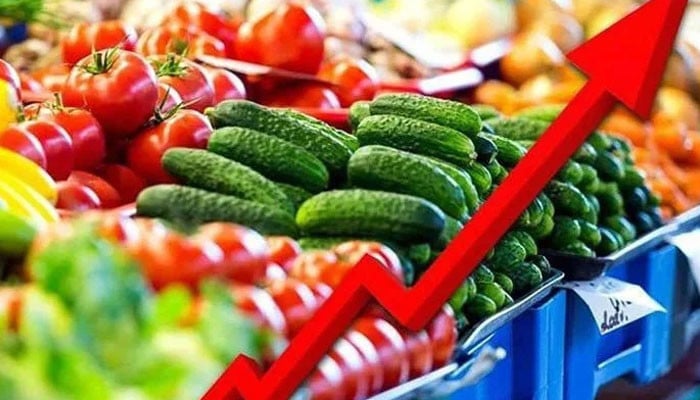
Among food items, tomatoes recorded the highest increase, with prices rising 39.92% in just one week. Egg prices increased by 7.31%, adding to household food expenses.

The report also showed that the price of liquefied petroleum gas (LPG) increased by 0.91%, while potatoes became 3.70% more expensive. Prices of garlic, beef and several other essential food items also registered increases during the week.

Although inflation remained on the rise, consumers received limited relief in the prices of a few commodities. Chicken prices fell by 4.66%, making it one of the biggest weekly declines among food products. Bananas became 1.72% cheaper, while prices of sugar, rice and different varieties of pulses also recorded decreases.

Economists say rising fuel prices are one of the major reasons behind the increase in weekly inflation because higher transportation and production costs often lead to price increases across various sectors of the economy.

The latest inflation figures suggest that many households continue to face pressure from the rising cost of essential goods, particularly food and fuel. While price reductions in some commodities have provided modest relief, overall inflation remains elevated due to continued increases in several key household items.


Similar Posts

  • |

    US imposes tariffs and price floors on Chinese-dominated polysilicon supply chain

    US President Donald Trump has signed a executive proclamation under Section 232 of the Trade Expansion Act of 1962, introducing a 15 per cent tariff and minimum import price floors on products made from polysilicon. The critical raw material forms the foundational supply chain for both semiconductor chips and solar panels, a sector currently dominated by Chinese manufacturing. The executive action establishes clear import price thresholds across key processing stages. Under the new policy, raw polysilicon is set at a minimum price floor of $21 per kilogram, while polysilicon ingots and wafers are capped at a floor of $100 per kilogram. Solar cells face a minimum price of $0.22 per watt, and finished solar modules or panels carry a minimum threshold of $0.38 per watt. The order also directs the Commerce Department to establish targeted incentive programs for domestic companies investing in polysilicon production facilities. While semiconductor manufacturing accounts for roughly 2.4 per cent of global polysilicon demand, the material’s economic viability depends directly on the volume scale maintained by solar manufacturing. US solar manufacturers and polysilicon producers, including Corning, Hemlock Semiconductor, Wacker Chemie, First Solar, and Qcells, welcomed the strategic protections as essential for safeguarding domestic supply chains necessary for advanced computing and renewable energy. The new trade protections take effect on 4 December 2026, granting buyers a four-month window to adjust existing supply contracts before the higher price thresholds apply.

  • |

    Tom Holland admits Justin Bieber was his childhood obsession

    Tom Holland has confessed that he once idolised Justin Bieber and even tried copying his look as a kid. The actor opened up about his childhood crush during a recent TV appearance. Speaking on Julian Shapiro-Barnum’s “Celebrity Substitute” show on Wednesday, the 30-year-old actor named Bieber as his biggest childhood obsession. He said he genuinely believed Bieber was the coolest person he’d ever seen at the time. Holland admitted he tried to style his hair just like Bieber’s when he was around 11 or 12 years old. He joked that the attempt didn’t go too well, since his hair simply wasn’t built for that look. The confession quickly caught fans’ attention online, with clips of the moment spreading across social media. Many pointed out that Holland’s admiration for Bieber actually predates their now-friendly relationship by more than a decade. The two stars famously connected during the COVID-19 lockdown, when they went live together on Instagram. During that stream, both artists openly praised each other’s work and expressed mutual admiration. Holland’s latest comments add a fun bit of context to that earlier friendship, showing his appreciation for Bieber started long before they ever crossed paths professionally. Fans have since revisited the old livestream clip, drawing comparisons between his teenage fandom and his adult friendship with the singer. On the professional front, Holland remains busy promoting his newest Marvel film, “Spider-Man: Brand New Day.” The movie officially released on July 31 and has already crossed the billion-dollar mark at the global box office. Holland reprises his role as Peter Parker in the film, starring alongside his real-life wife, Zendaya. The couple’s on-screen and off-screen partnership has continued to draw significant attention from fans and media alike. With “Brand New Day” performing strongly worldwide, Holland’s star continues to rise both critically and commercially. His playful trip down memory lane, though, has given fans a lighter, more personal glimpse into the actor’s life outside the superhero suit.

  • | |

    Rajab Butt claims his net worth has crossed Rs1 billion

    LAHORE, July 26: Pakistani YouTuber and social media personality Rajab Butt has claimed that his net worth has crossed Rs1 billion, saying he officially became a billionaire last year. Butt made the claim during a podcast appearance where he was asked whether he considered himself a millionaire or a billionaire. The YouTuber responded by asking the host whether she understood the difference between the two terms. After the host confirmed that she did, Butt revealed that he had crossed the billionaire mark in terms of his wealth. According to Butt, his net worth has exceeded Rs100 crore, which is equivalent to more than Rs1 billion. He attributed his financial success to years of hard work and his career as a digital content creator. Butt has built a large following on YouTube and other social media platforms in a relatively short period. His content has also generated significant attention because of his publicly displayed lifestyle. The YouTuber has frequently shared glimpses of an expensive lifestyle with his followers. His social media presence has included luxury items, costly watches, international trips and lavish celebrations. His wedding also attracted considerable attention online and further increased public interest in his personal life and financial status. Butt said his reported wealth was not achieved overnight. He described it as the result of around 12 years of hard work. The rise of creators like Butt highlights the growing financial potential of Pakistan’s digital content industry. YouTube, brand promotions and other online platforms have created new opportunities for creators to build businesses and generate substantial income. However, Butt’s net-worth claim is based on his own statement during the podcast. No independent financial records were provided in the discussion to verify the figure.

  • |

    93% admissions at top colleges go to private-schoo…

    Concern has been raised over the quality of education in Karachi’s government schools and the ability of their students to gain admission to the city’s leading government colleges. According to admission data, the overwhelming majority of students admitted to Karachi’s top 10 government colleges completed their matriculation from private schools. Despite these institutions being government colleges, around 93 out of every 100 students admitted to them are graduates of private schools, while only about seven come from government schools. Data obtained from the colleges shows that a total of 13,211 students were admitted to these institutions. Of them, 12,264 had completed their matriculation from private schools, while only 947 were graduates of government schools. This means that 92.8% of admissions were secured by students from private schools, while government school students accounted for just 7.2%. In other words, for every 100 students admitted to these government colleges, approximately 93 come from private schools and only seven from government schools. At Adamjee Government Science College, 613 students were admitted. Among them, 585 had completed matriculation from private schools, while only 28 came from government schools. Similarly, Government D.J. Sindh Science College admitted a total of 1,258 students. Of these, 1,214 were graduates of private schools and only 44 had studied at government schools. At Delhi Government Science College, 801 students were admitted. The figures show that 773 came from private schools, while only 28 were graduates of government schools. Government Boys College for Men, Nazimabad, admitted a total of 1,317 students. Of these, 1,257 had completed their matriculation from private schools, while only 60 came from government schools. The same trend is even more visible among government girls’ colleges. Government Sir Syed Girls College admitted 2,507 students. Among them, 2,266 had completed matriculation from private schools, while only 241 were graduates of government schools. At St Lawrence Government Girls College, 691 students were admitted. Of these, 631 came from private schools and only 60 from government schools. Similarly, at PECHS Government College for Women, 1,517 students were admitted. A total of 1,420 had studied at private schools, while only 97 had completed matriculation from government schools. At Khatoon-e-Pakistan Government College for Women, 2,107 students were admitted. Of these, 1,876 were graduates of private schools, while only 231 came from government schools. The figures for boys and girls at Government Degree College Malir Cantonment were also included. According to the data provided, 402 students were counted in the combined figures, while the reported breakdown listed 1,316 students from private schools and 86 from government schools. Meanwhile, Government Degree Boys and Girls College Stadium Road admitted a total of 998 students. Of these, 926 had completed matriculation from private schools, while only 72 were graduates of government schools. The situation at government girls’ colleges is similarly concerning. At Sir Syed Girls College, 2,266 students from private schools secured admission compared with only 241 from government schools. At PECHS Government College for Women, the ratio was 1,420 private-school graduates against 97 government-school graduates. At Khatoon-e-Pakistan Government College for Women, 1,876 private-school graduates were admitted compared with just 231 from government schools.

  • |

    Human rights organizations file federal lawsuit challenging Trump administration sanctions on ICC

    Four prominent non-governmental organizations filed a joint federal lawsuit contesting executive sanctions imposed by the Trump administration on the International Criminal Court, arguing the penalties unlawfully disrupt global war crimes prosecutions. The legal challenge, brought by Human Rights Watch, the Center for Constitutional Rights, the Open Society Institute, and the American Friends Service Committee, targets an executive order enacted in February 2025. The presidential directive established financial sanctions and travel bans against ICC officials, judges, and affiliated advocacy groups involved in investigating alleged war crimes in Palestinian territory, including cases involving senior Israeli officials. Attorneys representing the civil rights organizations contend that the broad scope of the sanctions violates First Amendment protections regarding free speech and association. The suit asserts that the threat of severe civil and criminal penalties has effectively forced US-based legal advocates to suspend representation of victims before the tribunal, while halting formal collaborations with sanctioned international rights groups. The filing marks the latest in a series of legal challenges against the administration’s broader push to limit the jurisdiction of the Hague-based court. Representatives for the US Department of State and Department of Justice did not immediately issue formal statements regarding the lawsuit.

  • |

    Pakistan’s trade deficit widens 26% in July as imports surge

    ISLAMABAD: Pakistan’s trade deficit increased by 26% during the first month of the fiscal year 2026-27, mainly driven by a sharp rise in imports, according to the latest data released by the Pakistan Bureau of Statistics (PBS). The widening gap between imports and exports highlights growing pressure on the country’s external trade position at the beginning of the new fiscal year. Imports increased by around 19% in July, with higher purchases recorded across several major categories, including food products, machinery, transport equipment, textiles, agricultural inputs and metals. According to the PBS data, the country’s food import bill reached $805.4 million in July 2026, equivalent to more than Rs224 billion. The increase reflects continued reliance on imported food products and essential raw materials to meet domestic demand. Among food items, imports of milk, cream and food products prepared for infants rose by 25% to $18.7 million. Pakistan also imported significant quantities of spices, soybeans, palm oil and pulses during the month. Sugar imports were also recorded during July, with the country importing around 112 metric tonnes, adding to the overall food import bill. Machinery imports rise sharply Machinery emerged as one of the major contributors to the increase in the import bill. Machinery imports jumped by 41% to $1.31 billion during July compared with the corresponding period. The increase covered a wide range of equipment used in key sectors of the economy. Imports included machinery for power generation, offices, textile manufacturing, agriculture, construction and telecommunications. The rise in machinery imports could indicate increased demand for equipment and investment-related goods across different industries, although it also contributed significantly to the expansion of the overall trade gap. Vehicle imports register strong growth Imports of transport equipment, including vehicles, also witnessed substantial growth during the month. The import bill for the category increased by 40% to $420 million. The increase in vehicle and transport-related imports added further pressure to the country’s import expenditure, particularly as several other major import categories also recorded double-digit growth. Textile-related imports increase Pakistan’s textile sector also recorded higher imports during July. Imports of textile-related products, including raw cotton, increased by 15% to $680 million. The rise in raw cotton and other textile inputs indicates continued demand from the country’s large textile manufacturing and export industry. Since the textile sector remains a major contributor to Pakistan’s exports, higher imports of production inputs can also be linked to industrial activity. Agricultural inputs and chemicals Imports of agricultural machinery, equipment and chemicals increased by 23%, taking the combined import bill for the category to more than $1 billion. The increase comes as demand remains high for inputs and equipment required by the agriculture sector. Higher imports of such goods can support domestic production but simultaneously add to the country’s foreign exchange requirements. Metals import bill also rises The country also witnessed a significant increase in imports of metals, including gold, iron and steel. Imports under the category increased by around 23%, while the import bill for precious metals alone crossed $730 million. The broad-based rise across food, machinery, transport, textiles, agricultural inputs and metals suggests that the increase in imports was not confined to a single sector. The latest figures indicate that controlling the trade gap will remain an important challenge for policymakers during the new fiscal year. While higher imports of machinery, industrial inputs and agricultural equipment may support economic activity, a sustained increase in imports without a corresponding rise in exports could place additional pressure on Pakistan’s external account.

Leave a Reply

Your email address will not be published. Required fields are marked *