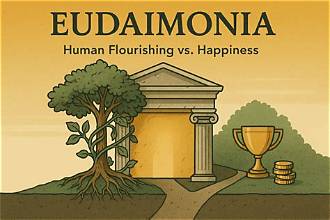
eudaimonia being human

Eudaimonia: When Being Human Was Enough”

From Laraib Zahra

Once upon a time, far from Earth, beyond the reach of our skies, there existed a planet called the Worthlands.

In the Worthlands, there was an equal proportion of humans and ghosts. Whenever a human was born, a little ghost was born by their side. These little ghosts were called Hounds. Every Hound possessed a superpower: it could know exactly what its human companion was thinking. The entire planet was ruled by three powerful ghosts, commonly known by humans and Hounds as the Great 3Gs. Each of the three had a separate kingdom. They were the Ghost of Guilt, the Ghost of Productivity, and the Ghost of Fear.

The Ghost of Guilt was the eldest of the three. He controlled the capital of the Worthlands. He had his own Guilt Police and Guilt Pumps. Guilt was a magical liquid found inside these pumps. The Guilt Police, along with the Hounds, kept a constant check on the behaviour of the people in the capital. Their job was to make sure that nobody ever ran out of fuel—the fuel of guilt.

Whenever a person was caught running out of guilt, the Hounds immediately reported them to the Guilt Police. They were then provided with more guilt fuel to make sure that nobody went “insane.” The biggest crime in the capital was the Rest Crime.

As soon as a person became exhausted and decided to take some rest, the Hounds would begin fiercely whispering in their ears:

“Strong people don’t stop.”

They would tell them not to rest until they reached somewhere. But where exactly this “somewhere” was, nobody really knew.

Sometimes, when a person was genuinely unable to work any further because of an overwhelming workload, the Hounds would call specialised therapists known as the Fear Feeders from the Kingdom of Failure for counselling—a kingdom I shall discuss in greater detail later.

On the other hand, the entire north of the Worthlands was ruled by the second Great Ghost: the Ghost of Productivity. Unlike the Guilt Police, who were actually in charge of the capital, there was no such police force in the north. Instead, there was a ministry known as the Ministry of Merit.

The humans there were never supposed to sit idle. Instead, they were expected to work harder and harder to make sure that they remained at the top of the list maintained by the Ministry of Merit. Every year, there was a grand ceremony known as the Annual Worth Ceremony. The humans who earned the highest number of merit points received a golden star carved with their names in the Worth Register of the Ministry of Merit.

Every time a human refused to rest in order to increase their productivity, the Hounds would greet them by saying:

“Congratulations! You have earned three merit points.”

Humans were comparatively happier in the north than in the other two kingdoms because here, they were rewarded with golden stars bearing their names. The more golden stars a human had beside their name in the Worth Register, the more likely they were to become part of the Hounds—the most respected position in the Worthlands.

After all, the Hounds had the superpower to read human minds, and they could even fly.

Their slogan was:

“You could be doing more.”

To the south lay the third kingdom—the Kingdom of Failure, ruled by the Great Ghost of Fear. This kingdom was the most terrible of them all. The humans there were weak and diseased. Every second person was a victim of anaemia. They looked as though they had been starving for days, perhaps even weeks.

On the contrary, the Great Ghost of Fear was the fattest of the three ghosts.

The reason for this strange contrast was hidden in the Hounds.

Unlike the Hounds in the north and the capital, the Hounds in the south had a distinct name. They were called Fear Feeders.

The Fear Feeders had one duty: to sense fear-bearing thoughts in human minds and suck them out, because the Great Ghost of Fear fed on those thoughts.

There were many kinds of fears that humans carried in that kingdom:

The fear of not doing enough.

The fear of getting left behind.

The fear of failure.

And many more.

The Fear Feeders collected these thoughts and presented them to their master. The Great Ghost of Failure had one dish that was especially dear to him. It was his favourite dish of all:

“What If” Spaghetti.

“What If” Spaghetti was a special dish found in all three kingdoms, but it was particularly abundant in the Kingdom of Failure. The humans looked starved because they had to constantly produce fear in their minds so that they could feed it to the Fear Feeders.

These fears were produced through a process called whispering, carried out by Hounds that were not themselves Fear Feeders.

Then, one day, something unexpected happened.

A few Hounds disappeared.

Seven Hounds.

Everyone in the Worthlands was deeply concerned about their sudden disappearance.

The Guilt Police, along with other investigation departments, launched a search operation. But not even a single missing Hound was found. The humans whose Hounds were missing were arrested and questioned. The results of the investigation shocked everyone in the Worthlands.

The Hounds could only exist if their humans obeyed them.

This was something that neither the Hounds nor the humans had ever known before. The humans whose Hounds had disappeared were, surprisingly, close friends. During the investigation, they confessed that one day, they had decided to step back from their usual exhausting routines and take a break to rest their tired and ruptured nerves.

All of a sudden, seven Hounds appeared and began whispering their usual slogans:

“Strong people don’t stop.”

“What if you get left behind?”

And their most favourite:

“You could be doing more.”

The humans became lost in their thoughts once again and decided to give up on their plan to rest. But then, suddenly, a voice echoed through the room:

“But we are more than what we produce.”

Everyone was shocked. For the very first time in the history of the Worthlands, a human had questioned a Hound. They noticed something strange. The Hound had become slightly smaller. Watching this whole scenario, another friend spoke in a low voice:

“Our worth needs no marks.”

The Hound became even smaller. And then, suddenly, it disappeared. The circle of friends had broken the code. They now understood the truth. The Hounds had been monitoring their thoughts all along.

Their only duty was to inspect and inject thoughts of guilt, productivity, and failure into human minds. If there were no negative and overpowering thoughts—thoughts that distorted the true meaning of productivity and merit—there would be no Hounds.

A flow of words that had the power to tear the Hounds apart began echoing through the room:

“Our worth needs no marks.”

“We are humans, not machines.”

“Rest is not rebellion.”

And many more.

One by one, they witnessed all seven Hounds disappear. The confession sparked a huge controversy across the Worthlands. Every human was now aware of their actual worth.

They finally realised that having a golden star beside their name could never be compared with the value of their health, their peace, and their well-being.

Days passed.

Then weeks.

And eventually, there was not a single Hound left in the Worthlands.

The Great 3Gs were no longer great.

The humans had thrown them out of the Worthlands with a huge catapult, sending them far beyond the reach of their planet. The Worthlands was finally ghost-free. And the humans gave their planet a new name:

Eudaimonia.

A life well lived.

Perhaps that was the greatest victory of all. They finally understood that they had never been machines in need of repair, nor workers in need of constant direction. They were simply human. And that had always been enough.

By: Laraib Zahra Sial

About the author: Author is a student of International Relations at Department of Political Science, University of the Punjab. It’s her first effort and she really is enthusiastic to do more. 
Similar Posts

  • Cultivating Peace, Instead of Controlling Violence

    Pakistan today stands at a defining moment where acts of intolerance, hate speech, mob violence, sectarian divisions and ideological polarisation are increasingly visible across both physical and digital spaces. While not every expression of intolerance translates into terrorism, history demonstrates that violent extremism rarely appears overnight; it gradually develops through unchecked prejudice, manipulated narratives and the normalisation of hatred. Every incident of mob lynching, religious intolerance, political violence or online radicalisation serves as a reminder that extremism is fundamentally a societal challenge before it becomes a security challenge. This reality demands a fundamental shift in national thinking from merely controlling violent behaviour after it erupts to cultivating a culture of peace, critical thinking, social cohesion and democratic values that prevents extremism from taking root in the first place. The controlling approach has historically dominated Pakistan’s national security doctrine. Following the Army Public School tragedy in December 2014, the National Action Plan (NAP) became the country’s principal counterterrorism framework. Security operations such as Zarb-e-Azb and Radd-ul-Fasaad significantly weakened organised terrorist networks and restored the writ of the state in several conflict-affected regions. These achievements cannot be underestimated. However, extremism is not merely a security problem; it is a social, psychological, educational and communication challenge. Arresting militants may eliminate immediate threats, but it does not necessarily eliminate the narratives, grievances and social environments that produce future extremists. Modern countering violent extremism (CVE) literature increasingly supports prevention over reaction. International experience from countries such as Indonesia, Singapore, Denmark and Morocco demonstrates that sustainable peace emerges through education reforms, community engagement, youth empowerment, digital literacy, responsible religious discourse and economic inclusion. Pakistan itself has gradually begun recognising this shift. The recently approved National Prevention of Violent Extremism (NPVE) Policy reflects an important transition from exclusively kinetic responses towards prevention, rehabilitation and resilience-building. The policy introduces a comprehensive prevention framework emphasising community participation, education, strategic communication, rehabilitation and institutional coordination. At the federal level, the National Counter Terrorism Authority (NACTA) remains Pakistan’s principal coordinating institution for counterterrorism and counter-extremism policies. Established under the NACTA Act 2013, its mandate extends beyond intelligence coordination to include research, policy development, monitoring the National Action Plan, public awareness, strategic communication and prevention of violent extremism. During the past two years, NACTA has expanded partnerships with universities, international organisations and civil society. It has launched the National Prevention of Violent Extremism Policy, strengthened monitoring mechanisms, promoted research through the Pakistan Journal of Terrorism Research, signed academic partnerships and introduced public engagement initiatives such as peace festivals and youth outreach programmes. Despite these encouraging developments, NACTA continues to face structural limitations that reduce its overall effectiveness. Institutional coordination between federal and provincial stakeholders remains inconsistent. Budgetary constraints, staffing shortages and overlapping mandates with provincial Counter Terrorism Departments often weaken implementation. Many of its policy recommendations remain stronger on paper than in practice because execution depends upon provincial governments. Furthermore, public visibility of NACTA remains limited. Most Pakistani citizens know little about its preventive work, despite the fact that ideological resilience requires continuous public engagement rather than bureaucratic coordination alone. Independent researchers have similarly concluded that Pakistan’s transition towards non-kinetic counter-extremism is promising but still constrained by implementation deficits and institutional fragmentation. Punjab has taken a significant institutional step by establishing the Punjab Centre of Excellence on Countering Violent Extremism (CoE-CVE), which recently received autonomous legal status through provincial legislation. The decision reflects an important understanding that violent extremism cannot be addressed solely through policing. The Centre has been designed to function as a policy, research, training and coordination platform supporting prevention, community resilience and strategic communication. Its transformation into an autonomous institution is expected to strengthen institutional continuity, inter-agency coordination and evidence-based policymaking. The Centre represents one of Pakistan’s most important experiments in moving from control towards cultivation. Instead of focusing exclusively on arrests and surveillance, it aims to understand why individuals become vulnerable to extremist narratives in the first place. Universities, educational institutions, media organisations, religious scholars, psychologists and community leaders are increasingly recognised as partners in prevention rather than passive observers. This multidisciplinary philosophy aligns with global best practices, where prevention begins in classrooms, families, workplaces and digital platforms long before security agencies become involved. Nevertheless, the Punjab Centre of Excellence also faces considerable challenges. Being a relatively new institution, measurable outcomes remain limited. Much of its work has concentrated on institutional development, stakeholder engagement and policy formulation rather than long-term behavioural impact. Evaluating prevention programmes presents an inherent methodological challenge because successful prevention often means that negative events never occur. Unlike policing statistics, cultivation outcomes such as increased social cohesion, reduced intolerance or strengthened democratic resilience require longitudinal research and sophisticated impact measurement. Pakistan’s educational system presents another critical weakness. Schools continue to prioritise examination performance while giving limited attention to civic education, media literacy, conflict resolution, emotional intelligence and critical thinking. Extremist organisations thrive where young people lack analytical skills and become vulnerable to simplified narratives dividing society into absolute categories of believers and enemies. A cultivation approach therefore requires curriculum reforms encouraging dialogue, diversity, constitutional values and peaceful disagreement. The digital environment further complicates Pakistan’s counter-extremism landscape. Radicalisation increasingly occurs through encrypted messaging applications, algorithm-driven social media platforms and transnational online networks. Traditional security institutions cannot effectively monitor every digital interaction. Instead, digital resilience must be cultivated among citizens themselves. Media literacy programmes teaching young people to identify misinformation, hate speech, manipulation and extremist propaganda should become integral components of educational policy. Economic marginalisation also deserves attention. Poverty alone does not create terrorists, but unemployment, social exclusion and limited upward mobility increase vulnerability to recruitment by extremist organisations offering identity, purpose and financial incentives. Pakistan’s youth bulge therefore represents both an opportunity and a risk. If properly educated, employed and politically included, young Pakistanis can become the country’s greatest peacebuilders. If neglected, the same demographic may remain susceptible to polarisation and radical narratives. Political polarisation constitutes another growing concern. Public discourse increasingly rewards confrontation over consensus. Television debates, social media campaigns and partisan rhetoric often

  • Iran’s Nuclear Program: From American Partne…

    By Ali Haider Iran’s nuclear program has been frequently described as defiance of the West. But the history reveals a different picture. It appears paradoxical that the very infrastructure of the nuclear facilities in Iran was built under the patronage of the Americans during the Cold War period. The project, which initially symbolized cooperation between Washington and Tehran, became one of the most dangerous confrontations in international relations. This transformation demonstrates how alliances shift in geopolitics.   The roots of the Iranian nuclear program can be traced back to the Cold War period in which the United States and the USSR were locked in idealogical and geopolitical rivalry. In 1950s, when the two superpowers were trying to increase their sphere of influence on the planet by establishing new alliances, US President Dwight Eisenhower introduced the initiative “Atoms for Peace” in 1953. On surface level, the program was devoted to the peaceful use of nuclear energy, however, it fulfilled the geopolitical interests of Washington as well. Several countries, including Pakistan, India, Japan, South Korea, Turkey, and Iran get benefited from the program. Yet the degree of aid was dependent on the strategic significance of each country. Iran, under the rule of Shah Mohammad Reza Pahlavi, became one of Washington’s closest regional allies. When Mohammad Mossadegh came to power in 1953, he nationalized the Iranian oil industry that ultimately affected British economic interests and aroused American fear that Iran would align with the Soviet Union. In order to save Iran from becoming a Soviet ally, the CIA, along with Britain’s MI6, undertook Operation Ajax, resulting in the ouster of Mossadegh and the restoration of power to the Shah. Such close relations between the United States and Shah Reza Pahlavi facilitated the signing of a civil nuclear cooperation agreement in 1957. The United States helped establish the Tehran Research Reactor, aided Iran with highly-enriched uranium to be used as reactor fuel and provided training to Iranian scientists in American universities. At that time, the nuclear aspirations of Iran did not provoke any concerns in the global community due to the fact that the country was considered a loyal ally of the United States. The technology that is now considered a threat by USA, used to be advertised by Washington itself as a tool of development. The situation changed drastically after the 1979 Islamic Revolution when Shah was overthrown and the Islamic Republic of Iran was created under Ayatollah Ruhollah Khomeini who pursued the agenda of anti-Americanism. Seizure of the US Embassy in Tehran and the resulting hostage crisis broke off diplomatic relations and transformed allies into bitter enemies. Initially, Iranian leadership suspended its nuclear program, and Khomeini showed religious concerns about it. However, soon the Iran-Iraq War changed the perspective of Iranian leaders.In the ensuing years, Iran started rebuilding its nuclear program with the help of Russia and China, while at the same time pursuing the development of uranium enrichment facilities independently. This dramatic reversal transformed Iran’s nuclear program from a symbol of strategic partnership into a source of deep geopolitical mistrust that continues to shape Western policy toward Tehran. Matters came to a head in 2002, when the National Council of Resistance of Iran revealed the existence of two undeclared facilities, Natanz and Arak. Subsequent inspections of the sites by the International Atomic Energy Agency found no evidence of an active nuclear weapons program, but criticized Iran for not reporting certain nuclear activities before. This became the core of the conflict: the West demanded transparency from Iran, while Iran claimed that its rights were enshrined in the Nuclear Non-Proliferation Treaty. Gradually, the situation developed into an international crisis. In 2006, the IAEA referred the case of Iran to the UN Security Council, after which the UN imposed a series of sanctions on Iran for refusing to stop the enrichment program. The US and EU imposed sanctions on Iran and restricted its banking system and oil exports, these sanctions brought Iran’s economy to its knees, causing severe damage to its currency. However, unprecedented economic pressure did not cause Iran to abandon its enrichment program.The Iranian case demonstrates that technological capability alone is rarely the real source of international conflict; rather, it is the absence of trust and transparency that transforms civilian nuclear technology into a geopolitical crisis. In 2015, the Joint Comprehensive Plan of Action was signed which was considered the most important non-proliferation deal in the modern world. Iran was willing to place strict limits on the enrichment of uranium, reduce its enriched uranium stocks, and make changes to its nuclear sites in return for the lifting of the sanctions. This deal proved that effective diplomacy can be used to manage the risk of nuclear proliferation instead of coercion. Nonetheless, this was short-lived. The success of the JCPOA, despite its eventual collapse, illustrated that diplomatic engagement can achieve outcomes that years of sanctions and pressure often fail to deliver. In 2018, President Donald Trump left the Joint Comprehensive Plan of Action saying that the deal overlooked the ballistic missile program, activities in the region, and the sunset clauses. America re-imposed tough sanctions and put maximum pressure on Iran. This move did not make Iran sign another deal but led Iran to abandon all of its commitments step-by-step and expanded uranium enrichment to levels of up to 60%. Indeed, the nuclear question is still relevant today. The program that was developed with the assistance of the US nearly seven decades ago has now become America’s major concern. Iran claims that its nuclear program is purely peaceful, whereas the US and its Western allies believe that increasing enrichment capacity of the country may pave the way for developing nuclear weapons. Sanctions could not prevent Iran from developing its nuclear capacities, whereas the JCPOA demonstrated that negotiation and transparency measures can be far more efficient in preventing proliferation than coercion. The history of Iran’s nuclear program illustrates two important lessons. First, it is not the technology that causes conflict between states, but mistrust. Second,

  • The exile who remained intellectually at home

    The passing of Professor Amin Mughal in London on August 12, 2026, at the age of 91, has left me with an overwhelming sense of personal bereavement. I have lost a mentor, friend and former colleague; Pakistan has lost one of the last representatives of a generation for whom progressive politics was inseparable from humanism, scholarship, intellectual integrity and personal courage. Harris Khalique called his departure “یہ ماتمِ وقت کی گھڑی ہے”—an hour for mourning the times—and described him as “the last of the Mohicans who touched so many lives.” These words capture the magnitude of the loss. Professor Mughal belonged to a generation that imagined Pakistan as a democratic, pluralistic and egalitarian state—not as a security-dominated order governed by fear, dogma and privilege. Born in Punjab in 1935, he taught English at Islamia College, Civil Lines, Lahore. His teaching career there ended because of his trade union activities. For Professor Mughal, principles were never dispensable instruments of convenience. Losing employment did not silence him. Along with Professor Manzoor Ahmed, he helped establish Shah Hussain College, transforming an act of official victimisation into another avenue for education and intellectual resistance. As a leader of the National Awami Party, he was imprisoned more than once. His politics sprang from compassion for workers, peasants, minorities and all those denied dignity by structures of power. It was not the doctrinaire radicalism of slogans. It was a deeply humane commitment to freedom from exploitation, arbitrary authority and cultural suffocation. He was associated with Lail-o-Nahar and later with the weekly Viewpoint, edited by the legendary Mazhar Ali Khan. I had the privilege of working with Professor Mughal at Viewpoint from 1979 to 1984. Its modest office at 4-Lawrence Road, Lahore, became my real university. Mazhar Ali Khan, I.A. Rehman, Zafar Iqbal Mirza—affectionately known as ZIM—Alys Faiz and Amin Mughal represented journalism as a public trust rather than a commercial enterprise. Reflecting on those formative years in my tribute to ZIM, I wrote: “Amin Mughal and Alys Faiz were so proficient in writing that few could match their stature. They also taught me the art of journalism with great affection and dedication.” That remains one of the greatest blessings of my life. Professor Mughal taught by example. His scholarship was vast, his editing precise and his intellectual standards uncompromising. He corrected younger colleagues without belittling them and encouraged inquiry without demanding conformity. The Viewpoint collective stood firm during General Ziaul Haq’s brutal dictatorship, when truth invited censorship, dismissal, imprisonment or exile. Literature and journalism became important sites of resistance during those years. Professor Mughal understood that control over language, culture and historical memory was central to authoritarian rule. His engagement with Urdu and Punjabi literature was therefore never merely aesthetic; it was part of a larger struggle to recover suppressed voices and alternative visions of Pakistan. Forced into political exile in 1984, he settled in London and never returned to Pakistan. Exile, however, could not sever his intellectual or emotional relationship with his homeland. He worked for Daily Jang and, in the early 1990s, edited the Urdu daily Awaaz. Although the newspaper survived for only a little over a year, it represented another attempt to provide Britain’s Pakistani community with a serious and progressive public forum. Writing in The News on Sunday in 2008, Arif Azad recalled Professor Mughal as looking “his usual sharp and buoyant self, dressed in impeccable attire as is his wont.” He described him as belonging to “the vanishing breed of left-wing Pakistan intellectuals” in whom one could still discern the lofty and humane aspirations associated with Pakistan’s early journey. The description was exact. Professor Mughal’s impeccable dress reflected something deeper: an inner discipline, dignity and refusal to be diminished by adversity. Political persecution could deprive him of employment and homeland, but it could not deprive him of intellectual independence or personal grace. His Finchley home gradually became, in Arif Azad’s memorable formulation, “a port of call” for visiting writers, politicians and political and cultural activists from both sides of the border. For decades it served as an informal salon, archive and classroom. Generations of visitors encountered there a formidable memory, an incisive mind and a host of unfailing generosity. Even when he withdrew from active engagement in South Asian politics, he remained an enduring reference point for politically conscious Pakistanis in Britain. His interests ranged across philosophy, literature, history, political economy and contemporary affairs. He wrote perceptively on Bhagat Singh and, following Benazir Bhutto’s assassination, produced After Benazir Bhutto: Some reflections. Although he had opposed her politics, he recognised her courage and wrote that in the imagination of the masses she had acquired a mystical significance destined to inspire future struggles. That ability to rise above personal political preference and acknowledge truth distinguished him as a genuine intellectual. Professor Mughal’s life reminds us that exile is not merely physical displacement. It is also the condition imposed upon ideas that a state refuses to accommodate. Pakistan expelled or marginalised many of its finest minds and then wondered why intolerance, intellectual poverty and historical amnesia prevailed. Professor Mughal remained physically in London, but intellectually he never ceased to inhabit the Pakistan for which he had struggled. One by one, the great teachers of my Viewpoint years have departed. Their passing makes the country feel lonelier and its moral landscape immeasurably poorer. Professor Amin Mughal leaves no office, fortune or monument carrying his name. His true legacy survives in the minds he liberated, the writers he encouraged, the causes he defended and the generations he taught to question received wisdom. Farewell, dear mentor and friend. You lived in exile, but your ideas never left us. They will remain at home wherever people struggle for a democratic, pluralistic, just and humane Pakistan.

  • Road to the East

    The subject idea of “Road To The East” is conceived by me by a textbook when the store Marco polo was described a story with a title of road to the east. The fascination of culture is everywhere especially, within the walled city of Kashi which is located comparatively on a high altitude like a natural fort. As this area from central east was under the invasion of different ethnic communities in the past. I got a chance to walk through the downtown streets which are relatively wider than the downtown streets of Lahore. The construction of the houses is also showing its beauty and culture with their traditions. Now the walled city have totally been preserved by the Chinese government and as I mentioned the tourism have become one of the most important growing industry in the region. The most famous place historically in this region is called Eig Gah. That is this famous mosque was built during the fifteenth century with the capacity of 20,000 people, can offer a prayer within the, inside of compound. While there is a huge yard outside of this compound which is the center of an attraction for all the tourists. Vice President Pakistan-China Joint Chamber There was a camel ride for the tourist attraction and these camels are special, only found in the Gobie desert, with two humps. These kind of camels are also an iconic symbol of China same as panda. It was also arranged a horse ride for the tourist who love to have a picture by riding at the back of the horse. At one time, in this area, the horses were used to have mainly without saddles. The local people are very fond of music, almost every coffee house have the people to play the traditional music, as their tradition music is with the history of hundreds of years. Duff is one of a very important part of their music playing with one instrument called Algoza. Always with the musicians, there is a singer playing the ancient music even though I did not understand the meaning but I got to know that this was mainly related with the stories of their local warriors. The conventional tea houses normally have their dance performance showing heir culture and dance skill. That all is very amazing. I love to watch that performance in different tea shops. Now, the culture have expended in different restaurants where not only girls but also men perform their traditional dance. I hope we can be able to arrange a cultural linkage between the cities of Lahore and Kashgar. All that modern restaurants are very beautiful, a clean and rich with their construction style. The waiters always dressed up like a female servant serving in the royale courts. Most of them are very beautiful to pass an impression of a royale age. Food of Kashgar (Kashi) is very traditional and tasty. The local people are really lamb lovers. You can find halal food in every corner of Kashi. Where you never need to ask the food quality is halal or not. Despite that, I have experienced the most lamb served in all over China is mostly done by the Muslims. The horse meat is one of the traditional delicacy of this region. But normally in our society we refrain to eat it. Camel milk is served as a soveigner to all the visitors. It was my first time to experience the camel milk. Most of the Xinjiang due the weather is dry and the rainfall is very limited. Despite of this all, Xinjiang is very rich for its fruit production in recent years. Chinese government have paid a lot of attention to improve the agriculture and food industry. This have helped a lot for the locals to improve their life standard. The government have paid a special attention to develop an agricultural farming industry in this region.   Walnut once it was used to exported from Pakistan to China but the border trade now have become an iconic product of Yecheng, is normally called as the capital of walnuts. They have also developed a technology to cultivate pomegranate in a sandy surface. I really hope under the BRI agriculture, is one of the major subject in Pakistan. Can we be able to get an experience from China that how they converted their barren lands into green fields. This is my proposal to the green initiative Pakistan, is that they are willing to improve their yield capability by the technology that have already been successful in the similar environment. Pakistan with its huge barren land along with the Gilgit city which can be experienced by using the technology already existing in this region. Mines and minerals is one of biggest subject that we need to pay attention. Till today, we are not been able to address our natural resources in to a successive model. I have observed to Pakistan side is full of natural resources with mines and minerals while the other sider of the border have already established the biggest units of processing. My advice to our provincial government of Gilgit Baltistan that why they don’t take an opportunity as China is already a friendly country with Pakistan, with a will of the transfer of technology. That means this can change the entire financial position of this region. We feel there is a lack with the technology of preservation of food and fruits. GB as a basket of the fruits, is not able to perform its strength where there are a lot of chances to earn a technology or going for a joint venture to improve the life standard of locals.

  • Increasing Pakistan’s Water Resilience

    Stockholm Resilience Centre defines resilience as the capacity of a system to deal with change and continue to develop. System can be an individual, a forest, a city or an economy. In simple words, resilience refers to the ability of an ecosystem to deal with disturbances and returns to its former state. When it comes to water resource management in Pakistan, unfortunately, we are not managing our water resource as sustainably as we should. WWF Pakistan points out a robust difference in water consumption between communities in Pakistan. Those who can afford uses 10 times more water than global average that stands at 10 gallons a day. On the contrary, poor lacks access to water in Pakistan. How sad it is that there exist two different water realities in Pakistan. On one hand, we have people that uses 100 gallons of water each day. On the other hand, we have masses that don’t even have access to water. We must put an end to existing water inequality in Pakistan. Water forms the backbone of our society and economy and without sustainable water management practices in place, we can neither have socially equitable society nor can we achieve sustainable economic growth for Pakistan. We must ensure that each person in Pakistan should have access to clean water regardless of geographical location and financial resources at disposal. If we really want to achieve Sustainable Development Goals (SDGs) for Pakistan, we must end water inequality in Pakistan. An access to clean water is a basic human right and thus it should be available to all in the country. It is important to mention here that each of the 17 Sustainable Development Goals (SDGs) is strongly coupled with how we manage water as a natural resource. If we mange water wisely (with tomorrow in mind), we can easily achieve all 17 SDGs for Pakistan. However, an unsustainable water resource management will act as Achilles heel and prevent us in realizing Sustainable Development Goals. We certainly need a paradigm shift in managing water as a resource in Pakistan. Ministry of Planning, Development and Special Initiatives (Government of Pakistan) highlights that at the time of independence, per capita water availability in Pakistan was over 5000 cubic meters each year. Unfortunately, today, per capita water availability in Pakistan is sharply reduced to roughly 1000 cubic meters per person each year. In other words, each person in Pakistan now only has 1/5 of the water available every year, when compared to 1947 (at the time of independence). Public policy makers in Pakistan must tackle decreasing per capita water availability in Pakistan with utmost seriousness and do all it takes to tackle it in the most sustainable manner. Before we head on to solutions, we must understand the root causes of decreasing per capita water availability in Pakistan. According to Australian Centre for International Agricultural Research (ACIAR), population in Pakistan has increased 7-fold since independence in 1947. Naturally, when we distribute the same amount of water we have each year on 7 times more population, the per capita water availability in Pakistan would then sharply reduce. ACIAR then stresses on the fact that irrigated agriculture in Pakistan consumes 95% of surface water supply in the country. Another report from Pakistan Council of Research in Water Resources (PCRWR) highlights that irrigated agriculture consumes 93% of the available water resource and acts as the single largest sector of economy employing 44% of the labour force, generating 60% of the foreign exchange earnings and produces roughly a quarter of Pakistan’s gross domestic product (GDP). The already spoken report from PCRWR then points out that Pakistan waste 60% of water from canals to farm gates. Do you know that per capita water storage ability of Pakistan is roughly 159 m3? On the contrary, the per-capita water storage ability of USA and Australia is over 5000m3, followed by China with a per-capita water storage ability of 2200m3, Egypt 2362 m3, Turkey 1402 m3 and Iran with 492m3. PCRWR further indicates that inadequate water storage ability has forced Pakistan to lose 120 BCM of water during floods of 2010, 2012 and 2014. If Pakistan had ample surface water storage infrastructure in place, it could had saved at least half of 120 BCM of surface water that could then be used to increase per-capita water availability in the country. The remaining 60 BCM of floodwater could restore Indus River Delta where many species are fighting for their survival due to reduced river flow. There is a dire need for Pakistan to build small, medium and large dams to store surface water. Doing so, will increase surface water availability on year-round basis, decrease flood related damage to agricultural lands and infrastructure, increase per-capita water availability, reduce reliance on underground water, recharge aquifers and mitigate their depletion. We have what it takes to build a series of small, medium and large dams in Pakistan to harvest floodwater during monsoon season. Do you know that 1 billion cubic meters of water has 1 trillion litres of water? Now imagine, if 50 litres of water cost 1 USD, the price tag of 1 billion cubic meters (or 1 trillion litres) of water would be 20 billion USD. Thus, a cumulative cost for 60 BCM of floodwater would roughly be USD 1200 billion. Now, if we would sharply reduce the already spoken figure to its one-tenth, the cost would still be a whooping USD 120 billion for 60 BCM of floodwater. We must understand that this is just the price of water. It is crucial to mention here that water forms the basis of all sorts of social and economic development, and we must learn to manage water sustainably to ensure a resilient Pakistan for all. We must invest heavily in constructing dams of all sizes to increase surface water availability and to enhance per-capita water in Pakistan. Here is an example. Do you know that Sweden has roughly 10,000 dams to manage surface water. It is quite simple, the

  • Self-Inflicted: How Pakistan’s Energy Regula…

    Pakistan does not need an external adversary to explain its economic decline. It has one at home, operating out of two regulatory buildings in Islamabad: the National Electric Power Regulatory Authority and the Oil and Gas Regulatory Authority, backstopped by a Ministry of Power and a Ministry of Petroleum that have spent two decades signing contracts, indexing tariffs, and deferring hard decisions in ways that now function less like national stewardship and more like a slow, self-administered dismantling of the country’s own industrial base. There is an old Urdu instinct for this kind of failure — “apne pairon par khud kulhari maarna,” to swing the axe onto your own foot — and it captures the pattern better than any conspiracy theory could. Nobody needs to have plotted Pakistan’s energy collapse. Two regulators simply kept striking the same foot, quarter after quarter, determination after determination, until there was nothing left to stand on. Start with NEPRA, and start with the number that should embarrass every member of its board. On August 10, 2026, the Authority approved a 30-year, 9.4-US-cent tariff for the 102 MW Gulpur hydropower project — a project whose tariff history is itself a case study in regulatory drift, having been revised in 2015, modified again in 2021 for exchange-rate relief, and delayed by force majeure claims for the better part of a decade before finally being settled this month, over the recorded dissent of one of NEPRA’s own members. Three weeks earlier, the same regulator had approved a tariff of just 3.0899 US cents for a 269 MW hybrid wind-and-solar project at Dhabeji.  A regulator capable of holding both of those numbers in its hands in the same month and treating them as equally acceptable outcomes is not pricing risk. It has simply stopped asking what things should cost. Then, in February 2026, NEPRA turned the same instinct on ordinary citizens. Its Prosumer Regulations 2026 dismantled the one-to-one net metering framework that had made rooftop solar a rational household investment, replacing it with net billing: excess power sold back to the grid at the National Average Energy Purchase Price of roughly Rs 10–13 per unit, while the same household buys grid electricity back minutes later at full retail rates. A citizen who financed their own panels, took on their own installation risk, and asked nothing from the state now effectively subsidizes the grid every time the sun shines. Compare that to Gulpur’s sponsors, who face none of that asymmetry and are guaranteed indexed returns for three decades. The Ministry of Power approved this framework and let it stand, even after the Prime Minister was reported to have ordered a NEPRA appeal to protect existing solar users — an appeal that, months later, has changed remarkably little for new applicants. OGRA, the sister regulator for oil and gas, has been just as busy inflicting damage of its own kind, and its failures deserve equal billing, because it is the gas sector, not electricity, that has produced Pakistan’s most persistent circular debt crisis. By July 2026, Pakistan’s gas circular debt had reached roughly Rs 3.44 trillion, and the country had missed an IMF deadline for a gas tariff notification that the Fund treats as a structural benchmark for the entire bailout program. OGRA’s own determinations tell the story: SNGPL and SSGC continue to report system losses well above the “unaccounted-for-gas” allowances built into their tariffs — 8.8 % actual against a roughly 7 % allowance for SNGPL, and a startling 13.6 % actual against an 8.2 % allowance for SSGC — with the gap simply passed through to consumers as cost rather than treated as the operational failure it is. In July 2026, when OGRA’s own recalculated prescribed prices should have lowered consumer gas bills, the federal government instead chose to keep tariffs unchanged and let SNGPL bank a projected Rs 44 billion surplus and SSGC a smaller one, rather than pass relief to the households and factories paying the bill. This is not regulation. It is bookkeeping in service of institutional convenience, dressed up as prudence. The consequence of all this — NEPRA’s mispriced generation contracts, its punitive treatment of rooftop solar, OGRA’s tolerance of chronic system losses, and both ministries’ shared unwillingness to force a reckoning — is a business environment where foreign direct investors cannot model their own electricity or gas costs five years out, let alone thirty. Industrial production stalls not because Pakistani manufacturers lack skill or ambition, but because no factory can plan around a power bill and a gas bill set by regulators who reward legacy contracts over least-cost technology and who treat circular debt as something to defer rather than solve. Pakistan’s Interior Minister recently said publicly that “the system has collapsed” — a remark aimed at governance and security, but one that describes the energy sector with uncomfortable precision, and one the security establishment has been strangely slow to connect to its own economic consequences. A country cannot out-negotiate a debt crisis it keeps manufacturing at the regulator’s desk every single quarter. None of this requires believing anyone set out to sabotage the country. It requires recognizing that an institution can do a slow version of the same damage through nothing more than inertia, misaligned incentives, and a persistent unwillingness to price energy the way the rest of the world now prices it — cheaply, competitively, and honestly. NEPRA and OGRA do not need another IMF-mandated hearing or another quarterly adjustment. They need leadership willing to admit that thirty years of axe-swings at the country’s own foot is enough, and that the next tariff determination should finally start asking what things should cost, not merely what precedent allows. So who actually chooses the people who run NEPRA and OGRA? This is the part of the story that gets almost no scrutiny, and it should. Both chairmen are selected by the federal cabinet from shortlists assembled by selection committees chaired by a serving federal minister — for NEPRA, historically the Minister for

Leave a Reply

Your email address will not be published. Required fields are marked *