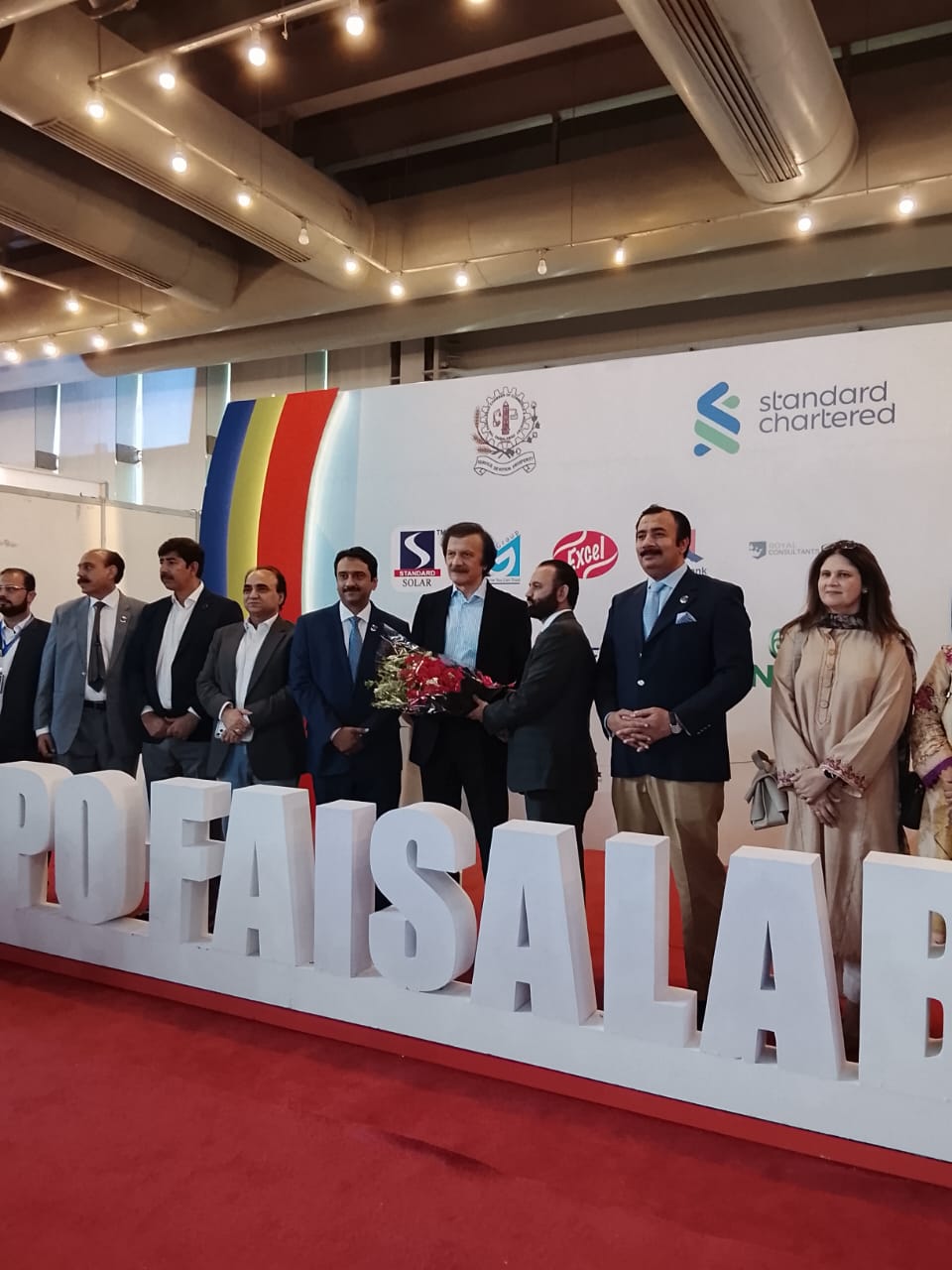
expo faisalabad 2026
|

Expo Faisalabad 2026’ a springboard for MSMEs: SAPM Haroon Akhtar Khan

LAHORE (July 25) – Special Assistant to the Prime Minister for Industries and Production Haroon Akhtar Khan has reaffirmed the government’s commitment to creating a robust and competitive ecosystem for Micro, Small and Medium Enterprises (MSMEs).

Speaking at “Expo Faisalabad 2026”, being held from July 24 to 26 at the Expo Center, Lahore, he emphasized that the sector remains central to Prime Minister Muhammad Shehbaz Sharif’s vision for sustainable economic growth, industrial development and export promotion.

He said Pakistan has militarily shown its prowess to the world and it’s time to show economic resilience and development.

He appreciated the efforts of the Faisalabad Chamber of Commerce & Industry (FCCI) for organizing the exhibition.

“Faisalabad is the industrial and textile heart of Pakistan and a major contributor to our exports and manufacturing sector. Platforms like Expo Faisalabad create valuable opportunities for entrepreneurs to showcase their products, build business partnerships and explore new markets,” he said.

The SAPM said the government has placed special emphasis on improving access to finance, promoting business formalization, enhancing exports and creating an enabling environment where entrepreneurs can innovate, invest and expand their businesses.

He appreciated SMEDA’s proactive engagement with the business community and its efforts to connect entrepreneurs with government support programmes through exhibitions and outreach activities across the country.

Earlier, CEO SMEDA Nadia Jahangir Seth said the Authority remains committed to supporting entrepreneurs through strategic partnerships and market-driven interventions.

“SMEDA believes that exhibitions such as Expo Faisalabad are powerful platforms for connecting entrepreneurs with opportunities, knowledge and government support services. Its participation reflects the commitment to promoting business formalization, improving competitiveness, facilitating market access and strengthening Pakistan’s MSME ecosystem through sustained engagement with the private sector,” she emphasized.

SMEDA has established a dedicated helpdesk where entrepreneurs and visitors are being briefed on the flagship initiatives, government support programmes and business development services. The helpdesk is also facilitating free registration of informal enterprises through the SME Registration Portal (SMERP), enabling businesses to formalize their operations and benefit from enhanced opportunities for growth, financing and market access.

As part of its capacity-building programme, SMEDA is conducting sessions on “Marketing Strategies for SMEs” and “Improving Product Quality for Export Markets”, equipping entrepreneurs with practical knowledge to improve competitiveness and strengthen their presence in domestic and international markets.

Expo Faisalabad 2026 has brought together leading manufacturers, exporters, investors, entrepreneurs and business support organizations to showcase Faisalabad’s industrial excellence and create new avenues for trade, investment and business collaboration.
Similar Posts

  • |

    Trump backs Infantino as FIFA power struggle intensifies

    WASHINGTON: US President Donald Trump has thrown his support behind embattled FIFA president Gianni Infantino, warning that removing the football chief would be a “terrible mistake” as opposition to Infantino grows within several major football confederations. Trump’s intervention came after UEFA, CONCACAF and the Asian Football Confederation (AFC) jointly criticised Infantino in an unusually strong open letter, accusing him of damaging trust and placing his authority above the wider football community. “If, for any reason, they even considered replacing President Gianni Infantino,” Trump said on Truth Social, “FIFA would be making a terrible mistake.” The US president described Infantino as “fantastic” and praised his leadership of the expanded 2026 World Cup, which was hosted by the United States, Canada and Mexico. Trump also argued that the tournament had been the most successful World Cup ever and warned that FIFA could struggle to maintain the same level of success and profitability without Infantino. The public backing is significant because Infantino is facing growing resistance over a controversial proposal to bring private investment into FIFA competitions, including the World Cup. The plan was eventually withdrawn after fierce opposition from European football authorities. UEFA had threatened to boycott future World Cups if the investment proposal went ahead, describing the arrangement as an opaque and questionable deal. The pressure ultimately played a major role in Infantino abandoning the plan. The FIFA president received renewed support from senior officials during an emergency meeting in Morocco last week. However, UEFA, CONCACAF and AFC dismissed that backing, arguing that the meeting did not address the concerns raised by the confederations. The three bodies accused Infantino of failing to uphold the principles of accountability and collective leadership. They stressed that football’s governing structure should not revolve around one individual. The dispute could have major consequences ahead of the FIFA presidential election scheduled for March 2027. Infantino, who has led FIFA for a decade, is seeking a fourth and final term. Candidates must declare their intentions by November 18. CONCACAF president Victor Montagliani is regarded as a potential challenger, although Infantino continues to enjoy support from several influential football bodies. The Confederation of African Football has backed him, while South American governing body CONMEBOL remains broadly supportive. Several individual national associations have also expressed support. However, FIFA’s voting system means individual member associations—not confederations—will ultimately decide the election. Infantino’s position had appeared secure after the successful 48-team World Cup, but the private investment controversy has dramatically changed the political landscape. The latest confrontation has therefore turned the road to the 2027 FIFA election into an increasingly intense power struggle, with Trump now openly backing Infantino while several major football authorities demand greater accountability and collective decision-making.

  • | |

    Naqvi makes surprise visit to NCCIA headquarters, …

    ISLAMABAD: Federal Interior Minister Mohsin Naqvi made an unannounced visit to the under-construction headquarters of the National Cyber Crime Investigation Agency (NCCIA) in Islamabad and expressed concern over the slow pace of development work. During his inspection, Naqvi reviewed the progress of the headquarters upgrade project and questioned officials about the delays. A worker informed the minister that only nine workers were currently assigned to the site and that construction activities had remained suspended for several days. Expressing dissatisfaction over the situation, Naqvi contacted the relevant authorities on the spot and instructed them to immediately accelerate construction work. He stressed the need for timely completion of the project and directed officials to ensure that progress was maintained. The surprise inspection comes as the government seeks to strengthen the country’s institutional capacity to tackle cybercrime through the NCCIA.

  • | | |

    Pakistan to lead new Turkey-Saudi defence pact

    ISLAMABAD: Pakistan is set to take the first three-year leadership of a new secretariat established under the defence agreement signed by Pakistan, Türkiye and Saudi Arabia in Makkah on Aug 7, giving Islamabad a prominent role in coordinating the emerging regional security framework. According to Turkish and international media reports, the secretariat will serve as the central mechanism for implementing decisions taken by the three countries and coordinating their growing defence cooperation. After Pakistan’s initial three-year term, leadership is expected to pass to Saudi Arabia and then Türkiye. The agreement is built around a collective-security principle under which an armed attack against one member would be regarded as an attack against all three. However, unlike NATO’s automatic response mechanism, the pact leaves the nature of any response to be determined according to the circumstances and the request of the affected country. A high-level council comprising foreign and defence ministers as well as military chiefs is also expected to oversee the arrangement. The council is expected to meet twice a year, while cooperation could range from intelligence sharing and logistics to direct military assistance when required. The partnership also places a strong emphasis on defence technology. The three countries plan to expand cooperation in unmanned systems, electronic warfare and artificial intelligence, alongside joint military exercises designed to improve coordination among their armed forces. Joint defence production, research and technology transfer are also part of the broader framework. For Pakistan, the first leadership term could prove strategically significant. Islamabad already maintains longstanding defence ties with both Ankara and Riyadh, and its role at the secretariat could give it greater influence in regional security diplomacy. Türkiye has stressed that the agreement is defensive and is not directed against any particular country. Turkish Foreign Minister Hakan Fidan said the pact is intended to strengthen regional security rather than replace existing alliances. With the Middle East facing continued instability, the new arrangement could become an important test of how effectively three regional powers can turn political solidarity into practical defence cooperation.

  • |

    IMF-backed move to End EPZ local sales Quota sparks concerns over textile recycling, jobs

    KARACHI: A proposed move to withdraw the permission allowing factories operating in Pakistan’s Export Processing Zones (EPZs) to sell up to 20% of their output in the domestic market has triggered concerns among exporters, investors and international textile-recycling organisations, who fear the policy could disrupt investment, employment and a wider global circular-economy supply chain. The controversy has emerged after Pakistan committed to the International Monetary Fund (IMF) that it would amend the existing rules governing EPZs and prohibit sales from these zones into the domestic tariff area. According to the IMF’s latest programme review, Pakistan has committed to introduce amendments aimed at ending domestic sales by EPZ-based manufacturers. The report states that the amendments were to be placed before the federal cabinet for approval by September 2026. However, exporters and industry representatives have challenged the move, arguing that the existing 80:20 arrangement was part of the investment and regulatory framework under which many businesses established operations in the zones. Under the existing system, EPZ manufacturers can export 80% of their production while selling up to 20% in Pakistan after payment of applicable duties and taxes. Industry stakeholders say the domestic-sale provision is particularly important for products that have limited commercial demand in overseas markets. The proposed abolition has also attracted attention in the United States because American companies supply raw materials and used textiles to Pakistani businesses operating in the EPZs. The US-based Secondary Materials and Recycled Textiles Association (SMART) has approached IMF Mission Chief to Pakistan Iva Petrova, warning that eliminating the domestic-sales provision could have consequences extending beyond Pakistan’s industrial sector. The association has argued that Pakistan occupies an important position in the global textile circular economy, particularly in the sorting, grading, reuse and recycling of used textiles collected in North America and Europe. According to SMART, used clothing and textile materials collected in the United States, Canada and European countries are sent to Pakistan, where they are sorted and graded before being channelled into reuse, recycling, manufacturing and affordable consumer markets. The association has warned that ending the 80:20 mechanism could reduce demand for recovered textiles and place downward pressure on their prices. Such a development, it said, could weaken textile-collection programmes in North America and reduce the income generated by charitable organisations from donated clothing. Organisations including Goodwill, the Salvation Army and St Vincent de Paul depend partly on revenues generated from donated goods to finance a range of social programmes, including workforce training, employment assistance, food support, recovery services, youth programmes and housing assistance. SMART has therefore cautioned that a major disruption in Pakistan’s used-textile market could have financial consequences for charitable organisations in North America, with potential losses running into tens of millions of dollars. The association also warned that reduced demand for used textiles could ultimately result in a greater volume of reusable material being sent to landfills or incinerators rather than being recycled or reused. US exporters raise objections US exporters have also expressed concern over the proposed withdrawal of the 20% domestic-sale allowance. Their concerns are significant because American suppliers form part of the upstream supply chain that feeds Pakistani recycling and manufacturing units located in EPZs. Abid Iqbal, representing Nashmia Industries, said during Express News programme The Review that US exporters had communicated their concerns to Pakistani counterparts. According to Iqbal, US exporters had also been told informally that the IMF itself had not initiated the proposal to remove the 20% quota. The development has consequently raised questions within the industry about how the condition was incorporated into Pakistan’s commitments under the IMF programme and whether sufficient consultation took place with affected stakeholders. Industry representatives have also warned of possible legal and contractual disputes, maintaining that the 20% domestic-sales provision was part of the regulatory and investment framework under which businesses made their investment decisions. They argue that companies entered the zones with an understanding that they would be able to export the bulk of their production while disposing of a limited portion in the domestic market after meeting applicable tax and customs obligations. EPZ rules and proposed amendment The Export Processing Zones Authority (EPZA) operates under the legal framework established through the EPZ Act of 1980. The law enables the establishment of export processing zones with approval from the federal government. Under Rule 228(5) of the Customs Rules, EPZ-based factories have historically been allowed to sell up to 20% of their production in the domestic tariff area, subject to applicable duties and taxes. A higher limit of 30% had been applicable to the Resalpur area. EPZA has reportedly forwarded a proposal to the Federal Board of Revenue (FBR) to eliminate the 20% quota from October 1 in line with the IMF-related commitment. The proposal, however, has exposed differences within the government over the scope and interpretation of the IMF condition. Proceedings of the Senate Standing Committee on Industries held last month indicate that the Ministry of Industries and Production maintained that abolition of the 20% domestic-sales quota was not included in the original IMF agreement. According to the ministry’s position, the initial IMF requirement was restricted to preventing the introduction of new fiscal incentives, including tax concessions and subsidies, rather than immediately eliminating the existing domestic-sales mechanism. The ministry has reportedly argued that the later addition of the quota-related condition requires further clarification. Assessment of EPZs The issue is also linked to an assessment of Special Economic Zones (SEZs) and EPZs that Pakistan was required to undertake under the IMF programme. The government engaged consultancy firm AT Kearney to assess the zones and determine whether their operations were creating distortions in the domestic market. According to records presented before the Senate Standing Committee on Industries, the assessment completed last year concluded that EPZs were not creating significant market distortions. The report, according to the parliamentary proceedings, did not recommend withdrawing existing fiscal incentives. The issue has therefore become a point of discussion between government officials and the IMF as authorities seek to reconcile the lender’s programme requirements with

  • | |

    Wedding joy turns to mourning, Rickshaw falls into…

    Muzaffargarh: A wedding celebration turned into a tragedy after an overloaded rickshaw carrying members of a wedding party plunged into a canal on Monday evening, leaving at least seven people dead and several others missing. According to rescue officials, the incident occurred when the rickshaw, which was carrying a large number of passengers including women and children, reportedly lost control while travelling along the canal-side road. The vehicle skidded off the road and fell into the water. Local residents and rescue divers immediately launched an operation to search for the passengers. Nine people were rescued alive and shifted to a nearby hospital for medical treatment. Some of those rescued were reported to be in critical condition. Rescue teams have so far recovered the bodies of seven people. The deceased have been identified as 14-year-old Dilawar, son of Abdul Rasheed; seven-year-old Muneeb, son of Rashid; 58-year-old Sakina Bibi, wife of Allah Ditta; 15-year-old Sameera Bibi, daughter of M Shafiq; M Saim, son of M Iqbal; seven-year-old M Sabtain, son of Musharraf; and nine-year-old Raju, son of M Iqbal. Several passengers are still believed to be missing. Those reported missing include M Bilal, son of M Iqbal; M Yasir, son of Fida Hussain; M Ali, son of M Shafiq; Usman, son of Ghulam Fareed; Shakir, son of Ashiq Hussain; Hassnain, son of Musharraf Ali; Iqbal Bibi, daughter of Fida Hussain; Kaleem Ullah, son of Basheer Ahmad; and Zareef, son of Wazeer Ahmad. The rickshaw was reportedly carrying far more passengers than its permitted capacity, raising concerns about dangerous overloading. Rescue teams continued their search operation on Tuesday as authorities feared the death toll could increase. The incident has cast a pall of grief over the families of the wedding party, with relatives anxiously awaiting information about their loved ones as the recovery operation continues.

  • | |

    Jason Kelce says one detail made Taylor Swift and …

    Jason Kelce has shared fresh details about his brother Travis Kelce’s wedding to Taylor Swift, revealing the one aspect of the ceremony that left him genuinely amazed. The former Philadelphia Eagles star spoke candidly during a radio interview about the couple’s lavish yet remarkably private wedding, describing it as an unforgettable celebration despite the immense public interest surrounding the pair. According to Jason, the most remarkable part of the wedding was not the celebrity guest list or the grand venue—it was the fact that almost no legitimate photos from the ceremony have surfaced online. Considering Taylor Swift and Travis Kelce are among the world’s most recognizable celebrities, Jason admitted he never expected the event to remain so private. “I haven’t seen one real photo,” Jason said, adding that he was genuinely surprised by how successfully the couple managed to protect their special day from leaks. He praised everyone involved for respecting the newlyweds’ privacy, calling the achievement “remarkable.”  The wedding reportedly took place earlier this month at Madison Square Garden, where around 1,000 guests gathered to celebrate the couple. Despite the scale of the event and the presence of numerous high-profile celebrities, attendees largely honored the couple’s request to keep the ceremony intimate and away from the public eye. Jason said creating a secure and personal atmosphere was clearly a priority for Taylor and Travis, and he believes they accomplished exactly that.  Jason also reflected on the emotional side of the celebration. Serving as his brother’s best man, he admitted that he probably cried more during Travis’ wedding than he did at his own, joking that his wife, Kylie Kelce, might not appreciate hearing that. He described the ceremony as “more than a 10 out of 10” and said seeing his brother so happy made the occasion even more meaningful.  The wedding reportedly featured a star-studded guest list, heartfelt vows and a ceremony that balanced elegance with warmth. While many details remain under wraps, Jason’s comments suggest the privacy surrounding the event may ultimately become one of its defining features. In an era where celebrity moments often appear online within minutes, Taylor and Travis managed to keep one of the biggest weddings of the year almost entirely out of the public eye.  For Jason, that accomplishment is what made the celebration truly special. Rather than becoming another viral spectacle, the wedding remained exactly what the couple intended—a deeply personal moment shared with family and close friends.

Leave a Reply

Your email address will not be published. Required fields are marked *