zhu rongji chinese
| | | |

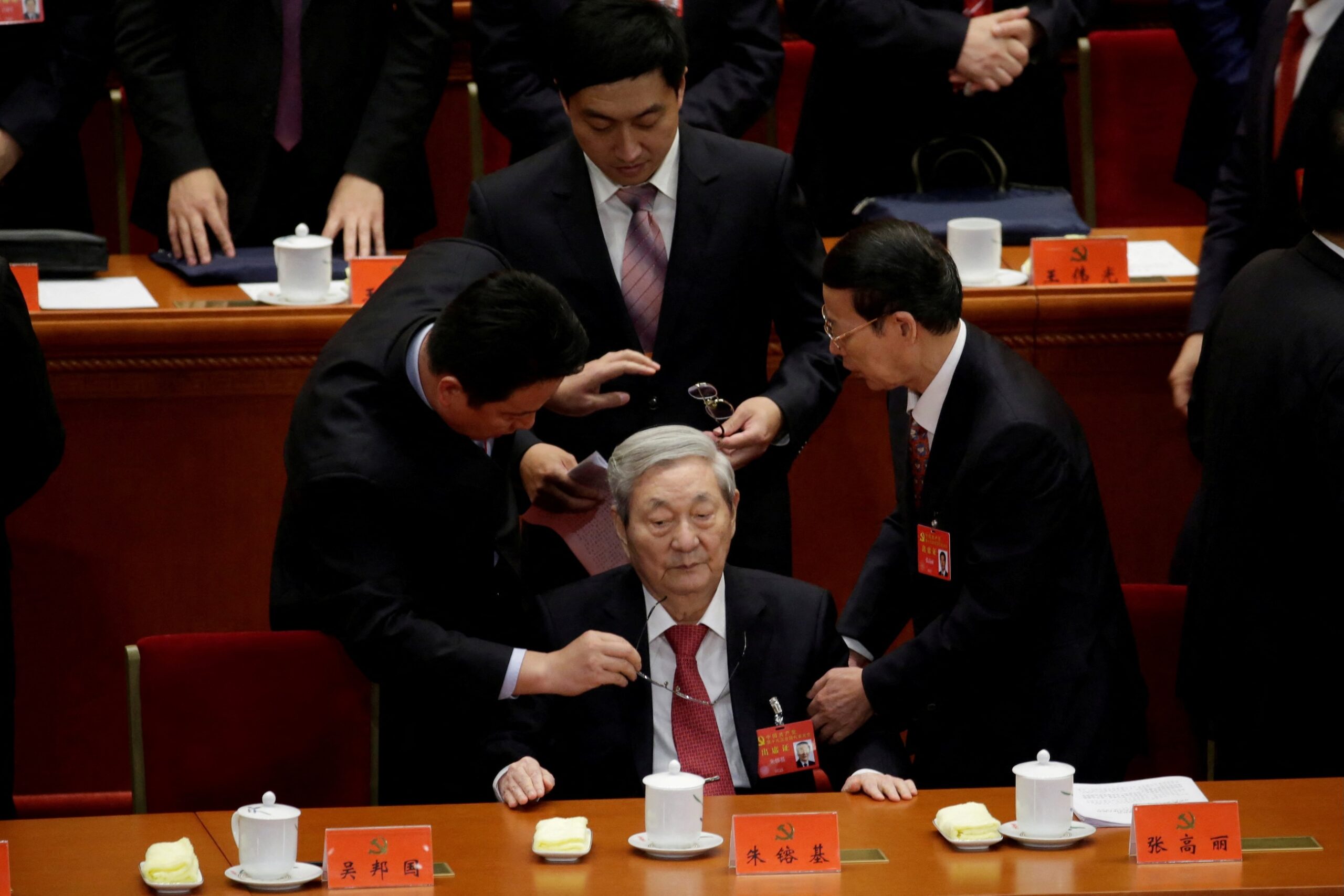
Zhu Rongji, Chinese premier who cajoled economy into modern era, dies at 97

BEIJING, China – Former Chinese premier Zhu Rongji, who died on Wednesday, August 12, aged 97, was never one to mince his words.

When the four-volume selection of his speeches came out in 2011, they shocked readers with his description of “tofu dregs” flood dykes built by “parasites,” and erring bankers labeled as “half-wits.”

It was little wonder that his blunt comments from his years in power became bestsellers, finding eager readers in a nation whose then leaders were seen as wary and cautious, prone to often bland public pronouncements.

Yet the reaction to Zhu’s speech selection from his time as vice premier from 1991 to 1998 and then as premier until early 2003 also reflected deeper anxieties coursing through China as it approached a transition that ushered in Xi Jinping as leader.

Reformist former officials and intellectuals held up the 2,042 pages of Zhu’s words, many made public for the first time, as an unflattering mirror to the conservatism and conformism of current leaders. Magazine editors and internet users scoured the volumes for any comments that offer a message for the present.

Indeed, many of the problems that dogged China’s economy as Xi prepared to take power dominated “The Authentic Speeches of Zhu Rongji”: local government debt and reckless bank loans, inflation and feverish urban growth, and corruption devouring public trust and coffers.

“Our country faces many potential crises that could erupt at any time,” Zhu said early in 1998. “Ordinary people are discontent about us in many ways. Especially, there is corruption among officials, the gulf between rich and poor, and the way some local officials act like tyrants.”

Zhu graduated from Beijing’s elite Tsinghua University, joining the Communist Party in 1949, the same year Mao Zedong declared the People’s Republic of China.

Sent to the countryside during the chaos of the Cultural Revolution, he gradually worked his way up through the ranks after being politically rehabilitated, and was appointed Shanghai mayor in 1987, overseeing its first steps into becoming the global financial hub it is today.

Moving to Beijing in 1991 to work for the central government, he helped push the reforms that transformed China from a beleaguered holdout against the collapse of Soviet-style Communism in the early 1990s to an emerging superpower with economic growth rates envied by other governments.

Zhu dragged back the Chinese economy from overheating in the early 1990s, and then as premier pushed through reforms that shut or privatized many state-owned firms and laid off workers, wrenched tax power from local officials to the central government, and launched housing ownership reforms that gave birth to a feverish real-estate boom.

Above all, Zhu coaxed and cajoled China’s way into the World Trade Organization in 2002 through grueling negotiations. At the time, many Chinese officials feared he had made so many concessions to gain entry that China’s economy would be hobbled.

By no means did all Chinese observers think Zhu’s tenure was an unalloyed success. Some said missteps in grains policy, tax distribution and state factory shutdowns left messes that his successors had to clean up in quieter ways.

Zhou Ruijin, a former senior editor of the People’s Daily, the Communist Party’s official newspaper, suggested in a 2011 interview that the leaders likely to succeed then-president Hu Jintao and then-premier Wen Jiabao had much to learn from Zhu.

“The Zhu Rongji era was one of promoting big reforms, and it nurtured a group of brave risk-takers who were at the forefront of pioneering a market economy,” Zhou, a cheerleader for rapid market reforms in the 1990s, said in an interview with South Breeze Window, a historically pro-reform magazine published in south China.

“Today…there is still potential for big steps in reform.” – Rappler.com

Similar Posts

  • | | |

    Ukrainian Ambassador Visits Pattaya to Strengthen Ties and Boost Tourism Cooperation

    Pattaya, July 23rd, 2026 – Mayor Poramese Ngamphichet of Pattaya City, together with city executives and heads of government departments, welcomed H.E. Mr. Viktor Semenov, Ambassador of Ukraine to Thailand, and his delegation at Meeting Room 132 of Pattaya City Hall. The visit was to discuss avenues for cooperation and further strengthen bilateral relations between […]

  • | |

    India’s Education Minister resigns amid exam controversy

    India’s Union Education Minister Dharmendra Pradhan resigned on Saturday amid growing pressure over a nationwide controversy involving alleged examination paper leaks. His resignation comes after weeks of protests by students and opposition parties. Demonstrators have demanded greater accountability and changes to the country’s examination system. The controversy has intensified criticism of the government’s handling of the issue. Students and opposition leaders have called for stronger measures to prevent examination irregularities and protect the credibility of competitive exams. Pradhan’s departure marks a significant development for Prime Minister Narendra Modi’s government as pressure continues to mount over the examination crisis. The resignation is expected to fuel further debate over examination reforms, transparency and accountability in India’s education system. Earlier, Indian Prime Minister Narendra Modi has pledged to establish fast-track courts to swiftly punish officials involved in examination paper leaks, attempting to contain a widespread youth-led protest movement that has rocked New Delhi and disrupted Parliament. Posting on X in his first public remarks on the crisis, Modi declared that “those who try to harm the future of our youth will not be spared”. The satirical “Cockroach Janta Party” (CJP), coined after India’s top judge reportedly likened unemployed youths to “cockroaches”, promptly rejected Modi’s proposal as a superficial “Band-aid” measure. The CJP continues to demand educational reforms and the immediate resignation of Education Minister Dharmendra Pradhan, who has faced intense pressure following 152 recorded paper leaks over the past decade.

  • US and Saudi forces launch joint precision strikes on Iranian-backed targets in eastern Iraq

    Joint military operations between United States fighter jets and the Saudi Arabian Armed Forces targeted multiple logistics and weapons facilities belonging to Iranian-aligned armed groups across eastern Iraq, US Central Command confirmed in an official statement. The coordinated air raids were conducted in direct retaliation to more than thirty Iranian-directed aerial drone attacks launched over a seventy-two-hour period. Central Command specified that the targeted militia groups acted under the explicit direction of Iran’s Islamic Revolutionary Guard Corps to strike American troop installations and Saudi energy infrastructure. While American military officials confirmed that recent strikes against US assets were successfully defended without casualties, the Saudi Ministry of Defense cited international self-defence provisions under Article 51 of the United Nations Charter, noting that the aerial campaign directly addressed drone incursions originating from Iraqi territory against petroleum facilities in eastern Saudi Arabia and Riyadh. The joint intervention signals a notable strategic escalation for Saudi Arabia, which had previously sought to limit direct military involvement despite recurring proxy threats along its borders and maritime trade corridors. Central Command noted that Iranian-backed militias in Iraq attempted over six hundred attacks against US personnel and facilities between February and April alone, warning that failure to cease offensive operations would trigger further military action. In response to the bombings, representatives for Iraq’s Popular Mobilization Forces reported casualties and structural damage across several headquarters, condemning the strikes as a severe violation of Iraqi national sovereignty.

  • |

    Planning a trip to Russia? Visit Russia offers all-in-one travel platform

    Planning a trip to Russia has become easier with Visit Russia, a comprehensive digital travel platform designed for international tourists. Available through both a website and mobile application, the platform aims to make travel planning simpler, more organised and enjoyable. Powered by artificial intelligence, Visit Russia provides a range of services to help travellers prepare for their journey. From creating personalised itineraries and accessing reliable travel information to booking flights, hotels, travel insurance and airport transfers, the platform brings essential travel services together in one place. Through the Visit Russia website, travellers can explore some of the country’s most attractive destinations, including Moscow, St Petersburg, Kazan and Sochi, and begin planning their trips. The platform also offers information about Russia’s world-famous historical landmarks, grand museums, cultural centres, scenic landscapes and popular travel routes. Alongside destination guides, visitors can access practical information and useful travel tips designed to make their journeys easier, safer and more enjoyable. Whether travelling to Russia for leisure, business or cultural exchange, Visit Russia aims to serve as a digital travel companion throughout the journey. The platform supports travellers from the initial planning stage to their stay in Russia, helping them make their trips more convenient, meaningful and memorable. International visitors can explore destinations, plan itineraries and access travel-related services through the Visit Russia platform. Visit Russia: https://visitrussia.online/

  • |

    Taliban seeks improved ties with Pakistan

    The Taliban administration has expressed its desire to reduce tensions and improve relations with Pakistan, saying that continued disputes serve the interests of neither country. Taliban spokesperson Zabihullah Mujahid said both sides should work to resolve outstanding issues through dialogue and cooperation. He noted that the closure of border crossings and restrictions faced by Afghan traders have contributed to strained relations and disrupted bilateral trade. Mujahid said the Taliban wants these issues to be addressed to facilitate smoother cross-border movement and strengthen economic ties between the two neighboring countries. He also acknowledged that trade with Pakistan has been affected in recent months, adding that Afghanistan has increased its economic engagement with Iran while pursuing new projects aimed at developing the country’s mineral resources. However, analysts have raised concerns over the transparency of some of the reported mining agreements and questioned whether sufficient oversight and accountability mechanisms are in place. The remarks come at a time when Pakistan and Afghanistan continue to face challenges in bilateral relations, including border management, trade disruptions and broader security concerns.

  • | | | |

    Iran, Oman move closer to Hormuz shipping agreement

    TEHRAN: Iran and Oman have reached a preliminary understanding on the geographic coordinates of a proposed shipping route through the Strait of Hormuz, marking progress in negotiations aimed at regulating navigation through one of the world’s most strategically important waterways. Iranian Foreign Ministry spokesperson Esmaeil Baghaei said discussions between Tehran and Muscat had advanced positively and that both sides had agreed on the geographical framework of the proposed route. He added that a joint statement outlining the key points of the understanding was in its final stages and could be issued if the process is not disrupted by external factors. Despite the progress, Baghaei emphasised that the agreement alone would not automatically guarantee security in the Strait of Hormuz. He noted that ensuring stability in the region would require broader cooperation and continued diplomatic engagement. According to regional officials familiar with the negotiations, the proposed arrangement would give Iran a greater role in overseeing vessels entering the Gulf through the strategic waterway. However, several technical and operational issues still need to be resolved before any final agreement can be implemented. The Strait of Hormuz remains one of the world’s busiest energy transit routes, carrying a significant share of global oil and gas exports. Any changes to shipping arrangements in the area are closely watched by international markets due to their potential impact on global trade and energy supplies. Officials involved in the negotiations described the talks as constructive, while indicating that further consultations would continue before a formal announcement is made. Both Iran and Oman have maintained that dialogue remains the preferred path for addressing issues related to maritime navigation and regional stability.

Leave a Reply

Your email address will not be published. Required fields are marked *