fuel price hike
| |

Fuel price hike again on August 18 after last week’s rollback

MANILA, Philippines – Fuel prices are going up again starting Tuesday, August 18, after last week’s rollback as fuel markets remain volatile.

In a press conference on Monday, August 17, Energy Secretary Sharon Garin announced the following fuel price adjustments for the week of August 18 to 24:

  • Gasoline – increase of P2.49 per liter
  • Diesel – increase of P3.84 per liter
  • Kerosene – increase of P5.01 per liter
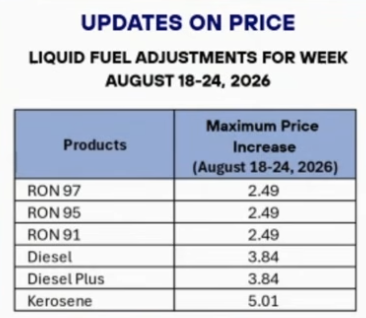
The adjustments will take effect on Tuesday, August 18.

The latest increase follows last week’s fuel price rollback, when oil firms cut pump prices by P4.70for gasoline, P4.30 per liter for diesel, and P4.88 per liter for kerosene.

That rollback had offered motorists some relief after the steep fuel price hikes in late July. On July 28, pump prices rose by P6.80 per liter for gasoline, P7.32 per liter for diesel, and P4.22 per liter for kerosene. A week earlier, on July 21, gasoline rose by P3.65 per liter, diesel by P10.68 per liter, and kerosene by P11.77 per liter.

The latest hike shows how quickly domestic pump prices can swing as global crude and refined fuel markets react to shifting supply conditions, foreign exchange movements, and geopolitical risks.

The DOE’s oil monitor as of August 11 showed that Dubai crude prices decreased by around $1.10 per barrel during the August 3 to 7 trading period. International prices of gasoline, kerosene, and diesel also declined by around $10.80 per barrel, $10.20 per barrel, and $10.20 per barrel, respectively.

Those declines were partly driven by expectations of a possible US-Iran agreement that could restore normal shipping flows through the Strait of Hormuz and ease supply concerns. But the DOE said risks remained, with shipping activity through the Strait still subdued and continued attacks on vessels in the Red Sea raising concerns over maritime security.

Diesel also remains vulnerable to tight regional supply. The DOE said middle distillate stocks in the Amsterdam-Rotterdam-Antwerp region fell to their lowest level since July 2022, while strong distillate margins and low inventories were expected to continue supporting diesel prices.

Despite last week’s rollback, local pump prices remain well above levels seen before fighting involving Iran and US-Israeli forces broke out on February 28. In the last full week before the conflict, DOE data showed common retail prices in Metro Manila at P56 per liter for gasoline RON95, P54.70 per liter for gasoline RON91, P55 per liter for diesel, and P83.47 per liter for kerosene.

The Philippines is a net importer of petroleum products, making local pump prices vulnerable to global oil price swings, foreign exchange movements, regional refined fuel prices, and disruptions in international supply routes. – Rappler.com


Similar Posts

  • |

    Goods transport strike threatens Pakistan’s industry

    KARACHI: A nationwide strike by goods transporters has triggered growing concern among industrialists, who fear that a prolonged disruption in cargo movement could disrupt factory operations, delay export shipments and add further pressure to Pakistan’s already fragile economy. Business leaders have warned that the continued suspension of freight services could create serious bottlenecks in the supply chain, particularly for industries that rely on the regular movement of raw materials and intermediate goods. Any prolonged shortage of essential inputs could force factories to slow down production or temporarily shut operations. The industrial sector is also facing the risk of delays in the delivery of finished products to domestic markets and international buyers. Export-oriented industries, in particular, could suffer if consignments fail to reach ports or overseas customers within agreed timelines. President of the SITE Association of Industry (SAI) Abdul Rehman Fudda said the transporters’ strike had created a critical situation for the manufacturing sector, as industries could not maintain uninterrupted production without a reliable logistics network. He said factories depended on the timely arrival of raw materials and the smooth transportation of finished goods. Any disruption in freight movement, he added, could interrupt production schedules and increase costs for manufacturers. Fudda warned that the impact of the strike could extend beyond factories, affecting workers, suppliers, exporters, retailers and other businesses linked to the industrial supply chain. He pointed out that Pakistan’s export sector was already operating under significant pressure because of high production costs and other economic challenges. A disruption in transportation, he said, would further increase the difficulties faced by exporters. The SAI president cautioned that delays in export shipments could have financial as well as reputational consequences. International buyers may impose penalties, demand price reductions or seek compensation when shipments fail to arrive within agreed deadlines. According to him, exporters operate under strict delivery schedules, and even a temporary disruption in logistics can affect production planning, container bookings and shipment arrangements. Fudda stressed that the consequences of the strike should be assessed from a broader economic perspective rather than being viewed solely as a dispute between transporters and other stakeholders. He said an interruption in the movement of goods could affect the entire supply chain, from the procurement of raw materials to the manufacturing process and eventual delivery of products to customers. The industrialist further warned that repeated delays in fulfilling export orders could undermine the confidence of foreign buyers and make it more difficult for Pakistani businesses to retain existing international contracts or secure new orders. Industrialists have therefore urged the relevant authorities and representatives of goods transporters to resolve their differences at the earliest and restore the movement of cargo across the country. They maintained that an uninterrupted logistics system was essential for keeping factories operational, protecting jobs, meeting export commitments and supporting economic activity. Business leaders also called for a sustainable resolution to the issues behind the transporters’ strike so that similar disruptions could be avoided in the future. They said uncertainty in the movement of goods not only affects individual industries but can also have wider implications for investment, exports, government revenue and overall economic growth. With industries already facing a challenging business environment, manufacturers fear that a prolonged transport shutdown could further increase operational costs and compound supply-chain problems. They urged the authorities to prioritise negotiations and ensure the resumption of freight services without further delay.

  • Thailand Freezes Cooking Gas Prices to Shield Families as Oil Debt Soars

    BANGKOK – Thailand will keep the cost of household cooking gas locked at 423 baht for a standard 15-kilogram cylinder. This helpful price freeze will last until October 31 to help local families manage their daily living costs. Furthermore, the government wants to stop food and essential service prices from jumping higher. However, this popular […]

  • | |

    US appeals court allows thousands of social media …

    SAN FRANCISCO: A US appeals court has cleared the way for thousands of lawsuits against major social media companies, including Meta Platforms, Google parent Alphabet, TikTok owner ByteDance and Snap, rejecting an attempt by the technology firms to use federal online protections to halt litigation over allegations that their platforms are deliberately designed to keep young users hooked. The ruling was issued Monday by the 9th US Circuit Court of Appeals, which declined to immediately consider an appeal filed by Meta and TikTok challenging a lower court decision that had allowed more than 3,000 lawsuits to continue in federal court. The lawsuits, brought by parents, children, school districts, local governments and state authorities, accuse social media companies of designing products and features that encourage excessive use among children and teenagers. Plaintiffs argue that the companies were aware of potential risks associated with prolonged social media use but failed to adequately protect young users or warn families about those risks. At the center of the companies’ legal argument is Section 230 of the Communications Decency Act of 1996. The law generally protects online platforms from being held liable for content created and posted by their users. Meta and TikTok argued that the protection should also prevent lawsuits alleging that the companies failed to warn users about the allegedly addictive characteristics of their platforms. However, the appeals court determined that the companies had sought appellate review too soon. The court said Section 230 provides a defense against liability but does not give companies immunity from having to defend themselves in litigation. As a result, the companies cannot use the current appeal to stop the cases from proceeding through the lower courts. Meta’s attempt to delay multistate trial rejected The appeals court also rejected Meta’s request to postpone a major trial involving 29 US states. The case, brought by state attorneys general, accuses Meta of unlawfully collecting and using information relating to children, designing its platforms to encourage young users to remain engaged for extended periods and making misleading statements concerning the safety of its services. Meta had sought to delay the trial while its appeal concerning Section 230 was pending. The court rejected that request, meaning the proceedings can move forward as scheduled. The development represents another significant legal challenge for Meta, which has faced growing scrutiny from regulators, lawmakers and families over the impact of its platforms on children and teenagers. A Meta spokesperson declined to comment on the appeals court’s decision. TikTok representatives did not immediately respond to requests for comment. Lawyers say trials could reveal what companies knew Attorneys representing thousands of individuals and school districts involved in the federal litigation welcomed the ruling. Lawyers Lexi Hazam and Previn Warren said the decision would allow the multistate case to proceed and would also clear the path for a separate trial involving school districts that is scheduled for February. The attorneys said court proceedings could provide the public with evidence about what social media companies knew regarding the potential effects of their products on children, when they became aware of those concerns and how they responded. The lawsuits have become part of a much broader legal battle in the United States over the responsibilities of technology companies toward minors. Plaintiffs contend that social media platforms can contribute to serious problems among young people, including anxiety, depression, eating disorders and concerns about body image. They argue that companies intentionally use features such as recommendation algorithms, notifications and engagement mechanisms to encourage repeated and prolonged use. The technology companies have generally denied allegations that they deliberately designed their platforms to harm children. Thousands of cases consolidated The federal lawsuits have been centralized before US District Judge Yvonne Gonzalez Rogers in Oakland, California. The cases involve claims brought by a wide range of plaintiffs, including families, school districts, municipalities and state governments. They seek financial damages, penalties and other forms of relief from the technology companies. Meta and TikTok previously appealed rulings issued by Judge Rogers in 2023 and 2024 that largely permitted the litigation to continue. The companies also face hundreds of similar cases in state courts. Around 3,300 related cases have been consolidated in California state court, underscoring the scale of the legal challenge confronting the social media industry. Jury verdict adds pressure on technology companies The latest appeals court decision comes after several significant courtroom developments involving the alleged impact of social media on young users. In March, a Los Angeles jury found Meta and Google negligent in connection with claims that their social media products were designed in ways that could harm young people. The jury awarded $6 million to a young woman who said she became addicted to Instagram and YouTube after using the services as a child. The verdict was closely watched because it represented an early test of how juries may respond to similar allegations against major technology companies. Meta and Google have denied wrongdoing in the case and said they intend to appeal. New Mexico ruling increases scrutiny Meta has also suffered a major legal setback in New Mexico. A judge in the state recently ruled that the company had created a public nuisance and ordered it to pay $567 million into a fund intended to support teen mental-health initiatives, while also requiring the company to implement additional measures aimed at protecting young users. The New Mexico proceedings followed an earlier stage of litigation in which a jury found that Meta had misled consumers about the safety of its platforms and ordered the company to pay $375 million. Meta has rejected the allegations and indicated that it will challenge the findings through the appeals process. The growing number of lawsuits reflects increasing pressure on social media companies in the United States to explain how their platforms are developed, marketed and operated for younger audiences. The latest 9th Circuit decision does not resolve whether Meta, Google, TikTok or Snap will ultimately be held liable. Instead, it allows the underlying lawsuits to continue, potentially setting the

  • | | |

    PRL and SSGC face Senate anger over missing inform…

    Islamabad: State owned petroleum companies Pakistan Refinery Limited (PRL) and Sui Southern Gas Company (SSGC) faced serious criticism in the Senate after lawmakers expressed dissatisfaction over missing information, failure to follow committee directions and concerns about company management. The Senate Standing Committee on Petroleum questioned the performance and accountability of government owned petroleum companies and considered taking strict action against officials who failed to cooperate with parliamentary oversight. During the meeting chaired by Senator Umer Farooq, the committee reviewed the appointment criteria for chairpersons and managing directors of petroleum companies, the structure of their boards and progress on previous committee recommendations. The committee took serious notice of the absence of the Managing Director of Pakistan Refinery Limited during the meeting. Members expressed concern that PRL, despite being a state-owned company, did not provide the required information to the committee. The committee considered initiating a privilege motion against the Managing Director of PRL for failing to appear and provide necessary details. The Petroleum Division was directed to submit complete information about the boards of directors and senior management of all government owned petroleum companies. The committee said transparency in leadership appointments and company management is necessary because these organisations deal with matters directly linked to the national economy and public interest. The committee also expressed dissatisfaction over the performance of Sui Southern Gas Company and its failure to implement previous recommendations. Members said SSGC had not provided details of its board of directors despite earlier instructions. The committee also raised concerns over remarks made by SSGC that were considered discouraging toward the Senate Standing Committee’s role in discussing important matters. The committee considered moving a privilege motion against SSGC over non compliance with its directions. The Petroleum Division was further directed to review the tenure of board members who have remained in positions beyond the approved period and submit a detailed report. The committee also raised concerns over the absence of performance audits of oil rigs. Authorities were directed to provide the required audit report within seven days so that the committee could review the performance and efficiency of petroleum sector operations. Members said proper audits are necessary to identify problems, improve production and ensure better use of national resources. The committee also reviewed issues related to LPG quotas and licensing. The Oil and Gas Regulatory Authority was directed to hold consultations with all relevant stakeholders and submit a detailed report to the committee. Senators stressed that petroleum companies must improve governance, follow parliamentary instructions and ensure public institutions operate with transparency. The committee said accountability in state owned petroleum companies is essential to protect national interests and improve confidence in the energy sector.

Leave a Reply

Your email address will not be published. Required fields are marked *