fuel prices rise
| |

Fuel prices rise again with big hike on September 22

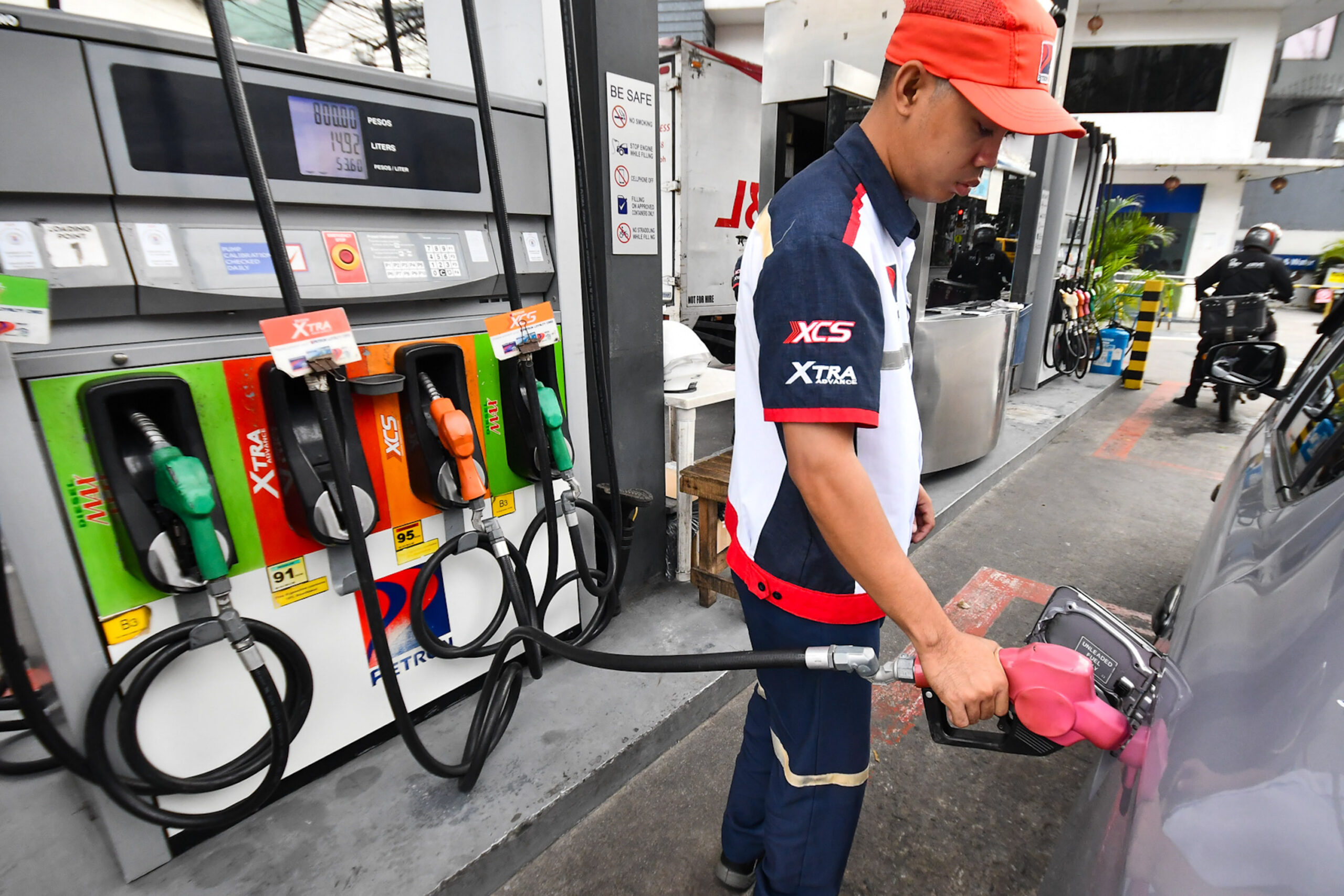
MANILA, Philippines – Fuel prices are going up again starting Tuesday, September 22, continuing a run of pump price increases as tight global supply and continuing Middle East tensions keep petroleum markets under pressure.

In a press conference on Monday, September 21, Energy Secretary Sharon Garin announced the following fuel price adjustments for the week of September 22 to 28:

  • Gasoline – increase of P4.88 per liter
  • Diesel – increase of P8.82 per liter
  • Kerosene – increase of P6.47 per liter

The adjustments will take effect on Tuesday, September 22.

Before the latest adjustment, the Department of Energy’s (DOE) price monitoring showed common retail prices in Metro Manila at P91.40 per liter for gasoline RON95, P83.10 per liter for gasoline RON91, P94.50 per liter for diesel, and P124.50 per liter for kerosene for the week of September 15 to 21.

The latest increase follows last week’s big fuel price hike, when gasoline prices rose by P5.68 per liter, diesel by P4.31 per liter, and kerosene by P4.62 per liter.

The continuing increases come as physical fuel supplies remain tight despite efforts by Saudi Arabia to restore some of its export capacity. Saudi Arabia has been working to bring part of its East-West pipeline capacity back online and offer additional cargoes to Asian refiners, helping ease some of the most severe price pressures seen earlier in the week.

But supply risks remain. Vessel traffic through the Strait of Hormuz continues to be constrained, while continuing tensions involving Saudi Arabia and Yemen’s Houthis threaten energy infrastructure and shipping through the Red Sea. 

The government, meanwhile, is considering another round of fuel tax relief. Last week, the DOE formally certified that the one-month average price of Dubai crude reached $99.41 per barrel from August 13 to September 11, well above the $80-per-barrel threshold that allows the government to consider suspending or reducing excise taxes on petroleum products. (READ: DOE sees ‘no signs’ oil prices will fall as excise tax relief goes on table)

The Development Budget Coordination Committee is still finalizing its recommendation on possible excise tax relief, which will be submitted to President Ferdinand Marcos Jr. for approval. The Department of Finance earlier said it was prepared to propose a suspension of excise taxes on liquefied petroleum gas and kerosene.

Local pump prices also remain far above levels seen before fighting involving Iran and US-Israeli forces broke out on February 28. In the last full week before the conflict, DOE data showed common retail prices in Metro Manila at P56 per liter for gasoline RON95, P54.70 per liter for gasoline RON91, P55 per liter for diesel, and P83.47 per liter for kerosene.

The Philippines is a net importer of petroleum products, making local pump prices vulnerable to global oil price swings, foreign exchange movements, regional refined fuel prices, and disruptions in international supply routes. – Rappler.com


Similar Posts

  • Major Fuel Smuggling Ring Exposed at Chiang Rai-Myanmar Border

    CHIANG RAI – Thai law enforcement officials have exposed a massive fuel smuggling operation operating along the Mekong River. Smugglers have successfully bypassed a national export ban by using falsified shipping documents. The illegal operation has rerouted tens of millions of liters of fuel directly into Myanmar. National Police Deputy Chief General Thatchai Pitaneelaboot led […]

  • |

    Gold prices hold steady at Rs461,936 per Tola

    KARACHI: Gold prices in Pakistan remained unchanged on Tuesday, with the price of one tola of 24-karat gold holding at Rs461,936, according to the latest rates released by the All-Pakistan Gems and Jewellers Sarafa Association (APGJSA). The local bullion market remained relatively calm after gold recorded a notable increase in the previous trading session. On Monday, the price of gold had risen by Rs2,000 per tola, bringing it to Rs461,936. The price of 10 grams of 24-karat gold also remained unchanged at Rs396,035 on Tuesday. In the international market, gold prices showed little movement, with the benchmark rate standing at $4,395 per ounce, including a $20 premium. The stability in global bullion prices contributed to the lack of significant movement in domestic gold rates. Market participants continue to closely monitor international developments, particularly movements in the US dollar, expectations surrounding global interest rates and geopolitical developments, all of which can influence demand for the precious metal. Meanwhile, silver prices moved in the opposite direction in the domestic market. The price of silver declined by Rs43 per tola, settling at Rs6,986 per tola.

  • |

    Pakistan refineries ready to sign long-delayed upgrade agreements 

    Pakistan’s oil refineries have agreed to move ahead with long-delayed agreements for upgrading their ageing plants, even as they continue to raise objections over a new financial penalty linked to the petroleum policy. Under the revised arrangement, refineries will be required to surrender 2.5 percent of the deemed duty retained on diesel for the period of delay. Industry representatives have termed the condition unfair, arguing that the delays were largely beyond their control and should not result in a financial burden on the refineries. Despite the disagreement over the penalty, refinery companies have indicated that they do not intend to hold up the signing of the agreements and are prepared to proceed with the modernization programme. The government’s Brownfield Refinery Policy, originally approved in August 2023, was introduced to encourage investment in the modernization and expansion of Pakistan’s existing refining capacity. The policy has subsequently been amended twice in an effort to address implementation issues and facilitate investment in the sector. Petroleum Minister Ali Pervaiz Malik has indicated that the long-pending agreements will be finalized shortly, while officials in the Petroleum Division are expecting the documents to be signed by the end of August. Agreements to Be Signed With ISGS A key change under the revised mechanism is that the upgrade agreements will now be executed with Interstate Gas Systems (ISGS), which operates under the Petroleum Division. Previously, the agreements were expected to be concluded through the Oil and Gas Regulatory Authority (Ogra). The change in the implementing entity is part of the government’s efforts to move the refinery-upgrade programme forward after delays in finalizing the contractual framework. Industry representatives, however, have maintained that refinery companies had already taken substantial steps to comply with the earlier arrangements and should not be penalized for delays that occurred afterward. Refineries Object to 2.5% Penalty Adil Khattak, Chief Executive Officer of Attock Refinery Limited and Chairperson of the Energy Committee of the Overseas Investors Chamber of Commerce and Industry, said Attock Refinery and National Refinery had completed several important formalities ahead of the previous deadline of October 22, 2024. According to Khattak, the companies had initialed agreements with Ogra, secured approval from their respective boards and arranged Rs1 billion bank guarantees each as part of the requirements. He said the companies were nevertheless being asked under the revised arrangement to surrender 2.5 percent of the deemed duty retained on diesel for the period between the previous deadline and the signing of the new agreements. The financial implications could be substantial. Khattak said Attock Refinery alone could face a penalty of around Rs7.5 million for every day of delay, increasing the industry’s concerns over the cost of the prolonged implementation process. Refineries argue that imposing the financial charge is inappropriate because they had already completed the required formalities within the earlier timeframe and were not responsible for subsequent delays in finalizing the agreements. Draft Agreements Circulated The Petroleum Division has now circulated draft upgrade agreements among the refineries, marking another step towards implementation of the long-delayed modernization programme. Officials are expected to hold further consultations with the Ministry of Finance, Controller of Accounts and ISGS before the agreements are finalized. Although refinery companies have reservations about the penalty clause, industry representatives have indicated that the disagreement will not prevent them from signing the agreements. The refineries are instead seeking a resolution of the financial issue separately while allowing the broader modernization programme to proceed. Upgrade Seen as Critical for Energy Security The modernization of Pakistan’s refining sector has gained greater importance as the country remains heavily dependent on imported petroleum products to meet domestic demand. Khattak estimated that delays in upgrading local refineries are costing Pakistan approximately $1.5 billion annually through additional fuel imports and the resulting foreign exchange outflows. Industry officials argue that upgrading domestic plants would allow refineries to produce a greater proportion of higher-value petroleum products while reducing dependence on imports. The issue has also acquired greater significance amid repeated disruptions and uncertainty in international energy markets. Greater domestic refining capacity and improved processing technology could provide Pakistan with an additional buffer against external supply shocks and volatile global fuel prices. Attock Refinery Moves Toward Financing Attock Refinery has already made considerable progress on the technical side of its proposed modernization project. The company has largely completed its front-end engineering and design work and has begun discussions with banks to arrange financing for the planned investment. The next stage will depend on the finalization of the government agreement and the completion of financing arrangements. For Pakistan, the successful implementation of the brownfield refinery upgrade programme could help improve domestic fuel production, reduce import dependence and ease pressure on foreign exchange reserves. However, industry stakeholders say timely decisions on the remaining contractual and financial issues will be essential if the government wants to avoid further delays in a programme that was originally launched several years ago.

  • | | |

    PSX ends week on negative note, KSE-100 loses near…

    The Pakistan Stock Exchange (PSX) witnessed a bearish trend during the outgoing business week, with the benchmark KSE-100 Index losing 2,938 points as investor sentiment remained under pressure. The KSE-100 Index closed the week at 177,166 points, compared with its previous level. During the week, the index fluctuated within a range of 5,048 points, reaching a high of 181,158 points and falling to a low of 176,110 points. Trading activity remained substantial throughout the week, with around 4.22 billion shares changing hands at a total value of approximately Rs205 billion. Meanwhile, the market’s overall capitalization declined by Rs247 billion during the week, settling at around Rs19.88 trillion. The weekly performance reflects continued volatility in the stock market as investors closely monitor domestic economic developments and regional geopolitical conditions. Earlier, Pakistan’s benchmark stock index opened on a positive note on Friday, with strong buying interest across major sectors pushing the KSE-100 Index more than 800 points higher in the early trading session. At around 9:19am, the KSE-100 Index was trading at 177,399.75 points, recording a gain of 807.99 points, or 0.46%, compared with the previous close. The early-session rally reflected renewed investor interest in several key sectors of the market. Automobile assemblers, cement companies, commercial banks, fertiliser manufacturers, oil marketing companies (OMCs) and refineries remained among the prominent areas attracting buying activity. Several index-heavy stocks also traded in positive territory, providing support to the benchmark. Shares of Attock Refinery Limited (ARL), Mari Energies Limited (MARI), Fauji Fertilizer Company (FFC), Habib Bank Limited (HBL), Meezan Bank Limited (MEBL), National Bank of Pakistan (NBP) and United Bank Limited (UBL) were among the notable gainers during the opening phase. The positive start comes a day after the Pakistan Stock Exchange witnessed a volatile trading session amid concerns over geopolitical developments and elevated international oil prices. On Thursday, the KSE-100 Index lost 254.59 points, or 0.14%, to settle at 176,591.77 points. Selling pressure in several heavyweight stocks outweighed selective buying and kept the market in negative territory by the close. Investors are now closely monitoring developments in global financial markets, particularly movements in bond yields, oil prices and international geopolitical conditions, which could influence capital flows and market sentiment. Global markets remain under pressure The positive opening at the PSX came against a mixed backdrop in Asian markets, where several major stock indices remained on track for weekly declines. Investor sentiment globally continued to be affected by rising government bond yields and uncertainty surrounding inflation and fiscal conditions. A diplomatic stalemate in the Gulf region also contributed to a rise in oil prices, with crude prices reaching their highest level in about a month. Higher oil prices have renewed concerns over inflation, particularly for economies that rely heavily on energy imports. For Pakistan, movements in international crude prices remain particularly important because they can affect the country’s import bill, exchange-rate pressures and domestic inflation expectations. In the United States, Treasury yields resumed their upward movement after a brief respite following an unexpected intervention by the US Treasury on Wednesday. US Treasury Secretary Scott Bessent has indicated that the government could potentially expand its purchases of US Treasuries. He has also raised the possibility of fiscal consolidation as authorities seek to address concerns surrounding the country’s growing budget deficit. However, market participants remain cautious about the prospects of significant fiscal adjustment. Analysts have questioned whether sufficient expenditure reductions can be achieved to meaningfully narrow a budget deficit exceeding 6% of US gross domestic product. The rising cost of servicing government debt is another concern. Interest payments alone are estimated to have reached around $1.2 trillion during the year, highlighting the pressure created by elevated borrowing costs. Higher yields pose challenge for equities The continued increase in bond yields has broader implications for international equity markets. Higher yields can increase borrowing costs for governments and businesses while making fixed-income investments relatively more attractive. The impact is particularly significant for technology companies that are undertaking substantial borrowing to finance investments in artificial intelligence infrastructure and other capital-intensive projects. At the same time, higher interest rates increase the discount rate applied to future corporate earnings, potentially putting pressure on equity valuations. Asian markets reflected some of these concerns on Friday. Japan’s Nikkei index declined around 0.8%, taking its losses for the week to approximately 4.4%. South Korean and Taiwanese stocks managed modest gains during the session but remained lower on a weekly basis. Meanwhile, MSCI’s broadest index of Asia-Pacific shares excluding Japan advanced around 0.5%, indicating some selective risk appetite despite continued uncertainty in global markets.

Leave a Reply

Your email address will not be published. Required fields are marked *