israeli strikes persist
| |

Israeli strikes persist in Lebanon, white phosphor…

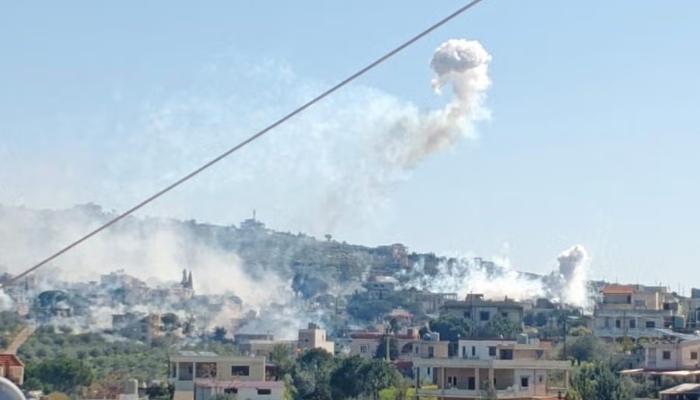
Israeli forces have continued carrying out strikes in southern Lebanon despite an existing ceasefire, with Arab media reports alleging that white phosphorus was used in the mountainous area of Ali al-Tahir.

The latest reported attacks come a day after an Israeli strike killed 11 people, including seven members of the same family, according to local and foreign media reports. The continued bombardment has intensified concerns over the fragile ceasefire and the humanitarian situation in southern Lebanon.

Iran has strongly condemned the Israeli military action, describing the ongoing attacks as aggression against Lebanon.

Tensions escalated earlier this year after Hezbollah launched an attack on Israel, two days after the United States and Israel began military action against Iran. Israel subsequently expanded its operations in Lebanon and took control of parts of the country’s southern region. Israeli authorities have said their forces will remain in the area to prevent further attacks against communities in northern Israel.

Foreign news reports say that at least 4,300 people have been killed in Lebanon since March 2 amid the continuing escalation.

Similar Posts

  • |

    Singapore offers $55,000 per child to tackle birth crisis

    Singapore has announced a major expansion of financial support for families as the city-state struggles with a record-low birth rate and a rapidly ageing population. Prime Minister Lawrence Wong unveiled the new measures during his annual National Day Rally speech, saying the government wants to make it easier for Singaporeans who wish to have children to start and raise families. Under the revised package, families will receive nearly S$70,000, equivalent to about US$55,150, in direct financial support for each Singaporean child up to the age of 17. The assistance includes a S$10,000 payment at birth, while another S$10,000 will be provided to help with further education. The government plans to distribute the financial support over a child’s early years rather than concentrating most of the assistance around birth. Singapore will also expand parental leave, particularly for families with more children. The government intends to cover a greater share of the costs associated with extended leave, reducing the financial burden on employers and working parents. Housing support is another part of the initiative. Authorities plan to make it easier for families with children to purchase their first homes through subsidised housing schemes. The measures come as Singapore’s fertility rate continues to fall. The country’s total fertility rate dropped to a record 0.87 children per woman last year, compared with 0.97 in 2024. The figure is far below the estimated replacement level of 2.1 needed to maintain a stable population without relying on immigration. The demographic decline is becoming an increasingly serious challenge for Singapore. Longer life expectancy combined with fewer births means the country is rapidly moving towards an older population. Singapore is expected to enter the United Nations’ category of a “super-aged” society this year, when more than 21 per cent of its population is aged 65 or above. The proportion is expected to increase further, with one in four Singaporeans projected to be aged 65 or older by 2030. Wong acknowledged that financial incentives alone may not reverse the trend. Many younger Singaporeans are postponing parenthood because of concerns about financial stability, housing, careers and the responsibilities associated with raising children. Others are choosing not to have children. The prime minister said the government must be realistic about the limits of its policies and warned that the fertility rate is likely to remain below replacement level. With fewer births, Singapore’s working-age population could shrink while the number of elderly citizens continues to rise. This could place greater pressure on the younger population to support healthcare, pensions and other social services.

  • |

    Israeli strikes kill two in Gaza as hospital medicine warehouses are destroyed

    Two Palestinians were killed in an Israeli air strike in Gaza on Saturday, while separate strikes destroyed warehouses storing medical supplies for Al Aqsa Martyrs Hospital, raising new concerns about access to healthcare in the territory as uncertainty continues over a possible agreement between Israel and Hamas. According to Palestinian health officials, the two people were killed in the Sheikh Radwan area of Gaza City. The Israeli military said the strike targeted Hamas fighters but did not provide further details about the operation or identify those killed. In another strike earlier the same day, two warehouses near Al Aqsa Martyrs Hospital in Deir al Balah were destroyed. Gaza’s Health Ministry said the buildings contained essential medicines and medical equipment used by the hospital to treat patients, including those receiving dialysis for kidney failure. Other supplies such as wound care materials and gauze were also stored there. The attack also damaged two additional medical storage facilities and the hospital’s outpatient clinic. Hospital officials said no injuries were reported among staff or patients during the incident, but they warned that the destruction of medical supplies would make it more difficult to provide treatment to those in need. Dr Khalil al Daqran, who works at the hospital, condemned the strike and said the destroyed warehouse contained critical medical resources needed for daily operations. He said the loss of the supplies would place further strain on healthcare services already struggling under difficult conditions. Witnesses said Israeli forces issued an evacuation warning before carrying out the strike. The Israeli military did not immediately comment on the attack targeting the warehouse complex. Under international humanitarian law, hospitals and civilian medical facilities are protected during armed conflict unless they are being used for military purposes. Israel has repeatedly accused Hamas and other armed groups of operating from within civilian infrastructure, including hospitals and surrounding buildings, an allegation Hamas has denied. Fatima Sharab, a displaced Palestinian staying in a nearby camp, said many families had chosen to shelter close to the hospital because they expected easier access to medical care if needed. She said the strike caused widespread destruction in the area and left many displaced people without shelter. The latest attacks come despite a ceasefire agreement reached last year through US mediation. Fighting and Israeli military operations have continued across Gaza in the months since. Palestinian health authorities say more than 1,200 people have been killed during that period, with many of the victims reported to be civilians, including women and children. Hamas has not regularly disclosed the number of its fighters killed. Attention is now focused on a possible breakthrough in negotiations to end the conflict. US President Donald Trump recently announced that Hamas had agreed to disarm as part of a broader peace initiative aimed at ending the war. However, Israeli Prime Minister Benjamin Netanyahu has not publicly confirmed whether Israel accepts the reported agreement. Israeli National Security Minister Itamar Ben Gvir has openly opposed the proposal, saying Israel should continue military operations and maintain its campaign against Hamas leaders. Meanwhile, Trump’s Board of Peace has released a roadmap outlining the final steps of its proposed plan, stating that Israel would halt military operations as part of the agreement if all parties move forward with its implementation.

  • |

    Iran appoints former IRGC commander Mohsen Rezaei as national security chief

    Iran has appointed former Islamic Revolutionary Guard Corps (IRGC) commander Mohsen Rezaei as secretary of the Supreme National Security Council (SNSC), placing a prominent hardliner at the center of the country’s defense and foreign policy establishment. Rezaei replaces Mohammad Baqer Zolqadr, who held the post briefly following the death of previous secretary Ali Larijani during an air strike in the ongoing conflict with the US and Israel. Supreme Leader Mojtaba Khamenei issued a decree appointing Rezaei as his direct representative on the council alongside Saeed Jalili, citing Rezaei’s extensive military experience during the Iran-Iraq War. The leadership shuffle comes as Iran negotiates conditional proposals to reopen shipping lanes through the Strait of Hormuz amid ongoing military and diplomatic friction. Rezaei, 71, commanded the IRGC from 1981 to 1997 and later served as secretary of the Expediency Discernment Council and vice president for economic affairs under President Ebrahim Raisi. Zolqadr, whom officials shifted to a political advisory role under the Supreme Leader, had previously outlined strict preconditions for diplomatic progress, including an immediate end to US military threats and an easing of economic sanctions.

  • | | |

    Petrol up Rs6.39, diesel Rs7.83

    The federal government has announced an increase in the prices of major petroleum products, including petrol, high-speed diesel and kerosene oil. The revised prices came into effect from today and will remain applicable for one day, according to official notifications. The Oil and Gas Regulatory Authority (OGRA) issued a notification confirming the increase in fuel prices. The revised rates were also endorsed through a separate notification issued by the Petroleum Division. Under the new pricing structure, the price of petrol has been increased by Rs6.39 per litre. Following the increase, the new retail price of petrol has been fixed at Rs327.12 per litre. The price of high-speed diesel (HSD) has also been revised upward. It has been increased by Rs7.83 per litre, taking the new price to Rs375.04 per litre. The government has also raised the price of kerosene oil by Rs7.80 per litre. The new price has been set at Rs297.17 per litre. The revised fuel prices became effective immediately after the issuance of the official notifications. According to the government, these rates will remain in force for one day only. The increase is expected to affect transportation costs and fuel expenses for consumers during the period in which the revised prices remain applicable. Petrol is widely used by private vehicles and motorcycles, while high-speed diesel is consumed by heavy transport vehicles, public transport, agriculture and industrial sectors. Kerosene oil is commonly used in remote areas for cooking and heating purposes.

  • | | |

    Rising fuel taxes add to motorists’ burden

    Consumers are facing a growing burden of taxes and other charges on petrol and high-speed diesel. Official documents show that the difference between the basic cost and retail price of petrol is Rs139.93 per litre. For high-speed diesel, the difference stands at Rs116.10 per litre. The documents show that the basic cost of one litre of petrol is Rs197.69. However, consumers are currently paying Rs327.62 per litre. Several taxes, levies and margins are included in the retail price. These charges significantly increase the amount paid by consumers at fuel stations. Petrol carries a petroleum levy of Rs80 per litre. A climate support levy of Rs5 is also imposed. The price also includes Rs21.24 in customs duty. An Inland Freight Equalisation Margin of Rs7.48 is charged per litre. Oil marketing companies receive a margin of Rs7.87 per litre. Dealers are paid a margin of Rs8.64 per litre. As a result, consumers pay Rs130.23 per litre in combined levies, taxes and margins on petrol. The situation is similar for high-speed diesel. Its basic cost is Rs264.76 per litre. However, its retail price has been fixed at Rs380.86 per litre. According to the documents, consumers pay around Rs116 per litre in levies, taxes and different margins on high-speed diesel. The petroleum levy on high-speed diesel is Rs74.28 per litre. The fuel also carries a climate support levy of Rs5 per litre. Customs duty accounts for another Rs15.68 per litre. The Inland Freight Equalisation Margin stands at Rs4.63. Oil marketing companies receive a margin of Rs7.87 per litre. Dealers receive Rs8.64 per litre as their margin. The figures show that taxes, levies and various margins form a significant portion of the final prices of both fuels. The additional charges directly affect motorists and consumers. They also increase transportation and operating costs for businesses that depend heavily on fuel. The rising cost of petrol and diesel can also put pressure on the prices of goods and services. Transport operators, traders and other businesses often pass higher fuel costs on to consumers.

  • |

    ‘Ramayana: Part One’ finally gets official release date

    The makers of one of the year’s most anticipated films have finally locked in a release date. Sony Pictures confirmed on X that the epic will hit theatres soon. Directed by Nitesh Tiwari, the film stars Ranbir Kapoor, Sai Pallavi and Yash in lead roles. It’s set to release on November 6, 2026, just two days ahead of Diwali. Produced by Namit Malhotra, the project is being released as a two-part film. While Part One arrives this November, Part Two isn’t expected until around Diwali 2027, though an exact date is yet to be revealed. Ranbir Kapoor recently opened up to The Direct about the difficulty of adapting the sprawling epic into just two films. He admitted that doing justice to the story in such a limited format wasn’t easy. The 43-year-old actor explained that a story as vast as Ramayana would typically need far more room to be told properly. He said condensing it into two parts posed a genuine creative challenge. Kapoor also pushed back against the idea that the story required reinterpretation for today’s audiences. He said the text has endured for roughly 4,000 years, offering timeless lessons on courage, forgiveness, compassion and the battle between good and evil. He added that Lord Rama has remained a moral guide for millions of people across generations. For Kapoor, the story’s themes still resonate strongly without needing modern updates. The film’s trailer, released in July, opens with Yash’s Ravana declaring dominion over all three worlds before triggering widespread chaos. That destruction prompts Lord Vishnu to take the form of Ram to restore balance. The story then follows Ram’s journey through childhood, battles with demons, and his marriage to Sita, before he is sent into 14 years of exile. Sita and Lakshman choose to accompany him during that period. The narrative eventually shifts toward Sita’s abduction by Ravana, setting up the climactic battle that follows. With the release date now locked, anticipation for the film’s arrival is only expected to grow.

Leave a Reply

Your email address will not be published. Required fields are marked *