japan8217s record rains
|

Japan’s record rains strand thousands at Narita airport, kill eight

CHIBA, Japan – Record rainfall in Japan stranded thousands of travellers at Tokyo’s Narita airport on Friday, bringing floods to the surrounding area that disrupted transport, knocked out power to 20,000 homes and killed eight.

During one of Japan’s busiest holiday weeks, more than 360 mm (14 inches) of rain fell in 24 hours in parts of the Chiba area adjoining Tokyo, inundating roads and railways, with soldiers sent to help with rescue efforts.

“This case was an extremely unusual situation,” Chiba Governor Toshihito Kumagai told reporters. “I have responded to many disasters in the past, but I have never experienced a case like this.”

The eight dead included one person trapped in a submerged vehicle, public broadcaster NHK said, citing Chiba authorities and police.

At Narita, airport staff distributed sleeping bags, water and snacks to hundreds of passengers, many of whom had bedded down on Thursday after transport disruptions stranded about 7,000 people, causing widespread chaos.

“I queued for a taxi, but the wait was four hours,” said Minoru Yamasaki, a 48-year-old Chiba resident returning from holiday, who had booked a hotel only to be told it could not put him up. With nowhere else to go, he returned to the airport.

An airport spokesperson said most flights were expected to operate normally on Friday.

More than 20,000 homes were without power in the early hours of Friday, after rain flooded a power substation, utility Tokyo Electric Power said, while gas supply to nearly 13,000 was temporarily cut.
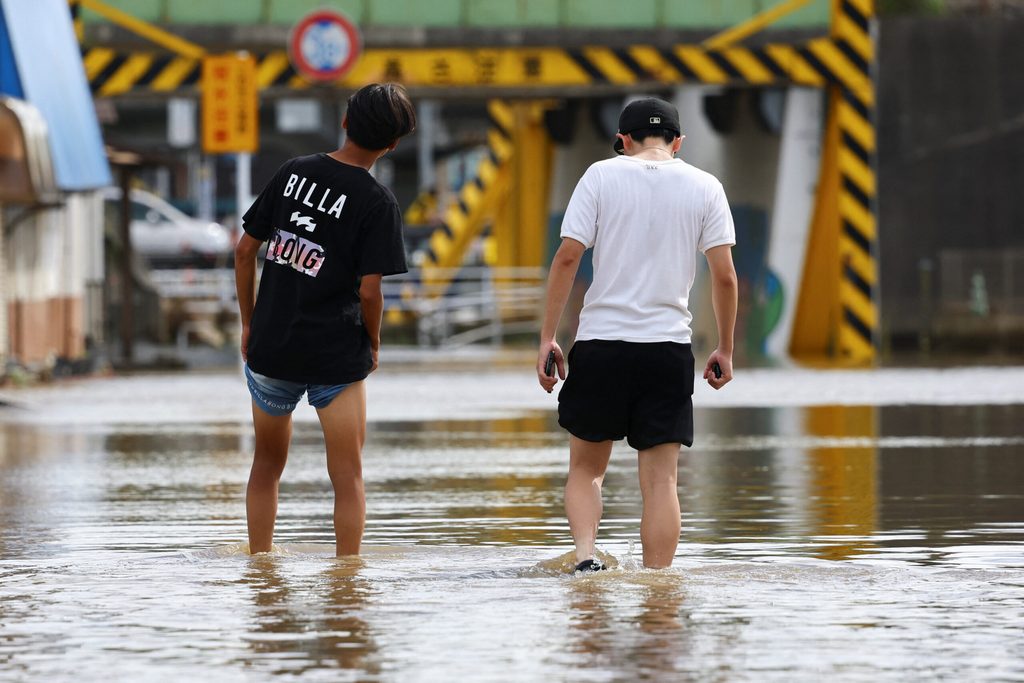
Local residents walk in a flooded area after heavy rain in Oamishirasato, Chiba Prefecture, Japan, August 14, 2026. Reuters/Issei Kato

In Chiba city, one of the worst-hit spots, hundreds of people spent the night under foil blankets at makeshift evacuation centers in government buildings.

Some major highways in Chiba were shut, forcing drivers to take alternative routes that clogged traffic, said highway operator NEXCO East.

Several rail services were also suspended on Friday, though some services from Narita to Tokyo resumed, easing congestion at the international transport hub.

Weather authorities said the 367 mm (14.5 inches) of rain over a 24-hour period in Chiba exceeded the previous record of 309 mm (12.17 inches) set in October 2013. – Rappler.com

Similar Posts

  • |

    China holds military drills near disputed Scarborough Shoal

    China’s military carried out joint naval and air exercises around the disputed Scarborough Shoal in the South China Sea on Saturday, saying the operations were intended to strengthen combat readiness and protect what it considers its territorial and maritime rights. The People’s Liberation Army Southern Theater Command said the drills took place in the waters and airspace surrounding the shoal, which China refers to as Huangyan Dao. The area is also claimed by the Philippines, where it is known as Bajo de Masinloc, and has long been one of the region’s most contested maritime zones. In a statement, the Chinese military said the exercises were a necessary response to actions by what it described as “certain countries” that it claimed were disrupting peace and stability in the South China Sea. The statement did not identify any country by name, but the Scarborough Shoal has remained at the centre of ongoing tensions between China and the Philippines. The Philippine embassy in Beijing did not immediately comment on the military exercises or respond to requests for a statement. According to the Chinese military, the operation was designed to test the coordination and readiness of naval and air forces while improving their ability to respond to security challenges in the region. Officials said the exercises would help strengthen China’s capability to defend its territorial claims and safeguard its maritime interests. On the same day, Chinese authorities also announced new rules governing the Huangyan Island National Nature Reserve, which was established in September 2025. State news agency Xinhua reported that the updated policy bans unauthorised fishing, mining, coral collection, giant clam harvesting and other activities considered harmful to the protected marine environment. Chinese officials said anyone found violating the new regulations would face legal action under the country’s laws. The measures are intended to strengthen environmental protection while reinforcing China’s administrative control over the disputed area. The Scarborough Shoal has been a source of repeated diplomatic and maritime disputes for years. Both China and the Philippines claim sovereignty over the area, and encounters between their coast guards and fishing vessels have frequently heightened tensions in the South China Sea. The latest military exercises are expected to draw close attention from neighbouring countries and regional observers, as competing territorial claims continue to shape security concerns in one of the world’s busiest and most strategically important waterways.

  • | | | |

    Iran, Oman make progress on Strait of Hormuz shipping talks

    Iran and Oman have reported progress in discussions aimed at ensuring safer shipping through the Strait of Hormuz amid the ongoing regional conflict. Iranian Foreign Ministry spokesman Esmaeil Baghaei said senior officials from both countries held talks in Tehran over two days to discuss arrangements for managing maritime traffic through the strategic waterway. According to Baghaei, the discussions focused on common principles and practical measures to maintain safe shipping while respecting the sovereignty of Iran and Oman, the two countries bordering the strait. He described the talks as useful and said progress had been made. Further political and technical consultations are expected to continue between the two sides. Baghaei also said there had been no change in the current traffic situation in the Strait of Hormuz. The development comes as tensions remain high between Iran, the United States and Israel. The waterway has become a major focus of the conflict because it is a critical route for global energy shipments. Iranian army spokesman General Abolfazl Shekarchi separately claimed that Washington had failed to achieve its objectives in the Strait of Hormuz and in weakening Iran. He described the situation for the United States as “chaotic and undesirable” and said Washington was apparently considering a new strategy. Shekarchi also suggested that any possible US withdrawal from the conflict could depend on Israel’s approval. Meanwhile, tensions have spread beyond the immediate battlefield. Iran summoned Ukrainian diplomats after Kyiv reportedly struck an Iranian vessel in the Caspian Sea, killing at least one sailor and injuring another. Ukraine said the operation targeted Russian vessels allegedly carrying military cargo linked to Iran. Ukrainian President Volodymyr Zelenskyy has also accused Russia of supporting Iran during the ongoing conflict.

  • | |

    Belgium’s largest wildfire in decades double…

    A wildfire officials describe as the largest in Belgium’s recent history more than doubled in size within 24 hours, local authorities said Sunday, as hundreds of firefighters entered a third day battling flames tearing through the country’s largest nature reserve. The blaze has forced the evacuation of two villages near Hautes Fagnes, a protected reserve close to Belgium’s eastern border with Germany. Local farmers have hauled water tankers toward the park to assist firefighting crews, while water bombing aircraft and helicopters sent from Sweden and the Netherlands have joined the effort from the air. The Belgian fire is one of several burning across Europe this weekend. At least two people died in forest fires on a Greek island off the coast of Athens on Sunday, part of a broader pattern of blazes spreading across the continent. Belgian officials said intense heat combined with the reserve’s difficult terrain, a mix of bog like wetlands, moorland and forest, has made the fire especially hard to contain. According to figures reported by a French news agency citing local officials, the fire grew from 80 hectares, or about 200 acres, on Friday to 850 hectares by Saturday morning, before expanding further to 3,000 hectares by early Sunday. Belgian Interior Minister Bernard Quintin said two fronts of the fire, one advancing toward Jalhay and the other toward Monschau, have now been brought under control. Authorities said conditions remain difficult overall and that they continue to rely heavily on aerial support to bring the fire under control, though no homes have been damaged so far. Two water bombing aircraft arrived from Sweden on Sunday afternoon to reinforce four helicopters, two Belgian and two Dutch, already working the fire. Nicolas Yernaux, a spokesman for regional authorities in Wallonia, said Saturday that the blaze ranks as the largest the country has seen in recent history. He said firefighters have allowed portions of the heathland to burn because those areas are extremely difficult to reach. Rescue teams have been unable to access the location where the fire started, leaving its cause unknown for now. Additional forest fires have broken out in Croatia, Spain and Serbia since Friday, following a summer of extreme heat that has left large parts of Europe either burning or scorched brown. In southwestern France, local officials in the Landes region said a separate wildfire forced the evacuation of 650 residents on Saturday. That fire first broke out Thursday and reignited Saturday, prompting authorities to deploy more than 500 firefighters to bring it under control. The EU’s climate monitoring service, Copernicus, has confirmed that western Europe just experienced its hottest June to July period on record, a finding that aligns with the wave of wildfires now spreading across multiple countries on the continent.

  • | |

    Trump vows heavy strikes on Iran’s Pickaxe M…

    President Donald Trump said Monday that US forces will hit the Pickaxe Mountain area, located near Iran’s already heavily damaged Natanz uranium enrichment facility, very heavily in the near future. Trump had threatened the site last week, saying the United States was going to take out Pickaxe Mountain, a heavily fortified location tied to Iran’s nuclear program that contains two deeply buried tunnel complexes. He also said Tuesday that Tehran wanted to meet desperately, adding that Washington has no interest until Iran shows readiness to engage in a meaningful way. Facing mounting political pressure at home over rising gasoline prices since the war began, and with Iran having effectively closed the Strait of Hormuz, Trump defended the latest strikes as a response to the deaths of American service members killed in recent Iranian attacks. He wrote on social media Monday that Iran will pay many times over every time it kills an American soldier, saying he had passed the directive to Secretary of War Pete Hegseth, Joint Chiefs Chairman Daniel Caine and every military leader. The broader conflict has killed thousands of civilians, most of them in Iran and Lebanon, where Israeli forces have occupied part of the country following attacks by Hezbollah fighters who said they acted in solidarity with Tehran. Lebanese President Joseph Aoun met Trump at the White House Tuesday, thanking him for what he called a historic achievement in signing a Lebanon Israel framework agreement. Aoun said he had looked forward to the visit for a long time and that the region is due for stability and security. Trump said he would speak with Hezbollah if Aoun wanted him to, noting he has already communicated with the group through intermediaries in June and secured a pledge that it would not attack Israel, a first for any US president given Hezbollah’s designation as a terrorist organization. Trump also addressed threats from Yemen’s Houthi movement to block Red Sea shipping, saying the United States would take care of business if the group follows through on a naval blockade. Two oil tankers carrying Saudi crude toward Asia reversed course in the Red Sea Tuesday after Houthi threats, diverting toward the Suez Canal, though Saudi Arabia’s Red Sea port of Yanbu continued operating normally. The Houthis said Monday they were imposing an immediate maritime embargo against Saudi Arabia, citing what they called an unjust and oppressive siege imposed on Yemen for nearly 12 years. The Saudi led coalition in Yemen said it would respond with force and began protective measures for ships transiting the Bab el Mandeb Strait, a critical route for Saudi oil exports following the effective closure of Hormuz. Yemen’s defence minister said separately that the government’s army stood ready to end what he called the Houthi coup, while clashes between government forces and Houthi fighters have resumed in parts of the country. Iran’s Revolutionary Guards said two oil tankers exploded after attempting to pass through the Strait of Hormuz via an unsafe route, a claim that followed a similar Sunday statement describing an accident involving two vessels in the same area, though it remains unclear whether the incidents were connected. A separate vessel was struck by an unidentified projectile off Oman’s coast near the strait, according to the United Kingdom Maritime Trade Operations agency. Inside Iran, explosions were reported in Tabriz, Chabahar, Konarak, Bandar Mahshahr and Bandar Imam Khomeini, with one person killed and several wounded southwest of Tabriz, state media reported. Iran’s Guards said they targeted US aircraft at Jordan’s Aqaba airport with ballistic missiles, along with military assets at Kuwait’s Al Adiri camp and Ali Al Salem Air Base, and additional positions in Syria. Air raid sirens sounded repeatedly in Bahrain throughout Monday, and Kuwait’s army said early Tuesday that its air defenses had again intercepted Iranian drones. Kuwait also said Iran struck its power and desalination infrastructure for a fourth consecutive day, sparking fires at several critical facilities that authorities have since extinguished while damage assessments and repairs continue. The United Arab Emirates condemned Iranian strikes on Bahrain, Kuwait and Jordan as a flagrant violation of sovereignty and pledged full solidarity with the three nations. A separate vessel was struck by an unknown projectile off the UAE coast near Dibba, damaging its steering gear, though all crew members remained safe. Iranian state media quoted a military source as saying the Strait of Hormuz will stay closed as long as US strikes continue, with the source describing the waterway as fully under Iranian military control. Iran’s Guards also claimed a strike on central data infrastructure belonging to Amazon in Bahrain, a claim that could not be independently verified. Amid the widening conflict, the Association of Southeast Asian Nations called Tuesday for maximum restraint and an immediate halt to hostilities between Washington and Tehran, warning that continued fighting undermines mediation efforts and diminishes prospects for a peaceful resolution. A senior Iranian official said Tehran had received a proposal from mediators for a ten day ceasefire aimed at salvaging the interim agreement reached in June, though no further details were provided. Pakistani officials said Iran’s interior minister had asked Islamabad to resume its mediation role, and he later traveled to Pakistan for additional talks, continuing a diplomatic effort that Pakistan and Qatar have led since the earlier memorandum of understanding was signed. Separately, Britain’s new government faces pressure from Washington to maintain American access to strategic military bases including RAF Fairford and the Diego Garcia base on Chagos Island, according to a British newspaper report, with Trump said to be pressing new Prime Minister Andy Burnham on the issue shortly after Burnham took office this week.

  • |

    Escalating water shortages compound the crisis for Sudanese refugees in Chad

    Sudanese refugees who escaped violent conflict in Darfur are facing an severe water shortage in eastern Chad’s overcrowded displacement camps. Over 938,000 people have fled into Chad since fighting erupted in April 2023 between the Sudanese Armed Forces (SAF) and the Rapid Support Forces (RSF). Settlements such as the Goudrane refugee camp, which accommodates roughly 50,000 refugees, frequently go days without water tank deliveries, leading to desperate scrambles when limited supplies arrive. The extreme scarcity forces many families to survive on less than half of the United Nations High Commissioner for Refugees’ (UNHCR) recommended daily minimum water allocation. At local medical clinics, doctors report an inability to effectively administer treatments for bacterial infections because patients lack access to clean drinking water. Aid agencies, including Solidarités International, caution that existing funding levels cannot keep pace with the growing capacity requirements for boreholes, sanitation, and water treatment infrastructure. Refugees arriving at transit sites such as Adré and long-term camps like Metche describe systematic violence in Sudan, particularly targeting the Masalit community. Reports detail mass killings, sexual violence, heavy shelling, and deliberate destruction of vital supplies by RSF fighters during escapes from towns like el-Fasher and el-Geneina. With the conflict entering its fourth year and diplomatic resolution remaining distant, displaced families face prolonged instability alongside severe resource shortages.

Leave a Reply

Your email address will not be published. Required fields are marked *