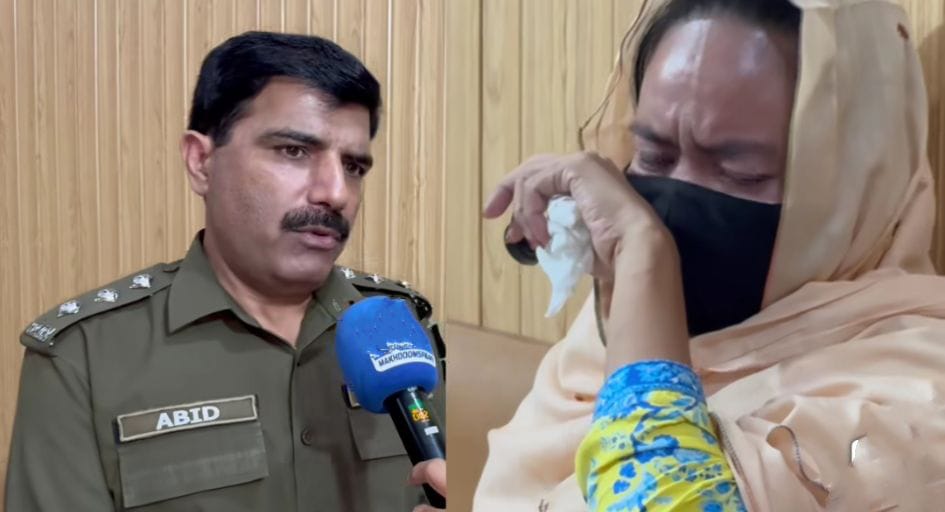
lodhran police rescue

Lodhran police rescue Filipino woman after alleged abuse

Lodhran: A friendship that began on social media turned into love, bringing a Filipino woman to Lodhran to meet the man she loved. A Filipino woman, Rose Marie, embraced Islam before marrying a middle-aged man, Amir Matam, and adopted the Islamic name Kaniz Mai.

However, after the marriage, she allegedly became a victim of domestic violence, while her husband also extorted millions of rupees from her.

Acting on the instructions of DPO Lodhran Captain (Retd.) Ali Bin Tariq, a police team led by DSP Sadar Circle Lodhran Abid Hussain Bhulla carried out a swift operation, rescued the woman, and recovered her cash and belongings.

Speaking to the media, DSP Abid Hussain Bhulla said that around two years ago, Rose Marie established contact with Amir Matam, a welder from Lodhran, through social media. Their friendship gradually developed into a love relationship, after which Amir Matam persuaded her to travel to Pakistan for marriage.

The Filipino woman came to Lodhran, married Amir Matam, and began living with him. He said that serious disputes had developed between the couple in recent months, leaving the foreign woman feeling unsafe.

According to the DSP, Rose Marie informed a Malaysian friend living in Islamabad about her situation. The Malaysian woman then contacted Police Helpline 15 seeking immediate assistance for her friend.

DSP Abid Hussain Bhulla said that due to the high-profile nature of the call, DPO Lodhran Captain (Retd.) Ali Bin Tariq was immediately informed, who promptly constituted a police team under his supervision to respond to the situation.

He added that the police not only rescued their foreign sister but also recovered her belongings and Rs. 1.5 million in cash, which had allegedly been misappropriated by her husband, Amir Matam. The recovered cash and belongings were returned to the woman, while she was provided with secure accommodation and police protection.

DSP Abid Hussain Bhulla emphasized that the protection of the lives, property, and dignity of foreigners whether residents or tourists is among the highest priorities of the State of Pakistan and the police.

Concluding his statement, the DSP Abid Hussain Bhulla said that the police response in high-profile cases is equally prompt and professional. He added that Lodhran Police resolved all matters concerning the foreign woman in accordance with her wishes. She is now expected to return to her home country, the Philippines, while the accused, who is currently on bail, will face legal proceedings in accordance with the law.
Similar Posts

  • | |

    741 dangerous buildings identified across Sindh

    The Sindh Building Control Authority (SBCA) has identified 741 dilapidated and dangerous buildings across the province. The disclosure was made during a meeting of the Sindh Assembly’s Public Accounts Committee (PAC) in Karachi. The meeting was chaired by PAC Chairman Nisar Khuhro. According to an official statement, the SBCA briefed the committee about the condition of buildings across Sindh. The authority said a large number of unsafe structures were located in Karachi. Of the 741 dangerous buildings identified across the province, 588 are situated in Karachi. The figure includes 444 buildings classified as heritage structures. The SBCA also informed the committee about steps taken to deal with buildings that pose risks to residents and the public. According to the authority, approval has been granted to evacuate 59 dilapidated buildings. Permission has also been given to demolish 39 structures considered dangerous. The issue of heritage buildings also came under discussion during the meeting. The Public Accounts Committee decided to summon the Heritage Committee at its next session. It also sought a detailed report on buildings constructed illegally around the Mazar-i-Quaid. The committee expressed concern over unauthorised construction in important areas of Karachi. It directed the relevant authorities to provide complete details of such structures. The meeting also discussed illegal housing schemes operating in Karachi. The committee was informed about 58 unauthorised housing schemes in the city. The PAC directed authorities to take steps to prevent people from investing in these illegal schemes. It also ordered action against individuals and groups involved in operating them. The committee further directed officials to identify and disclose the names of people involved in the illegal housing projects. The latest disclosure has raised concerns over the safety of residents living in old and structurally weak buildings across Sindh. The authorities are now expected to take further measures to identify unsafe structures, evacuate residents where necessary and remove buildings that pose an immediate threat. The issue is particularly significant in Karachi, where hundreds of old and heritage buildings are located in densely populated areas.

  • |

    Two tribal elders killed in South Waziristan

    Two tribal elders were shot dead by unidentified armed men in the Zarmilan area of Toi Khulla tehsil in Lower South Waziristan on Sunday, according to police District Police Officer (DPO) Shah Hassan identified the victims as Haji Gul and Malik Badshah, both members of the Suleman Khel tribe. Police said the two elders were travelling from Gul Kach towards Zarmilan when gunmen opened fire on their vehicle near Darozanda. Both men sustained multiple bullet wounds and died at the scene, while the attackers escaped. Police registered a preliminary case at Toi Khulla police station and launched an investigation. DPO Hassan said officers were examining all possible aspects of the incident and working to identify and arrest the suspects. The killings come amid growing concerns over the deteriorating security situation in Lower South Waziristan. The district has witnessed a rise in targeted killings, bomb attacks, kidnappings for ransom, extortion and attacks on police and security personnel over the past 18 months. Tribal elders and their relatives have increasingly become targets of violence. The trend has raised concerns about the safety of influential tribal figures, who have traditionally helped resolve disputes and maintain peace through jirgas and other local mechanisms. In May, prominent tribal elder and chief of the Ahmadzai Wazir tribe, Malik Tariq Wazir, was among three people killed in an IED blast near Gulshan Plaza in Wana’s busy Rustam Bazaar. Four others suffered injuries in the explosion. Police said explosives had allegedly been planted near the plaza overnight and detonated in the morning as Malik Tariq passed through the market in a vehicle. He was considered an influential figure who played an active role in tribal jirgas and local dispute resolution. He had also been abducted by armed men in December 2024 but was later released following efforts by tribal elders and local mediators. In another incident in June 2026, unidentified gunmen killed two sons of prominent tribal elder Malik Jamil Wazir near Kari Kot Bazaar in Wana tehsil. The brothers were identified as Naveed Wazir and Moeenuddin Wazir.

  • | |

    Bushra Ansari clarifies viral remarks about Saira …

    Senior Pakistani actress Bushra Ansari has clarified her recent remarks after social media pages linked a story she shared during a podcast to actors Saira Yousuf and Shehroz Sabzwari. Bushra Ansari, who remains popular for her acting as well as her personal vlogs, recently discussed an incident involving the marriage of the only son of close friends during a podcast conversation. However, some social media pages allegedly connected the story to Saira Yousuf and Shehroz Sabzwari. In her latest vlog, Bushra Ansari expressed surprise over the way her comments had been presented online. She explained that she had been talking about close friends who are associated with the banking sector and had never said that the people involved in the story were actors. According to the actress, she was discussing a couple whose marriage ended because of differences over living arrangements. She said the wife wanted to establish a separate home, while the husband was unwilling to leave his parents. Bushra Ansari said that some social media pages subsequently used pictures of Saira Yousuf and Shehroz Sabzwari alongside the story, creating the impression that she had been referring to the former couple. The veteran actress strongly rejected the interpretation and criticized what she described as misleading and negative social media reporting. She said that parts of conversations are sometimes taken out of context and presented in a way that creates an entirely different narrative. Bushra Ansari also came to Saira Yousuf’s defense, describing her as a respectable person and saying that she continues to maintain good relations with members of her former in-laws’ family. She further said that Saira shares a loving relationship with her daughter, Zahra, and suggested that the families involved understand their relationships better than outsiders speculating on social media. The actress questioned why she would use the names of people close to her while discussing an unrelated personal story. She emphasized that the people she had mentioned in the podcast were her banker friends and that the story had no connection to Saira Yousuf or Shehroz Sabzwari. Bushra Ansari’s clarification comes amid growing speculation surrounding celebrities on social media, where comments from interviews and podcasts can quickly be reshared without their original context. The actress urged people to avoid believing or spreading claims based on misleading interpretations and reiterated that her original comments were not about Saira Yousuf and Shehroz Sabzwari.

  • | |

    Over 4,000 cops to secure AJK elections in Rawalpi…

    More than 4,000 police personnel will be deployed in Rawalpindi division to ensure security during the Azad Jammu and Kashmir (AJK) Legislative Assembly elections on August 2. Police officials have prepared a detailed security plan for polling in four constituencies of the division, including Attock, Jhelum, Chakwal and Murree. A total of 4,029 police officers will be assigned duties at 175 polling stations. The polling stations have been divided into three categories according to their security requirements. Category A includes highly sensitive stations, Category B covers sensitive locations, while Category C consists of normal polling stations. Rawalpindi Regional Police Officer Babar Sarfraz Alpa said providing voters with a safe and peaceful environment is the top priority. He added that all available resources would be used to ensure free and transparent elections. He said strict monitoring would be carried out at sensitive polling stations. Additional patrolling and surveillance measures would remain active throughout the polling process. Police officials will also monitor suspicious activities, illegal weapons and any violations of the election code of conduct. Legal action will be taken against individuals involved in disrupting the electoral process. In Rawalpindi district, more than 3,100 police personnel and 200 traffic police officials will be deployed at 100 polling stations. These stations are located in different areas, including Rawalpindi city, Taxila, Wah Cantt, Gujar Khan, Kallar Syedan and Kahuta. Among the 100 polling stations, 18 have been declared highly sensitive, 45 sensitive and 37 normal. Security arrangements have also been made for the safe transportation of polling materials. City Police Officer Hassan Mushtaq Sukhera said the police would ensure implementation of the Election Commission’s rules and maintain law and order until the completion of the election process. The AJK elections are being conducted in phases due to security concerns. Authorities have increased security measures after previous election-related tensions and allegations of irregularities.

  • | |

    Climate authority summoned again as questions grow…

    Islamabad: The Pakistan Climate Change Authority has been called back before a Senate committee only days after Chairperson Sherry Rehman strongly questioned why a new authority was operating alongside the Climate Change Ministry, asked what new work it was actually doing and raised concerns over staff costs, duplication and the use of public money. The fresh meeting will again focus almost entirely on the authority, its work, projects, programmes and progress. The quick return of the issue to the committee has increased pressure on the authority to clearly explain why it exists and what results it has produced that the Ministry of Climate Change and Environmental Coordination could not already deliver. At the previous meeting, Sherry Rehman repeatedly asked officials what work the authority was doing that the ministry was not already responsible for. She questioned whether the government had effectively created a parallel structure carrying out the same work on climate mitigation, adaptation, coordination and policy implementation. Rehman said the presentation before the committee did not show a clear new role for the authority. She also questioned why another institution was being created at a time when the ministry itself was facing shrinking development budgets. One of the strongest moments came when the committee discussed the authority’s staffing and expenditure. Rehman referred to a sanctioned strength of 24 positions and said employee related expenditure had already reached around Rs 80 million according to the presentation placed before the committee. She questioned why these costs were being incurred when she could not see a clear difference between the work of the authority and the ministry. She warned officials not to treat the meeting as a routine presentation exercise and demanded direct answers about public spending and actual results. Rehman also questioned whether creating the authority had brought new climate experts into government. Members asked whether the purpose was to recruit technocrats who could not otherwise be brought into the ministry. However, Rehman said the presentation appeared to show many of the same officials who had already worked inside government departments. She described the situation as a reshuffling of bureaucracy rather than the creation of a new technical institution. She said fragmentation was already a major government problem, with different organisations working separately on connected climate and disaster issues. According to her argument, creating another body without a clearly different mandate could increase costs while making responsibility more confusing. Rehman also questioned why the authority had been activated years after the law creating it first appeared. She said the law allowed the authority to exist but argued that this did not necessarily mean the government was forced to operationalise it. She said earlier governments had discussed removing such overlapping structures instead. During the exchange, she said she had opposed operationalising the authority while serving as minister because she feared it would create duplication. She told the committee that the result now appeared close to what she had warned about: officials were moving between the ministry and the authority instead of creating a completely new technical team. The authority defended its role. Dr Muhammad Rafiq told the committee that the authority was originally designed to provide technical support to the ministry. He acknowledged that more explanation was needed regarding what the authority was delivering against its original responsibilities. He suggested that the ministry and authority should be given an opportunity to return with a clearer presentation explaining what results they expected to achieve and what the authority could do that the ministry could not. The committee was told that the authority was still incomplete. Officials said a permanent chairperson was still being appointed and that only three members were working at the authority with a limited number of staff against the total positions planned. The authority also presented one of its strongest arguments in defence of its performance. An authority member told the committee that it had become Pakistan’s first public sector organisation to qualify as a delivery partner with the Green Climate Fund through the relevant mechanism. The official said this had been achieved by only three members and without technical assistance. He argued that this status could help the authority develop technical proposals and bring more climate finance into Pakistan. Rehman was not convinced that this achievement alone justified a separate authority. She argued that Green Climate Fund financing had already been coming to Pakistan through government structures and questioned why a completely new authority was needed when a climate finance office could operate within the ministry. She again asked why project development and technical hiring could not be handled directly by the ministry. Her central question remained the same throughout the discussion: what exactly could the new authority do that the ministry could not already do? The ministry told the committee that it had a supervisory and controlling role over the authority and that the authority’s budget passed through the ministry. However, Rehman continued to question how effective that control was if the authority could hire staff and exercise statutory powers separately. She asked officials to explain how rotating officials into a separate authority would make climate work more efficient when the ministry itself was losing development resources. Professor Dr Zahoor Ahmed Bazai, who identified himself as an unpaid member nominated to the authority and as a climate change academic, defended the institution. He told the committee that the authority was included in the climate law and that members had been nominated through the formal process. He argued that the authority was intended to provide expertise and serve an advisory role. Rehman said her criticism was not directed personally at individual members. She said the bigger problem was duplication between institutions and the growing number of attached bodies dealing with similar climate matters. The committee chairperson was also critical of the presentation the authority gave. Rehman said the presentation was not strong enough to be used by Pakistan at an international climate forum and described it as outdated in style. She said that if the authority wanted to demonstrate its value and

  • | | |

    SC fixes Sept 16 hearing on Imran’s medical tran…

    ISLAMABAD: The Supreme Court has fixed September 16 for hearing a contempt petition filed by Uzma Khanum, sister of PTI founder and former prime minister Imran Khan, over the alleged non-implementation of the court’s order regarding his medical treatment. The petition was submitted after the government took Imran Khan to the Pakistan Institute of Medical Sciences (PIMS) instead of shifting him to Shifa International Hospital, as directed by the Supreme Court in its August 18 order. The court had also directed arrangements for regular meetings between Imran Khan and his family. PTI had challenged the government’s decision and filed a contempt petition through Uzma Khanum. The petition was returned after the Supreme Court registrar raised certain objections. The party later resubmitted it after addressing the objections. Speaking outside the Supreme Court, PTI Chairman Barrister Gohar Khan said the party wanted the matter to be heard at the earliest. He said the PTI founder’s health remained the party’s primary concern. Gohar urged the authorities to facilitate meetings between Imran Khan and his family members. He maintained that the Supreme Court’s August 18 order had not been implemented in its original form. Uzma Khanum also submitted an application seeking an early hearing. She expressed concern over what she described as a deterioration in Imran Khan’s health and argued that further delay could have serious consequences. The application alleged that the government had failed to follow the Supreme Court’s directions. It maintained that if authorities required clarification about the order, they should have approached the court instead of taking a different course of action. The government, meanwhile, has filed a review petition challenging the August 18 order. It has described the directive as discriminatory and sought its reconsideration. Imran Khan was taken to PIMS on August 21 for a medical examination and was later returned to Adiala Jail after doctors declared him medically fit. The government has maintained that security concerns prompted the decision to use PIMS instead of Shifa International Hospital. Information Minister Attaullah Tarar said the security situation involving PTI workers affected the planned transfer. The Supreme Court had also declined an immediate hearing of petitions seeking contempt proceedings and review of its August 18 order. The government’s review petition is therefore expected to be heard according to the court’s schedule. Gohar said PTI wanted Imran Khan’s sister, Dr Uzma, and his personal physician, Dr Faisal Sultan, to be included in the medical board. He also called for the medical tests recommended by Imran Khan’s doctors to be conducted. The PTI chairman said the party was currently focusing on Imran Khan’s health rather than political matters. He described the issue as a humanitarian concern and urged the authorities to implement the Supreme Court’s directions. Gohar also questioned the detention of Imran Khan’s physician, Dr Faisal Sultan, who was taken to Shifa International Hospital. He asked why the doctor was detained for several hours while Imran Khan was not transferred to the same facility. He reiterated that a Supreme Court order should be followed unless the court itself modifies, reviews or suspends it. Gohar said PTI also recognised the importance of security arrangements and did not want any violation of security protocols. However, he claimed the party had not been informed in advance that security concerns would prevent Imran Khan’s transfer to Shifa International Hospital.

Leave a Reply

Your email address will not be published. Required fields are marked *