lower protein may

Lower protein may boost longevity

Protein rich foods such as cereals coffee water and many other products have become increasingly popular.

However a new study suggests that for many people eating less protein instead of more may actually be better for overall health and could even help people live longer.

The review published on July 31 in the journal Cell Press Blue examined more than 350 scientific studies exploring the connection between lower protein intake and healthy aging.

Researchers found that reducing protein intake may improve metabolism help cells respond better to nutrients lower cell damage and support normal cell function.

Together these effects may promote better health and a longer lifespan. The study’s lead author Dudley Lamming said that protein is important for people who exercise regularly because it helps build muscle and improves workout results.

However he added that most people are not very physically active which means they may be eating more protein than their bodies actually need. In some cases this could have negative effects on health.

Experts also noted that the right amount of protein is different for everyone.  It depends on factors such as age overall health physical activity and lifestyle.

They recommend following a balanced diet and getting advice from a healthcare professional before making major changes to protein intake.

Similar Posts

  • Montaigne’s philosophy is the antidote to modern burnout

    Approximately four centuries ago, the French Renaissance philosopher Michel de MMontaigne offered a philosophy that feels relevant to our hyper-connected world. He wrote in his famous essay Of Solitude that every person ought to maintain a hidden back room (arrière-boutique) inside their own mind. He should possess an uncolonized space where external obligations, public opinions, and societal expectations are strictly forbidden. In this interior, he argued, we establish our true independence and safeguard our core identity. Montaigne was writing long before the advent of smartphones, social media feeds, and workplace notifications. However, his reflections speak directly to a growing contemporary dilemma. The erosion of personal mental autonomy. This 16th-century insight continues to captivate modern psychologists. It reveals how carving out deliberate quietude remains our strongest defense against emotional exhaustion. To appreciate Montaigne’s metaphor, it helps to envision a medieval or Renaissance shopkeeper. In the front of the store, the merchant greets customers, negotiates prices, manages displays, and puts on a professional performance upto public expectations. However, behind the commercial counter sits a private back room. A space away from the gaze of buyers, where the owner can rest, reflect, and exist simply. Montaigne argued that human life operates on a similar dual structure. We all inhabit public identities. We are employees, parents, partners, citizens, and friends. In these roles, we must navigate duties, relationships, and social etiquette. However, Montaigne warned against allowing these outward roles to swallow our entire psychological existence. Our self-worth and peace of mind mustn’t rely exclusively on external validation. We must leave ourselves utterly vulnerable when those external structures vanish. The back room of the mind isn’t a place to hide misdeeds or abandon loved ones. Rather, it is a deliberate mental reserve. It is the part of your consciousness that remains unrented. It’s where you can question assumptions, process emotions, and figure out what you genuinely believe before the rest of the world tells you how to think. Psychologists today pose distinction between two experiences that are often conflated. Loneliness is an involuntary, painful state caused by an unwanted deficit in social connection. It acts as an emotional alarm signal that our fundamental human need for belonging is unmet. In contrast, solitude is a voluntary, chosen pause from social interaction. Recent psychological studies affirm what Montaigne intuitively understood. When individuals intentionally step back from social eengagements in reflective solitude, they experience lower levels of stress, improved emotional regulation, and creative problem-solving. Crucially, the key variable that determines whether time alone feels refreshing or painful is personal agency. Chosen solitude restores energy, whereas forced isolation breeds distress. Montaigne’s philosophical framework complements these findings by emphasizing that true solitude is a mental habit rather than a physical location. You do not need to retreat to a secluded mountain or cut ties with society to experience it. You can sit in a crowded coffee shop or a busy subway train and still inhabit your internal back room. One condition provided that you retain control over your own thoughts and judgment. In the modern digital landscape, preserving an uncolonized back room has become significantly more difficult. Technology companies design algorithms specifically to capture and monetize human attention. Our devices invite us to check messages from the moment we wake up. Afterwards, we respond to emails, view news updates, and seek social validation in the form of likes and comments. Many people have turned their entire interior life into a public display. Every preference is shared. The thought is broadcast. The free moment is filled with external input. When every gap in our day is filled with podcasts, streams, or scrolling feeds, the boundary protecting our inner retreat disintegrates. We become perpetually accessible to everyone else while remaining complete strangers to ourselves. Most people cannot afford to abandon their careers or family obligations to go live in isolation. So, a mental back room in the 21st century requires intentional daily boundaries. The room does not need to be built with physical walls. It can be constructed out of time and habits. A daily twenty-minute walk without wearing headphones or listening to audiobooks allows thoughts to drift, settle, and organize naturally. The delaying act of checking social media notifications for the first thirty minutes after waking up ensures that your mind starts the day with its own thoughts. Also, keeping personal journal where thoughts are written purely for self-clarification reclaims the joy of private thought. Ultimately, Montaigne’s classic essay reminds us that reserving a private space in the mind is not an act of selfishness or social withdrawal. On the contrary, an inner sanctuary ensures that we return to our families, workplaces, and communities. We bring a grounded, clear-headed, and genuine self to the table. We ensure that while we may give our time to the world, we never give away the key to our mind.  

  • The unforgettable legacy of Raja Mehdi Ali Khan

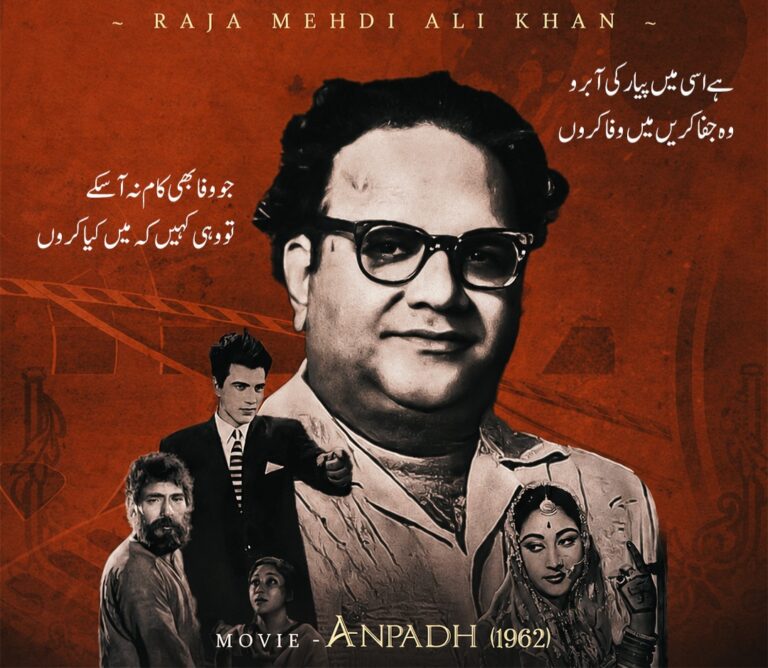
    Twentieth-century Urdu literature and Indian cinema was shaped by figures whose creativity crossed literary traditions and popular entertainment. Among these luminaries, Raja Mehdi Ali Khan stands out as a unique persona connecting high-art literary satire and immortal Bollywood melodies. This legend was born in 1915 in the historical town of Wazirabad. Khan was an observer of culture. He inherited a formidable poetic pedigree that caused him to be one of the most celebrated humorists and lyricists of his era. Raja Mehdi Ali Khan’s literary inclinations were virtually coded into his lineage. He was related to the renowned journalist and political figure Maulana Zafar Ali Khan. He was raised in an environment saturated with verse and socio-political commentary. Moreover, his mother was a recognized poetess in her own right. She taught him a deep reverence for language and rhythmic expression from an early age. This environment nurtured his inherent talent, allowing him to absorb classical Urdu poetic conventions while developing an understated wit that would define his future work. Before making a name for himself in the cinema, Khan began his journey in print journalism. He contributed prolifically to prominent periodicals and literary magazines of the era. The names included Monthly Alamgir, Weekly Khayyam, Tehzeeb-e-Niswan and Do Phool. His early journalistic writings allowed him to polish his observational skills. Whether analyzing social norms or painting witty portraits of everyday life, his prose stood out for its accessibility and warmth. Later, he transitioned into radio broadcasting. It’s considered a medium that further refined his sense of auditory storytelling and lyrical timing. He was driven by creative ambition. Later, Khan relocated to Bombay (now Mumbai) during a transformative era for Indian cinema. His entry into the film industry marked the beginning of a golden age for Hindi film music. He partnered with legendary music composers such as Madan Mohan. Khan penned lyrics that transcended simple movie themes, capturing profound emotional truths. His songs have proved to be timeless masterpieces, continuing to resonate across generations. Among his most iconic works are: hai isi mein pyaar ki aabru wo jafa karen main wafa karun jo wafa bhi kaam na aa sake to wahi kahen ki main kya karun Raja Mehdi Ali Khan, Anpadh (1962) His celebrated catalog includes evergreen classics. Lag Jaa Gale (Woh Kaun Thi?): Widely regarded as one of the greatest romantic ballads in Hindi cinema. Aapki Nazron Ne Samjha (Anpadh): A masterpiece of subtle expression and devotion. Jhumka Gira Re (Mera Saaya): A vibrant classic in popular culture. Tu Jahan Jahan Chalega (Mera Saaya): A hauntingly beautiful exploration of love and devotion. Agar Mujh Se Mohabbat Hai (Aap Ki Khaatir): A poignant reflection on romantic commitment. What set Raja Mehdi Ali Khan apart from many of his contemporaries was his dual identity.  Film audiences revered him for his deeply romantic and melancholic lyrics. On contrary, the literary world celebrated him as an exceptionally gifted humorist and satirist. Even amidst his demanding schedule in Bombay’s competitive cinematic landscape, Khan never abandoned his literary roots. His satirical essays and humorous poems were regularly featured in leading newspapers and journals across both India and Pakistan. His humor was rarely cynical. Instead, it offered a gentle, witty critique of human flaws, societal absurdities, and the complexities of modern living. Khan proved that high literary craft could flourish alongside popular music. Raja Mehdi Ali Khan passed away leaving behind a rich archive of literary contributions and cinematic songs that continue to be sung, reimagined, and loved today. His life journey from the quiet streets of Wazirabad to the recording studios of Bombay embodies the shared cultural heritage of the Indian subcontinent. His art remains vibrant and melodious whether delivered in a literary journal or sung by iconic playback singers.  

  • Road Safety: Everyone’s Responsibility

    By Sumaiya Azeem Behind every road accident statistic is a name, a family, a dream that never came true. The next name doesn’t have to be someone we know—but only if we take responsibility. Road accidents do not happen by chance; they happen because of preventable mistakes. Saving lives is a shared responsibility. Road safety is not just about following traffic rules, it is about protecting human lives. Every day in Pakistan, we hear about road accidents on the news. A bike crash near a school, a bus overturned on the highway, and a child hit while crossing the road—these aren’t just headlines. They are the fathers who won’t come back, students whose exams will never be taken, and futures cut short. Roads connect people, communities, and economies. They allow students to reach school, workers to reach their workplace, and families to travel from one place to another. However, road accidents have become one of the leading causes of death and injury across the world, and unsafe road behavior has turned roads into a major global safety challenge. Every day, thousands of people lose their lives or suffer serious injuries; it also causes permanent disability and leaves families with lifelong conditions. According to the World Health Organization (WHO), approximately 1.19 million people die every year due to road traffic crashes, while 20 to 30 million people suffer non-fatal injuries, many of which result in permanent disability. Road accidents are a serious public health and economic issue. The WHO report shows that more than 90% of traffic accidents occur in low- and middle-income countries. These accidents cause enormous financial losses. Medical expenses, vehicle damage, loss of productivity, and long-term disability create a heavy burden on families. There are several major causes of road accidents. Overspeeding is one of the leading causes of serious road accidents. When vehicles move at high speeds, drivers have less time to react to sudden dangers such as pedestrians crossing, vehicles stopping suddenly, or obstacles on the road. It also increases the severity of injuries during a crash. The use of mobile phones while driving has also become a growing danger. Texting, making calls, or scrolling on social media can cause more accidents. Responsible drivers must keep their full attention on the roads and avoid unnecessary distractions. In addition, driving after consuming alcohol or drugs seriously affects judgment. An impaired driver may not realize the danger in time or may make risky decisions that endanger others. Strict laws and public awareness are necessary to prevent such behavior. Ignoring traffic signals, unsafe overtaking, driving on the wrong side of the road, and failing to give way are other common causes of crashes. Traffic rules are designed to protect everyone; following them is a responsibility, not merely a legal requirement. Moreover, one mistake by one person creates a ripple effect that impacts everyone on the road. A road accident doesn’t just hurt one person. It breaks a family, blocks traffic for hours, burdens hospitals, and wastes national resources. A helmet, a seatbelt, or a 10-second wait at a red light can save lives. Apart from this, everyone has a role to play: Drivers have the biggest role. They must wear seatbelts, avoid using phones while driving, follow speed limits, and obey traffic signals. Riders, especially motorcyclists, are very vulnerable. They should always wear helmets, avoid rash driving, and use indicators, which also helps them stay visible. Pedestrians also need to be careful. A pedestrian is anyone walking on foot. They should use footpaths and zebra crossings, look both ways before crossing, and avoid distractions like headphones on busy roads. Pakistan faces significant road safety challenges due to rapid population growth, an increasing number of vehicles, unsafe driving practices, and weak enforcement. Improving road safety requires better roads, stronger law enforcement, and public awareness. The problem can be solved by following traffic rules, raising awareness, building better road infrastructure, and utilizing strict law enforcement to help prevent accidents. In short, if drivers drive carefully, riders stay alert, pedestrians walk safely, and the community supports traffic rules, we can make our roads much safer. Road safety is not the duty of one person or one department; it is a responsibility shared by everyone. Governments must provide safe infrastructure, and citizens must make responsible choices. A moment of carelessness can destroy a family, while a moment of responsibility can save a life. By respecting traffic rules and promoting awareness, we can create safer roads for ourselves and future generations. Every journey should end safely, and every single person has a role in making it possible.

  • Short intense exercise may benefit your body

    A new study suggests that you may not need to spend hours exercising every day to support your health.  Even a few minutes of very intense physical activity can cause important changes inside the body. Researchers found that intense exercise can quickly change hundreds of proteins in the blood These proteins are linked to heart health metabolism body fat and other important body functions. What did the study find? The researchers compared short high-intensity cycling with cycling at a normal pace.  Participants completed several 30-second bursts of very fast cycling with about four minutes of rest between each burst. After the intense exercise changes were found in 714 blood proteins. In comparison only 7 proteins showed similar changes after normal paced cycling. This suggests that exercise intensity can strongly affect how the body responds. What happens during intense exercise? During hard exercise the body produces different chemical signals.  One of them is called Lac-Phe, which has been linked to appetite energy use and other body processes. These signals may also affect metabolism and how fat cells work. Some of the protein changes seen in the study were connected to processes related to heart disease type 2 diabetes and obesity. Researchers also examined data from more than 53,000 people. Some of the proteins affected by intense exercise were linked to healthy aging heart health and the risk of metabolic diseases. Is a few minutes of exercise enough? The findings do not mean that three minutes of intense exercise can completely replace a longer workout.  Different types of exercise provide different benefits. Longer moderate exercise can still be important for improving endurance muscle strength and heart and lung health. However the study shows that even short periods of intense activity may have meaningful effects on the body. For people with busy schedules adding brief bursts of physical activity to their daily routine could be a practical option. However high intensity exercise is not suitable for everyone. People who have not exercised for a long time or have a medical condition should speak with a healthcare professional before starting intense workouts.

  • Poultry industry linked to foodborne infections

    A new study warns that modern large scale chicken farming may be helping dangerous food poisoning bacteria spread more easily creating new risks for human health. Researchers from the Oxford University found that the rapid growth of industrial poultry farming has created ideal conditions for Campylobacter, a bacteria that causes food poisoning to grow spread and develop new traits. Campylobacter is one of the world’s leading causes of diarrhea and food poisoning. In the UK it causes around three and a half times more stomach illness cases each year than all other monitored foodborne bacteria combined. The researchers said the global chicken population has increased about sevenfold since the 1960s reaching around 31 billion birds. This growth has made it easier for bacteria carried by wild birds to spread among farm chickens. The team studied nearly 2,800 bacterial genomes collected from chickens and wild birds in 30 countries including the UK and the US between 1979 and 2024. Genetic analysis showed that the bacteria had developed changes linked to modern farming conditions. These included genes that help it resist antibiotics and survive more easily in large poultry farms. Researchers warned that rising antibiotic resistance is making Campylobacter infections harder to treat. The study’s lead author Sam Sheppard said the findings provide new evidence that human activities and environmental changes can increase the spread of infectious diseases. He added that understanding how bacteria evolve will be important for reducing future risks of animal to human diseases and antibiotic resistant infections.

  • How to keep curly hair healthy and frizz free

    Keeping curly hair looking fresh can sometimes feel difficult. The wrong products or styling habits can make curls dry, frizzy or lose their shape.  The good news is that with simple care, you can keep your curls soft healthy and well defined. Keep your curls hydrated Moisture is one of the most important things for curly hair. Curls usually become dry faster than straight hair so use a moisturizing shampoo and conditioner made for curly hair. Look for products with hydrating ingredients such as coconut oil argan oil or natural butters to help keep your hair soft. Avoid washing too often Washing curly hair too frequently can remove its natural oils and leave it dry and rough. Try washing your hair around two or three times a week depending on your hair type and lifestyle. Between washes you can refresh your curls with a light water based spray. Use a microfiber towel or T-shirt Regular towels can create friction increase frizz and cause hair breakage. Instead gently squeeze excess water from your curls using a microfiber towel or a soft old T-shirt. Avoid rubbing your hair because it can disturb the natural curl pattern. Use the right styling products After gently drying your hair apply a styling product designed for curly hair. Curl creams gels and mousses can help keep curls in shape. Apply the product gently with your fingers working from the roots toward the ends. Protect your curls while sleeping A silk or satin pillowcase can reduce friction while you sleep. This may help keep your curls smoother and reduce frizz and breakage. Get regular trims Regular trims can help remove split ends and keep curls looking neat and healthy. Consider trimming your hair every 8 to 12 weeks depending on its condition and growth. Protect curls from heat Too much heat from straighteners curling tools or blow dryers can make curly hair dry and damage its natural shape. Whenever possible choose heat free styling methods such as air drying foam rollers or other gentle techniques. With proper moisture gentle handling and regular care your curls can stay soft healthy and beautifully defined.

Leave a Reply

Your email address will not be published. Required fields are marked *