naqvi vows full
| |

Naqvi vows full support for Balochistan security

Interior Minister Mohsin Naqvi has assured Balochistan of continued federal support to improve security and restore lasting peace in the province.

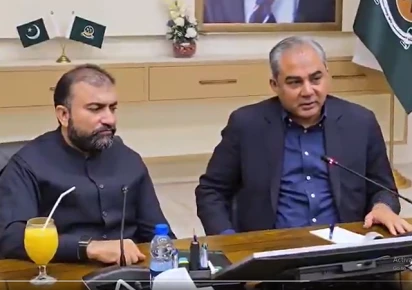
Naqvi visited Quetta on Saturday. He met Balochistan Chief Minister Mir Sarfraz Bugti. The two leaders jointly chaired a high-level meeting on the province’s law and order situation.

The meeting reviewed the latest security situation in Balochistan. Officials also discussed ongoing security operations and future plans to deal with terrorism.

Chief Minister Bugti briefed the meeting on the challenges facing the province. He also explained the measures being taken to improve security and maintain peace.

The meeting decided to further strengthen the Counter-Terrorism Force (CTF) and Balochistan Police. The participants agreed that the professional capabilities of both forces must be improved.

The authorities also agreed to speed up decisions aimed at strengthening the provincial police force. The federal government assured Balochistan that it would provide the required resources and support.

Naqvi said the federal government would continue to provide every possible assistance to Balochistan. He said restoring peace required immediate and effective implementation of a comprehensive security plan.

The interior minister also called for greater use of the experience of former Balochistan police chiefs. He said their expertise could help authorities develop a stronger and more effective security strategy.

Naqvi stressed the importance of modern technology in counterterrorism operations. He also highlighted the need for better intelligence and stronger coordination between security institutions.

He said the federal and provincial governments were working together to address the security challenges. According to Naqvi, coordinated efforts are essential for establishing lasting peace in the province.

Chief Minister Bugti also reaffirmed his government’s determination to fight terrorism. He said the provincial government would remain prepared to respond to threats on every front.

Bugti made it clear that the government would not surrender to pressure from terrorists. He said the writ of the state would be established across Balochistan.

The chief minister said no space would be allowed for terrorists to operate. He also stressed that security agencies would continue taking steps to protect citizens and public institutions.

Bugti said the government’s strategy would not focus only on security operations. He said improving opportunities for young people was equally important.

According to the chief minister, education, skills development, employment and positive activities could help young people build better futures.

He said promoting merit would help restore the confidence of the province’s youth. He added that young people should receive equal opportunities to succeed.

Bugti also highlighted the strong connection between peace and development. He said security, progress and prosperity must move forward together.

He said the provincial government would continue working with the federal government to improve law and order. Development projects would also be accelerated across the province.

The meeting came as Balochistan continues to face serious security challenges. Several attacks have occurred in the province in recent months.

Security forces and law enforcement agencies have increased operations against militant groups. The Pakistan Army, Frontier Corps and Balochistan Police have also continued joint efforts in affected areas.

Officials believe stronger intelligence sharing and better coordination can help prevent future attacks. Modern equipment and improved training are also being considered important parts of the security strategy.

The federal and provincial governments have therefore agreed to combine security measures with development initiatives. They say improving employment, education and skills opportunities for young people is essential for long-term stability.

Similar Posts

  • | |

    Gohar Rasheed criticises Aurat March posters

    Actor Gohar Rasheed, known for his versatility and outspoken nature, has sparked a fresh round of public debate after sharing his views on Aurat March during a recent podcast appearance, taking particular issue with what he described as vulgar posters that appear at the annual women’s rights march. Rasheed drew a comparison between two things he sees as similarly problematic. He said that women should not be objectified, and in that spirit, item numbers in films should not exist because they reduce women to objects. He then extended that same logic to certain placards that appear at Aurat March, arguing that some posters cross a line into vulgarity and do not represent an appropriate way to communicate ideas or demands. He said the same points could be made in a more sophisticated manner without resorting to language or imagery that he found objectionable. The remarks touched on one of the most consistently contested topics in Pakistani public life. Aurat March, held annually on March 8 in major cities across Pakistan to mark International Women’s Day, has been a flashpoint for debate since its earliest editions. Supporters argue it is a necessary and long-overdue platform for women to voice demands around safety, equality and rights. Critics, including Rasheed, have frequently taken issue with specific posters that appear at the marches, arguing that certain slogans or images do not reflect the broader values of Pakistani society. The response online was immediate and divided, as it tends to be whenever the march becomes the subject of public commentary. Some users agreed with Rasheed. One person wrote: “He is right. Now Aurat Marchers will go against him,” anticipating the backlash while expressing support for the sentiment. Others pushed back sharply. One commenter wrote: “I wish he was this offended by violence against women and child rape,” arguing that the energy directed at posters would be better channelled toward the far graver issues women face daily. Another said: “Three men mansplaining what women should do or not do,” pointing to the irony of male voices deciding what is and is not an appropriate mode of feminist expression. The division in the comments reflects the genuine complexity of the debate. For those who support Aurat March unconditionally, the criticism of posters is a distraction from the march’s core purpose and represents the kind of policing of women’s expression that the march itself is pushing back against. For those who share Rasheed’s view, the concern is that certain forms of communication within the march alienate potential allies and hand critics easy ammunition to dismiss the broader cause. What is clear from the reaction is that this is a conversation Pakistan has not finished having, and that every public voice that enters it, whether from the entertainment industry or elsewhere, adds another layer to a debate that touches on deeply held values about gender, expression and what it means to advocate for change.

  • | | |

    Kangana Ranaut clarifies ‘Cockroach’ and ‘Gu…

    Indian actress and BJP Member of Parliament Kangana Ranaut has clarified her controversial remarks involving the words “cockroach” and “gutter” after facing strong criticism on social media. Kangana said her comments were not directed at the entire younger generation. Instead, she claimed that she was referring to specific individuals and certain women while discussing social issues and the importance of responsibility alongside personal freedom. Her earlier remarks triggered a significant reaction online after she criticized the way some young Hindu women expressed their freedom. In that context, she reportedly used the phrase “Generation Gutter,” leading critics to accuse her of making a sweeping statement about young people. Speaking to Indian news agency ANI, Kangana explained that her comments were made in the context of protests at New Delhi’s Jantar Mantar over the alleged NEET-UG paper leak. She stressed that she was not making a general statement about all young people. According to Kangana, she had specifically referred to certain people or some women, and it was therefore unfair to interpret her comments as an attack on the entire younger generation. She also addressed her controversial reference to a “cockroach.” Kangana argued that if someone describes themselves as a cockroach, saying that cockroaches come from a gutter should not be considered offensive. The actress said that she does not consider herself a cockroach. If someone told her that she lived in a gutter, she would reject the claim. However, she questioned why the reference would be considered offensive if a person themselves used the term “cockroach” to describe their identity or behavior. Kangana further rejected the interpretation that she had compared all young people to a gutter. She said that discussing problems such as drug use, betting, gambling or dark-web activities among a particular section of young people does not mean that the entire younger generation should be viewed in the same way. She questioned why comments about a specific group or certain women were being presented as a generalized criticism of all young people. The clarification comes amid continuing debate over the responsibilities that accompany personal freedom, particularly among young people. Kangana maintained that her intention was to highlight certain behaviors and social problems rather than criticize an entire generation. The controversy has once again drawn attention to Kangana’s outspoken public statements, which frequently generate strong reactions online and in political and entertainment circles. By clarifying her comments, the actress has sought to distance herself from the interpretation that she was labeling the entire younger generation as “gutter” or making a blanket criticism of young people.

  • | |

    Auqib Nabi earns maiden India call-up as replacement for injured Jasprit Bumrah

    Right-arm pacer Auqib Nabi has been added to India’s squad for the upcoming two-match Test series against Sri Lanka, replacing injured fast bowler Jasprit Bumrah. The series begins in Galle on August 15, followed by a second Test in Colombo on August 23. It marks India’s first assignment in the World Cup Test Championship cycle since a 2-0 home defeat to South Africa in 2025. Auqib, a tall right-arm quick from Jammu and Kashmir, earns his first national call-up after strong performances in domestic cricket. He topped the wicket-taking charts in India’s premier first-class competition, the Ranji Trophy, across the past two seasons. He played a central role in Jammu and Kashmir’s historic Ranji Trophy title win, taking 60 wickets in 17 innings during that campaign, an effort that earned him the player of the tournament award. He also featured for India A against Sri Lanka A during a recently concluded tour, picking up six wickets across two four-day matches. Should he make his Test debut in the upcoming series, Auqib would become the first cricketer from Jammu to represent India in the format. Across his first-class career, Auqib has taken 162 wickets in 43 matches at an average of 18.63, including four ten-wicket hauls in a match and 16 five-wicket innings hauls. Bumrah, meanwhile, has been ruled out after failing to recover in time from a left knee injury sustained during the ODI series against England. He had originally been named in India’s squad for the Sri Lanka tour before the setback. His workload has been closely monitored since he suffered a back injury during the 2024-25 Border-Gavaskar Trophy series in Australia, and the recent ODI series against England marked his first appearance in the format since the 2023 World Cup final. India’s updated squad for the Sri Lanka Tests reads: Shubman Gill (captain), KL Rahul (vice-captain), Yashasvi Jaiswal, Rishabh Pant (wicketkeeper), B Sai Sudharsan, Dhruv Jurel (wicketkeeper), Ravindra Jadeja, Kuldeep Yadav, Manav Suthar, Mohammed Siraj, Prasidh Krishna, Gurnoor Brar, Auqib Nabi, Devdutt Padikkal and Saransh Jain.

  • Thailand Cracks Down on Cannabis: Strict New Rules Target Flower Sales and Exports

    Thailand is dramatically shifting its approach to the rapidly booming domestic cannabis industry. The government recently announced incredibly strict new controls targeting the sale and export of cannabis flowers. Officials have officially designated the popular cannabis plant as a highly regulated “controlled herb.” This sudden regulatory move signals a definitive end to the brief era […]

  • |

    Govt hikes petrol by Rs4.4, diesel by Rs3.62 as gl…

    The federal government on Thursday increased the prices of petrol and high-speed diesel by Rs4.40 and Rs3.62 per litre, respectively, effective July 24. Following the latest revision, petrol now stands at Rs331.52 per litre, while HSD is priced at Rs378.66. The price hike comes amid a surge in global oil prices, with Brent crude jumping 6% to $100.50 a barrel following attacks on tankers in the Red Sea, which have choked off a second crucial Middle East artery for global oil supplies alongside Iran’s near-closure of the Strait of Hormuz. This is the fourth consecutive day the government has revised fuel prices after switching to a daily review mechanism last week to reflect volatility in international markets. The new system bases daily fuel prices on a seven-day average of international market rates, ensuring timely adjustments to align with global trends. The latest increase was anticipated as oil prices surged to their highest level since May, driven by escalating tensions in the Middle East. The price revision came after the government and the All Pakistan Petrol Pump Owners Association reached an agreement a day ago to postpone the association’s planned nationwide shutdown for two weeks. The agreement followed successful negotiations with Petroleum Minister Ali Pervaiz Malik, who assured dealers that their long-pending concerns, including demands for a monthly pricing mechanism and an increase in dealer commissions, would be addressed. The surge in global oil prices has been fueled by Houthi attacks on oil tankers in the Red Sea, which have raised fears of a wider regional conflict. The attacks have disrupted shipping through the Bab el-Mandeb strait, a vital alternative route for Saudi oil exports, adding to the supply concerns already triggered by the near-closure of the Strait of Hormuz. The dual disruptions have put energy markets on edge, with fears of a global supply crunch intensifying. The spike in oil prices has also impacted global stock markets, with major tech giants knocking US stocks lower and Europe’s borrowing costs spiking to long-term highs. The unsettling day across markets reflects the broader economic implications of the Middle East conflict, which continues to disrupt global energy supplies and threaten economic stability. As the situation remains volatile, further price revisions are likely in the coming days. The government has assured the public that it is monitoring the situation closely and will take necessary measures to mitigate the impact on consumers. However, with global oil prices expected to remain elevated, Pakistani consumers are likely to face continued pressure on fuel costs, affecting transportation, goods, and services across the country. The government’s daily price revision mechanism aims to provide transparency and responsiveness to market changes, but it also means that consumers will face more frequent price adjustments as global oil markets remain volatile. The coming days will be critical in determining whether the situation stabilizes or whether further hikes are needed to reflect global trends.

  • |

    US authorises private firms to target cybercrime groups

    WASHINGTON: The United States has taken an unusual step in its fight against international cybercrime by allowing selected private companies to conduct government-approved hacking operations against foreign criminal organisations. President Donald Trump has signed a memorandum directing the departments of Justice and Homeland Security to establish a framework under which approved private-sector partners can investigate, infiltrate and disrupt transnational cybercrime networks. The move is aimed at tackling growing threats including ransomware attacks, online fraud and so-called sextortion schemes. The White House said such crimes caused more than $20 billion in losses to Americans during 2025. Under the new framework, authorised companies could potentially infiltrate cybercriminals’ computer systems, deploy spyware or disrupt servers used to conduct criminal activities. However, each operation would require approval from the US government before any action is taken. Participating companies would also be required to provide a bond of at least $1 million. Operations involving actions that could cause death or physical injury would remain prohibited. Activities that could qualify as the use of force under international law would also be excluded. The initiative has drawn comparisons with privateering, a practice used centuries ago when governments authorised private vessels to attack or seize enemy ships. Supporters argue that private technology companies possess specialised cyber expertise and access to data that government agencies may not have. They believe combining those capabilities with government authority could help disrupt criminal networks more effectively. However, cybersecurity experts have raised concerns about accountability, oversight and the possibility of unintended consequences. Critics warn that allowing private companies to conduct offensive cyber operations could create diplomatic complications and make it difficult to control activities once they begin. The policy also represents a notable shift in the Trump administration’s previous position. Earlier this year, senior US officials had indicated that the government was not interested in using private companies to fight cybercriminals through offensive operations. It remains unclear what prompted the change in policy. Some cybersecurity specialists believe the programme contains important safeguards because operations will be conducted under government authorisation. Others remain concerned that existing oversight institutions may not be strong enough to monitor such activities effectively. The initiative could also expose participating technology companies to new risks. Experts warn that firms involved in government-sanctioned cyberattacks could become targets themselves and face retaliation from criminal groups or foreign governments. The Trump administration has 60 days to finalise the programme’s operational framework, while some details are expected to remain classified.

Leave a Reply

Your email address will not be published. Required fields are marked *