order limit starshield
| | |

Order to limit Starshield for Ukraine came from inside White House, sources say

The order to limit a satellite system used by Ukraine for battlefield communications and drone operations came from inside the White House, according to two US officials and a Western official briefed on the matter.

The officials said leaders at the Defense Department received a message that the SpaceX Starshield service for the Ukrainian military needed to be slowed.

The officials, who spoke on the condition of anonymity, did not specify who in the White House made the decision or who was responsible for implementing the order. The Pentagon is the biggest customer of Starshield, which is the military-grade version of the Starlink service.

Ukrainian officials said this week that military-grade Starlink receptors stopped working in Ukraine when mounted on fast-moving objects, interfering with the performance of ‌Ukrainian drones that rely on them for onboard guidance systems over Ukrainian territory.

A person in Ukraine’s Defence Ministry said on Thursday, October 15, that the receptors were now working when in motion, but only at speeds of up to 100 miles per hour (160 kph).

US pressures Ukraine over refinery attacks

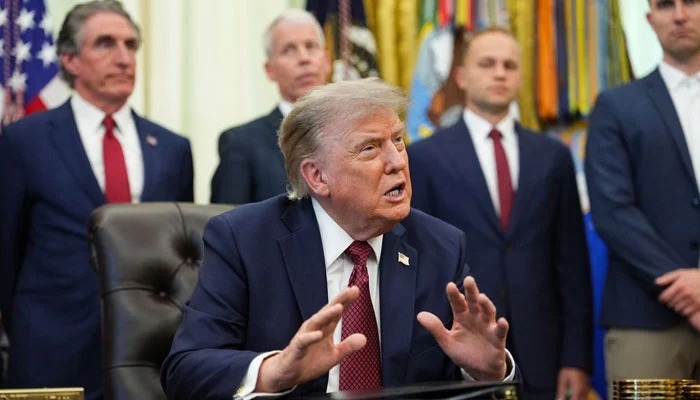
The move to temporarily restrict the vital communications system came as President Donald Trump has pressured Kyiv to stop its attacks on Russian refineries, which he has blamed for the soaring energy prices that are denting his Republican Party’s prospects in the November midterm elections.

But experts say that surge in energy costs is mainly the result of the US-Israeli war with Iran, which brought Iranian attacks on energy facilities and has largely shut the vital Strait of Hormuz.

In response to a request for comment about the order to limit Starshield, a senior US official said: “No such request was ever made by the president.”

The White House did not respond to questions about whether other administration officials might have made the request.

Starshield was developed by SpaceX specifically for government and national-security customers, particularly the US Department of Defense. Starshield uses the Starlink constellation as its backbone.

Ukrainian officials said the restrictions complicated strike missions against Russian forces and logistics in occupied territory and slowed interceptor drones used to shoot down incoming Russian Shahed drones.

Elon Musk, the CEO of SpaceX, said on X on Wednesday that because Starshield systems are owned and controlled by the US government, any limits on speed or usage are decided by the US military or the president.

SpaceX did not respond to a request for comment.

The Department of Defense and the Ukrainian embassy in Washington also did not respond to requests for comment.

Decline in relations

Relations between Kyiv and Washington have deteriorated in recent days following a meeting in Miami on October 9 that convened representatives from both countries as well as Europe and the World Bank.

Trump’s son-in-law Jared Kushner and Steve Witkoff, the Trump administration’s Middle East envoy, struck a tough tone with Ukraine in the meeting, according to a separate person familiar with the matter. They told Ukrainian officials that the US was frustrated with Kyiv’s continued strikes on Russian refineries despite repeated requests from Washington to stop.

The US delegation also explained Washington’s decision to strike a diesel deal with Russia, saying the White House hoped it would soften Moscow’s stance on peace talks.

That deal, under which Russia will supply more than 2.25 million barrels of diesel to ​US and global markets, has triggered a backlash from some US lawmakers, who say it will give Moscow cash to pursue its war without forcing Russian President Vladimir Putin to make concessions to end the conflict.

In the days that followed, Ukrainian President Volodymyr Zelenskiy and Trump criticized each other, with Zelenskiy calling the US decision on the Russian diesel deal “weak.” Trump called for elections in Ukraine and Zelenskiy’s ouster.

Behind the scenes, American officials threatened to stop providing intelligence to Kyiv about Russian missile launches that Ukraine uses to thwart attacks, as Reuters previously reported. Trump said on Tuesday Washington was still sharing intelligence with Ukraine.

Following the move to restrict Ukraine’s access to Starshield, the Ukrainians made calls on Tuesday and Wednesday to find answers from senior officials at the White House, State Department and Pentagon, a senior Ukrainian official said, adding that Kyiv was told it was a White House decision.

The Pentagon has spent billions of dollars on the Starlink and Starshield services. It has also bought dedicated Starshield satellites, including communications spacecraft ​for missile-warning missions and a spy ​constellation for the National Reconnaissance ⁠Office, Reuters reported in 2024. – Rappler.com

Similar Posts

  • | | | | |

    Hlun Solo’s Death Devastates Fans, We Explain Why He Was The Exact Opposite of Most Influencers and YouTubers and Why He Was So Beloved by Thais

    Thailand/Georgia His real name was Bowornthat Pengsuk, born in 1999 in Kalasin province in northeastern Thailand, he grew up in modest circumstances. After his father died, he was raised primarily by his grandmother, who focused on education and practical values. He attended local schools that offered scholarships and support, then worked factory jobs in Bangkok, […]

  • | |

    Zimbabwe ferry disaster death toll climbs to 68

    HARARE: The death toll from a ferry disaster on Zimbabwe’s Lake Kariba has risen to 68 after rescuers recovered 22 more bodies, police said on Saturday. The ferry, operated by the government’s Rural Infrastructure Development Agency, overturned on Tuesday while travelling through rough waters. The vessel was carrying villagers and fish traders who rely on the lake for their livelihoods. Authorities said the boat was licensed to carry 90 passengers but had 114 adults and five crew members on board, along with an unknown number of children. The overcrowding has raised concerns about safety standards as the search for the remaining victims continues. Lake Kariba lies along Zimbabwe’s border with Zambia and is a vital source of transport and trade for communities living around the lake.

  • |

    Japan earthquake disrupts auto and chip production as death toll rises to 34

    A powerful earthquake that struck Japan’s Kumamoto region has killed at least 34 people and disrupted major manufacturing operations, exposing the continued vulnerability of the country’s industrial supply chains. The 7.1 magnitude quake damaged roads, interrupted essential services and forced several automobile and semiconductor companies to suspend production, raising concerns about delays across global supply networks. The earthquake struck on Tuesday, causing widespread destruction in southern Japan. Thousands of households were left without basic utilities while damaged roads and transport links made it difficult for businesses to continue normal operations. Kumamoto is one of Japan’s most important manufacturing regions and plays a key role in producing vehicles, auto parts and semiconductors used around the world. Toyota has temporarily suspended production at three factories in Fukuoka until August 5 because of concerns about employee safety and disruptions affecting suppliers and transport companies. The company has also decided to halt operations at one of its plants in Aichi, located more than 600 kilometres from the disaster zone, showing how shortages of essential components can quickly affect factories far from the earthquake’s epicentre. One of Toyota’s major suppliers, Aisin, also suffered disruptions at its factory near the hardest hit area. The company manufactures engines, doors and other vehicle parts for Toyota, Nissan and Daihatsu. Aisin said it plans to restart production gradually after confirming that facilities are safe and product quality can be maintained. However, it has not announced when full operations will resume. Trucks carrying supplies, including portable toilets, were seen entering the factory as recovery work continued. Local businesses reported that water services had been interrupted although electricity remained available. The latest disaster has revived memories of the 2016 Kumamoto earthquake, which caused severe damage to the same Aisin plant and forced Toyota to suspend production across Japan because of shortages of a critical door component. Industry officials said smaller suppliers further down the supply chain may also have been affected this time, increasing the risk of continued production delays. Auto parts manufacturer Denso said one of its suppliers had already reported damage while several others were still assessing conditions. Nissan has suspended some production at its two vehicle plants in Kyushu because of delays in receiving parts. Mitsubishi Motors has also halted certain production lines at its factory in Okayama as the effects of the earthquake continue to spread through the manufacturing sector. Kumamoto has also become one of Japan’s leading centres for semiconductor production in recent years. The region is often referred to as the country’s Silicon Valley because of its concentration of advanced chip manufacturers. Taiwan Semiconductor Manufacturing Company, the world’s largest contract chipmaker, evacuated workers from its Kumamoto plant immediately after the earthquake. The company later confirmed that operations had started to resume within a few hours. Other semiconductor companies are expected to take longer to recover. Renesas said damage at one of its facilities included fallen ceiling panels, cracked walls and water leaks. The company plans to restart production in stages beginning on August 5. Tokyo Electron announced that it expects to resume production next week, while Sony said efforts are continuing to restore operations at its semiconductor factory in Kumamoto. Although the number of deaths is lower than the more than 260 people killed in the 2016 earthquake, this disaster has still caused significant human and economic losses. Nearly half of the fatalities occurred inside commercial buildings. Nine people died when severe structural damage struck a Nippon Paper Industries mill near the epicentre. Another seven people lost their lives at an Aeon shopping mall where authorities believe a gas explosion occurred more than an hour after the initial earthquake. The disaster has once again highlighted the challenge Japan faces in protecting both its population and its globally important manufacturing industry from natural disasters.

  • | | |

    Oil prices surge as US-Iran talks falter and suppl…

    Global oil prices climbed on Friday as stalled efforts to end the conflict involving Iran heightened concerns over possible disruptions to crude supplies. Markets remained focused on developments in the tense US-Iran negotiations, with traders also weighing the risk of further military and economic escalation. Brent crude futures rose 1.45 per cent to $88.33 a barrel, while US West Texas Intermediate crude gained 1.26 per cent to $82.27. Both benchmarks were on course for substantial weekly gains as uncertainty surrounding regional oil supplies continued to influence trading. Concerns intensified after the United States indicated that economic pressure on Iran could be increased, including the possibility of extending a naval blockade. Analysts warned that any significant escalation in the conflict could cause a much sharper increase in energy prices by threatening supplies from the region. Market strategist Kyle Rodda of Capital.com said geopolitical uncertainty remained a major obstacle for financial markets despite otherwise supportive economic conditions. Investors have so far absorbed considerable uncertainty without demanding substantially higher risk premiums, but analysts cautioned that this balance could change quickly if tensions worsen. Rising crude prices also weighed on European equities, which ended the week lower and broke a four-week run of gains. In the United States, major stock indexes also declined, with the Dow Jones Industrial Average falling 0.14 per cent, the S&P 500 losing 0.19 per cent and the Nasdaq Composite dropping 0.39 per cent. Meanwhile, the US dollar weakened after disappointing retail sales data reduced expectations of another Federal Reserve rate increase. The softer dollar provided support to gold, with spot gold advancing 0.69 per cent to $4,380.03 an ounce. Currency markets also remained focused on Japan, where the yen edged higher against the dollar amid speculation that the Bank of Japan could raise interest rates as early as September. The currency nevertheless remained close to the 160-per-dollar level, which traders believe could prompt further intervention from Japanese authorities. Investors are now watching the next developments in US-Iran relations closely. A breakthrough in negotiations could ease pressure on energy markets, while any major escalation could trigger a renewed surge in oil prices and broader financial market volatility.

  • | | | | | |

    Trump orders one-day pause in Iran strikes as talks continue

    US President Donald Trump has reportedly ordered a one-day halt to military strikes against Iran, temporarily interrupting a nearly two-week-long series of attacks, according to reports from US media outlets. The pause comes as uncertainty remains over whether the decision represents a temporary break in operations or the beginning of a broader ceasefire process. Reports suggest that the US military had been preparing for possible further strikes against Iran, but Trump has not yet approved any new major offensive. According to US media reports, military plans for continued operations were presented to the president, but Trump instructed officials not to proceed with attacks on that day. The decision marked a significant shift after a period of repeated strikes targeting Iranian positions. Trump later told reporters that the United States still had the option to continue military action and increase the intensity of attacks if necessary. However, he indicated that pursuing a diplomatic solution could be a more effective strategy. “The smart strategy is to make a deal,” Trump was reported as saying, adding that Iran appeared to be becoming more serious about discussions while the US remained prepared for possible military action. The reported pause came as an Omani delegation arrived in Iran for discussions aimed at addressing regional tensions and negotiating a possible agreement related to the reopening of the Strait of Hormuz. Officials suggested that a deal between Iran and Oman could potentially be reached during the weekend, after which the final decision would depend on Washington. Meanwhile, Iran’s Islamic Revolutionary Guard Corps (IRGC) claimed that Iranian forces had destroyed several US military aircraft and drones during attacks on American bases. The group claimed that 17 drones, an F-15 fighter jet, a P-8 aircraft, a C-17 transport aircraft, and eight refueling planes were destroyed. The claims from both sides have not been independently verified, and officials have continued to provide competing accounts of the military developments. The situation remains highly sensitive as regional tensions continue, with diplomatic efforts taking place alongside military preparations. The coming days are expected to determine whether the temporary pause leads to broader negotiations or whether hostilities resume.

  • | |

    Ada Lovelace, the tech woman

    Long before the dawn of modern computers, a twelve-year-old girl named Ada Lovelace set her heart on how to fly. Rather than merely dreaming about the skies, she treated the challenge as a practical engineering problem. Beginning in early 1828, she meticulously studied avian anatomy and tested potential wing materials. Her experiments ranged from light paper and smooth silk to natural feathers. Lovelace even documented her findings in an illustrated manuscript she titled Flyology. Her pursuit only halted when her mother put an end to the project. A traditional mother who insisting that such whimsical ideas were a distraction from proper academic training. This tension between wild imagination and strict logic defined Lovelace’s upbringing.  Mother Annabella Byron was an intensely practical woman whose mathematical tendencies led her estranged husband, the tempestuous Romantic poet Lord Byron, to nickname her the Princess of Parallelograms. Shortly after Ada was born, Annabella separated from Byron. She further  separated the infant from her father’s chaotic influence. Lady Byron made it her mission to raise her daughter on a rigid diet of arithmetic, French and music. By doing so, the mother explicitly aimed to suppress any artistic interest she believed Ada might inherit from Byron. When Byron inquired about his young daughter, Annabella noted Ada applied her imagination strictly to mechanical problem-solving. Yet, despite her mother’s best efforts to extinguish her creative potential, Lovelace refused to treat reason and imagination as opposing forces. Instead, she fused them into a single approach to understanding the world. In early 1841, she pondered the true nature of imagination while identifying two distinct powers. First, she defined it as a combining faculty: the rare ability to find meaningful connections between entirely unrelated subjects. Second, more profoundly, she recognized imagination as a discovering faculty: the equipment that pierces the invisible world to reveal the hidden mechanics of science.   This hybrid worldview that Lovelace would later call poetic science is precisely what enabled her to look at Charles Babbage’s early mechanical calculating engines and see far past their raw math. While others saw mere gear-driven counting machines, Ada envisioned a future where machines could manipulate symbols, compose music, and run complex sequences of instructions. By bridging the emotional depth of her father’s romanticism with the rigorous structure of her mother’s mathematics, Ada Lovelace did not just become the world’s first computer programmer; she proved that groundbreaking technical innovation requires equal parts calculation and visionary artistry.

Leave a Reply

Your email address will not be published. Required fields are marked *