pakistan takes charge
| |

Pakistan takes charge of UN disarmament conference

Pakistan has assumed the presidency of the United Nations Conference on Disarmament (CD), taking a leading role in international discussions on arms control and global security.

Additional Secretary for Arms Control and Disarmament Tahir Hussain Andrabi is representing Pakistan and will preside over the conference’s meetings during the presidency.

Pakistan holds the final presidency of the CD’s 2026 session. It will therefore oversee the conclusion of the conference’s proceedings for the year and guide work on its annual report and the related resolution for the UN General Assembly’s First Committee.

As part of the opening activities, Ambassador Andrabi chaired a meeting with former presidents of the conference for the 2026 session. He also held consultations with representatives of different regional groups.

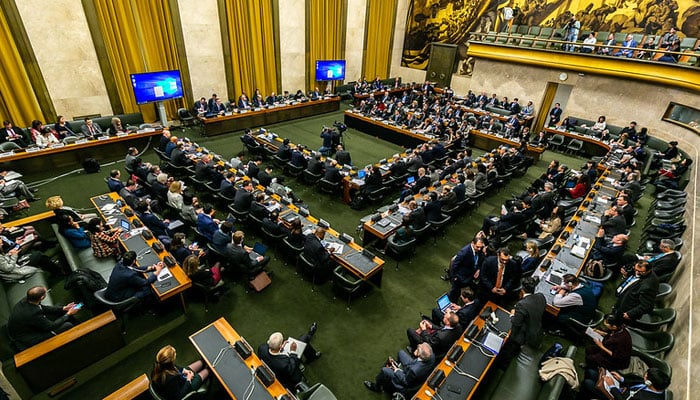
The Conference on Disarmament, headquartered at the United Nations Office in Geneva, is the principal multilateral forum for negotiating international disarmament and arms-control agreements.

The forum has 65 member states, including countries that possess nuclear weapons. Its discussions cover some of the most sensitive issues affecting international peace and security.

Key areas on its agenda include preventing a nuclear arms race, reducing the risk of nuclear war and stopping the weaponisation of outer space.

The conference and its predecessor bodies have played a significant role in developing major international security agreements. These include the Biological Weapons Convention, Chemical Weapons Convention and Comprehensive Nuclear-Test-Ban Treaty.

Pakistan’s presidency comes at a time when nuclear risks, arms competition and emerging security challenges remain major concerns for the international community.

The Foreign Office said Pakistan’s leadership of the conference reflects international confidence in its diplomatic role and its continued engagement in multilateral arms-control efforts.

Similar Posts

  • |

    Ukraine accuses Russia of launching North Korean missiles in deadly regional strikes

    Ukrainian President Volodymyr Zelensky accused Moscow of deploying North Korean ballistic missiles during a series of overnight attacks across Ukraine that left at least seven people dead in Zaporizhzhia. Local officials in Zaporizhzhia reported that the strikes hit the city’s Zaporizhstal metallurgical plant with guided bombs and missiles, killing seven employees, injuring 24 others, and forcing the facility to suspend operations. The barrage was part of a broader aerial offensive involving 120 Russian drones and multiple missile launches that disrupted power supplies in Kharkiv and Kherson while damaging civilian infrastructure in Kyiv and Sumy. In response, Ukrainian forces launched retaliatory deep-space strikes targeting critical Russian supply and industrial assets. Ukrainian drones struck facilities belonging to online retailer Wildberries in the Voronezh region, as well as a petrochemical plant in western Siberia. The long-range campaign follows a strike on the Tanevo oil refinery in Tatarstan, located over 680 miles inside Russian territory, which killed 13 people and injured dozens. Zelensky warned that Moscow’s growing reliance on North Korean weaponry and troops presents a expanding international security threat. Western military intelligence previously noted that thousands of North Korean soldiers had been deployed to support Russian units in the Kursk region, where allied forces suffered heavy casualties during autumn combat.

  • | | |

    Wheat imports spark farmer anger

    The federal government’s decision to import one million tonnes of wheat has sparked strong criticism from farmers and agricultural experts. The move has raised concerns about Pakistan’s food policy and the country’s continued dependence on imported grain despite being a major wheat producer. Pakistan produces around 31 million tonnes of wheat annually. The crop covers nearly 40 per cent of the country’s cultivated area and remains a major part of the daily diet of millions of people. Punjab is the country’s largest wheat-producing province and contributes almost three-fourths of national production. Farmers and experts say the issue is not simply about wheat availability. They believe repeated imports are linked to weak planning, inaccurate crop estimates, poor storage facilities, post-harvest losses and inconsistent government policies. Population growth and changing weather patterns have also increased pressure on the wheat supply chain. Farmer organisations have strongly opposed the import decision. They say local growers are still struggling to sell their recently harvested wheat. Many farmers claim they are receiving prices below their production costs after spending heavily on seeds, fertiliser, pesticides, diesel and electricity. Growers fear that imported wheat could further reduce local prices. They argue that the government should first ensure that locally produced wheat is purchased at fair rates before turning to international markets. The controversy has also highlighted changes in Pakistan’s wheat procurement system. Under wider economic reforms linked to the International Monetary Fund programme, successive governments have reduced state intervention in agricultural markets. The aim is to limit government losses and encourage greater private-sector participation. The IMF has not directly ordered Pakistan to stop purchasing wheat from farmers. However, governments have moved away from the traditional procurement and support price system. Provincial authorities have also reduced wheat purchases, leaving farmers increasingly dependent on private traders. Farmers say the transition has not been properly managed. They argue that private buyers now have greater influence over prices because of weak market regulation. This has forced some growers to sell their wheat below production costs.

  • | |

    President Zardari approves civil awards for 355 pe…

    ISLAMABAD: President Asif Ali Zardari has approved civil awards for 355 Pakistani and foreign personalities in recognition of their outstanding services and achievements in various fields. The awards will be presented at a special ceremony on Pakistan Day, March 23, next year. The recipients include prominent figures from politics, public service, entertainment, sports, journalism, law enforcement, medicine and other sectors. Among the personalities from the entertainment industry, singers Tarannum Naz and Nisho Begum will receive the Sitara-i-Imtiaz. Actors Ghazala Kaifi, Sania Saeed and Maria Wasti, along with singer Zohaib Hassan, will be honoured with the Tamgha-i-Husn-i-Karkardagi. Singer Shiraz Uppal will receive the Tamgha-i-Imtiaz. In sports, shooter Kishmala Talat and former Test cricketer Sadiq Mohammad will be awarded the Tamgha-i-Husn-i-Karkardagi for their contributions and achievements. Several senior government officials and political figures have also been included in the awards list. Deputy Prime Minister and Foreign Minister Ishaq Dar, Interior Minister Mohsin Naqvi, Federal Ministers Ahsan Iqbal and Muhammad Aurangzeb, and Minister of State Bilal Azhar Kayani will receive the Nishan-i-Imtiaz. Director General Intelligence Bureau Fawad Asadullah, Attorney General Mansoor Usman Awan, Federal Board of Revenue Chairman Rashid Mahmood Langrial, Finance Secretary Imdadullah Bosal and Commerce Secretary Jawad Paul will receive the Sitara-i-Imtiaz. Chairman Pakistan Ulema Council Allama Hafiz Tahir Mahmood Ashrafi will be awarded the Tamgha-i-Imtiaz, while Federal Minister Engineer Amir Muqam will receive the Hilal-i-Imtiaz for public service. Zobia Khursheed Raja of Azad Kashmir will receive the Tamgha-i-Shujaat for her bravery in confronting rioters. She reportedly risked her life to rescue an injured police officer who was surrounded by rioters. A total of 46 martyrs of law enforcement agencies will be awarded the Sitara-i-Shujaat. Group Captain Asim Tariq Shaheed will also receive the same honour. Drug Regulatory Authority of Pakistan CEO Dr Ubaidullah will receive the Sitara-i-Imtiaz, while Punjab Saaf and Suthra Authority Director General Babar Sahib Din will be awarded the Tamgha-i-Imtiaz. Senior journalists Saleh Zafar and Haji Nawaz Raza will receive the Sitara-i-Imtiaz. Journalists Ammar Masood, Maria Zulfiqar, Adil Shahzeb and Hamad Hassan will be honoured with the Tamgha-i-Imtiaz. Two physicians associated with Quaid-e-Azam Muhammad Ali Jinnah, Dr Jal Ratanji Patel and Dr Jal Dabu, will be conferred the Nishan-i-Quaid-i-Azam posthumously. The list also includes prominent foreign figures. Saudi Prince Saud bin Naif will receive the Hilal-i-Pakistan, while Turkish Foreign Minister Hakan Fidan, Defence Minister Yasar Guler and Trade Minister Omer Bolat will each be awarded the Sitara-i-Pakistan. Dr Khalid Abbas Al-Asadi and Dr Paul Jacob Bhatti will receive the Tamgha-i-Imtiaz in recognition of their services.

  • PAAM opposes DRAP’s proposed alternative medicine rules 2026

    LAHORE: A covert gambit by the Drug Regulatory Authority of Pakistan (DRAP) to impose arbitrary regulations on the alternative medicine sector has been laid bare, sparking widespread outrage across the pharmaceutical industry. ​The regulatory body is accused of using an upcoming ‘Pak Health Expo’, organized by an association at a local hotel in Islamabad on August 12–13, as a smokescreen to push through controversial policies. Reliable sources revealed that the final draft of the highly contentious “Alternative Medicines Rules 2026” has already been finalized behind closed doors, completely bypassing key industry stakeholders. According to these sources, the draft has already been forwarded to the Law and Justice Division for formal vetting. Against this backdrop, the industry has termed DRAP’s sudden announcement of a “consultative session” at the expo issued on a mere 48-hour notice as a farcical exercise in paperwork, designed solely to create a false record of stakeholder consensus. Insiders further alleged that top DRAP officials had been cold-calling homeopathic and Unani pharmaceutical firms over the past several days, pressuring them to purchase expensive stalls worth hundreds of thousands of rupees at the private event. Following a widespread boycott of the expo by established manufacturers, DRAP reportedly engineered the controversial regulatory session within the event to corner the industry into participation. Reacting strongly to the development, Kashif Aslam Malik, Chairman of the Pakistan Association of Alternative Medicine (PAAM), categorically rejected DRAP’s maneuvers, stating that the leadership had anticipated the bureaucratic trap. ​”When the final draft has already been sent to the Law and Justice Division for vetting, this sudden drama of a consultative session at a private venue is nothing but an absolute mockery,” Malik questioned while speaking to journalists. The PAAM chairman emphasized that leaning on private event platforms to legitimize sensitive, sector-defining legislation is clear evidence of regulatory bad faith. He maintained that if DRAP were genuinely sincere about consultation, it would have convened an official, independent roundtable with all veteran associations where the actual draft could be scrutinized transparently. The PAAM leadership has announced that any back-door attempt to benefit a favored private group or to bulldoze industry-hostile clauses under the guise of an expo crowd will be resisted tooth and nail. Kashif Aslam ​Malik reiterated that this persistent bureaucratic high-handedness and regulatory blackmail are precisely why PAAM continues to spearhead the movement for a dedicated, independent federal ministry for alternative medicine. The association demands that policies governing traditional and alternative health sciences be framed by domain experts who understand the discipline, rather than traditional regulators.

  • |

    US Forest Service chief reportedly pressed staff to deploy extra aircraft for fire near his Idaho ranch

    Michael Boren, the US Undersecretary of Agriculture for Natural Resources and Environment who oversees the US Forest Service, reportedly pressured agency staff to deploy additional aircraft to a small 7-acre wildfire burning near his private property in Idaho. According to agency communications and current and former Forest Service officials, the Cabin Creek fire began on 12 July 2026 in the Sawtooth National Forest due to an unattended campfire. Boren, who owns a 480-acre ranch in the nearby Sawtooth National Recreation Area, repeatedly contacted regional and national operations leadership to question why more aircraft were not assigned to the blaze. Flight data reveals that approximately nine aircraft—including air tankers, tactical planes, and helicopters—were dispatched to the small fire, with some assets diverted from other active wildfires in Idaho. Insiders noted that the emergency response was unusually heavy for a minor outbreak that ground crews could easily access and which posed no immediate threat to life or major infrastructure. In response, a spokesperson for the Department of Agriculture maintained that Boren merely reported the fire as any local landowner would and denied that he ordered or pressured staff to shift resources. The fire was fully contained by 15 July.

  • Cambodia Continues Border Assaults, Prompting Expanded Thai Curfews and Retaliation

    BANGKOK – Cambodian forces have continued attacks along the Thai border, leading Thailand to expand retaliatory operations and impose wider curfews in affected provinces, the Thai Ministry of Defence announced on Sunday. The escalation comes despite reports of a proposed ceasefire brokered by regional leadership. Cambodian rocket attack on Sisaket village injures civilians and damages […]

Leave a Reply

Your email address will not be published. Required fields are marked *