rain likely karachi
| |

Rain likely in Karachi from today till August 3

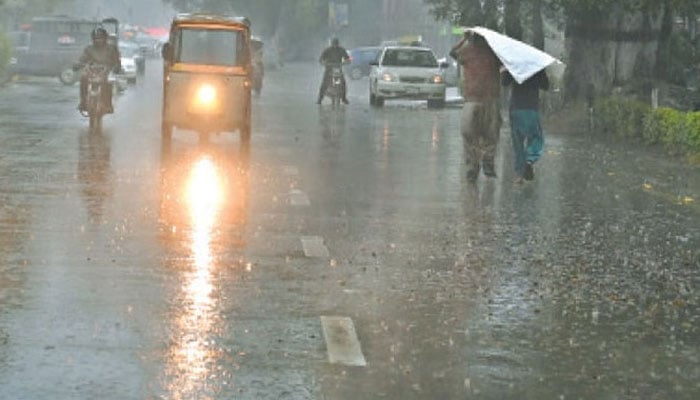
KARACHI: The Pakistan Meteorological Department (PMD) has forecast rain accompanied by thunderstorms in Karachi from Saturday afternoon or evening until August 3 as a weather system continues to influence parts of Sindh.

According to meteorologists, the intense low-pressure system that had developed over southern Madhya Pradesh has weakened further. It is now located near Rajasthan as a well-marked low-pressure area and is expected to weaken further over the next 24 hours.

Despite weakening, the system continues to draw monsoon currents from the Arabian Sea and the Bay of Bengal into the upper and central parts of Pakistan. At the same time, a westerly weather system is also affecting the country’s northern regions, creating favourable conditions for rainfall in several areas.

The Met Office said Karachi is likely to receive rain with thunderstorms from Saturday afternoon or evening through August 3 under the influence of the weather system.

Weather experts also forecast intermittent rain accompanied by dust storms and thunderstorms in Tharparkar, Umerkot and Mithi until August 3. Similar weather conditions are expected in Sanghar, Hyderabad and surrounding districts during the same period.

The PMD warned that heavy rainfall could lead to urban flooding in low-lying areas of Sukkur, Shaheed Benazirabad, Hyderabad, Badin, Sanghar, Khairpur, Matiari, Mirpurkhas, Umerkot, Tando Muhammad Khan and Tando Allahyar.

The department also cautioned that heavy rain, strong winds and lightning could damage weak structures. Farmers have been advised to plan their agricultural activities according to the changing weather conditions to avoid potential losses.

For Karachi, the Met Office said the sky is expected to remain mostly cloudy during the next 24 hours. The maximum temperature is likely to reach around 36 degrees Celsius.

During the past 24 hours, the minimum temperature recorded in the city was 29.5 degrees Celsius.

Similar Posts

  • |

    Nick Reiner denied $1.5 million trust fund access

    Nick Reiner has suffered another legal and financial setback following his indictment in connection with the deaths of his parents, filmmaker Rob Reiner and his wife, Michelle Reiner. The 32-year-old writer is reportedly being denied access to a trust fund worth more than $1.5 million as he prepares to fight the serious criminal charges against him. According to a report published on Saturday, August 15, a new trustee overseeing Reiner’s trust has refused his request to withdraw money from the account. Reiner had sought access to the funds to help cover his legal expenses and pay for basic necessities while he remains in custody. The decision is reportedly based on California’s so-called “slayer statute.” Such laws are designed to prevent an individual from financially benefiting from the death of someone they are accused of intentionally killing. The statute can restrict a person’s ability to inherit or receive assets connected to the alleged victim. Reiner’s trust was established by his parents after his birth in 1993 and is now valued at more than $1.5 million. In a court filing, Reiner claimed that he was expected to receive half of the trust once he reached the age of 30. However, he said that the money had never been transferred to him. He is now seeking access to the funds, arguing that they are needed to pay his attorneys and support himself while incarcerated. His request reportedly includes money for his commissary account, which he said would allow him to purchase everyday necessities such as socks and personal hygiene products. The dispute over the trust comes shortly after prosecutors secured an indictment against Reiner in the deaths of his parents. On Wednesday, August 12, a Los Angeles grand jury reportedly indicted him on two counts of first-degree murder. The charges relate to the deaths of Rob and Michelle Reiner. Prosecutors presented evidence to the grand jury, which ultimately determined that there was sufficient evidence for the case to proceed toward trial. The indictment also reportedly includes a special circumstance allegation of “lying in wait.” Prosecutors allege that Reiner deliberately waited for his parents before attacking them when they were vulnerable or unaware. The additional allegation could significantly increase the potential consequences if Reiner is ultimately convicted. Depending on how the case proceeds and the applicable sentencing rules, a conviction involving such circumstances could expose him to extremely severe punishment, including life imprisonment without parole or potentially the death penalty. For now, Reiner remains entitled to the presumption of innocence, and the allegations against him have yet to be proven in court. His ongoing legal battle now involves not only the murder charges but also an effort to gain access to the substantial trust established by his parents.

  • | | |

    Why are thousands protesting Sindh’s major civil…

    HYDERABAD: A civil service examination meant to open the door to prestigious government jobs in Sindh has instead triggered months of protests, legal battles and allegations of irregularities, with unsuccessful candidates demanding that the entire process be scrapped and conducted again. The controversy centres on the Combined Competitive Examination 2024 (CCE-24) conducted by the Sindh Public Service Commission (SPSC). More than 4,300 candidates appeared in the written examination, which consisted of 10 papers. Yet when the results were announced on May 6, only 70 candidates were declared successful. The examination is particularly important because successful candidates can be appointed to Grade 16 and 17 positions, including assistant commissioners, assistant directors and section officers. For many candidates, the unusually low pass rate immediately raised questions. Why did the results trigger protests? The protesters’ concerns intensified when detailed marks certificates were uploaded following the announcement. Candidates noticed what they described as apparent inconsistencies in the marks sheets. One example involved Criminology, an optional subject carrying 100 marks in a single paper, which appeared in some detailed certificates as two papers carrying 200 marks. Candidates said a similar issue was visible in Environmental Science. Farman Ali, one of the campaign leaders, said candidates initially believed the discrepancy could simply be a technical mistake. However, after finding similar problems in other subjects, they began demanding an explanation from the commission. The SPSC, meanwhile, has maintained that the examination was conducted according to the applicable rules. Its spokesperson, Hifzullah Kaka, declined to comment on the disputed issues while the matter remained before the courts. Protests spread across Sindh Following the results, social media quickly filled with allegations that the examination process had been manipulated to benefit selected candidates. The Sindh Students Action Committee subsequently organised protests, while candidates began a sit-in outside the SPSC headquarters on Hyderabad’s Thandi Sarak. A larger rally was held on May 13, drawing students from different parts of Sindh. The following day, MQM-P lawmaker Maaz Mahboob submitted a resolution in the Sindh Assembly, expressing concern over alleged irregularities, merit violations and a lack of transparency. Protesters later launched the Movement for Restoration of Meritocracy, demanding broader reforms in public recruitment. The campaign has since spread beyond Hyderabad, with protests reported in Nawabshah, Ghotki, Qambar, Umerkot, Islamkot and Gambat. How did the controversy reach the courts? The dispute soon moved into the courtroom. The Sindh High Court suspended the CCE-24 results and directed the SPSC to produce the complete examination record. The court also halted further appointments and proceedings based on the disputed results. The SPSC challenged the Sindh High Court’s interim orders before the newly established Federal Constitutional Court, arguing that the examination had been conducted fairly, transparently and under the Sindh Public Service Commission Act, 2022, and Recruitment Management Regulations, 2023. On July 16, the federal court suspended the Sindh High Court’s interim orders concerning the inquiry, interviews and rechecking of failed candidates. The development allowed the SPSC to proceed with interviews of the 70 successful candidates. Protesters refuse to back down Despite the legal developments, unsuccessful candidates say their concerns remain unresolved. They are demanding that CCE-24 be cancelled and a fresh examination conducted. They are also calling for the resignation of SPSC Chairman Muhammad Rizwan and commission members, along with an independent judicial inquiry into SPSC examinations and recruitments for Grade 16 and 17 posts over the past five years. At the heart of the dispute is a question that extends beyond one examination: can young candidates trust the system responsible for deciding who gets a government career? For thousands of applicants who spent years preparing for the competitive examination, the answer remains uncertain. As the court proceedings continue, protesters remain camped outside the SPSC headquarters, insisting that their campaign will continue until they receive what they consider a transparent and credible resolution.

  • |

    UK faces potential red weather alerts as fifth heatwave of 2026 brings 36C temperatures

    The United Kingdom is preparing for a fifth heatwave this summer, with temperatures projected to reach 36C and prompting the Met Office to consider issuing rare red weather alerts. The extreme heat poses severe risks of disruption across railway lines and power networks, whilst compounding growing concerns over drought and food security. Following a temporary drop in temperatures on Monday, heat levels across England and Wales are expected to climb rapidly. Sunday marked the 35th day in 2026 where British temperatures exceeded 30C, hitting a peak of 30.6C. Met Office meteorologist Tom Morgan indicated that mid-30s temperatures will become widespread on Wednesday and Thursday, with Thursday currently tracking as the hottest day of the week and holding a small chance of exceeding 36C. The prolonged period of dry conditions has left half of England and Wales grappling with near-drought environments, and officials warn that further regions could soon be declared affected zones. Alongside potential infrastructure damage, authorities are highlighting risks to health and agricultural output. The Met Office confirmed that formal amber and red warnings are under active consideration as the situation develops. Meanwhile, the UK Health Security Agency has put yellow heat-health alerts in place across the East Midlands, West Midlands, South East, South West, East of England, Yorkshire and the Humber, and London. These health advisories remain active through Tuesday evening, with potential extensions if extreme conditions persist.

  • Welfare pharmacy seal-off adds to poor patients’ woes

    GUJRAT: The District Health Authority (DHA) has shut down the medical store of the Patients’ Welfare Association at Jalalpur Jattan Civil Hospital following the recent visit of Punjab Secretary for Health and Population Nadia Saqib, a move that has drawn concern from patients, civil society representatives and local residents. The medical store, which had been providing medicines to poor and needy patients on a welfare basis, was closed after Secretary Nadia Saqib’s visit to Gujrat last week. Medical stores at THQ hospitals in Kharian and Kunjah were also closed following the health secretary’s directions, according to official sources. The Health Department’s position is that medicines should not be distributed without a Drug Testing Laboratory (DTL) report. Officials said the Jalalpur Jattan store was sealed because the medicines available there did not have the required DTL reports. They maintained that the department could not allow medicines to be provided to patients without ensuring their quality through the prescribed testing process. However, the closure of the patients’ welfare association’s medical store has raised concerns among local residents, particularly because the association had been supplementing the medicines officially provided by the hospital and helping poor patients who could not afford medicines from private pharmacies. Sources said the official medicine budget of Jalalpur Jattan Civil Hospital was already very low, even when compared with hospitals functioning at the THQ level. Local authorities had therefore engaged civil society and philanthropists to supplement the officially provided medicines and facilitate poor and needy patients. The development has also triggered protests by civil society representatives, who have demanded immediate attention to the shortage of medicines and other healthcare facilities at the hospital, particularly now that the welfare pharmacy is no longer operational. Representatives of the Patients’ Welfare Association have also urged Punjab Chief Minister Maryam Nawaz to take notice of the situation and ensure the establishment of a proper THQ hospital at Jalalpur Jattan, permission for the resumption of medicine provision through appropriate channels, and an increase in the hospital’s medicine budget. The association’s representatives have also criticised the frequent changes of medical superintendents at Jalalpur Jattan Civil Hospital and demanded more medical officers and other staff to improve healthcare services. Jalalpur Jattan was upgraded as a tehsil headquarters by former Punjab chief minister Chaudhry Parvez Elahi in 2022. Despite being the second major urban centre of Gujrat district, the tehsil has yet to get a THQ-level hospital for its population of around 700,000, according to local sources. The issue has become particularly sensitive for residents because the Patients’ Welfare Association had emerged as an important support system for poor patients seeking treatment at the civil hospital. While the Health Department insists that medicines must undergo the required testing process before being distributed, local residents argue that the closure has further reduced an already limited source of medicines for needy patients. The situation has now put the spotlight on both the quality-control requirements for medicines and the broader shortage of healthcare resources at Jalalpur Jattan Civil Hospital.

  • | |

    Pakistan’s military tightens grip on Islamis…

    Munir’s family background feeds into this shift as well. He is the son of an imam and considers himself a devout, conservative Muslim, and religious identity remains deeply woven into Pakistan’s state institutions. Even so, he has pushed the country toward international engagement through cryptocurrency partnerships, foreign investment deals, a mediating role in the conflict between the United States and Iran, and a mutual defence pact with Saudi Arabia. Data shared with a foreign news agency by the Armed Conflict Location and Event Data Project, a group that tracks conflict incidents worldwide, shows the scale of the shift. Pakistan averaged more than seven blasphemy related riots or attacks annually between 2021 and 2024, but recorded only one such incident over the past twelve months. Economic pressure appears to have played a significant role in prompting the crackdown. Two Pakistani government sources said officials grew alarmed during the summer of 2025 that rising hostility from fundamentalist groups toward France and other European countries threatened to jeopardize a European Union duty waiver covering Pakistani exports. Nearly a third of Pakistan’s total exports go to the EU, and losing that preferential access could have dealt a severe blow to the national economy. Neither the European Commission nor Pakistan’s commerce ministry responded to requests for comment on the matter. Washington has added its own pressure over religious freedom concerns. The US Commission on International Religious Freedom, a government watchdog, recommended last year that Pakistan be placed back on a list of countries of particular concern due to its blasphemy laws, a designation Islamabad has firmly rejected. Analyst Abdul Basit of Singapore’s S. Rajaratnam School of International Studies said worsening insurgent violence in Balochistan and Khyber Pakhtunkhwa, Pakistan’s two most mineral rich provinces, likely added urgency to Munir’s campaign, particularly since he has pitched foreign investment in the country’s mining sector to American officials over the past year. Basit noted that religious groups have lost favor within the state’s priorities, though he cautioned that the militias driving these regional insurgencies are not formally tied to the newly banned Islamist organizations, even if both draw recruits from the same pool of young, radicalized men. Elizabeth Threlkeld, who directs the Stimson Center’s South Asia program, said the open question going forward is whether Pakistan can sustain this level of focus over time. Crackdown targets country’s largest fundamentalist movement The largest of the groups swept up in the crackdown, Tehreek e Labbaik Pakistan, built its identity around the slogan “Death to blasphemers” before authorities banned it late last year. Many of its leaders now sit in jail, its mosques have been sealed shut and its financial accounts frozen. A previously undisclosed government document that laid the groundwork for the ban argued the organization had become a serious threat to Pakistan by damaging both domestic stability and the country’s standing internationally. A spokesperson for the group pointed to a statement it issued last year describing the ban as illegal and unconstitutional. The move against Tehreek e Labbaik follows earlier crackdowns on groups such as Lashkar e Taiba and Jaish e Muhammad, which Pakistan pursued under pressure from the Financial Action Task Force, the international body that monitors terrorism financing. Basit linked the newest crackdown to a period of internal reflection within Pakistan over its historical backing of the Afghan Taliban, whom Islamabad now blames for stoking Islamist insurgencies against the Pakistani state from across the border. The Taliban government in Kabul has dismissed that accusation as baseless, and a spokesperson for its foreign ministry declined to comment further, describing Pakistan’s crackdown as an internal matter. For Pakistan’s Christian, Shia and Ahmadi communities, the change in atmosphere has been dramatic. In the past, suspects in blasphemy related killings, including police officers, were sometimes greeted with rose petals or celebratory receptions, and individuals accused of burning churches or minority mosques often received public praise. Blasphemy remains a capital offense under Pakistani law, and even a rumor of an accusation has historically been enough to spark riots or lynchings. Human rights organizations say victims’ families have rarely obtained justice, since judges and lawyers have often been too frightened to take on such cases. Officer Malik said everyone who confronted the crowd during last month’s incident in Karachi felt genuine fear. The Christian family targeted that day was eventually moved to safety, and an initial investigation has since found the accusations against them to be false. Group’s military links trace back a decade Tehreek e Labbaik formed in 2015 while its founder was imprisoned for shooting and killing a Pakistani provincial governor in 2011 over his support for a Christian woman accused of blasphemy. That gunman, a former police bodyguard, was later convicted and executed months after the group’s founding. Analysts have long suspected the group’s creation received at least tacit support from Pakistan’s military establishment, including its intelligence services, as a tool to keep civilian governments and mainstream political parties in check. Following violent riots led by the group in 2017, then army chief General Qamar Javed Bajwa referred to its protesters as the country’s own people. Pakistan’s Supreme Court later ordered the military and intelligence agencies to stay out of politics but stopped short of directly tying them to the organization. Analysts and former officials say the effects of years of tolerance for the group will not disappear simply because of a ban, and that the shock felt by its supporters could still trigger backlash. Ihsan Ghani, who served as Pakistan’s counter terrorism chief during the 2017 riots, said he worries the group could resurface at full strength if its usefulness to the state changes again. He compared decades of state backed nurturing of the movement to something that cannot simply be switched on and off at will. Within Pakistan’s minority communities, the sudden shift still feels fragile. One of the Christian women rescued during last month’s incident in Karachi said she and her family are now physically safe, but admitted the fear has not fully faded.

  • |

    Government raises petrol price by Rs4.45, cuts diesel by Rs2

    The federal government has announced a fresh revision in petroleum prices, increasing the cost of petrol while providing a slight reduction in the price of high-speed diesel. According to a notification issued by the Petroleum Division, the revised fuel prices came into effect on August 6 as part of the government’s regular fortnightly price adjustment mechanism, which is based on fluctuations in international oil markets and the exchange rate. Under the latest revision, the price of petrol has been increased by Rs4.45 per litre, taking the new retail price to Rs333.10 per litre. In contrast, the price of high-speed diesel (HSD) has been reduced by Rs2.00 per litre, bringing its new retail price down to Rs383.86 per litre. The increase in petrol prices is expected to affect millions of private vehicle owners, motorcycle riders and commuters across the country, as petrol is the primary fuel used in passenger transport. Meanwhile, the modest reduction in diesel prices may provide limited relief to the transport and agriculture sectors, where diesel is widely used for heavy vehicles, machinery and irrigation equipment. Petroleum prices in Pakistan are reviewed every two weeks, with adjustments reflecting movements in global crude oil prices, refined petroleum product premiums, freight costs and the rupee-dollar exchange rate. The government says the pricing mechanism is intended to align domestic fuel rates with international market trends while meeting fiscal commitments. The latest adjustment comes at a time when international oil markets remain volatile amid geopolitical developments and shifting global supply expectations. Analysts believe future fuel prices will continue to depend on global crude oil trends and currency movements.

Leave a Reply

Your email address will not be published. Required fields are marked *