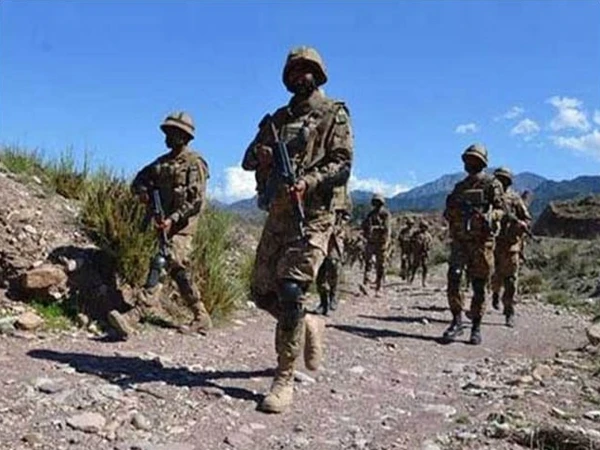
security forces kill
| | |

Security forces kill five militants in Panjgur ope…

Security forces have killed five militants during an intelligence-based operation in Panjgur district of Balochistan, according to the Inter-Services Public Relations (ISPR).

The operation was conducted after security agencies received intelligence about the presence of militants in the area.

Security personnel moved into the suspected location and carried out the operation.

Five militants were killed during the operation, ISPR said.

A significant quantity of weapons and ammunition was also recovered from the militants.

The recovered weapons and ammunition were taken into custody. They were later destroyed by the security forces, according to ISPR.

Following the operation, security personnel launched a clearance and search operation in the surrounding area.

The search operation is aimed at checking the area for any remaining militants and possible hideouts.

Security forces are also examining the area for additional evidence and material linked to militant activities.

ISPR said the operation was part of ongoing efforts to eliminate terrorism from Balochistan.

The military’s media wing said security forces remain determined to prevent militant groups from carrying out attacks.

It further said efforts would continue against terrorism allegedly being carried out with foreign support and assistance.

Security forces have intensified operations against militant networks in different parts of the province.

Authorities have repeatedly stressed the need for intelligence-based operations to identify and target militant elements.

The latest operation in Panjgur comes amid continued security efforts in Balochistan

Similar Posts

  • |

    Armed gunmen kill 12 and abduct women in Nigerian village raid

    Armed gunmen launched a hours-long night-time raid on the village of Lajinge in northwestern Nigeria’s Sokoto state, killing at least 12 people and abducting several women and children. The assailants set fire to homes during the assault, causing six members of a single family to burn to death inside their residence. Local residents reported that four additional individuals sustained injuries while the attackers also rustled significant amounts of livestock. Sokoto state police forces confirmed an ongoing investigation into the assault, which follows a similar attack that left 24 farmers dead in neighbouring Zamfara state just a week prior.

  • |

    Ines Garcia opens up on scary hospital visit amid needle fear

    Ines Garcia, girlfriend of football star Lamine Yamal, has revealed a frightening health scare through her Instagram. The 21-year-old influencer left fans worried after describing a sudden trip to the hospital. Sharing the update on Friday, August 7, Garcia walked followers through the unexpected medical emergency as it unfolded. She explained that despite never having a fear of needles before, the entire experience turned out to be genuinely horrible for her. She also praised the hospital staff for helping her stay calm throughout the ordeal. Garcia said she felt overwhelmed during the visit, but noted the nurse looking after her had a good sense of humour that helped ease the tension. In a follow-up story, Garcia posted a photo of herself lying in a hospital bed, looking noticeably pale. She joked about how visibly her emotions and health always show on her face, saying she can never hide it when something is wrong. The update came just a day after Garcia had already hinted that something was off. She’d posted a selfie earlier in the week, telling followers she had so much bad news lately that she barely knew where to begin. Garcia and Yamal have remained under intense public scrutiny since the conclusion of the 2026 World Cup. Their relationship first drew attention after rumours suggested Garcia had ended a previous relationship to be with the young football star. Speculations did not stop there either, with some fans even suggesting she might be pregnant, though nothing was ever confirmed. The couple’s relationship first became public knowledge during the FIFA tournament, and it’s kept them in headlines ever since. While Garcia has not shared the exact medical reason behind her hospital visit, her posts were enough to spark concern among her large online following. Fans have since flooded her comments section with messages wishing her a quick and full recovery. For now, both Garcia and Yamal appear to be navigating a stretch of unusually intense media attention, with little sign of it slowing down anytime soon.

  • |

    Nepra approves Rs21.4bn investment plan for SEPCO, sets loss targets

    The National Electric Power Regulatory Authority (Nepra) has approved a Rs21.436 billion Distribution Investment Plan (DIP) for Sukkur Electric Power Company Limited (SEPCO), covering its transmission and distribution operations for the five-year Multi-Year Tariff (MYT) period from fiscal year 2025-26 through FY2029-30. Along with the investment plan, the regulator has also set provisional targets for transmission and distribution (T&D) losses, while directing SEPCO to improve project execution, digitalise operational data and strengthen its planning and monitoring mechanisms. SEPCO had originally requested approval for an investment programme worth Rs90.563 billion. However, after Nepra raised several questions regarding the proposed projects, costs, utilisation of existing assets and investment requirements, the power utility submitted revised details. Following the revisions, SEPCO reduced its proposed investment to Rs40.191 billion in information submitted to Nepra on June 19, 2026. The revised proposal included changes in investment priorities and network development requirements based on updated demand projections. The company also revised project costs in light of the latest Purchase Orders (POs). Nepra, however, found substantial weaknesses in SEPCO’s original investment submission. According to the regulator, the initial proposal did not adequately reflect actual field conditions and lacked a comprehensive assessment of the utility’s requirements. It also contained gaps in cost calculations and information concerning the utilisation of existing assets. The regulator stressed that future investment planning should be based on reliable data, realistic demand assessments and proper evaluation of existing infrastructure rather than relying solely on projected requirements. Low utilisation of previous investments raises concerns Nepra also raised concerns over SEPCO’s ability to execute projects and utilise approved investment funds effectively. During the previous control period, SEPCO had been allowed investment of Rs39.509 billion. However, the company utilised only Rs14.231 billion, representing around 36% of the approved amount. The regulator said the low utilisation rate raised questions about SEPCO’s project implementation capacity and the efficiency with which approved investments were being converted into infrastructure and operational improvements. Delays were particularly noted in projects falling under the STG head. Nepra attributed the slow progress to difficulties in acquiring land, procurement-related problems and inadequate coordination between relevant departments. The regulator indicated that these issues point towards weaknesses in project planning, monitoring of milestones and implementation. SEPCO asked to improve network performance Nepra has also expressed concern over SEPCO’s technical and operational performance, particularly its transmission and distribution losses and reliability indicators, including the System Average Interruption Frequency Index (SAIFI) and System Average Interruption Duration Index (SAIDI). The authority directed the company to strengthen preventive maintenance programmes, improve energy accounting and introduce stronger system controls. These measures, Nepra said, are necessary to reduce losses, improve reliability and ensure consumers receive a more stable electricity supply. SEPCO’s approved investment priorities include expansion and strengthening of its 132-kilovolt network, augmentation of the existing system to accommodate future electricity demand and the deployment of modern technologies. The proposed technological improvements include Advanced Metering Infrastructure (AMI), Supervisory Control and Data Acquisition (SCADA) systems and Geographic Information System (GIS)-based mapping. These technologies are expected to support better monitoring of the electricity network, improve operational efficiency and enhance safety and service quality. Independent consultant made mandatory In a significant condition attached to the investment approval, Nepra has required SEPCO to engage an independent third-party consultant to review and validate its future investment plans before they are submitted to the regulator. SEPCO has also been instructed to prepare detailed Terms of Reference (ToRs) for the consultant and obtain Nepra’s approval before beginning the procurement process. The regulator said independent validation would help ensure that future investment proposals are based on actual requirements and that proposed projects are properly justified. Nepra pushes digitalisation of SEPCO operations Nepra has further directed SEPCO to move away from manual data-management practices and establish a comprehensive digital system for its operational information. The authority noted that dependence on manual systems can result in errors, delays and inefficient decision-making. A fully integrated digital platform, according to Nepra, would allow the company to monitor its network in real time, improve demand forecasting and make investment decisions based on reliable data. The regulator has also adopted a dynamic approach to the approved investment programme, allowing adjustments on an annual basis as well as a mid-term review. SEPCO has been directed to submit its mid-term review by December 2027. The review will include updated electricity demand forecasts, progress on approved projects and the company’s financial performance. Provisional T&D loss target set at 16.31% For FY2025-26 and FY2026-27, Nepra has approved a provisional T&D loss target of 16.31% for SEPCO. The target includes a 1% allowance related to law-and-order conditions. The regulator has also ordered SEPCO to commission an independent third-party assessment of its T&D losses through an international consultant or consortium. The study is required to be completed within nine months, with the timeline taking effect from January 7, 2026, in accordance with the tariff rebasing decision. Nepra warned that failure to submit the required independent study within the prescribed period could result in the regulator applying benchmark loss levels. Under the benchmark framework, the applicable levels would include 5.32% high-tension (HT) losses and 1.85% low-tension (LT) losses, resulting in total distribution losses of 7.17%. Transmission losses would be set at 1%, while the overall technical loss ceiling would remain within the range of 8% to 10%.

  • Road Death Toll Reaches 241 as New Year Holiday Travel Concludes

    BANGKOK – The first six days of the annual “Seven Dangerous Days” New Year road safety campaign have resulted in 241 fatalities and 1,313 injuries from 1,364 traffic accidents across Thailand, authorities reported today. Bangkok recorded the highest death toll, with 20 lives lost since the monitoring period began on December 30. New Year Road […]

  • | |

    Imran Khan, Arijit Singh back New Delhi student protests

    High-profile Indian public figures, including actor Imran Khan, popular singer Arijit Singh, and veteran actress Zeenat Aman, have joined a growing list of celebrities voicing firm support for student-led protests in New Delhi, urging authorities to exercise restraint and engage in constructive dialogue with demonstrators. ​The nationwide movement—triggered by mounting student grievances regarding examination irregularities and proposed education reforms—escalated dramatically following reports of harsh police action against peaceful demonstrators gathering at New Delhi’s iconic Jantar Mantar protest site. ​Taking to social media platform X to condemn the reported use of force against young marchers, playback sensation Arijit Singh expressed intense outrage over the crackdowns: ​”Now you are beating the students. Aren’t you ashamed? Everything will be remembered.” ​Actor Imran Khan similarly broke his long-standing public silence to issue an impassioned, lengthier statement on Instagram. Recounting his distress over news footage showing authorities using teargas and physical force against student marchers, the actor questioned the government’s stance on youth empowerment and accountability: ​”Something broke in me today. Watching as police gassed and battered student protestors… How could I make sense of this? These students worked hard, only to be failed by the system. These people who asked to be heard, only to be met with silence. These citizens who stood up for what matters to them… beaten down and disowned by the establishment. Are these not the children of Mother India? If not them, for whom do we build, and whose future do we claim to protect? Those who demand ‘organization’ from students protesting education reform, but don’t apply such lofty standards of accountability to established authority; bootlickers, one and all. If we don’t listen to those who have the most at stake today, we forfeit all our tomorrows. There is no choice here but one: solidarity with the students.” ​Concurrently, veteran screen icon Zeenat Aman drew public attention to the deteriorating condition of environmental activist Sonam Wangchuk, whose ongoing hunger strike in the capital entered its third week alongside student gatherings. Aman warned against societal indifference, stressing that neglecting visionary reformers and student leaders threatens the moral fabric of the nation. ​Their statements build upon an expanding solidarity movement within the entertainment industry. Artists including Diljit Dosanjh, Sonakshi Sinha, Aditi Rao Hydari, Shabana Azmi, Pooja Bhatt, Huma Qureshi, and Ali Fazal have all publicly called for an immediate cessation of violence and transparent administrative reforms. As student assemblies persist across multiple locations in the capital, public calls continue to intensify for top political leadership to sit down with student representatives to peacefully address their concerns.

  • | |

    Shein turns to China as Hong Kong IPO nears

    Fast-fashion giant Shein is preparing to make its stock market debut in Hong Kong after years of efforts to list in the United States and Britain, marking a significant shift in how the company presents its relationship with China. The company is expected to raise around $1.7 billion through its Hong Kong initial public offering, with a valuation of about $26.5 billion. That figure is considerably below the company’s valuation in 2022. Shein had previously sought to establish itself as a global company. It moved its headquarters to Singapore in 2021 and promoted plans to expand manufacturing and operations in countries including Brazil, Türkiye and parts of Europe. However, its attempts to secure a Western listing faced regulatory and political obstacles. Chinese authorities were also reportedly involved in blocking earlier efforts to list in New York and London. After shifting its focus to Hong Kong in 2025, Shein founder Sky Xu increased his engagement with Chinese officials and became more involved in regulatory and capital-market discussions inside the country, according to people familiar with the matter. Xu also made a rare public appearance at a business forum in Guangdong earlier this year, where he announced plans for Shein to invest $1.5 billion in the province. He said the company would deepen its presence in Guangdong and develop its smart supply-chain system while contributing to the region’s fashion industry. Shein also opened a research and development centre in Nanjing, the eastern Chinese city where the company was founded in 2012. These moves helped reinforce the company’s economic links with China at a time when Beijing has been paying close attention to companies with major overseas operations. Officials in Guangdong also reportedly highlighted Shein’s contribution to employment and domestic economic activity when engaging with central authorities. The company has sought to emphasise that its main business is overseas rather than in China. Shein does not market its extremely low-priced products to Chinese consumers, allowing it to distance itself from the intense competition among domestic e-commerce platforms. Shein has instead argued that its international operations benefit China by generating foreign currency and supporting Chinese manufacturing and supply chains. The company’s Hong Kong prospectus describes China as the foundation of its global logistics and fulfilment network. Nearly 80 per cent of Shein’s workforce is based in mainland China. The shift comes after growing difficulties in Western markets. In the United States, lawmakers raised concerns over Shein’s supply chains and called for stronger assurances that its products were not linked to forced labour. The company has also faced scrutiny in Europe over competition, product safety and items offered through its online marketplace. At the same time, changes to low-value import rules in the US and Europe have created additional challenges for Shein’s business model, which relies heavily on inexpensive shipments directly to consumers. Analysts say the company’s experience demonstrates how geopolitical tensions are increasingly influencing corporate decisions and stock-market listings.

Leave a Reply

Your email address will not be published. Required fields are marked *