shaheen afridi pulls
|

Shaheen Afridi pulls out of LPL 2026

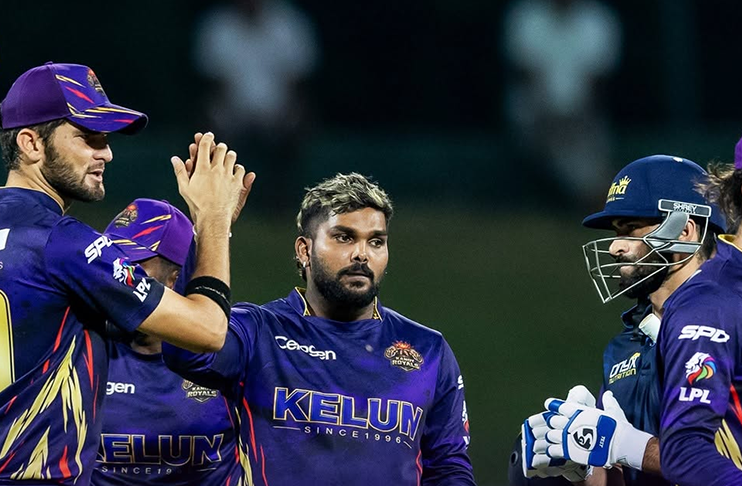
COLOMBO: Pakistan fast bowler Shaheen Shah Afridi has reportedly withdrawn from the Lanka Premier League (LPL) 2026, bringing an early end to a turbulent campaign that was overshadowed by an administrative mix-up and below-par performances.

According to media reports, the 26-year-old informed his franchise, Kandy Royals, that he was leaving the tournament for personal reasons. Neither Afridi nor the franchise has disclosed further details, while Kandy Royals are yet to announce a replacement.

Afridi’s departure comes just days after he was at the centre of an unusual selection controversy. Reports claimed he had initially been listed as the team’s Impact Player for a match against Colombo Capitals, but was unable to feature after an administrative error left his name off the official team sheet.

The mistake reportedly occurred after Kandy Royals elected to bat first, with team officials later informing Afridi that an analyst had accidentally omitted his name from the final squad submitted before the match.

The incident prompted the Pakistan pacer to raise the issue with an official from the tournament’s Anti-Corruption Unit, after which the matter was referred to the match referee for review.

Franchise officials and tournament organisers later apologised to Afridi for the error. Reports suggested the left-arm fast bowler had briefly considered leaving the competition immediately after the incident but decided to stay with the squad following the apology.

Despite remaining in the tournament, Afridi struggled to make his usual impact with the ball. He claimed seven wickets in six matches, averaging 32.00, while conceding runs at an economy rate of 10.18, figures well below the standards expected from one of Pakistan’s premier fast bowlers.

Meanwhile, the LPL continues to see changes in team combinations, with two more Pakistani cricketers joining the competition as replacement signings.

Young batter Khawaja Nafay has been drafted by Jaffna Kings to replace Afghanistan opener Ibrahim Zadran, while experienced all-rounder Iftikhar Ahmed has signed with Dambulla Sixers as a replacement for Afghanistan fast bowler Fazalhaq Farooqi.

Shaheen’s reported withdrawal marks another twist in an eventful LPL campaign and is likely to spark further discussion about player management and tournament administration as the competition heads toward its decisive stages.
Similar Posts

  • | | |

    Justice for Kashmir begins with implementing UN re…

    Pakistan’s High Commissioner to the UK, Tipu Usman, has urged the international community to play a more proactive role in resolving the Kashmir dispute, declaring that “justice for Kashmir begins with implementing United Nations Security Council resolutions” and reaffirming that Pakistan’s support for the people of Jammu and Kashmir “remains unwavering and unconditional.” He was addressing a seminar organised by the Pakistan High Commission in London to observe Youm-e-Istehsal Kashmir, marking the anniversary of India’s August 5, 2019 decision to revoke the special status of Indian Illegally Occupied Jammu and Kashmir (IIOJK). The event brought together British parliamentarians, diplomats, community leaders and members of the British Pakistani and Kashmiri diaspora, who condemned India’s revocation of Article 370 and reiterated support for the Kashmiri people’s right to self-determination. In his keynote address, Tipu Usman called upon the international community, particularly the United Kingdom, to stand on the side of justice by urging India to reverse the unilateral measures introduced on August 5, 2019, restore the rights and special status of Jammu and Kashmir, and honour the relevant United Nations Security Council resolutions. “Pakistan’s support for the people of Jammu and Kashmir remains unwavering and unconditional,” he said, adding that a peaceful and lasting settlement of the dispute must be achieved in accordance with the wishes of the Kashmiri people as reflected in the UN resolutions. The seminar was attended by Lord Qurban Hussain, Baroness Nosheena Mobarik, Afzal Khan MP and Adnan Hussain MP, alongside prominent community figures including Councillor Yasmine Dar, UK-Pakistan Kashmiri Councillors Forum Chairman Liaqat Ali MBE, Jammu Kashmir Self Determination Movement International Chairman Raja Najabat Hussain and former Deputy Mayor of Peterborough Mohammad Nadeem. Speakers strongly criticised India’s constitutional changes of August 2019, describing them as illegal and unconstitutional. They expressed concern over the human rights situation in IIOJK and called for an immediate end to alleged rights violations. Participants stressed that the Kashmir dispute remains an internationally recognised issue that should be resolved through dialogue and in line with UN Security Council resolutions. The seminar also proposed a strategic roadmap to enhance engagement with policymakers, parliamentarians and international stakeholders to build support for a just and lasting resolution of the Kashmir dispute. Messages from the President of Pakistan, the Prime Minister and the Deputy Prime Minister and Foreign Minister were read out during the event, reiterating Pakistan’s continued diplomatic, political and moral support for the people of Jammu and Kashmir. The ceremony concluded with participants observing a minute’s silence in memory of those who lost their lives in the Kashmir conflict.

  • | | |

    President delays assent for 19 high court judges

    The appointment of 19 additional judges to four high courts remains pending as President Asif Ali Zardari has yet to approve the summary. The Judicial Commission of Pakistan (JCP) approved the nominations during meetings held on July 20 and 21. The proposed appointments involve the Lahore High Court, Sindh High Court, Balochistan High Court and Islamabad High Court. Nine days have passed since the JCP approved the nominations. However, the president has not yet given his assent to the summary. The delay has caused concern within the government. A senior cabinet member questioned why the approval had not yet been granted. The official argued that the summary was initiated by the JCP rather than the prime minister. Therefore, according to the government’s position, the president could not send it back to the prime minister for reconsideration. The official also warned that continued inaction could create further tension within the superior judiciary. The government’s legal team is reportedly examining possible options to address the issue. The matter has also exposed differences between the government and the Pakistan Peoples Party (PPP). According to government officials, the PPP leadership is unhappy with the JCP because some of its preferred nominees were not considered for judicial appointments. The PPP had shown particular interest in securing the appointment of two candidates to the Sindh High Court. However, neither the judicial nor executive members of the JCP supported their nominations. Officials said the candidates were below the age of 45. Both government and judicial representatives reportedly agreed that nominees below that age should not be approved. PPP Senator Farooq H Naek, a senior legal figure and member of the JCP, had proposed 33 candidates for the four high courts. His proposed list included 16 candidates for the Sindh High Court, 10 for the Lahore High Court, five for the Balochistan High Court and two for the Islamabad High Court. A member of the commission said the PPP could potentially have secured appointments for other candidates from interior Sindh. Some of those candidates were considered sympathetic to the party. However, the commission member claimed that the party’s insistence on its two preferred nominees affected the outcome. The dispute comes amid wider political and judicial developments involving Sindh. JCP judicial members have already reached a consensus on the performance of constitutional benches in the Sindh High Court. The judges serving on those benches were given three months to demonstrate their performance. The commission’s judicial members also opposed the confirmation of Sindh High Court Additional Judge Syed Fiaz ul Hassan Shah. The development was viewed by some political circles as another setback for the PPP. The party has historically sought influence over judicial appointments in Sindh and other provinces. Last year, the PPP was able to influence appointments in several high courts, including the Sindh High Court, Peshawar High Court and Lahore High Court. The judicial landscape has also changed following the 27th Constitutional Amendment. After the amendment, Justice K K Agha was elevated to the newly established Federal Constitutional Court. Another judge of the Sindh High Court was transferred to the Islamabad High Court.

  • | |

    Khawaja Asif hails Sialkot Medical City project

    Defence Minister Khawaja Muhammad Asif has said that Sialkot urgently needed a medical city. He said the project would help improve healthcare facilities for people in the city and nearby areas. Addressing the inauguration ceremony of Sialkot Medical City, Khawaja Asif praised the business community for supporting the project. He also appreciated the role of the Sialkot Chamber in making the initiative possible. The minister said Sialkot had been facing a major healthcare gap. He said patients often had to travel to Lahore when serious medical emergencies occurred in the city. According to Khawaja Asif, the new medical city will help reduce the need for patients to travel to Lahore. It will also provide better healthcare services closer to the people of Sialkot. He said the project was an important development for the city. He hoped that the medical facilities would further improve the quality of healthcare available to local residents. Khawaja Asif also spoke about major road projects in the region. He said another lane would be added to the Lahore-Sialkot Motorway. He said the Kharian Motorway would be completed before the other project. He added that better road links would further improve connectivity between Sialkot and other parts of Punjab. The defence minister recalled that he had received a positive response when the motorway proposal was presented. He said major road networks had connected several cities and towns with each other. He said the route from Shahdara to Rawat had created stronger links between different urban centres. Such projects, he added, were important for trade, travel and economic activity. Khawaja Asif also highlighted the growing importance of Sialkot International Airport. He said the airport was no longer serving only the people of Sialkot. He said people from Jhelum and Gujrat were also using the airport. Residents of Azad Jammu and Kashmir were also travelling through the facility, he added. The minister credited Sialkot’s business community for many of the city’s major development projects. He said local traders and industrialists had made significant contributions to the city’s growth. Khawaja Asif said the Sialkot business community had established high standards. He added that these standards were recognised internationally. He said the success of Sialkot showed what could be achieved through cooperation between the business community and public institutions. He stressed that continued development could further strengthen the city’s position as an important economic and industrial centre.

  • | | |

    Imran Khan’s sons renew concerns over father…

    The sons of former prime minister Imran Khan have once again expressed concern over their father’s health, saying they have been unable to receive reliable information about his condition due to continued restrictions on family access. Speaking in an interview with an international news outlet, Kasim Khan and Sulaiman Khan said they have not been allowed to communicate with their father for several months and claimed that his family, lawyers and personal doctors have also been denied regular access. Kasim said the family has remained in the dark about Imran Khan’s health throughout his imprisonment. He referred to an Islamabad High Court order that directed authorities to facilitate regular phone calls, but claimed the arrangement has not been effectively implemented. The brothers, who were interviewed in London, also said they have been trying to travel to Pakistan but have faced difficulties related to travel documentation. According to them, their National Identity Cards for Overseas Pakistanis (NICOPs) have expired, while visa-related issues have prevented them from visiting their father. The Ministry of Information, however, rejected the allegations, maintaining that the brothers possess NICOPs and therefore do not require visas to enter Pakistan. The ministry described their claims as misleading and said an administrative matter should not be turned into a political issue. The government did not comment on the brothers’ claim that their identity cards had expired. Asked whether Imran Khan might reach a political understanding with the government, both sons expressed doubt. Sulaiman said his father would be unlikely to agree to any arrangement that did not also address the situation of other political prisoners. Kasim added that the family’s inability to obtain updated medical information made it difficult to assess his father’s current health. The brothers also criticised the legal cases against the former prime minister, insisting the allegations were politically motivated. Kasim urged the international community to pay attention to the situation, claiming that his father remained imprisoned despite enjoying widespread public support. Imran Khan has been in prison since August 2023 after being convicted in the Toshakhana case. He is also serving a sentence in the £190 million corruption case and continues to face several other legal proceedings, including cases linked to the May 9 riots. His health has remained a point of dispute between the government and the opposition since he was diagnosed earlier this year with central retinal vein occlusion (CRVO), an eye condition affecting vision. Opposition leaders and members of his family have repeatedly demanded access for his personal doctors and called for his transfer to a private hospital for further treatment.

  • | | |

    ISPR calls India’s ‘Operation Sindoor&…

    Pakistan has strongly rejected what it described as India’s attempt to reshape the history of the 2025 military confrontation through a recently produced documentary on “Operation Sindoor,” calling the production a highly dramatized and factually distorted portrayal of events. In a statement, Pakistan said the documentary relied on selectively edited interviews, emotional narration and cinematic reconstructions to present a version of the conflict designed primarily for domestic political consumption. It argued that the production failed to provide an objective account of the military engagements and instead sought to portray a disputed outcome as an unequivocal Indian victory. Pakistan also questioned the documentary’s chronology surrounding the Pahalgam incident of April 22, 2025. It said India had subsequently claimed that the alleged perpetrators of the incident were identified and eliminated on July 28, nearly three months after Operation Sindoor. Islamabad argued that this timeline raised questions about India’s assertion that the May 7 operation was specifically intended to punish those responsible for the Pahalgam attack. The statement further rejected India’s claim of “100 percent mission success,” maintaining that Pakistani forces had effectively responded to the Indian offensive during what Pakistan refers to as Marka-e-Haq. Islamabad claimed that eight Indian military aircraft were shot down during the confrontation and said Pakistan later launched Operation Bunyanum Marsoos, targeting military installations with precision-guided rockets and missiles, precision air-launched munitions, loitering munitions and artillery. Pakistan said the documentary itself contained admissions that undermined its portrayal of decisive Indian dominance. According to Islamabad, references by Indian military officials to Pakistani missile and drone activity, prolonged engagements along the Line of Control and the activation of Indian air-defence systems demonstrated that the confrontation involved significant military exchanges on both sides. The Pakistani statement also challenged New Delhi’s account of how hostilities ended. It noted that the documentary acknowledged communication between the two countries’ Directors General of Military Operations and an agreed cessation of military activity. Islamabad said this account was inconsistent with portraying the conclusion of the conflict as an unconditional Indian military victory, particularly given the role of international diplomatic engagement in facilitating the ceasefire. Pakistan further accused the documentary of presenting contradictory explanations for India’s approach to escalation. While the production reportedly emphasised surprise attacks, precision strikes and escalation dominance, it simultaneously portrayed India as deliberately restricting the scope of the conflict and offering Pakistan an opportunity to withdraw. Islamabad described the documentary as an attempt to create a politically convenient narrative rather than an impartial military assessment. It maintained that cinematic reconstructions and official claims could not alter the chronology of events, the military engagements or the losses suffered during the confrontation. Pakistan said it had no need to construct an alternative narrative around Marka-e-Haq, arguing that battlefield developments, diplomatic interactions and subsequent statements by Indian officials provided sufficient material for assessing the conflict. Reaffirming its stated commitment to regional peace and stability, Pakistan said its armed forces remained prepared to protect the country’s sovereignty and territorial integrity. It warned that any future military escalation would receive a strong response, while asserting that no subsequent narrative or media production could change the actual course of events on the battlefield.

  • | |

    District judge, security guard killed in gun attac…

    A district and sessions judge and his security guard were killed after unidentified gunmen opened fire on their vehicle on the national highway in Balochistan’s Mastung district on Thursday. The attack also left an additional sessions judge and another passenger seriously injured, according to local authorities. Deputy Commissioner Bahram Saleem said District and Sessions Judge Abdul Hakeem Kakar was travelling from Quetta to Mastung when armed assailants ambushed his vehicle. The attackers opened fire, killing Judge Kakar and his security guard on the spot. Additional Sessions Judge Tariq Lashari and another individual sustained critical injuries and were immediately shifted to a nearby hospital, where they continue to receive medical treatment. Following the incident, security forces and law enforcement agencies sealed off the area and launched a large-scale search operation. Checkpoints were established along key routes in an effort to track down and arrest those responsible for the attack. The incident drew strong condemnation from Pakistan’s political leadership. President Asif Ali Zardari expressed deep sorrow over the loss of lives and offered prayers for the recovery of the injured. He stated that anti-state elements backed by foreign interests would never succeed in destabilizing Pakistan and reaffirmed the country’s commitment to eliminating terrorism. He stressed that terrorist groups and those supporting them could not weaken Pakistan’s institutions or its determination to maintain peace. Prime Minister Shehbaz Sharif also condemned the attack, calling it another attempt by anti-state forces to undermine national stability. He reiterated the government’s resolve to eliminate terrorism in all its forms and ensure that those responsible are brought to justice. Balochistan Chief Minister Sarfraz Bugti described the attack as a direct assault on the state and its institutions. He vowed that both the attackers and those facilitating them would face strict legal action. According to the chief minister, the sacrifice of those protecting the law would not be forgotten, and the government would intensify operations against terrorist networks across the province. He further emphasized that there would be no safe haven for militants in Balochistan and that the state’s authority would be upheld at all costs. Special Assistant to the Chief Minister for Information and Political Affairs, Shahid Rind, also denounced the attack, calling the killing of a judge and his security guard a deeply tragic incident. He said targeting members of the judiciary and legal community was part of a broader attempt to weaken the rule of law but insisted such efforts would fail. He added that the provincial government had directed authorities to provide the best possible medical care to the injured while extending full support to the victims’ families. Balochistan Home Minister Mir Ziaullah Langove expressed grief over the attack and ordered an immediate investigation. He directed the Inspector General of Police and the provincial commissioner to submit a detailed report and ensure the swift arrest of those responsible. He reaffirmed that protecting citizens and state institutions remains the government’s highest priority. The Balochistan Bar Council strongly condemned the attack, describing it as an assault on the judiciary, the legal profession, and the rule of law. In protest, the council announced a two-day boycott of court proceedings and declared three days of mourning. Lawyers across the province will wear black armbands while appearing before courts. The council also demanded enhanced security for judges, lawyers, and court staff, reaffirming the legal community’s commitment to defending justice and standing united against terrorism.

Leave a Reply

Your email address will not be published. Required fields are marked *