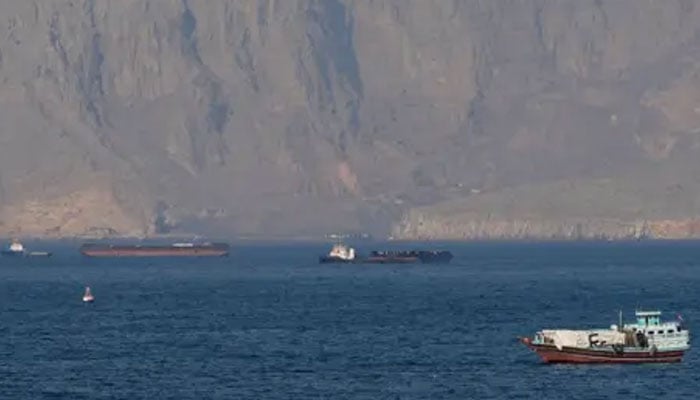
ship attacked near
| |

Ship attacked near Strait of Hormuz

A vessel came under attack by an unidentified projectile while sailing through the Strait of Hormuz near the coast of Oman, according to maritime security sources.

The incident reportedly caused a fire in one section of the Liberia-flagged vessel. The crew attempted to bring the blaze under control, while authorities began assessing the situation and the extent of the damage.

Maritime security sources said that one crew member went missing following the attack. The incident has raised fresh concerns about maritime safety in and around the Strait of Hormuz, one of the world’s most strategically important shipping routes.

The latest incident comes as regional authorities continue efforts to maintain safe navigation through the waterway amid heightened security concerns.

Meanwhile, Iran has confirmed that it is close to reaching an understanding with Oman on a new maritime arrangement for the Strait of Hormuz. Iranian Foreign Ministry spokesperson Esmail Baghaei said talks with Oman have made progress and that both sides are working on establishing a temporary safe passage through the strategic waterway.

Baghaei said discussions between Iran and Oman remain ongoing, with the two countries coordinating efforts to facilitate safer maritime movement through the Strait of Hormuz.

The development comes at a sensitive time for commercial shipping in the region, with any disruption in the Strait of Hormuz carrying potential consequences for international trade and energy supplies.


Similar Posts

  • | |

    Israel quietly receives advanced INS Drakon submar…

    JERUSALEM: Israel has quietly taken delivery of the advanced INS Drakon submarine, with the handover reportedly taking place without the usual public ceremony or official fanfare. According to media reports, the submarine belongs to the Dakar-class fleet and was built in Germany by Thyssenkrupp Marine Systems (TKMS). The vessel is regarded as one of the most sophisticated additions to the Israeli Navy’s underwater fleet. Defense analysts say the INS Drakon is designed for long-range covert operations, intelligence gathering, and extended deployments at sea, significantly enhancing Israel’s naval capabilities. The submarine is part of Israel’s ongoing efforts to modernize its maritime defense amid evolving regional security challenges. Some defense experts have also suggested that Israel’s Dolphin-class submarines may be capable of carrying nuclear-armed missiles, although Israeli authorities have never officially confirmed such capabilities. The arrival of the INS Drakon further strengthens Israel’s strategic naval deterrence and expands its ability to conduct long-duration missions across distant maritime regions.

  • | |

    Congo tightens grip on mineral exports with ban on…

    The Democratic Republic of Congo has prohibited exports of copper concentrate and cobalt concentrate, according to a government order reviewed on Thursday, marking the latest step in an ongoing push to force more mineral processing to happen inside the country and capture a larger share of the value generated by its mining sector. News of the ban sent benchmark three month copper prices on the London Metal Exchange up by as much as 1.8 percent to $14,369.50 a metric ton, the highest level since January 29, when the metal touched an all time peak of $14,527.50. Prices stood at $14,300 as of 0930 GMT following the report. Congo holds the position of the world’s largest cobalt supplier and ranks among the top sources of copper and other minerals critical to the global energy transition. The government is using that leverage to encourage the build out of domestic processing capacity rather than allowing raw or partially processed materials to leave the country. The order, dated June 29 and signed jointly by Mines Minister Louis Kabamba Watum, Foreign Trade Minister Julien Paluku Kahongya and Economy Minister Daniel Mukoko Samba, states plainly that exporting copper and cobalt concentrates is now prohibited. The prohibition took effect immediately, though the order allows for one year export waivers to be granted under unspecified strategic circumstances. The same order also establishes a new tax structure covering economically significant mining by products, with a three month transition period built in before the new rules take full effect. Officials said the export ban aims to push mining companies toward marketing or exporting higher value processed mineral products rather than raw concentrate. This marks the fourth time Congo has restricted concentrate exports, following similar bans imposed in 2013, 2019 and 2023, each of which included waivers in cases where domestic smelting capacity could not keep pace with output. The new order formally repeals the 2023 measure and its associated exemptions, replacing it with a broader regulatory framework governing both mineral exports and taxation of significant by products recovered during processing. Congo already exports the vast majority of its copper in refined form. During the first quarter of 2026, the country shipped 696,725 tons of copper cathodes, compared with just 53,926 tons of copper concentrate containing roughly 18,863 tons of copper metal, according to official figures. Over the same period, Congo exported 51,940 tons of cobalt hydroxide containing about 17,054 tons of cobalt metal. Christian Geraud Neema, a mining analyst with the nonprofit China Global South Project, said the new ban is unlikely to significantly disrupt most mining operators since the bulk of Congo’s copper and cobalt already undergoes domestic refining before export. He said the operation most likely to feel the impact is the Kamoa Kakula venture, jointly owned by Ivanhoe Mines, China’s Zijin Mining and the Congolese government, which still exports some volume of concentrate under existing exemptions. Neither Ivanhoe nor Zijin responded immediately to requests for comment, and the Congolese chamber of mines also did not respond. The newly introduced tax regime applies broadly across mineral categories, extending to trace and ultra trace minerals recovered during the refining process. These by products will be taxed using a 55 percent valuation coefficient, with royalties applied alongside those already charged on the primary mineral being extracted. The policy fits into a broader pattern across resource rich African nations seeking to move beyond raw material exports and capture more manufacturing and processing value domestically, a shift that has gained momentum as global demand for energy transition minerals like copper and cobalt continues to grow.

  • |

    Antarctic cold blast grips New Zealand’s South Island

      A powerful cold wave sweeping north from Antarctica has engulfed New Zealand’s South Island, bringing freezing temperatures, fierce winds, and unusually heavy snowfall that has severely disrupted daily life across the region. The city of Dunedin has been among the hardest hit, experiencing strong icy winds accompanied by significant snowfall. Residents woke up to streets, rooftops, and vehicles covered in several inches of snow, creating hazardous conditions for both pedestrians and motorists. The unusual weather has transformed the city into a winter landscape, while also causing widespread travel disruptions. Authorities reported that the heavy snowfall has blanketed roads, making many routes dangerous and, in some areas, impassable. Snowplows and emergency crews have been deployed to clear major highways and ensure safe access for emergency services. However, officials have urged residents to stay indoors unless travel is absolutely necessary, warning that icy roads and reduced visibility could lead to accidents. Public transportation has also been significantly affected. All bus services in Dunedin were suspended due to unsafe road conditions, leaving commuters stranded and forcing many schools, businesses, and public institutions to adjust their schedules. Local authorities continue to monitor the weather closely before deciding when transportation services can safely resume. The severe weather has also disrupted travel between New Zealand’s North and South Islands. Ferry services connecting the two islands have been suspended because of dangerous sea conditions caused by the powerful Antarctic storm system. Strong winds and rough waves have made navigation unsafe, affecting both passenger and freight transport. The suspension of ferry operations is expected to delay the movement of goods and impact travel plans for thousands of people. Meteorologists say the cold outbreak originated from Antarctica and pushed unusually frigid air across southern New Zealand. Such weather systems are capable of producing intense snowfall, especially when cold Antarctic air interacts with moisture over the surrounding oceans. While snowfall is common during winter in parts of the South Island, the intensity of this storm has been described as exceptional for several areas. Emergency management agencies have advised residents to prepare for continued freezing conditions. People have been encouraged to keep emergency supplies at home, avoid unnecessary travel, dress warmly, and check on elderly neighbors or vulnerable family members who may require assistance during the cold spell. The harsh weather has also raised concerns for farmers, who are working to protect livestock from freezing temperatures and strong winds. Agricultural authorities have urged farmers to provide adequate shelter and food for animals until conditions improve. Forecasters predict that the Antarctic cold blast may continue to affect parts of the South Island over the coming days, with additional snowfall and icy conditions possible in higher elevations. Officials remain on high alert as they assess the impact of the storm and work to restore essential services. Residents are advised to stay informed through official weather updates and follow safety instructions until the severe weather subsides.

  • | |

    China stands firm on economic strategy ahead of ke…

    BEIJING: China has intensified its defence of its state-led economic model as it prepares for crucial trade discussions with the European Union and the United States, signalling that it is unlikely to make major policy concessions despite mounting international criticism. Beijing has repeatedly argued that its development strategy, which prioritises investment in advanced manufacturing and technology, remains essential for long-term economic growth. Chinese leaders maintain that the country’s industrial policies have helped strengthen innovation and global competitiveness, rejecting accusations that they distort international trade. The latest policy statements from China’s leadership indicate a commitment to maintaining its current economic direction. While officials acknowledge challenges such as weak domestic demand and excess production capacity, they continue to favour targeted policy support instead of broad consumer-focused stimulus measures. Chinese authorities have also dismissed Western claims of industrial overcapacity, describing such criticism as politically motivated. They argue that China’s manufacturing success reflects its stage of economic development and benefits global consumers through affordable, high-quality products. Ahead of expected meetings between President Xi Jinping and US President Donald Trump later this year, as well as upcoming negotiations with the European Union, Beijing has adopted a more confident tone in defending its economic policies. Analysts believe the messaging is intended to establish clear limits on what China is willing to negotiate while encouraging greater understanding of its development model. China has also sought to counter warnings of a new “China shock” by portraying its industrial expansion as an opportunity for global economic growth. However, many Western economists argue that China’s reliance on exports, combined with subdued domestic consumption, continues to create imbalances that affect international markets. Although Beijing has slowed public investment by tightening oversight of local government spending, officials acknowledge that supply and demand remain uneven. Authorities have pledged to reduce destructive price competition among manufacturers and have reiterated their intention to strengthen consumer demand, though without announcing sweeping structural reforms. Chinese policymakers have also recognised that the country’s traditionally low household consumption cannot remain a permanent feature of its economy. While official publications describe the existing model as historically appropriate, they also suggest gradual adjustments will be necessary to ensure sustainable long-term growth. Despite these acknowledgements, Beijing remains cautious about implementing rapid reforms, fearing that abrupt policy changes could undermine economic stability. International studies continue to raise concerns over China’s economic practices. Recent research suggests that government subsidies have played a significant role in boosting the global market share of many Chinese companies, while other reports attribute much of China’s export growth to weak domestic consumption and industrial overcapacity. Analysts also note that China continues to invest in productive assets at a much faster pace than Europe and the United States, even though returns on those investments have declined. Many experts believe Beijing’s increasingly assertive defence of its economic model reflects growing confidence that it can manage trade tensions with Western partners without fundamentally changing its industrial strategy.

  • |

    China rejects reports of Saindak project shutdown

    Islamabad:China has dismissed reports claiming that it has suspended operations or withdrawn investment from the Saindak Copper-Gold Project in Balochistan, reaffirming its commitment to the long-running mining venture. According to a spokesperson for Pakistan’s Ministry of Planning, the Chinese company operating the project continues its activities without interruption. The spokesperson said reports suggesting that China had halted work or decided to pull out of the project are false and do not reflect the actual situation. The ministry also revealed that a Chinese company recently visited Pakistan to assess investment opportunities for another major project. The delegation completed its feasibility study, highlighting China’s continued interest in expanding economic cooperation and investment in Pakistan. The Saindak Copper-Gold Project remains under the management of China Resource Development Limited, a subsidiary of the state-owned Metallurgical Corporation of China (MCC). The company renewed its lease for the project in 2022 and has continued mining and development work since then. Officials stressed that operations at the Saindak mine are proceeding as planned and rejected speculation about the project’s closure. They added that the project remains an important symbol of Pakistan-China economic cooperation and continues to contribute to the country’s mining sector and regional development.

  • |

    England on track to eliminate hepatitis C by 2030

    More than 100,000 people in England have received potentially life-saving treatment for hepatitis C in the past decade, as the NHS steps up efforts to eliminate the virus as a public health threat by 2030. New NHS figures show that more than 100,000 people have been diagnosed and treated since pioneering antiviral medicines were introduced in 2015, putting England among a handful of countries that have already exceeded the World Health Organisation benchmark of treating 80% of known hepatitis C cases. (NHS England) Hepatitis C is a viral infection that can damage the liver and, if left untreated, can lead to serious and potentially life-threatening conditions including cirrhosis, liver failure and liver cancer. The infection can remain undetected for years because many people experience no noticeable symptoms until significant liver damage has already occurred. However, modern treatment has transformed the disease. A free course of antiviral tablets lasting between eight and 12 weeks can cure more than 95% of cases. The NHS says effective treatment could reduce the number of people requiring liver transplants by 80% over the next decade, while also reducing cases of liver cancer and cirrhosis. Deaths from hepatitis C have already fallen by 36% over the past ten years. (NHS England) NHS urges people at risk to get tested The latest figures have prompted the NHS to urge people who may be at greater risk of having undiagnosed hepatitis C to order a free and confidential home-testing kit. Those particularly encouraged to test include people who have moved to England from certain Eastern European countries, anyone who has had a tattoo abroad, and people who currently use or have previously used injectable drugs. Adults born in Ukraine, Romania, Estonia, Latvia, Poland, Albania, Lithuania, Bulgaria, Czechia and Slovakia are also being urged to test. The NHS says some people from these countries may have been exposed to the virus through medical or dental procedures before 1991, when modern sterilisation standards were introduced. The free home-testing service is designed to reach people who may not otherwise come into contact with drug and alcohol services, sexual health services, GPs or A&E departments. Thousands of hidden cases identified The NHS has significantly expanded hepatitis C testing over the past five years. A first-of-its-kind programme offering hepatitis C testing to patients having blood tests in participating A&E departments has identified around 1,900 previously undiagnosed cases since 2022. GP practices are also asking new patients whether they received a blood transfusion before 1996, helping identify people who may have been infected through the contaminated blood scandal. The treatment programme was made possible on a large scale following a landmark 2019 agreement between the NHS and pharmaceutical companies Gilead Sciences, MSD and AbbVie, which enabled access to modern curative treatments. (NHS England) ‘Determined to finish the job’ Professor Frankie Swords, NHS national medical director, said hepatitis C could cause serious harm including liver failure and cancer, while many people could remain unaware they have the virus. He said treating more than 100,000 people in a decade was a major achievement but stressed that the NHS would continue looking for people with undiagnosed infections. “England is now leading the world in the mission to eliminate this disease and on course to beat the WHO’s 2030 target,” Professor Swords said. He added that the NHS was “determined to keep up the momentum and finish the job”. “With hepatitis C curable in more than nine out of ten cases, we are committed to finding and treating everyone who needs support,” he said. (NHS England). Patient urges others to take the test Among those treated is 65-year-old Paul Eatwell from Blackburn, Lancashire, who discovered he had hepatitis C after routine liver-function tests following a change of GP. His new doctor ordered additional tests, including screening for hepatitis C. Paul said he initially could not believe the result because he had no symptoms and could not understand how he might have contracted the virus. The precise source of his infection was never established, although possible risk factors included surgery in South Africa several decades ago. He said the specialist team helped answer his questions and reassured him about the condition. Paul said treatment was far less difficult than he had imagined, involving one tablet a day for 12 weeks and several blood tests. He urged anyone who believes they may have been exposed to hepatitis C to get tested, saying that knowing their status could provide peace of mind. ‘Leading the world’ Health and Social Care Secretary Yvette Cooper said the progress demonstrated the impact of NHS treatment and prevention programmes. She said hepatitis C was now curable in the vast majority of cases and described the UK’s progress as part of efforts to “wipe out this disease for good”. “This is exactly the kind of preventative, forward-looking healthcare that we want the NHS to deliver across the board – catching illness earlier, easing pressure on hospitals, and giving people the chance to live longer, healthier lives,” Cooper said. (NHS England. Dr Sema Mandal, deputy director of Blood Safety, Hepatitis, STIs and HIV at the UK Health Security Agency, said the sharp fall in cases since 2015 demonstrated the impact of expanded testing and access to modern treatments. She said treating more than 100,000 people in ten years had brought England closer than ever to eliminating hepatitis C as a public health threat. The Hepatitis C Trust also called for continued long-term investment to maintain the progress made by the national programme, particularly among marginalised communities that can face barriers to healthcare. Rachel Halford, chief executive of The Hepatitis C Trust, said continued funding would be essential to ensure people at greatest risk were not left behind. Hepatitis B remains a challenge While England’s progress against hepatitis C is described as world-leading, health authorities stress that elimination of viral hepatitis as a whole also includes hepatitis B. Further work is therefore required to improve diagnosis and access to treatment for people living with hepatitis B. A national

Leave a Reply

Your email address will not be published. Required fields are marked *