
sophie turner reveals
| |

Sophie Turner reveals what America had that she ca…

Sophie Turner may have found her way back home, but there is one thing about America that the actress admits she still misses: the sun.

The Game of Thrones star recently opened up about her experience living in the United States and returning to England after several years abroad. While Turner says she is much happier being back in her home country, she revealed that she occasionally misses the bright sunshine she enjoyed while living in America. (E! Online⁠)

Turner is happy to be home

Turner spent several years living in the U.S. during her marriage to Joe Jonas. The couple married in 2019 and spent time living in Los Angeles and Miami before their relationship ended in 2023.

Following their split, Turner returned to London with their two daughters, Willa and Delphine. The move brought her closer to her roots and the people and places she grew up around. (People.com⁠)

In her latest interview with The Sunday Morning Herald, Turner made it clear that she does not particularly miss American life. When asked whether she missed living there, she gave a simple answer: she misses the sun, “but that’s it.” (Female First⁠)

Why England feels different

Although sunshine may be harder to find consistently in the UK, Turner has discovered plenty of things she values about being back home.

The actress has previously spoken about missing British humor, familiar comfort foods and, especially, being close to her childhood friends and family. She has also praised British pub culture and the sense of community surrounding it. (People.com⁠)

For Turner, returning to England appears to have been about more than simply changing countries. After spending important years of her adult life in America, being home has allowed her to reconnect with the environment and people who shaped her early years.

A new chapter in London

Turner has also continued building her acting career while living in the UK. Her return comes as she enters a new professional chapter, including her highly anticipated role as Lara Croft in the upcoming Tomb Raider series.

While America provided Turner with years of memories and plenty of sunshine, her latest comments suggest that England feels more like home. The cloudy British weather may not always be her favorite, but everything else about being back seems to make up for it.

For Turner, there is apparently only one thing America has that she truly wishes she could bring back with her: more sunshine.
Similar Posts

  • | | | | |

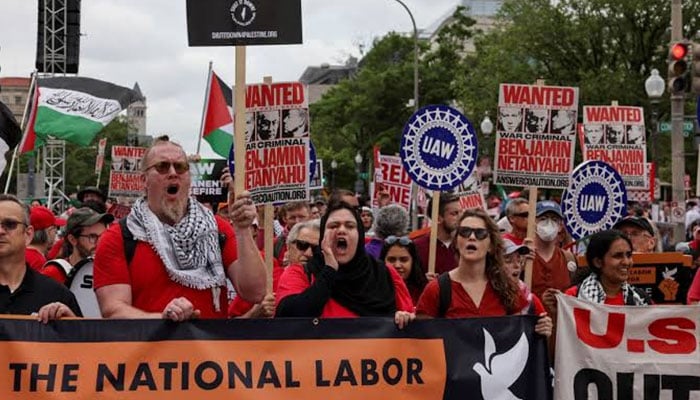
    Protest erupts in Washington over Netanyahu visit

    WASHINGTON: Israeli Prime Minister Benjamin Netanyahu’s visit to Washington has sparked a fresh wave of protests, with demonstrators taking to the streets to oppose U.S. support for Israel and demand that the Israeli leader be arrested. Pro-Palestinian protesters gathered in the U.S. capital carrying Palestinian flags and banners criticising Washington’s backing of Israel. The demonstrations came as Netanyahu arrived in the United States for a scheduled meeting with President Donald Trump. At the heart of the protest was a demand that U.S. authorities enforce the International Criminal Court’s arrest warrant against Netanyahu. Demonstrators argued that the United States should not provide protection to an Israeli leader facing allegations before the international court. The protest reflects the wider political and public debate in the United States over Washington’s relationship with Israel and its approach to the conflict in Gaza. Trump rules out Netanyahu arrest The demonstrations gained additional attention because Trump has already made his position clear. The U.S. president has said Netanyahu will not be arrested while he is in the United States, directly rejecting calls for his detention. Trump has also strongly defended Israel and Netanyahu in connection with the ongoing regional conflict. Netanyahu’s visit comes at a particularly sensitive moment. His meeting with Trump on Tuesday is the first between the two leaders since their joint war against Iran, with tensions reportedly emerging over how the conflict should be handled. Protest adds pressure ahead of Trump meeting The Washington demonstration adds another layer of political pressure surrounding Netanyahu’s visit. Protesters say U.S. support for Israel should be reconsidered and that international legal proceedings should not be ignored. The issue of Netanyahu’s potential arrest has also become prominent in U.S. politics. New York Mayor Zohran Mamdani has said his administration is examining whether the city could enforce the ICC warrant if Netanyahu visits New York for the United Nations General Assembly in September. For now, however, Trump’s administration has made clear that Netanyahu will not face arrest during his stay in the United States. With protests continuing and the Trump-Netanyahu meeting attracting international attention, the visit is likely to keep the debate over Gaza, U.S.-Israel relations and international accountability firmly in the spotlight.

  • |

    PSX sheds over 1,800 points as US-Iran peace deal uncertainty triggers selling

    KARACHI: Selling pressure intensified at the Pakistan Stock Exchange (PSX) on Tuesday, with the benchmark KSE-100 Index suffering a sharp decline as investors turned cautious amid growing uncertainty surrounding the prospects of a near-term peace agreement between the United States and Iran. By 1:24pm, the benchmark index had dropped 1,806.12 points, or 0.89%, to 178,896.29, compared with the previous close of 180,502.44. The decline reflected widespread profit-taking and fresh selling across several key sectors of the market. The KSE-100 started the session at 180,502.44 and initially moved higher, reaching an intraday peak of 180,602.44. However, the early gains failed to hold as investors began offloading positions, pushing the index steadily lower. During the session, the benchmark touched an intraday low of 178,488.91, highlighting the intensity of selling activity. At one stage, the index was down 1,545.52 points, or 0.86%, at 178,956.92, before losses widened further. Market sentiment was affected by renewed uncertainty over the possibility of a diplomatic breakthrough between Washington and Tehran. Investors remained concerned that prolonged tensions could create additional risks for energy supplies and regional trade, particularly if disruptions affect major oil-producing and transportation routes. The rise in international oil prices added another layer of concern for investors. Higher crude prices can increase Pakistan’s import bill and place additional pressure on external-sector balances, while also raising concerns about inflationary pressures and corporate costs. The selling was not confined to a single segment. Significant weakness was witnessed in automobile assemblers, cement manufacturers, commercial banks, oil and gas exploration companies, oil marketing companies and power generation firms. The broad-based nature of the decline suggested that investors were adopting a cautious stance rather than selectively rotating into individual sectors. Market participants appeared particularly sensitive to developments in global geopolitics and their potential implications for commodity prices and Pakistan’s macroeconomic outlook. Trading activity, meanwhile, remained robust despite the decline in the benchmark. Around 358.21 million shares had changed hands by midday, while the total traded value stood at approximately Rs22.47 billion, indicating considerable participation from investors. The latest decline came after the KSE-100 ended the previous trading session at 180,502.44, leaving the index vulnerable to profit-taking following its recent strong performance. Tuesday’s movement therefore reflected a combination of investor caution, external geopolitical concerns and selling in major market segments. Analysts and market participants are expected to closely monitor developments on the US-Iran front, movements in international crude oil prices and domestic economic indicators for direction in the coming sessions. Any improvement in geopolitical sentiment or a renewed expectation of progress toward a peace agreement could help restore confidence, while further escalation and sustained increases in global oil prices could continue to weigh on equities.

  • |

    Irish politicians urge action over citizen’s high-security pro-Palestinian trial in Germany

    A cross-party delegation of Irish politicians has called on Dublin to send official observers to the trial of the “Ulm 5” activists in Stuttgart and raise concerns over the severe detention conditions of Irish citizen Daniel Tatlow-Devally. Tatlow-Devally, 32, was arrested alongside four other Berlin-based European activists in September after trespassing at an Ulm facility owned by Israeli defense contractor Elbit Systems, where they destroyed equipment and smashed windows to protest German arms exports to Israel. German prosecutors have charged the group with trespassing, property damage exceeding €1 million, and membership in a criminal organisation under Section 129 of the German criminal code. The visiting delegation, including Sinn Féin TD Mairéad Farrell and representatives from Fine Gael, Labour, People Before Profit–Solidarity, and the Social Democrats, voiced alarm over Tatlow-Devally being confined to a 5×2-metre cell for 23 hours a day with only one hour of monthly visitation. They also highlighted courtroom barriers, such as holding the defendants behind glass panels that restrict direct legal communication. Farrell urged Irish Prime Minister Micheál Martin to press German Chancellor Friedrich Merz on human rights and legal access concerns during his upcoming visit to Dublin.

  • |

    Ananya Panday and Walker Blanco reportedly split after two years

    Ananya Panday and Walker Blanco have reportedly called time on their relationship after nearly two years of dating. The Bollywood actress and the former model were first linked in 2024, and although neither of them ever officially confirmed their romance, their interactions over the past two years sparked continued speculation about their relationship. The two were reportedly introduced during the pre-wedding celebrations of Anant Ambani and Radhika Merchant in 2024. Their connection gradually attracted attention as they were spotted around the same social circles and appeared to share a close bond. While they largely kept their personal lives away from the spotlight, fans noticed subtle signs that suggested they were more than just friends. Social media interactions further fueled the dating rumours surrounding Panday and Blanco. The pair were said to have used affectionate nicknames for each other, including “Annie” and “Walkie,” giving fans another reason to believe that they were romantically involved. Despite the growing public interest, both maintained a low profile and refrained from making their relationship official. However, reports now claim that the couple have decided to go their separate ways. According to recent reports, the decision to end the relationship was initiated by Ananya last week. Despite this, the split was reportedly mutual, with both sides understanding the decision and choosing to move forward separately. A source reportedly described the breakup as a mutual decision and suggested that there is no bitterness between the former couple. The development has attracted considerable attention because Panday and Blanco had managed to keep much of their relationship private despite being followed closely by Bollywood fans and entertainment media. Blanco, who previously worked as a model in Chicago, is associated with the Ambani family’s Vantara wildlife initiative in Jamnagar, India. His connection with the Ambani family brought him into the same social circles as several prominent Bollywood personalities, including Panday. Before her reported relationship with Blanco, Panday was involved with actor Aditya Roy Kapur. The pair were linked from 2022 until 2024 and frequently made headlines during their time together. They were spotted on dinner outings, holidays and other public occasions, although they also chose not to make a formal announcement about their relationship. Panday was also previously linked to actor Ishaan Khatter. The two reportedly dated between 2020 and 2022 after working together on the film Khaali Peeli. Their relationship was also the subject of considerable media attention during that period. At 27, Panday has established herself as one of the younger stars of the Hindi film industry, appearing in projects across different genres and building a strong presence on social media. Her personal life has often attracted as much attention as her professional career, particularly because of her high-profile relationships. For now, neither Panday nor Blanco has publicly addressed reports of their alleged breakup. The pair have yet to release an official statement confirming that their relationship has ended. Until either of them comments publicly, details surrounding the reported split remain based on claims from sources familiar with the situation. The reported separation marks the latest development in Panday’s much-discussed personal life, while fans continue to wait for any direct confirmation from the actress or Blanco regarding their relationship status.

  • | |

    Pakistan’s Pharmaceutical exports reach 20-year …

        ISLAMABAD: Federal Minister for Planning and Development Ahsan Iqbal has said that Pakistan’s pharmaceutical exports have reached a 20-year high of $457 million, stressing that the pharmaceutical industry must establish a clear contribution towards the country’s ambitious target of generating more than $100 billion in exports by 2035. Speaking at a roundtable conference in Islamabad organised to facilitate pharmaceutical exports under the government’s Uraan Pakistan initiative, the federal minister said the industry needed to adopt a long-term strategy to expand its presence in international markets. Ahsan Iqbal called on representatives of the pharmaceutical sector to hold consultations over the next month and prepare a comprehensive roadmap for the industry’s development through 2030 and beyond. He said Pakistan’s objective should be to transform the country into a global hub for pharmaceutical manufacturing and exports. The minister emphasised that Pakistan needed to secure a significant position in the international pharmaceutical market by improving the competitiveness and quality of locally manufactured products. He said cooperation between the government and private sector could help the industry compete more effectively at the global level. According to the minister, continuity in government policies and the creation of a business-friendly environment are essential for the sustainable growth of the pharmaceutical sector. He stressed that investors and manufacturers require predictable policies and a supportive regulatory framework to make long-term investments in production, research and exports. Ahsan Iqbal also highlighted the need to reduce Pakistan’s dependence on imported pharmaceutical inputs and increase domestic manufacturing capacity. He said approximately 85 percent of the raw material used by the pharmaceutical industry is currently imported, creating challenges for the sector and increasing its exposure to international supply disruptions and currency fluctuations. He called for strengthening the local pharmaceutical value chain so that a greater proportion of raw materials, intermediate products and finished medicines could be produced within Pakistan. The minister said enhancing domestic production would not only reduce the country’s import bill but could also improve the competitiveness of Pakistani pharmaceutical companies in international markets. A stronger local supply chain could help manufacturers reduce production costs, improve efficiency and develop products that meet international standards. He further stressed the importance of developing a coordinated strategy involving government institutions, pharmaceutical manufacturers, researchers and other stakeholders. Such cooperation, he said, would be necessary to identify the major obstacles facing the sector and develop practical solutions. The roundtable conference was held as part of efforts under Uraan Pakistan to promote exports and strengthen productive sectors of the economy. The initiative aims to improve Pakistan’s economic performance by encouraging investment, increasing exports and promoting sustainable industrial development. Ahsan Iqbal said the pharmaceutical industry had significant potential to contribute to Pakistan’s export growth if its structural challenges were addressed. He urged industry representatives to use the consultation process to develop realistic targets and identify measures that could help Pakistan increase its share in the global pharmaceutical market. The minister’s remarks come as Pakistan seeks to diversify its export base and reduce dependence on traditional export sectors. He said the pharmaceutical industry could become an important contributor to this effort by improving domestic production, investing in innovation and expanding access to international markets. The government, he added, would continue working with the private sector to create conditions that encourage investment and promote the long-term growth of Pakistan’s pharmaceutical industry.

  • | | | |

    Pakistan’s blasphemy cases hit record low

    Pakistan has witnessed a significant decline in registered blasphemy cases this year following a crackdown on hardline religious groups, signalling what analysts describe as a major shift in the country’s security policy. According to figures cited by the Human Rights Commission of Pakistan (HRCP), only 13 blasphemy cases have been registered so far in 2026, marking a fall of nearly two-thirds compared with the same period in recent years. Data from conflict monitoring organisation ACLED also indicates that only one blasphemy-related riot or attack has occurred over the past year, compared with an annual average of more than seven incidents between 2021 and 2024. The decline comes after security agencies intensified action against several extremist organisations accused of exploiting blasphemy allegations to incite violence. Officials familiar with the matter said the campaign has included arrests of key figures, restrictions on organisational activities, freezing of financial assets and tighter monitoring of religious gatherings. The change was evident during an incident in Karachi last month, where allegations of blasphemy against a Christian family drew a large crowd. Police officers intervened before the situation turned violent and persuaded protesters to disperse peacefully. Authorities later determined that the accusations against the family were baseless, allowing them to be moved to safety without further harm. Analysts believe the reduced presence of organised extremist groups has played a key role in preventing mob violence that has historically followed blasphemy accusations. Pakistan has witnessed around 90 blasphemy-related lynchings since 1990, with many incidents beginning after rumours spread through local communities. Security experts say the military leadership has adopted a tougher stance against groups previously accused of using religious sentiments to mobilise supporters and pressure governments. They argue the policy shift is linked to broader efforts to strengthen Pakistan’s international image, attract foreign investment and improve relations with Western countries while tackling growing security threats at home. Officials also believe that curbing religious extremism is necessary to address worsening militancy in Balochistan and Khyber Pakhtunkhwa, where insurgent violence continues to challenge the state’s authority. Some analysts say extremist organisations and militant groups have historically drawn support from similar networks of radicalised youth. The country’s largest hardline religious party, Tehreek-e-Labbaik Pakistan (TLP), was banned last year after authorities concluded that its activities posed a threat to public order and Pakistan’s international reputation. Government measures reportedly included detaining senior leaders, sealing offices and restricting financial operations. The party has rejected the ban, calling it unconstitutional. Despite the decline in violence, observers caution that extremist ideology remains deeply rooted in parts of society. Human rights advocates say minority communities, including Christians, Ahmadis and Shia Muslims, continue to live under the fear of false accusations, as Pakistan’s blasphemy laws remain in force and carry the death penalty. Security analysts also warn that sustained enforcement will be necessary to prevent banned organisations from regrouping or resurfacing under new identities. They argue that long-term success will depend on consistent policies rather than temporary crackdowns.

Leave a Reply

Your email address will not be published. Required fields are marked *