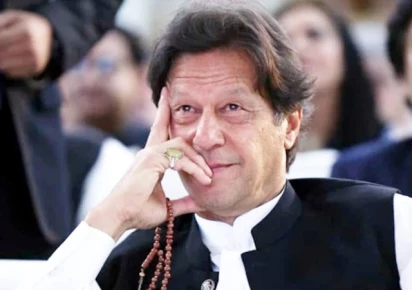
source rejects imran
| | |

Source rejects Imran deal, Shehbaz-Asim rift repor…

An informed source familiar with political and government developments has categorically rejected speculation about any possible “deal or relief” for former Prime Minister Imran Khan, as well as reports of differences between Prime Minister Shehbaz Sharif and Chief of Army Staff Field Marshal Asim Munir.

The source described the possibility of both developments as “zero,” amid intense speculation following the Supreme Court’s order concerning Imran Khan’s medical treatment.

It had been expected that Imran Khan would be shifted to Shifa International Hospital for treatment. However, instead of being taken to Shifa International, he was transferred to the Pakistan Institute of Medical Sciences (PIMS) and later returned to Adiala Jail.

The development triggered speculation in political circles about whether the issue was linked to a possible deal or some form of relief for the Pakistan Tehreek-e-Insaf founder.

When specifically asked whether there was any possibility of a deal or concession for Imran Khan, the informed source gave a clear one-word response: “Zero.”

The source was also asked about reports and speculation regarding differences between Prime Minister Shehbaz Sharif and Field Marshal Asim Munir. The response was again: “Zero.”

According to the source, such speculation is not unusual in Pakistan. Political developments involving the civilian and military leadership have historically been interpreted through the lens of possible deals, concessions or disagreements between the civilian government and the military establishment.

The source said that whenever an unusual political development takes place, speculation immediately emerges that a behind-the-scenes deal may be under discussion or that differences have developed between the civilian and military leadership.

However, the source stressed that the current political and institutional arrangement should not be viewed through the lens of Pakistan’s past political experiences.

Referring to the political setup that took shape around three to four years ago, the source said the relationship between the civilian government under Shehbaz Sharif and the military leadership was “completely different” from arrangements witnessed in the past.

The source also suggested that many reports currently circulating may reflect the wishes or expectations of certain individuals rather than the actual situation on the ground.
Similar Posts

  • |

    Federal agents arrest armed suspect near Donald Trump’s California golf course

    Federal and local law enforcement officers in California have arrested a 38-year-old man who was observed taking photographs and monitoring security preparations at President Donald Trump’s golf course in Rancho Palos Verdes, two days before the president was scheduled to attend a political fundraising dinner at the venue. The suspect, identified as Jeanine John Taele of Downey, California, was taken into custody on Sunday afternoon by Los Angeles County Sheriff’s deputies and federal agents. Authorities revealed that Taele had initially been spotted on the grounds of Trump National Golf Club on Friday, wearing an earpiece while filming federal personnel carrying out security assessments. Upon returning to the property on Sunday, Taele allegedly approached federal agents, falsely claimed to work for the US Department of State on a security detail, and admitted to possessing a loaded weapon inside his vehicle. Upon searching the suspect, law enforcement officers recovered a 16-round magazine loaded with hollow-point ammunition from his clothing. A subsequent search of his pickup truck parked on the property yielded a loaded 9mm pistol, additional hollow-point rounds, binoculars, and a fake badge reading “security protection agent”. Officers also determined that Taele was actively wanted in connection with an unrelated robbery investigation conducted by the El Segundo Police Department. Following the arrest, agents from the FBI’s Joint Terrorism Task Force and the Sheriff’s Department Major Crimes Bureau executed a search warrant at Taele’s residence in Downey. Investigators seized an illegally modified short-barrelled AR-style rifle, a .45-calibre handgun, body armour, high-capacity magazines, extensive ammunition supplies, and notebooks containing what officials described as “concerning statements”. Taele, a decorated US Marine Corps veteran who served in Iraq and Afghanistan between 2008 and 2016, faces both state and federal charges. State prosecutors in Los Angeles County have charged him with second-degree robbery, possession of a short-barrelled rifle, manufacturing or receiving a large-capacity magazine, and carrying a concealed firearm in a vehicle. He pleaded not guilty to state charges on Tuesday and remains held on $250,000 bail. Federal prosecutors have separately charged Taele with possession of an unregistered short-barrelled rifle, an offence carrying a maximum penalty of 10 years in federal prison. While the Secret Service and the FBI continue to investigate Taele’s motives, officials from the Los Angeles County Sheriff’s Department stated that there is currently no evidence of a direct, ongoing threat to the local community. President Trump proceeded with his planned visit to California, landing at the golf course via helicopter to host the Republican fundraising event.

  • | |

    Punjab imposes 60-day ban on swimming in water bod…

    The Punjab government has imposed a 60-day ban on swimming in dams, rivers, canals, ponds and lakes across the province. The restriction has been introduced under Section 144 of the law. The Punjab Home Department issued a notification announcing the ban. According to the notification, people will also be prohibited from bathing in rainwater accumulated on streets, roads and open areas. The government has also restricted boating without official permission in the province. The ban applies to the water bodies covered under the notification. Officials said the restrictions were imposed to protect human lives during the ongoing monsoon season. Water levels have increased in several dams, rivers, canals, ponds and lakes across Punjab. Heavy rainfall has also created pools of standing water in different areas. Authorities fear that entering these waters could increase the risk of drowning and other accidents. The government has therefore moved to prevent people from swimming or bathing in potentially dangerous locations. The Home Department said the restrictions would remain in place for 60 days. Citizens have been advised to cooperate with the authorities and avoid entering rivers, canals, dams and other water bodies. The ban comes as Punjab continues to experience monsoon rains. Several parts of the province have already faced heavy rainfall, flooding and rising water levels. Officials have urged residents to remain cautious, particularly in areas where water levels are rising. People have also been advised to follow official warnings and avoid unnecessary activities near flooded areas.

  • |

    SEF, Sindh Boy Scouts launch initiative to expand scouting across Foundation-assisted schools*

    KARACHI: The Sindh Education Foundation (SEF), Government of Sindh has initiated a collaboration with the Sindh Boy Scouts Association by holding a Group Scout Leadership Seminar aimed at promoting leadership, discipline and community service among students enrolled in Foundation Assisted Schools. The seminar, held at the Sindh Boy Scouts Association headquarters in Karachi, brought together representatives from 32 Foundation Assisted Schools, including head teachers, faculty members and students. The event was attended by SEF Managing Director Gahanwer Ali Laghari, Deputy Managing Director Shahpara Rizvi, Regional Head Karachi Ashfaque Hussain Meerani, senior directors, assistant directors and other officials. The Sindh Boy Scouts Association was represented by Provincial Scout Secretary Syed Akhter Meer, and other office-bearers. Addressing the seminar, Provincial Scout Secretary Syed Akhter Meer welcomed the participation of SEF schools and said introducing students to the history and values of scouting would encourage them to become part of a global movement focused on leadership, character building and service. He also recalled the support extended to the scouting movement by the late Prof Dr Anita Ghulam Ali during her tenure at SEF, saying it was encouraging to witness the Foundation continuing the same commitment under the leadership of Managing Director Gahanwer Ali Laghari. Participants were also briefed on the history of the scouting movement in Sindh, its achievements and future roadmap through a presentation highlighting the organisation’s contribution to youth development. Former senior bureaucrat Ghulam Ali Pasha said leadership and discipline could not be developed through classroom education alone, stressing that scouting provides young people with practical exposure to teamwork, responsibility and community service. He described such initiatives as essential for preparing students to become confident and responsible leaders. Speaking on the occasion, SEF Managing Director Gahanwer Ali Laghari said the Foundation’s mandate extended beyond improving access to education and academic outcomes. “Alongside quality education, we want our students to develop leadership, discipline and a sense of responsibility. Through scouting, they will have an opportunity to become part of an international movement that promotes these values,” he said. Laghari announced that SEF and the Sindh Boy Scouts Association would jointly organise a series of scouting activities across Foundation Assisted Schools throughout the province. He said the initiative had been launched with schools in Karachi and would gradually be expanded to all SEF-supported schools. “Our objective is to engage the entire network of Foundation Assisted Schools, and we are hopeful that within the next one-and-a-half years, scouting activities will be introduced across the province,” he added. The initiative is expected to provide students with greater opportunities for leadership development, teamwork and community engagement alongside their academic education.

  • |

    Ousted Bangladeshi leader Sheikh Hasina vows December return despite facing execution

    Former Bangladeshi Prime Minister Sheikh Hasina has announced plans to return to her home country in December, despite facing a death sentence following her conviction for crimes against humanity. Speaking via audio broadcast to journalists at the Foreign Correspondents’ Club in Delhi, her first direct address to the press since being ousted in August 2024, the 78-year-old former leader acknowledged the grave risks associated with her return. “I know that they may put me in jail or they may kill me, anything may happen, but still I have to go back.” Hasina stated, while declining to reveal specific travel dates or logistics. Hasina fled to India two years ago following a mass student-led uprising that ended her 15-year rule. Last year, a special tribunal in Dhaka sentenced her to death in absentia after prosecutors presented evidence, including verified audio recordings, showing she authorised the use of lethal force against demonstrators. UN reports estimate that up to 1,400 people were killed during the crackdown. Hasina continues to reject the charges as politically motivated, alleging that external groups transformed student protests over government job quotas into a violent movement. The announcement has heightened diplomatic tensions between New Delhi and Dhaka. Bangladesh’s newly elected government, led by Prime Minister Tarique Rahman of the Bangladesh Nationalist Party (BNP), expressed outrage over India permitting Hasina to address international media, renewing its demands for her immediate extradition. Meanwhile, analysts suggest Hasina’s high-stakes gamble aims to re-energise her banned party, the Awami League, whose supporters face increasing political isolation and violence ahead of her proposed return.

  • Unmasking “Rose Rose” The Mysterious Chiang Rai Woman Behind a Transnational Heroin Ring

    CHIANG RAI – Thai Narcotics Suppression Police have allegedly uncovered the identity of a major figure in a massive international drug ring. The woman operates under the digital alias “Rose Rose.” Police state her real name is Ms. Jantra, a native of Chiang Rai. Investigators linked her to a high-profile smuggling case involving a former […]

  • | |

    Mufti Muneeb-ur-Rehman criticizes Pakistan’s…

      Renowned Islamic scholar Mufti Muneeb-ur-Rehman has strongly criticized Pakistan’s judicial and economic systems, stating that a justice system that fails to deliver justice even after forty years cannot be considered a true system of justice but rather a system of oppression. He made these remarks while addressing a public ceremony in Karachi, where he spoke about the country’s pressing legal and economic challenges. During his speech, Mufti Muneeb-ur-Rehman expressed concern over the prolonged delays in the judicial process. He argued that when people have to wait decades for justice, the very purpose of the legal system is defeated. According to him, justice delayed for such an extended period effectively becomes justice denied, leaving citizens frustrated and deprived of their fundamental rights. He emphasized that a judicial system should provide timely and fair decisions so that public confidence in the rule of law remains intact. The scholar also urged those in positions of authority to focus on resolving Pakistan’s domestic problems instead of concentrating solely on international issues. He remarked that while government leaders often discuss and engage with global affairs, the country’s internal challenges require immediate attention. He specifically called upon policymakers and those holding power to prioritize the welfare of the people by addressing the nation’s economic difficulties. One of the major issues highlighted by Mufti Muneeb-ur-Rehman was the problem of Independent Power Producers (IPPs). He appealed to the government to find a practical and sustainable solution to the IPP issue, which has been widely debated due to its impact on electricity prices and the country’s financial stability. According to him, resolving this matter would help reduce the economic burden on both the government and ordinary citizens. Speaking about the national economy, Mufti Muneeb-ur-Rehman painted a concerning picture of Pakistan’s financial condition. He stated that after distributing the constitutionally allocated shares to the provinces and making payments on interest obligations, the federal government is left with very limited financial resources. This situation, he suggested, reflects the severity of the country’s fiscal challenges and highlights the urgent need for comprehensive economic reforms. He stressed that policymakers should adopt measures that promote financial stability, reduce unnecessary expenditures, and improve revenue generation without placing excessive burdens on the public. The event also featured an address by Maulana Bashir Farooqi, who criticized the government’s approach toward eliminating the interest-based financial system. He argued that the authorities are not demonstrating sufficient seriousness in transitioning toward an Islamic banking framework. According to him, meaningful reforms require not only policy changes but also practical steps to prepare financial institutions for such a transformation. Maulana Bashir Farooqi announced that his organization is willing to provide training for approximately 100,000 employees working in conventional banks. He explained that this initiative aims to equip banking professionals with the knowledge and skills necessary to operate within an interest-free Islamic banking system if the government decides to pursue such reforms. He maintained that the availability of trained professionals would facilitate a smoother transition and strengthen the implementation of Islamic financial principles in the country’s banking sector. The speeches delivered at the Karachi ceremony underscored concerns regarding Pakistan’s judicial efficiency, economic management, and financial policies. Both religious leaders called on the government to prioritize domestic reforms, strengthen public institutions, address long-standing economic challenges, and work toward a system that better serves the interests of the people.

Leave a Reply

Your email address will not be published. Required fields are marked *