
starcs 10wicket blitz
|

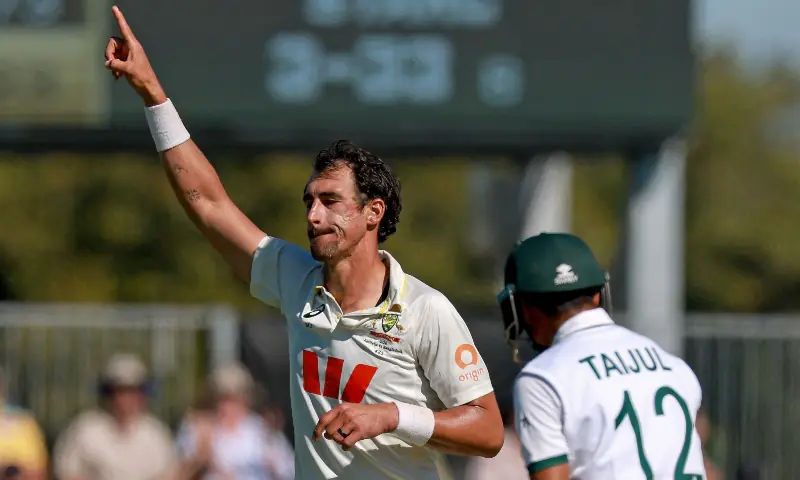
Starc’s 10-wicket blitz powers Australia to 51-run win over Bangladesh

MACKAY: Mitchell Starc produced a devastating fast-bowling masterclass as Australia stormed back from their first-Test shock to beat Bangladesh by 51 runs in the second Test in Mackay on Sunday, levelling the two-match series.

The Australian quick was virtually unstoppable, claiming 10 wickets for 51 runs in the match as Bangladesh’s batting collapsed twice inside two days. His performance transformed the contest after Bangladesh had stunned Australia with a nine-wicket victory in Darwin in the opening Test.

Starc finished the second innings with four wickets for 39 runs after destroying Bangladesh’s top order with six for just 12 in their first innings. His match figures of 10-51 marked the fourth time he has taken 10 wickets in a Test, putting him at the heart of Australia’s emphatic response.

Bangladesh began their second innings needing 147 runs to make Australia bat again. Instead, they quickly found themselves under intense pressure.

Shadman Islam lasted only three deliveries before edging a moving Starc delivery to Marnus Labuschagne. Mominul Haque followed with a second-ball dismissal, losing his off stump without offering a shot and handing Starc a hat-trick chance.

Captain Najmul Hossain Shanto survived the hat-trick ball and briefly attempted to steady the innings. He faced 46 deliveries before Nathan Lyon ended his resistance, with Shanto holing out to Starc at long-off for 31.

Starc returned to strike again, tempting Litton Das into a loose shot that was caught at third slip without scoring. Pat Cummins then added to Bangladesh’s misery, dismissing Mehidy Hasan Miraz and Hasan Mahmud.

Starc completed his 10-wicket haul when Taijul Islam was bowled for seven, while Lyon quickly cleaned up the tail.

Earlier, Australia had been bowled out for 210, giving them a 146-run first-innings lead. Cameron Green top-scored with 67, while Nathan Lyon remained unbeaten on 32 after helping Australia cross the 200 mark.

Bangladesh’s Shoriful Islam was the standout bowler for the visitors, taking seven wickets for 48 runs — the best figures by a Bangladeshi bowler in an away Test.

Australia’s victory completed a dramatic turnaround in the series. Bangladesh had arrived in Mackay full of confidence after their historic win in Darwin, but Starc and Australia’s bowling attack ensured there would be no repeat.

The result sets up a fascinating conclusion to the series, with Australia regaining momentum and Bangladesh left to regroup after a dramatic two-day collapse.

Similar Posts

  • | |

    Kangana Ranaut attacks Gen Z protesters, targets young women

    Actress and BJP Member of Parliament Kangana Ranaut has sparked widespread outrage after sharing a series of inflammatory Instagram Stories targeting the Gen Z-led Cockroach Janta Party movement, which has been demanding accountability over exam paper leaks that rocked India’s education system. Her remarks, which took direct aim at young women protesters and described them in deeply offensive terms, have drawn sharp condemnation from across the country. The political context for her comments is significant. The CJP protests, which began in New Delhi and spread to other cities, were triggered by widespread allegations of paper leaks in competitive examinations. The movement gained considerable momentum after Education Minister Dharmendra Pradhan resigned, intensifying public debate around the protesters’ demands for systemic reform and accountability. Ranaut chose not to address those demands. Instead, she used her platform to launch a sweeping attack on the character of the people participating in the protests. “They don’t do this at the cost of their parents or families,” she wrote. “Here is a new generation of so-called westernised Indian women. I call them generational gutter. Some of them have nothing to offer to the system. They are not good at studies but they are so ugly and corrupt that they can’t be home makers either. But they probably flaunt their freedom to have drugs, drinks or endless body counts.” She went on to specifically criticise young Hindu women whom she accused of aspiring to a form of independence they had not earned. “Most appalled is the behaviour of young Hindu women who want to imitate the lives of independent career women, without earning that freedom,” she said. “Women who are truly independent, they make rebellious choices, bold opinions, unconventional career moves and they take accountability for their actions.” She also addressed those who had faced physical confrontations during the protests, framing the violence as a natural consequence of their own behaviour. “Protesters who are getting beaten and abused on the roads by the common people because of their filthy and abusive roles, must understand that once you post, you will be criticised and once you damage public property, the public will damage you.” She concluded with a statement she presented as philosophical but which read to many as dismissive. “Now is not a time to cry. If you receive the opposite reaction, it is due to cause and effect. You will understand soon if you have not already.” The remarks have landed with considerable force at a moment when Indian celebrities are already divided over whether and how to support the CJP movement. While figures including Diljit Dosanjh, Arijit Singh and actor Imran Khan have expressed solidarity with the protesters, Ranaut has positioned herself firmly on the opposite side, in a manner that has gone well beyond political disagreement into personal attack. The language she used about young women in particular has drawn the most intense criticism, with many pointing out the specific ugliness of describing protesting citizens in the terms she chose.

  • | |

    Petroleum minister defends daily fuel pricing mech…

    Petroleum Minister Ali Pervaiz Malik defended the government’s new daily fuel pricing system on Thursday, telling lawmakers it has ended a practice under the previous mechanism in which oil companies restricted petrol supplies ahead of expected price revisions. The federal government announced on July 17 that petroleum product prices would now be reviewed and notified daily rather than weekly, a shift introduced as renewed tensions between the United States and Iran continue to unsettle global oil markets and raise concerns about fuel supply security. The daily system followed an earlier move from fortnightly to weekly price revisions that had been introduced during the first phase of the US Iran conflict. The change has faced pushback from transporters, businesses and opposition lawmakers, who argue that frequent price adjustments create uncertainty, push up transport and freight costs, and make it harder for businesses and households to plan their spending. Petrol pump owners had threatened a nationwide strike over the issue before suspending their protest after receiving government assurances that their concerns would be addressed. Speaking at a meeting of the National Assembly Standing Committee on Petroleum, chaired by Umar Farooq, Malik said petrol and diesel prices still rely on a seven day rolling average of international market prices, even though the pricing is now updated daily instead of fortnightly. He said the government has delegated pricing authority to the Oil and Gas Regulatory Authority, which coordinates with stakeholders before finalizing prices, and noted that the pricing methodology and benchmark figures are published on the regulator’s website. He added that Prime Minister Shehbaz Sharif had instructed the regulator to also publish the formula in Urdu to improve transparency. Malik explained that international benchmark prices are drawn from Platts, with government taxes and oil company margins added afterward to determine domestic retail prices. He said the switch to daily pricing corrected a flaw in the earlier weekly system, under which companies could anticipate price movements from an emerging three day average and adjust supply accordingly. Under the new approach, he said, prices are set daily based on the seven day average, removing that predictability. Committee members pushed back sharply on the new mechanism. Senator Saifullah Abro described it as slow poison for consumers, saying the public has no way of knowing what today’s price is, let alone tomorrow’s. He questioned recent price increases, pointing out that international crude prices rose from 76 dollars a barrel on July 11 to 82 dollars on July 17, and asked how domestic fuel prices had climbed by 30 rupees over the same period. Malik responded that the comparison was misleading since domestic fuel prices track refined petroleum products rather than raw crude oil. The minister also defended the existing tax structure, saying the petroleum levy remains lower than the rate imposed during the height of the conflict period. He said reducing the levy further would be difficult without agreement from the International Monetary Fund, though he suggested an alternative revenue source could eventually make a reduction feasible. Ogra officials also addressed the committee in support of the new system. Acting Chairman Nabeel Ahmed Awan said daily prices remain based on the seven day average, meaning that both price declines and increases in the global market are passed on to consumers gradually over a week. He said the new mechanism removes opportunities for short term profiteering by preventing traders from creating false market impressions to turn a profit. Officials also told the committee that customs duty on petrol currently stands at 18.11 rupees per litre. The session grew tense at points, with committee members criticizing Ogra for failing to circulate a working paper ahead of the meeting. When the acting chairman asked what a working paper was, Abro rebuked him sharply, questioning his familiarity with basic regulatory procedure. Malik also told the committee that the process to appoint a permanent Ogra chairman had begun on schedule, but that interviews failed to produce a suitable candidate, prompting officials to restart the search. The government had reshuffled Ogra’s leadership in April, replacing then acting chairman Shahzad Iqbal with Nabeel Ahmed Awan, a senior Pakistan Administrative Service officer and secretary of the Establishment Division, who was appointed to a three month term as the search for a permanent chairman continues.

  • | |

    Court rejects Gohar’s FIR plea against PM

    A district and sessions court in Islamabad has dismissed a petition filed by Pakistan Tehreek-e-Insaf (PTI) Chairman Barrister Gohar Ali Khan, who had sought the registration of a criminal case against Prime Minister Shehbaz Sharif, Interior Minister Mohsin Naqvi, and several other senior government officials over the events of the November 26 protest. The court issued a detailed 17-page written judgment, outlining the reasons for rejecting the application. The verdict was authored by Additional Sessions Judge Afzal Majoka, who concluded that the petitioner had failed to provide sufficient evidence to justify the registration of a first information report (FIR). According to the judgment, Barrister Gohar was given multiple opportunities to appear before the court and record his statement as an eyewitness. However, the court noted that he did not record his testimony despite repeated chances. The ruling further stated that the petitioner neither presented eyewitnesses nor submitted legally admissible evidence in support of his allegations. The court observed that the application relied mainly on claims without providing documentary or forensic material required to initiate criminal proceedings. The petition alleged that 12 people lost their lives and more than 38 PTI supporters were injured during the November 26 protest. However, the court noted that no post-mortem reports, death certificates, medical records, digital videos, photographs or other primary evidence were produced to verify the claims. The judgment emphasized that criminal action cannot be initiated against senior public officeholders solely on the basis of verbal allegations. It said there must be credible and legally admissible evidence before the court can direct the registration of an FIR against high-ranking officials. Among those named in the petition were Prime Minister Shehbaz Sharif, Interior Minister Mohsin Naqvi, Information Minister Atta Tarar, Defence Minister Khawaja Asif, Islamabad Inspector General of Police Ali Nasir, DIG Operations Ali Raza, SSP Operations Zeeshan Haider and other officials. The court also observed that if the petitioner believed that government institutions were not cooperating in the investigation, he had legal options available under Pakistani law. These included approaching the courts for further investigative measures, including exhumation where legally justified. The judgment noted that no such legal remedies were pursued.

  • |

    Perez Hilton hospitalized after livestream sparks emergency response

    Perez Hilton is receiving medical care after a livestream on Tuesday triggered an emergency response at his Miami-area home. The video, later removed, showed the celebrity blogger appearing to harm himself while viewers watched online. The Miami-Dade Sheriff’s Office confirmed deputies responded to reports of someone livestreaming self-harm on social media. Their initial statement did not name Hilton directly. A follow-up statement confirmed the person involved was safely recovered. He was then taken to a local hospital for treatment. According to details from the scene, Hilton was alone inside his residence at the time. His children and other family members were not present. Deputies arrived with multiple patrol vehicles and set up yellow tape around the neighbourhood. They later confirmed with family members that he was alone inside. The Sheriff’s Office added that in cases involving a mental health crisis or active self-harm, deputies focus on de-escalation. They said this involves creating time, distance and space for communication. The goal is to avoid immediate confrontation wherever possible. Golden Artists Entertainment, the talent management firm representing Hilton, said it was aware of the circulating content. The co-CEOs said Hilton and his family’s wellbeing was their main concern right now. They added that despite ongoing efforts, they had not yet been able to reach him directly. Hilton, 48, first became known in the early 2000s as a celebrity gossip blogger. He built one of the internet’s most-read entertainment sites during that era. He is a father of three children, all born via surrogacy. He had recently announced a move back to Miami from Las Vegas. This came shortly after a hospital stay earlier this year. The incident has sparked concern among fans and fellow public figures online. Many have shared messages of support and called for privacy during his recovery. As of now, further updates on his condition have not been released. Authorities and his team have not commented further on what led to the livestream.

  • |

    PhD exams face explosive questions over quality

    A renewed debate over the reliability of PhD examinations has emerged following questions surrounding the doctoral thesis of Professor Jason Arday. Arday submitted his PhD thesis at Liverpool John Moores University in July 2015. The controversy resurfaced after Professor Richard Dawkins publicly questioned whether the thesis had been thoroughly examined. Other commentators have also raised concerns about its academic quality and allegations of plagiarism. The debate has now expanded beyond the individual case. It has prompted questions about how universities assess doctoral research and whether the existing system consistently maintains the required academic standards. A PhD normally represents several years of specialised research. A doctoral thesis can contain tens of thousands of words and often requires extensive academic reading and analysis. The assessment is generally carried out by two examiners. One is usually from the candidate’s university, while the other comes from an external institution. Critics argue that the workload involved in examining a thesis is not always matched by the financial compensation provided to examiners. Examiners are commonly paid a relatively modest fee for reviewing lengthy and complex research. This has raised concerns that some may not devote sufficient time to the process. There are also concerns about inconsistencies in examination decisions. Some candidates have reportedly failed their PhDs despite believing that their research met the required standard. Others have received a pass even when questions remained about the quality of their work. The appeal process can be particularly difficult for unsuccessful candidates. A failed PhD can mean years of research being lost. Students who finance their own studies can also face substantial financial losses. For those hoping to build academic careers, the consequences can be even more serious. Another issue is the selection of examiners. Supervisors often play a role in recommending academics to assess their students’ work. Critics say professional relationships within academia could potentially influence the choice of examiners or the assessment itself. Academic misconduct presents another challenge. Universities can spend considerable time investigating allegations of plagiarism and other forms of cheating. Lengthy investigations can involve hearings, appeals and administrative procedures. The discussion has also highlighted the subjective nature of academic assessment. Different examiners can sometimes reach different conclusions about the same research. In some cases, candidates who fail with one set of examiners may later receive a pass from another panel after an appeal. There is no suggestion that these concerns necessarily apply to Arday’s examination. The available debate does not establish whether his thesis met or failed to meet the required standard. However, the controversy has renewed calls for universities to examine their doctoral assessment systems. Questions include how examiners are selected, whether they receive adequate compensation, how thoroughly theses are reviewed and how allegations of academic misconduct are handled. The wider debate is therefore about more than one doctoral thesis. It raises fundamental questions about the credibility, consistency and accountability of the PhD examination process.

  • |

    Abdullah Ejaz reveals painful reason behind leaving modelling

    Abdullah Ejaz, one of Pakistan’s well-known former male models and actors, has opened up about the difficult circumstances that forced him to step away from modelling. The former model, who once dominated the fashion industry, revealed that severe sciatica pain had a major impact on his career and eventually led him to pursue a different professional path. Abdullah Ejaz rose to prominence as one of Pakistan’s leading male models and received a Lux Style Award in 2006 in recognition of his work. After establishing himself in the modelling world, he successfully transitioned into acting and became part of several popular television projects. Over the years, Abdullah appeared in dramas and shows including Piya Mann Bhaye, Nail Polish, Tera Mera Rishta, Silsilay, and Hum Sab Umeed Se Hain. He later introduced himself to a new generation of viewers through his appearance in Tamasha Season 3, where audiences got the opportunity to see more of his personality beyond his earlier modelling and acting career. Abdullah is now working as a commercial director. He is also married to his university fellow from business school, Rabia, and the couple has two children. During a recent appearance on Wasim Shah’s talk show Zabardast with Wasi Shah, Abdullah spoke candidly about the health struggle that changed the direction of his career. Reflecting on the difficult period, he explained that he began experiencing severe sciatica around one and a half years ago. According to Abdullah, the pain became so intense that even sitting was extremely difficult for him. His condition eventually affected even the most basic aspects of his daily routine. Abdullah recalled that his back pain was so severe that he sometimes had to eat while lying down. He described the period as extremely challenging, not only for himself but also for his family, particularly his wife, who stood by him throughout the ordeal. The former model admitted that he still does not know exactly what caused the problem. However, he speculated that years of intense training and overtraining may have contributed to it. He said the pain appeared suddenly but continued for a prolonged period, making the experience particularly difficult. While discussing his wife’s role during that challenging time, Abdullah praised Rabia for the strength and support she showed. He described her as an “iron lady” and said her army background had made her exceptionally strong and resilient. Abdullah’s revelation gives fans a glimpse into the personal struggle behind his decision to move away from modelling. Although his career has taken a different direction, he continues to remain connected to the entertainment industry through commercial direction. His journey from a celebrated model to an actor and now a commercial director reflects the different phases of his career, while his recent candid revelation highlights the personal challenges that can sometimes remain hidden behind a successful public image.

Leave a Reply

Your email address will not be published. Required fields are marked *