tomato prices reach
|

Tomato prices reach Rs 500 per kg in Karachi

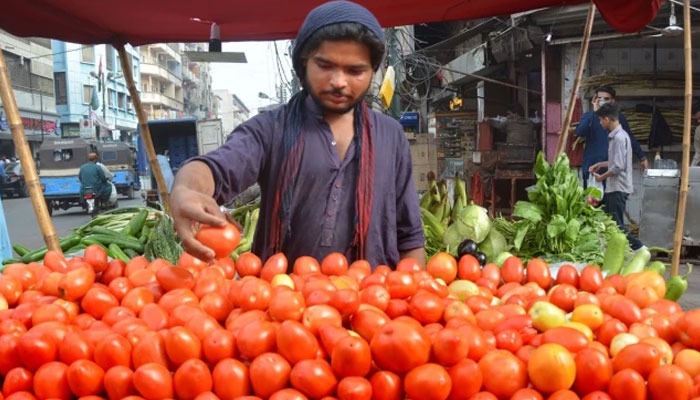
Tomato prices in Karachi have surged further, reaching between 450 and 500 rupees per kilogram despite the arrival of shipments imported from Iran.

According to media reports, local merchants are offering tomatoes sourced from Iran and Quetta within the 450 to 500 rupees per kilogram range, which translates to roughly 110 to 125 rupees per pound.

Consumers have received little financial relief from the imported supplies, with vendors selling under-ripe or smaller-sized tomatoes for 400 rupees per kilogram.

Similar Posts

  • | | |

    PM forms top panel to revive Iran gas pipeline

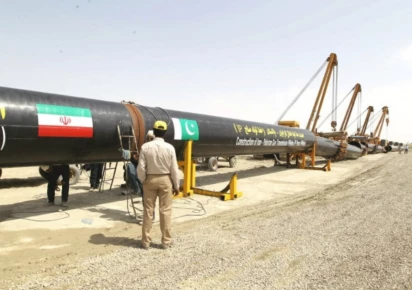
    Prime Minister Shehbaz Sharif has formed a high-level committee to find a mutually acceptable solution to the long-delayed Pakistan-Iran gas pipeline project, which has remained stuck for more than a decade. Petroleum Minister Ali Pervaiz Malik informed the Senate that the committee is examining the legal, financial and energy implications of the project. It will assess Pakistan’s potential financial exposure in the ongoing arbitration process while also considering the country’s future energy requirements. The minister was responding to a calling-attention notice raised by Senator Talha Mahmood. He said the government was seeking a negotiated solution rather than allowing the dispute to become more complicated through prolonged litigation. Describing Iran as a “brotherly country”, Malik said the leadership of Pakistan and Iran remained in contact and was working towards an amicable settlement. He noted that Iran had already completed substantial infrastructure on its side of the project. Iranian authorities have brought gas from the South Pars field towards a major city close to the Pakistani border. The dispute over the pipeline has reached international arbitration in Paris. Pakistan is therefore assessing the possible financial consequences of the project delays and the legal proceedings before deciding its next course of action. The government is also reviewing whether the pipeline can be made commercially viable. Pakistan has previously asked Iran to cut its gas price by around 50 per cent and reduce the proposed supply volume because several domestic sectors have shown limited interest in purchasing Iranian gas at existing prices. Officials have said that domestic consumers and fertiliser plants are currently receiving gas at significantly lower prices than the cost at which imported gas could be supplied through the project. Power producers have also indicated that purchasing imported gas at prices above Rs2,000 per million British thermal units would not be commercially feasible. The government has therefore been considering a lower price as a potential benchmark for making the pipeline economically sustainable. Pakistan has also indicated that it could move ahead with the project if the United States provides a waiver allowing energy cooperation with Iran despite Washington’s sanctions regime. The Iran-Pakistan pipeline, commonly known as the Peace Pipeline, was originally designed to transport Iranian natural gas to Pakistan and help address the country’s long-term energy needs. Iran completed a substantial portion of the pipeline within its territory. Pakistan, however, did not complete its section by the agreed deadline, leaving the project largely dormant. US sanctions against Iran, difficulties in securing financing and wider geopolitical tensions have complicated Pakistan’s efforts to complete the project. The issue has also resulted in legal disputes between the two countries. Iran initiated international arbitration proceedings in Paris over delays in the implementation of the project. Meanwhile, the petroleum minister told the Senate that the government was separately addressing gas-related problems in Balochistan. He said Prime Minister Shehbaz Sharif had instructed him to engage with provincial stakeholders. Another high-level committee, headed by Deputy Prime Minister and Foreign Minister Ishaq Dar, is examining gas-related issues in the province, including technical and payment-related matters. The latest move indicates that Islamabad is attempting to balance its obligations under the Iran gas project with its financial constraints, international commitments and changing energy requirements.

  • | |

    Australian court denies India exclusive claim over…

    The Federal Court of Australia has thrown out an appeal by India’s Agricultural and Processed Food Products Export Development Authority seeking to register Basmati as a certification trademark for rice in the country, a ruling Pakistan’s Ministry of Commerce welcomed in a statement issued Wednesday. The Indian authority, known as APEDA, had originally applied to register Basmati as a certification trademark for rice sold in Australia. A delegate of the Australian Registrar of Trade Marks rejected that application on December 22, 2022, finding that the word Basmati could not distinguish rice certified by APEDA from Basmati rice legitimately grown and sold by other producers. APEDA then appealed the decision to the Federal Court of Australia, which has now upheld the original rejection. Pakistan’s commerce ministry said the ruling confirms its longstanding position that Basmati functions as a geographical indication tied to a historically recognized growing region spanning parts of both Pakistan and India, rather than a term any single country can claim exclusively. The ministry noted that the original registrar’s decision had already acknowledged that Basmati rice is grown in Pakistan as well, and that Pakistani traders hold an equally legitimate claim to use the name. By dismissing APEDA’s appeal, the ministry said, the Federal Court affirmed those earlier findings. The ministry added that the Australian court also ordered APEDA to cover the respondent’s legal costs, either through agreement or a formal assessment. Islamabad described the ruling as a significant setback to Indian efforts to secure exclusive international rights over the Basmati name. The ministry said no single national authority can claim sole ownership of the term while excluding producers and exporters who have an equally valid right to use it, adding that Pakistan has consistently pushed back against Indian attempts to monopolize the Basmati name and has worked with relevant institutions and industry stakeholders to protect the interests of the country’s growers, millers and exporters. According to the ministry, the outcome safeguards the commercial and intellectual property interests of Pakistan’s Basmati sector and preserves the right of Pakistani producers to market authentic Basmati rice in the Australian market. Officials said they intend to keep protecting Basmati as a core part of Pakistan’s agricultural heritage and export identity, pursuing similar protections in other foreign jurisdictions on the basis of the rice variety’s historical origin, established reputation and distinctive qualities. Commerce Minister Jam Kamal Khan praised ministry officials and other stakeholders involved in the case, calling the ruling an important win for Pakistan’s agricultural heritage, commercial interests and export identity. India and Pakistan have long disputed the origins of Basmati rice, which both countries grow extensively. The rice traces its roots to the Punjab region, which was split into East Punjab, now part of India, and West Punjab, now part of Pakistan, following partition in 1947. In 2006, the European Union formally recognized Basmati as a joint product of both countries under its special geographical indication rules.

  • |

    Ancient Roman shipwreck found off Sicily carrying hundreds of 2,000-year-old amphorae

    Italian authorities have uncovered an ancient Roman merchant ship off the coast of Sicily, dating back to the 2nd or 1st Century BC. The vessel was discovered lying 46 metres underwater roughly three nautical miles off Mazara del Vallo. Measuring 21 metres long and 6 metres wide, the vessel’s cargo holds remain piled with hundreds of well-preserved amphorae, primarily Dressel 1A ceramic jars used during the late Roman Republic to transport commodities such as wine, olive oil, and grain. Italian Culture Minister Alessandro Giuli described the site as “one of the most important underwater archaeological discoveries of recent years”. Local fisherman and free-diver Giacomo De Mola first flagged the site after detecting an anomaly on his sonar scanner that resembled a massive reef or rock. Upon diving down to investigate, he encountered the intact cargo mound surrounded by marine life. Following De Mola’s report, specialist divers from the Carabinieri Command for the Protection of Cultural Heritage (Carabinieri Art Squad), working alongside the Sicilian Region’s Superintendency of the Sea, were dispatched to survey and document the seabed. Archaeologists also identified two lead anchor stocks alongside the vessel’s structure. Italian maritime authorities have implemented security measures to safeguard the wreckage from illicit looting while further documentation and cargo analysis take place.

  • | |

    Nimra Khan and husband reportedly part ways

    Pakistani actress Nimra Khan has once again drawn attention on social media after sharing a series of emotional and cryptic posts amid growing speculation surrounding her marriage. The actress, who has millions of followers on Instagram, has remained in the spotlight since announcing her marriage earlier this year. She had shared pictures and moments from her wedding and Nikah in Paris, receiving warm wishes from fans and fellow celebrities. However, reports and social media speculation about trouble in her marriage began circulating shortly afterward. The discussion intensified following a reel in which Nimra spoke about staying strong during difficult times and encouraged people not to abandon themselves when life becomes challenging. At the time, she appeared to dismiss concerns about her relationship, suggesting that everything was fine. She also explained that she had restricted access to some personal pictures to protect them from negative attention and the evil eye. Despite those remarks, speculation has continued to grow. In her latest Instagram activity, Nimra shared another message about strength and personal boundaries. Her post focused on standing firmly for oneself and making sure silence is not mistaken for weakness. The actress also highlighted the importance of setting boundaries, saying that failing to establish them had previously come at a personal cost. Adding to the speculation, her husband, Zain Hamid, reportedly shared a cryptic message on social media that appeared to suggest relief after a difficult situation. The development quickly caught the attention of social media users, particularly because the couple’s accounts reportedly no longer show signs of their previous connection. Nimra and Zain have also reportedly stopped following each other on Instagram, while pictures of the couple are no longer visible on his account. These developments have further intensified questions among fans about the status of their relationship. Neither Nimra Khan nor Zain Hamid has publicly provided a detailed explanation of the reported separation or addressed all the speculation circulating online. Meanwhile, Nimra recently shared content highlighting a woman’s account of alleged domestic abuse. In the post, the actress expressed support for women facing difficult circumstances and encouraged victims to speak up. Her decision to share the message has also attracted attention, with many followers linking it to her recent posts about boundaries, strength and self-respect.

  • | |

    Trump hosts Netanyahu, Zelensky for high level tal…

    WASHINGTON: US President Donald Trump is set to meet Israeli Prime Minister Benjamin Netanyahu and Ukrainian President Volodymyr Zelensky at the White House on Tuesday, as the wars involving Iran and Ukraine enter what officials describe as a decisive and highly sensitive phase. The two leaders are in Washington to attend a memorial service for Senator Lindsey Graham, a prominent Republican ally of Trump and a strong advocate of military support for Ukraine. However, the diplomatic spotlight has shifted to their separate meetings with the US president, which are expected to focus on two of the world’s most volatile conflicts. Trump’s relationship with Zelensky has improved significantly in recent months as Ukrainian forces have slowed Russian advances and intensified strikes on Russian energy infrastructure. Ahead of his meeting, Zelensky said strengthening anti-ballistic missile defence and expanding strategic cooperation with the United States were his top priorities, stressing that efforts to bring peace closer must continue. Despite renewed diplomatic contacts, there is little indication that either the Ukraine war or the widening confrontation involving Iran is nearing an end. Following the collapse of a ceasefire linked to the Iran conflict, Trump has said he paused US airstrikes to allow diplomacy another opportunity, while continuing consultations with regional allies. Netanyahu arrives in Washington amid signs of growing frustration within theWhite House over the lack of progress toward a broader settlement related to Iran. Tensions between Trump and the Israeli leader have become more visible in recent weeks, including reports of a heated phone conversation in June that was later publicly acknowledged by Trump. According to sources familiar with the discussions, Netanyahu is also seeking to reinforce his political standing ahead of Israel’s October 27 election. A public display of close coordination with Trump could help him domestically, where he has faced pressure in opinion polls. Before departing for Washington, Netanyahu said the talks would focus primarily on Iran, while also addressing regional security and efforts to expand peace agreements with Arab states. A White House official said Trump plans to discuss the Iran conflict, tensions between Israel and Lebanon, and the future of the Abraham Accords. The administration is reportedly continuing efforts to encourage Saudi Arabia to join the accords, although Riyadh has maintained that any normalisation with Israel would require a credible pathway toward Palestinian statehood. Trump struck a notably warmer tone when speaking to reporters aboard Air Force One, describing Netanyahu as a strong wartime leader and saying the two had worked well together.Zelensky is expected to hold a brief private meeting with Trump, likely without media present. Ukrainian officials say securing additional Patriot missile interceptors is their most urgent request, as Russian missile and drone attacks continue almost daily. The Ukrainian president is also expected to push for expanded air-defence cooperation, progress on a drone agreement with the United States, and discussions on Trump’s proposal to allow Ukraine to produce Patriot interceptors under licence. White House officials said the meeting with Zelensky would focus on the ongoing peace process between Russia and Ukraine and reiterated that the administration believes the time has come to seek an end to the war. After the White House talks, Zelensky is expected to visit Capitol Hill for meetings with all 100 US senators, underscoring the continuing bipartisan interest in Ukraine’s defence despite growing debate over the pace and delivery of American military assistance.

  • | |

    Poor internet access threatens girls’ education …

    PESHAWAR: Poor internet connectivity is creating serious problems for girls pursuing education in the merged districts of Khyber-Pakhtunkhwa. Students in remote areas often struggle to attend online classes. They also face difficulties downloading study material and submitting assignments. For 16-year-old Khadija Bibi from Kurram district, finding an internet signal has become part of her daily life. During the summer holidays, she often leaves her home and climbs a nearby hill. She carries her mobile phone with her. She stands on the rocky slope and searches for a stronger signal. She uses the limited connection to download lecture notes and complete academic tasks. She also tries to attend online classes from the hill. However, the weak network frequently disconnects. This causes her to miss lessons and submit assignments late. Khadija is a BS Computer Science student at Benazir Women University Peshawar. She said unreliable internet had become one of the biggest challenges in her education. She said students in remote areas were being left behind as education increasingly depended on digital technology. The problem is not limited to Kurram. Thousands of girls across the merged districts face similar difficulties. The region already has several major education challenges. Poverty remains a serious obstacle. Insecurity has also affected access to education. Many areas also lack proper schools and other educational facilities. The digital divide has added another challenge. Several schools in the merged districts either do not have computer laboratories or have laboratories without working computers. Some also lack internet connections. This prevents students from gaining basic computer skills. It also makes online education difficult. Official data highlights the wider education crisis in the region. Benazir Income Support Programme data shows that 66 per cent of children in North Waziristan are out of school. The rate stands at 63 per cent in Bajaur. It is 61 per cent in South Waziristan. Mohmand and Khyber each record an out-of-school rate of 51 per cent. Kurram and Orakzai each have a rate of 47 per cent. Girls face additional difficulties because of limited access to technology. The Khyber-Pakhtunkhwa Women Empowerment Policy 2026-2030 highlights the scale of the digital divide. According to the policy, only 11 per cent of women in the merged districts have access to the internet. The female literacy rate is also extremely low. It stands at only 17 per cent. Education and digital inclusion advocates say poor infrastructure is a major reason for the situation. Weak mobile networks make internet access unreliable. Many families also cannot afford smartphones or regular internet packages. Some girls have to borrow phones from family members. This makes it difficult for them to attend online classes regularly. Access to technology is also affected by social restrictions. In some communities, families remain concerned about girls using mobile phones and the internet. Concerns about online safety and social pressure often result in restrictions. Cultural norms can also limit girls’ access to digital technology. Experts say improving internet coverage alone will not solve the problem. Girls also need greater freedom to travel to schools, universities and training centres. Better transport facilities could help students reach educational institutions more easily. It could also improve access to vocational training and employment opportunities. Experts have urged the provincial government and telecommunications authorities to give greater attention to the merged districts. They say residents should receive reliable internet services similar to those available in settled areas. Improved digital infrastructure could transform educational opportunities for girls in remote communities. Reliable internet would allow students to attend online classes without travelling long distances. They could access digital libraries and educational resources. They could also develop computer skills and participate in online training programmes. For students like Khadija, internet access is more than a technological facility. It is directly linked to education and future opportunities. Without reliable connectivity, many talented girls may continue to struggle despite their willingness to study. Addressing the digital divide therefore requires investment in telecommunications infrastructure, schools, digital devices and affordable internet services. It also requires efforts to remove social barriers that prevent girls from using technology.

Leave a Reply

Your email address will not be published. Required fields are marked *