trkiye saudi arabia
|

Türkiye, Saudi Arabia and Pakistan to establish new defence cooperation mechanisms

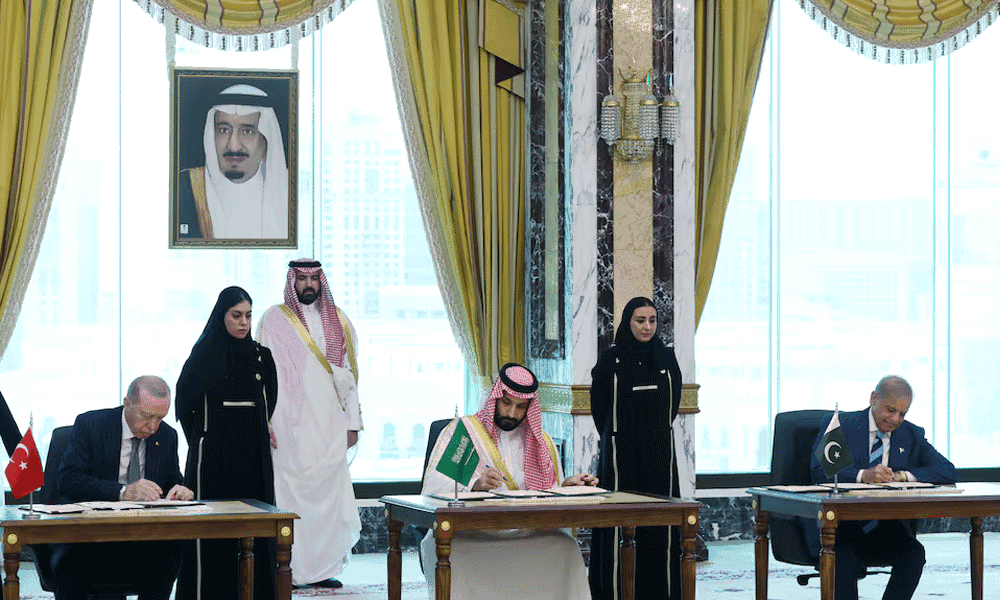
ANKARA: Türkiye, Saudi Arabia and Pakistan are set to establish new political and military coordination mechanisms following the signing of a landmark joint defence agreement, as the three countries move to strengthen strategic cooperation amid growing security concerns in the region.

Türkiye’s Defence Ministry said on Thursday that the framework agreed by the three countries would bring senior political and military leadership into a structured mechanism aimed at enhancing coordination on defence and security matters.

The three nations signed the Makkah Joint Defence Agreement on August 7, marking a significant development in their security relations. The agreement comes at a time of heightened tensions across the Middle East, with the escalation of regional hostilities raising security concerns among Gulf states and other countries in the region.

Under the agreement, an armed attack against any one of the three countries would be treated as an attack against all members. The provision establishes a collective-defence commitment similar in principle to the collective security arrangement contained in Article 5 of the North Atlantic Treaty Organisation (NATO).

High-level political and military coordination

According to the Turkish Defence Ministry, the new mechanisms will involve the defence ministers, foreign ministers and military chiefs of Türkiye, Saudi Arabia and Pakistan.

The arrangement is expected to provide the three countries with a regular platform for consultations on regional security developments, defence policy and potential threats. It could also facilitate closer coordination between their armed forces and government institutions.

The agreement reflects the growing strategic importance of cooperation between the three Muslim-majority countries, particularly as regional security challenges continue to evolve.

Joint military exercises planned

The Turkish ministry also said the three countries were planning joint military exercises under the new defence framework.

Such exercises could provide opportunities for their armed forces to improve interoperability, exchange operational experience and strengthen their ability to coordinate during potential security crises.

Defence cooperation is also expected to extend beyond military exercises. The Turkish side said the agreement could pave the way for greater collaboration in the defence industry, including joint production, technology sharing and other forms of industrial cooperation.

The expanded defence-industry partnership could allow the three countries to explore opportunities for developing and producing defence equipment together while sharing technical expertise and capabilities.

Agreement follows rising regional tensions

The pact was signed against the backdrop of heightened tensions in the Middle East, which have raised concerns over the security of Gulf countries and critical energy infrastructure.

The escalation has also highlighted the importance of collective security arrangements and closer coordination among regional powers.

For Pakistan, the agreement represents another step towards strengthening defence and strategic ties with Türkiye and Saudi Arabia. Islamabad has traditionally maintained close military and diplomatic relations with both countries.

The agreement is therefore expected to broaden cooperation from traditional bilateral defence relations towards a more structured trilateral framework involving political consultations, military coordination and defence-industrial collaboration.

Pakistan’s Deputy Prime Minister and Foreign Minister Ishaq Dar has also clarified the scope and intent of the Makkah agreement, stressing the nature of the arrangement and its broader security objectives.

The three countries are now expected to work out the details of the new mechanisms, including the structure of ministerial consultations, military coordination and proposed joint exercises.

Similar Posts

  • |

    PHF eyes european coach for Pakistan women’s hockey team

    The Pakistan Hockey Federation (PHF) is preparing to appoint a foreign coach for the national women’s hockey team in a move aimed at strengthening player development and improving the team’s international competitiveness. According to sources familiar with the matter, the PHF is currently in discussions with a European coach to take charge of the women’s national side. The negotiations are progressing, and officials are hopeful that an agreement will be finalized by the end of this month. The proposed appointment is part of the federation’s broader strategy to modernize women’s hockey and provide players with greater exposure to international coaching methods and high-performance training. Sources said the incoming coach would also oversee a series of training tours across Europe. These tours are expected to give Pakistan’s women hockey players the opportunity to compete against stronger opposition, gain valuable match experience and adapt to international standards of play. In addition to coaching the national squad, the foreign coach is likely to play a key role in organizing practice matches and training camps during overseas visits. These fixtures are expected to help the team improve its tactical awareness, fitness levels and overall performance ahead of future international competitions. The move reflects the PHF’s growing focus on rebuilding women’s hockey, which has struggled to maintain a consistent presence on the international stage in recent years. Officials believe that exposure to European coaching techniques and competitive environments could accelerate the team’s progress. While the federation has yet to make an official announcement regarding the coach’s identity, insiders say discussions are in the final stages and optimism is high that the appointment will soon be confirmed. If finalized, the hiring of a European coach would mark an important step in Pakistan’s efforts to revive women’s hockey and create a stronger pathway for future success at regional and global tournaments.

  • |

    Trump cuts childhood vaccine recommendations as doctors warn of health risks

    US President Donald Trump signed an executive order on Monday calling for fewer childhood vaccinations, limiting core federal guidance to immunisations against 11 diseases. Trump stated the adjustments would offer children “gold-standard” protection while bringing US policies in line with foreign nations that recommend fewer routine shots. The executive directive advises breaking up the combined measles, mumps, and rubella (MMR) vaccine into three distinct doses administered across separate clinical visits. Health Secretary Robert F. Kennedy Jr. has long advocated for reductions in the pediatric vaccine schedule. Medical researchers and global health bodies have repeatedly debunked claims championed by Kennedy alleging a causal link between routine childhood vaccines and autism. The American Academy of Pediatrics and pharmaceutical manufacturer Merck sharply criticised the executive action. “We are evaluating our next steps,” stated Richard Hughes IV, lead legal counsel for the American Academy of Pediatrics. Merck noted there is no published scientific evidence demonstrating clinical advantages to unbundling the MMR vaccine, warning the mandate could induce delayed or skipped immunisations. Republican Senator Bill Cassidy, a practicing physician, publicly broke with the administration over the decree. “I’m a doctor. This executive order is wrong. The president does not have the expertise to make these changes,” Cassidy said. Cassidy cautioned that unbundling combination shots will force children to endure a higher volume of individual injections to secure identical protection.

  • | |

    Australian court rejects Indian appeal in Basmati …

      An Australian court has dismissed an appeal filed by the Agricultural and Processed Food Products Export Development Authority (APEDA) in the Basmati word mark case, marking a significant legal development for Pakistan’s rice exporters. According to the Ministry of Commerce, the Australian court’s decision has reaffirmed Pakistan’s principled position that the term “Basmati” cannot be treated as the exclusive property of India. The ruling is being viewed by Pakistani authorities as an important legal success in protecting the rights of the country’s Basmati rice producers and exporters. The Australian court has also ordered the Indian institution APEDA to pay the legal costs associated with the proceedings. The decision follows a legal dispute over the use and registration of the word “Basmati” in Australia. APEDA had applied to register the word “Basmati” as a certification trademark. The application was challenged, leading to legal proceedings concerning whether the term could be claimed exclusively for Indian rice products. Pakistan has consistently maintained that Basmati rice is also produced in Pakistan and that Pakistani exporters should have equal rights to use the name. The Ministry of Commerce said Australian authorities had already acknowledged that Basmati rice is produced in Pakistan, strengthening Islamabad’s position in the dispute. The latest court decision has therefore been welcomed by Pakistani officials as confirmation of the country’s longstanding stance on the geographical and commercial identity of Basmati rice. The Ministry of Commerce stated that the ruling represents an important legal victory for Pakistan because it supports the principle that Pakistani exporters should not be deprived of the right to use the term Basmati for rice produced in the country. Federal Minister for Commerce Jam Kamal congratulated the Ministry of Commerce team on what he described as Pakistan’s legal success in the case. He appreciated the efforts of the officials and legal representatives involved in defending Pakistan’s position before the Australian authorities. The dispute is significant because Basmati rice is an important agricultural and export commodity for both Pakistan and India. The term has considerable commercial value in international markets because consumers associate Basmati with a distinctive variety of aromatic long-grain rice. Pakistan is among the countries known for producing and exporting Basmati rice, particularly from areas in Punjab. The country has sought greater recognition of its rights over the Basmati name in international markets, arguing that the rice is a shared agricultural heritage of the region and is produced on both sides of the border. APEDA’s attempt to register “Basmati” as a certification trademark had raised concerns in Pakistan because exclusive registration could potentially affect Pakistani exporters’ ability to market their products using the internationally recognized name. The Australian court’s rejection of APEDA’s appeal is consequently being seen by Pakistan as an important development in safeguarding its exporters’ commercial interests. The order requiring APEDA to pay legal costs also adds to the significance of the decision for Pakistan. The Ministry of Commerce has emphasized that the ruling strengthens Pakistan’s position in international legal and commercial forums. Pakistani authorities are expected to continue protecting the interests of local rice growers and exporters and ensuring that they retain the right to market their Basmati rice under its recognized name. The decision could also contribute to broader efforts to strengthen Pakistan’s agricultural exports and promote its Basmati rice in international markets.

  • | | |

    Gold rates decline by Rs1,000 per tola

    Gold prices continued to fall in bullion markets across Pakistan on Wednesday. The latest decline provided some relief to buyers as local rates moved lower. According to the All Pakistan Gems and Jewellers Association, the price of gold decreased by Rs1,000 per tola. The new price was recorded at Rs426,436 per tola. The decline was also seen in the price of 10-gram gold. Its rate fell by Rs857. The price reached Rs365,600. The latest reduction comes amid continued movement in gold prices in both local and international markets. Gold rates in Pakistan are influenced by global prices, currency movements and trends in the domestic bullion market. The international market also recorded a decline. The price of gold fell by $10 per ounce and reached $4,040 per ounce. The fall in international prices has also contributed to the downward movement in domestic gold rates. Local jewellers and traders closely monitor global prices when determining daily gold rates. Gold remains a popular investment and savings option in Pakistan. Changes in its price can affect both investors and consumers planning to purchase jewellery. The latest decline may offer some relief to customers who have been facing higher gold prices. However, market rates can change quickly depending on international developments and currency fluctuations. Jewellers are expected to continue monitoring the international bullion market. Any major movement in global gold prices could have a direct impact on domestic rates in the coming days. For now, the latest figures show a downward trend in gold prices in Pakistan. The per-tola rate has fallen by Rs1,000, while the price of 10 grams has declined by Rs857.

  • |

    EU plans sweeping new sanctions against Russia

    European Union foreign policy chief Kaja Kallas is preparing a major new sanctions package targeting Russia, describing it as potentially the bloc’s most extensive list since the war in Ukraine began. In an interview with German newspaper Welt, Kallas said she plans to present the proposed measures in the coming months. She said that if the package is approved, the number of sanctioned Russian individuals, companies and organisations could rise by about one-third. Kallas argued that continued pressure on Moscow was necessary and welcomed signs of closer coordination between the European Union and the United States. She pointed to the US Senate’s approval of a sanctions bill earlier this month as a development that could bring Washington and European capitals closer on Russia policy. The EU foreign policy chief also warned of what she described as a growing hybrid threat facing Europe. She cited alleged incidents involving sabotage, espionage and cyberattacks, which she said were frequently linked to Russia. Kallas also referred to recent reports of Russian missiles and drones entering the airspace of Poland and Romania. She said such incidents should not be treated lightly, arguing that Moscow was testing the readiness and defensive capabilities of European countries. She welcomed Germany’s plans to reform its intelligence services, saying stronger intelligence capabilities would be important in responding to emerging hybrid security threats. Kallas also discussed diplomatic efforts involving the United States and Iran. She said negotiations aimed at resolving tensions were continuing but warned that their outcome remained uncertain because of a lack of trust between the two sides. She highlighted the economic consequences of the closure of the Strait of Hormuz, a vital route for global energy and maritime trade. Kallas said freedom of navigation should remain unrestricted and argued that reopening the waterway should be treated as a priority. She also said efforts to prevent Iran from acquiring nuclear weapons should remain an important part of the international agenda. On the Israel-Palestine conflict, Kallas reiterated the European Union’s support for a two-state solution, describing it as the only viable long-term framework for allowing Israelis and Palestinians to live securely alongside each other. She said EU missions were continuing efforts to preserve the possibility of such a settlement and suggested that a US-backed Gaza peace initiative could provide an opportunity for progress.

  • | |

    Seven law enforcement personnel martyred during re…

    Azad Jammu and Kashmir (AJK) Information Secretary Muhammad Rashid Hanif has said that seven law enforcement personnel, including police and Rangers officials, were martyred during the recent unrest in the region. In a televised address on Monday, Hanif said the casualties occurred during clashes linked to ongoing protests by the now-proscribed Joint Awami Action Committee (JAAC). The committee has been demonstrating in the region for several weeks over its demand to abolish 12 seats in the AJK Legislative Assembly reserved for refugees from Indian-held Kashmir. The unrest intensified after clashes between protesters and security personnel in Rawalakot and Mirpur last week. The incidents reportedly resulted in multiple casualties and increased tensions across the region. Hanif stated that weapons allegedly recovered from JAAC members were presented during a previous press conference by a police official on July 27. He claimed that seven law enforcement personnel were killed using similar weapons, while 45 personnel suffered serious injuries and several others sustained minor injuries. The AJK information secretary also alleged that police and Rangers vehicles were damaged and burned during the unrest. He claimed that the incidents indicated the presence of armed elements within the banned organization and accused them of attempting to challenge the state’s authority and disrupt peace. Responding to allegations made by JAAC regarding events in Rawalakot and surrounding areas between July 27 and July 31, Hanif rejected the claims and described them as part of a misinformation campaign. He said the security institutions of AJK had shown restraint and professionalism while handling the law and order situation. Hanif denied allegations of unprovoked firing by security forces and rejected claims that bodies were being withheld. He stated that the government currently had no bodies in its custody and accused the organization of spreading misleading information through social media. He further alleged that JAAC activists had been involved in blocking and damaging vehicles carrying essential supplies and food items. The information secretary also highlighted previous incidents involving casualties among law enforcement personnel, claiming that one police official was martyred in 2024 and three others in October 2025 during unrest-related incidents. Meanwhile, the AJK government criticized international media reports regarding the clashes, describing some coverage as biased and incomplete. Officials said reports should have included the government’s position and verified information before publication. The Ministry of Information and Broadcasting also criticized coverage of the AJK elections by some media outlets, alleging selective reporting from specific polling locations. The situation in AJK remains tense as authorities continue security measures while political and public disputes over electoral representation and governance issues continue. The government and protest groups have presented conflicting accounts of the events, and further developments are expected as investigations proceed.

Leave a Reply

Your email address will not be published. Required fields are marked *