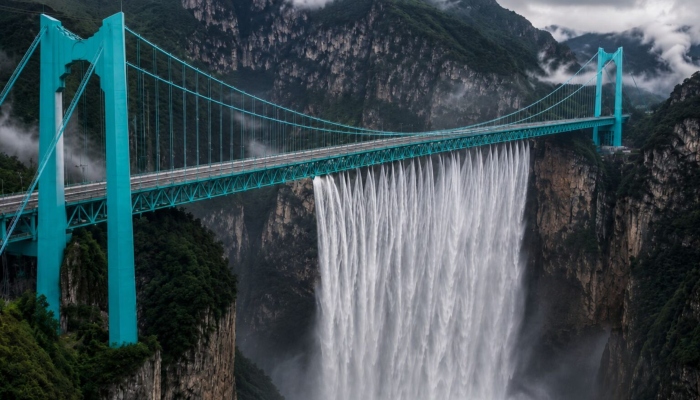
world8217s tallest bridge

World’s tallest bridge has a giant waterfall

China has completed many incredible engineering projects in recent years but the Huajiang Grand Canyon Bridge stands out as one of its most amazing achievements.

If you’re afraid of heights crossing this bridge might not be easy. It is built 625 meters (2,051 feet) above the ground making it the tallest bridge in the world.

It opened to the public in September 2025.

However its height is not the only reason it attracts attention. The bridge also features a 300 meter long artificial waterfall creating a spectacular view for visitors.

At night a laser lighting system makes the waterfall even more impressive. Chinese officials designed the bridge as more than just a road. It is also a tourist attraction with glass walkways cafes inside the bridge towers and adventure activities such as bungee jumping.

According to local authorities thousands of tourists visit the bridge every day.

The bridge was also recognized by Time which ranked it as the No. 1 place to visit in 2026.

Located in Guizhou the bridge was built to make travel faster in the province’s mountainous landscape.

Trips that once took about two hours can now be completed in just one minute.  The steel bridge is 9,482 feet long. Construction began in January 2022 and it was completed and opened in September 2025.

Around 20,000 tons of steel were used to build it roughly the same amount of steel found in three Eiffel Towers.

Similar Posts

  • Back to school tips every parent should know

    As the long summer vacation comes to an end, many parents wonder how to help their children get back into the school routine. After weeks of sleeping in playing and enjoying free time waking up early getting ready on time and returning to schoolwork can be difficult. Experts say that a few simple habits can make this change much easier. One of the most important steps is to fix your child’s sleep schedule. A few days before school starts encourage children to go to bed earlier and wake up at the same time they will on school days. Children aged 6 to 13 should get 9 to 11 hours of sleep each night while teenagers aged 13 to 17 need 8 to 10 hours. Good sleep helps improve both physical health and mental focus. Experts also recommend keeping children away from phones tablets computers and other electronic devices for at least one hour before bedtime. Instead parents can talk with them about their teachers classmates school activities and exciting things they can look forward to. Positive conversations can help reduce anxiety and build excitement. A healthy breakfast is another important part of a successful school day. Foods such as fruit milk eggs oatmeal whole grain bread and other balanced meals give children the energy they need and improve their focus memory and learning. Parents should also make time every day to ask their children about school.  Talking about lessons friends sports and classroom activities helps children feel supported and encourages them to share any concerns. Experts say parents should lead by example.  When the home follows a regular routine for sleeping eating and daily activities children are more likely to develop the same healthy habits. Most importantly school should be presented as a positive experience rather than something stressful. With encouragement patience and support children can adjust more easily and begin the new school year feeling happy and confident.

  • New drug treatment Center opens in Karachi

    Karachi: Sindh Health Minister Dr. Azra Fazal Pechuho has inaugurated a new Opioid Agonist Maintenance Therapy (OAMT) Center at Jinnah Hospital to help people recovering from drug addiction. Speaking to the media the minister said the center will support people in gradually overcoming addiction and returning to a healthy normal life. Patients will receive medical treatment regular health monitoring counseling and rehabilitation services under one roof. Dr. Pechuho said the facility will be staffed by experienced doctors and trained healthcare workers who will closely monitor patients throughout their recovery. She also stressed the need to speed up HIV screening so that more cases can be detected early and  treated without delay. Commenting on reports of a patient’s death at Jinnah Hospital the health minister said that every loss of life is deeply tragic. If negligence was involved she said a full and transparent investigation must be carried out to identify those responsible. She added that no patient’s death should ever be treated as unimportant and strongly condemned any remarks that appeared to downplay such incidents.

  • AI creates new viruses not found in nature

    US researchers have claimed to have developed new viruses with the help of artificial intelligence (AI) that did not previously exist in nature. The development is being described as an important breakthrough in the scientific community. According to a study published in the scientific journal Science, researchers from Stanford University and the Broad Institute of MIT and Harvard used a naturally occurring phage as a basis and employed AI to generate thousands of genetic designs. A phage is a type of virus that infects bacteria. The researchers chemically synthesized around 300 of these genetic designs and tested them in a laboratory. Of these, 16 viruses proved to be viable. According to the study, a combination of the AI-designed viruses was more effective than naturally occurring viruses at eliminating E. coli bacteria. The researchers said the approach expands the scope of synthetic genomics and could pave the way for more effective phage therapies against rapidly evolving pathogens. However, experts have expressed concerns about potential biological security risks alongside the possible medical benefits of the development. Isaac Bogoch, an infectious disease specialist at the University of Toronto and Toronto General Hospital said AI-designed viruses could have certain benefits such as creating specialized bacteriophages that could help tackle antibiotic-resistant infections. He warned that the same ability to design complete and functional viruses could pose a serious biological security threat if used to create harmful pathogens. Therefore, strong safety regulations, screening and monitoring are necessary alongside the technology. Professor Fatima Wafai of the University of New South Wales in Sydney said the current research does not pose a direct threat to humans because phages infect only bacteria. However, she noted that the methods used in the research could potentially be misused for harmful purposes. Tom Ellis, an expert in synthetic genome engineering at Imperial College London described the research as impressive but said it also demonstrates that AI is still far from being able to design complex genomes, cells and large viruses. He explained that the phage genome used in the study is very small and relatively simple while the genome of the virus that causes COVID-19 is approximately six times larger. The complexity of designing larger genomes increases rapidly. According to Ellis, the research does have implications for biological security. However, modifying naturally occurring viruses remains a more serious and immediate threat than creating new pathogens with AI. Hsu Li Yang, director of the Asia Centre for Health Security in Singapore also said that it may be possible to use AI to make viruses more dangerous. However, he cautioned against exaggerating the implications of the research. He clarified that the study does not mean that anyone with basic scientific or laboratory knowledge can now create life-saving or dangerous viruses at home. Considerable technical expertise is still required to physically produce a virus in a laboratory after it has been designed. Experts say the research is both medically promising and concerning from a biological security perspective as it demonstrates a technology that could potentially be used for both beneficial and harmful purposes.

  • Skin Cancer warning signs

    Skin cancer is one of the most common cancers in the world affecting millions of people every year. It often begins with small changes on the skin that may look harmless causing many people to ignore them.  However spotting these early signs and getting medical advice quickly can help save lives. According to the World Health Organization (WHO) around 330,000 new cases of melanoma the deadliest type of skin cancer were reported worldwide in 2022. About 60,000 people died from the disease that year. Harvard trained dermatologist Dr. Daniel Sugai says people should pay close attention to any unusual skin changes. if a pimple bump or sore on your face does not heal within a month it should be checked by a dermatologist. A spot that keeps bleeding or does not heal can also be a warning sign of skin cancer. Dr. Sugai says these symptoms may point to basal cell carcinoma the most common type of skin cancer. In the United States alone about 3.6 million cases are diagnosed each year. This cancer may appear as a shiny or clear bump a rough or scaly patch or a dark brown black or bluish spot on the skin. He also explained that basal cell carcinoma grows from cells that create new skin cells.  These cancer cells often develop tiny tree like blood vessels which can make the affected area bleed more easily. In people with darker skin tones the cancer may appear as a pigmented or darker colored spot. Experts say any new mole spot sore or skin change that does not heal should never be ignored. Early diagnosis and treatment greatly improve the chances of successful treatment and can help prevent the cancer from becoming more serious.

  • Why do car turn signals click?

    When you turn your car left or right you hear the familiar click-click sound from the turn signal. At the same time the arrow on the dashboard flashes to show the signal is working. Even though cars have become much more advanced this sound has stayed the same for many years. But have you ever wondered why? Turn signals first appeared in cars in the late 1930s. In older vehicles the clicking sound came from a thermal flasher. When the driver switched on the turn signal electricity heated a small metal strip.  As it bent from the heat it completed an electrical circuit and turned the signal lights on. The metal quickly cooled returned to its original shape and broke the circuit turning the lights off. This heating and cooling cycle repeated over and over making the lights flash. The movement of the metal strip created the well known clicking sound. As technology improved car makers replaced the old thermal system with electromagnetic and later electronic systems controlled by computer chips.  These newer systems no longer need moving metal parts to flash the lights. However most modern cars still play the click click sound on purpose. Manufacturers keep it because drivers are used to hearing it and the sound reassures them that the turn signal is working correctly even though it is no longer mechanically necessary.

  • Journalism Education in AI Era: Harmonizing Traditional Skills and Emerging Technologies

    By Muhammad Aaraiz Altutmish  Two weeks ago, I attended a workshop under the project titled “Digital Trust and Free Expression in the AI Era” at the Department of Media and Development Communication, University of the Punjab, supported by the U.S. Mission to Pakistan in partnership with the Pakistan-U.S. Alumni Network (PUAN). The Workshop fetched together students, media persons, and experts to address one of the most significant topics framing advanced communication: the impression of AI on Media & Journalism.  Across the set of captivating sessions, presenters highlighted how Artificial Intelligence revolutionizing newsrooms, altering the way journalists collect information, inspect the facts and generate content. The fast development of technology specifically Artificial Intelligence (AI) has reshaped the advance digital world. AI is no longer a far-off concept; it has already integrated into the newsrooms and become a part of modern media networking. Therefore, media professionals and journalists can’t neglect this technology anymore. Instead they are continuously expected to develop their expertise and to modernize their skillset according to the changing media environment. This circumstance raises a significant question for journalism students who aim to foster their careers in the media industry. Should they first concentrate on learning the traditional basics or foundations of journalism, or should they prefer AI and developing technologies? While AI is transforming the means of working in media industry, journalism students are still needed to practice and learn the conventional principles and standards of journalism that have long been instructed in academic institutions. The AI development has brought prominent changes to writing, editing, publishing and content creation. Most of the operations can now be done in more quick and efficient way. Research functions have become effortless and many of newsroom tasks have been managed via technological tools. These advancements have transformed the media organizations operate and have affected many aspects of journalistic practices. Regardless of these changes, journalism education proceeds to emphasize the conventional methods of reporting, news values, interviewing techniques, fact- verification, and other foundational skills. Students are expected to master these standard practices while they also have to upskill themselves understanding and adapting to AI driven technologies and tools. As a result, journalism students often face the challenge of learning both traditional techniques and mastering themselves to developing technological skills within the same academic timeframe. This challenge becomes even more substantial for upcoming generations of media education and profession. They will have the same timeframe of study as former generations, still they may need to master a wide range of subjects and practical skills. Alongside traditional training of journalism, they will also require to develop their skillset related to AI, Digital media technologies, data driven networking and developing newsroom techniques. Consequently, media instructors, academic institutions, field professionals, and experts are set upon with a significant problem. They must reflect upon that how journalism education can accommodate both traditional practices of journalism and developing technological requirements. The hurdle stems in empowering students to master a wider spectrum of knowledge and practical experience within the existing timeframes and educational structures. The development of AI in journalism has therefore produced a new educational reality. While conventional journalism stands a central component of media education, technological developments continues to transform professional expectations. This continuing transformation spotlight the growing requirement to confront how future journalists can productively learn both the traditional practices of journalism and developing skills needed in an AI-driven media environment. The views, thoughts, and opinions expressed in this blog are solely those of the author and do not necessarily reflect the official policy or position of the U.S. Mission to Pakistan or USEFP/PUAN.

Leave a Reply

Your email address will not be published. Required fields are marked *