terrorists killed panjgur
| | |

5 terrorists killed in Panjgur operation

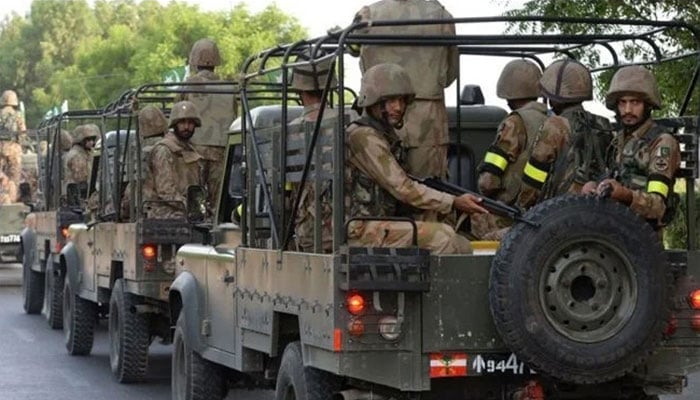
Security forces have killed five suspected terrorists, including a key commander of Fitna al-Hindustan, during an intelligence-based operation in Balochistan’s Panjgur district, according to security sources.

The operation took place in the Sarkini and Chhedgi areas of Panjgur under Operation Radd-ul-Fitna 3. Security forces conducted the raid after receiving intelligence about the presence of armed militants in the area.

According to the sources, the operation resulted in the death of Fitna al-Hindustan commander Wazir, son of Jamal, along with four other militants. The security forces also recovered four motorcycles, machine guns, other heavy weapons and a large quantity of ammunition from the militants’ possession.

Security sources said the militants had allegedly been involved in a range of criminal and terrorist activities, including extortion, kidnapping, robbery and attacks against traders and local residents. Their activities had created fear and insecurity among people in the area.

Following the successful operation, security forces have launched a clearance operation in the surrounding areas to locate and eliminate other members of the militant network. Officials said the security operation would continue until the area was fully cleared of remaining threats.

Interior Minister Mohsin Naqvi praised the security forces for their successful intelligence-based operation in Panjgur and commended their professional capabilities.

Naqvi said the country’s security personnel remained a source of pride for the nation and were working to eliminate terrorism from Balochistan. He said the entire nation stood united against terrorism and supported the security forces in their efforts to restore peace and stability.

The latest operation comes as security forces continue intelligence-led actions against militant groups across Balochistan as part of broader counterterrorism efforts.
Similar Posts

  • | |

    NDMA issues 48-hour flood alert as Chenab rises

    The National Disaster Management Authority (NDMA) has warned of an elevated flood risk in several parts of Pakistan as heavy monsoon rains continue across the country. The authority has placed relevant departments on alert and warned that the next 24 to 48 hours could bring flooding in riverine, urban and mountainous areas. The NDMA said medium-level flooding has been recorded in the Chenab River at Khanki, Qadirabad and Chiniot Bridge. The Palkhu Nullah in Wazirabad is also experiencing medium-level flooding. Low-level flooding has been reported at several other locations. These include Kalabagh, Chashma and Taunsa on the Indus River. Marala and Trimmu on the Chenab are also experiencing low-level flooding. Similar conditions have been observed at Balloki and Sidhnai on the Ravi River and Nowshera on the Kabul River. The situation along the Chenab remains a major concern. The NDMA said water levels are expected to rise further over the next 24 hours at Marala, Khanki, Qadirabad and Chiniot Bridge. Water levels at Trimmu Barrage are also expected to reach medium flood levels during the same period. The authority has warned of possible flash floods in the hill torrents of Dera Ghazi Khan, seasonal streams in Khyber Pakhtunkhwa and parts of northern Balochistan over the next two days. Several cities are also facing the risk of urban flooding due to continued heavy rainfall. The areas at risk include Gujranwala, Mandi Bahauddin, Sialkot, Narowal, Faisalabad, Sargodha, Jhang, Multan, Hafizabad and Lahore. The NDMA has advised citizens to avoid unnecessary travel in flood-prone areas. Motorists have been urged to check weather forecasts and road conditions before travelling. The authority has directed provincial and district administrations to maintain round-the-clock monitoring of vulnerable locations. Emergency response teams have also been asked to remain ready for immediate deployment. Authorities have been instructed to restore roads quickly if flooding or other weather-related incidents cause closures. The NDMA also warned about landslides, debris flows and sudden flash floods in mountainous areas. People have been advised to stay away from riverbanks, steep slopes and narrow mountain passages where landslides or falling rocks could occur. Citizens have also been warned against attempting to cross flooded roads, streams or rapidly moving water. The authority stressed that even shallow floodwater can sweep away vehicles and people. The Pakistan Meteorological Department has issued similar warnings. It said most major rivers are currently flowing at normal or low flood levels, while the Chenab at Qadirabad and Chiniot remains at medium flood level. The weather department also warned that southeastern Sindh could face urban or rainwater flooding over the next 24 to 36 hours. Flash flooding is also possible in the hill torrents of Dera Ghazi Khan and northeastern Balochistan.

  • | |

    Petition urges President Zardari to approve judici…

      A petition submitted to the Islamabad High Court (IHC) has challenged President Asif Ali Zardari’s delay in approving the appointment of judges to several high courts across Pakistan. The petitioner argues that the president’s failure to act on the recommendations has created a serious constitutional issue and worsened the shortage of judges, affecting the country’s justice system. The petition was filed by Advocate Luqman Zafar Chaudhry through his legal counsel, Zahid Asif Chaudhry. It requests the court to issue a writ of mandamus directing the president, through his secretary, to immediately approve the summary sent by the prime minister. The summary contains the recommendations of the Judicial Commission of Pakistan (JCP) for appointments to the Islamabad, Lahore, Sindh, and Balochistan High Courts, along with the confirmation of several additional judges. According to the petition, the Judicial Commission, chaired by the Chief Justice of Pakistan, completed the constitutional process by finalizing its recommendations on July 20 and 21. These recommendations were subsequently forwarded to the president under Article 48 of the Constitution through the prime minister. However, the president has neither approved the summary nor returned it for reconsideration, despite the constitutional process requiring timely action. The petitioner maintains that Article 48 allows the president to return the prime minister’s advice only once within 15 days for reconsideration. Beyond that, the Constitution does not permit indefinite delay or silence. Therefore, the petition argues that the president is constitutionally obligated to approve the recommendations once the prescribed period has passed. It further states that the delay disrupted the oath-taking ceremony for the recommended judges, which had been scheduled for July 27. As a result, the ceremony was postponed indefinitely, leaving several judicial positions vacant and increasing the burden on existing judges. The petition also argues that the president’s inaction effectively transforms a ceremonial constitutional responsibility into an unauthorized veto power, something the Constitution does not allow. It claims this undermines judicial independence protected under Articles 2A and 175(3) of the Constitution. Referring to previous Supreme Court judgments, the petitioner emphasizes that judicial appointments must be completed through a transparent, collaborative, and time-bound constitutional process without executive interference. The petition also compares the president’s role under Article 48 with Article 75, which governs presidential assent to legislation and similarly requires action within a specified timeframe. According to the petitioner, the continued delay has created an acute shortage of judges, slowing the disposal of cases and affecting citizens’ constitutional rights to a fair trial and access to justice under Articles 9, 10A, and 25. The petition also raises concerns that the delay may have been influenced by political considerations rather than constitutional requirements. Citing media reports and public statements, it requests the court to determine when the Presidency received the summary, seek an explanation for the delay, declare the continued inaction unlawful, and prevent any action inconsistent with the Judicial Commission’s recommendations until the case is decided. The controversy has emerged amid a wider constitutional debate regarding the president’s authority in judicial appointments. While earlier Supreme Court decisions have held that the president cannot reject recommendations made by the Judicial Commission, Article 175A(8) does not clearly specify how quickly the president must act. Legal experts believe the issue may ultimately require judicial interpretation to clarify the constitutional limits of the president’s role in the appointment process.

  • |

    Why you should stop sitting on your wallet

    Pain in the lower back hip or leg is often blamed on spine problems.  However doctors say a simple daily habit may also be responsible. Sitting for long periods with a thick wallet in your back pocket can put pressure on an important nerve causing pain numbness or tingling. This condition is commonly known as “wallet sciatica” or “fat wallet syndrome.” It is not a disease but a problem caused by pressure on the sciatic nerve. Because its symptoms are similar to sciatica caused by spine problems many people mistake it for a back condition. The sciatic nerve is the largest nerve in the body. It starts in the lower back and runs through the hips and down each leg. Sitting on a thick wallet can make one side of the body higher than the other creating an uneven sitting position.  Over time this can put extra pressure on the nerve and lead to discomfort. Doctors say this constant pressure may reduce blood flow to the nerve cause irritation and lead to inflammation. In some cases it may also contribute to a condition called piriformis syndrome which can be confused with a spine problem. Common symptoms include a dull ache in the lower back or hip burning or shooting pain down the back of the leg tingling or numbness in the leg or foot and pain that gets worse after sitting for a long time. These symptoms usually appear on the same side where the wallet is carried. Experts warn that similar symptoms can also be caused by a slipped disc spinal narrowing or other nerve conditions. For this reason people should not rely on online information to diagnose themselves. If the pain continues a medical check up is important to find the real cause. People who sit for long hours such as office workers drivers and frequent travelers may face a higher risk. Carrying a wallet packed with cards receipts and cash makes the problem even more likely. The good news is that many people improve simply by changing this habit. Keeping your wallet in a front pocket jacket or bag removing unnecessary items and using digital payments can help reduce pressure on the nerve. Doctors also recommend standing up and walking for a few minutes every 30 to 45 minutes sitting with good posture and doing gentle stretching exercises with professional guidance. If pain numbness or difficulty walking continues or becomes severe seek medical care immediately. Experts say ongoing back or leg pain should never be ignored as it may sometimes be a sign of a more serious nerve or spine problem.

  • |

    PML-N’s Electric buses spark poll code debat…

    The arrival of a fleet of green electric buses in Muzaffarabad, promised by Pakistan Muslim League-Nawaz leaders, has sparked a political and legal debate just days before the first phase of the 2026 Azad Jammu and Kashmir general elections. The AJK Election Commission has warned that no new development schemes, financial packages, or government resources can be introduced or used during the election period in violation of the code of conduct. The controversy follows recent election rallies addressed by former prime minister Nawaz Sharif and Punjab Chief Minister Maryam Nawaz, during which they unveiled a series of development initiatives for AJK, including the provision of 10 green electric buses each for Muzaffarabad and Mirpur, along with several other public welfare projects. Shortly after the announcements, the first fleet of ten electric buses reached Muzaffarabad, drawing attention from political observers and raising questions about whether the move is compatible with election regulations. The AJK Election Commission has emphasized that the code of conduct prohibits the announcement or initiation of new development schemes during the election period to ensure a level playing field for all political parties. The PML-N’s unveiling of development projects and the subsequent arrival of the buses have been criticized by opposition parties, who argue that the move constitutes a violation of the code and an attempt to influence voters. The election commission has not yet issued a formal ruling on the matter, but the controversy has added to the pre-election tensions in the region. The first phase of the AJK general elections is scheduled for July 27 in Mirpur Division, with a comprehensive three-tier security strategy in place, involving police, Civil Armed Forces, and the Pakistan Army to ensure a peaceful and orderly polling process. As the election date approaches, the debate over the electric buses highlights the broader challenges of maintaining electoral integrity and ensuring that all parties adhere to the rules. The election commission’s warning serves as a reminder that the use of state resources for political purposes during elections is strictly prohibited, and any violations could lead to legal consequences. The coming days will determine whether the PML-N’s initiatives are deemed compliant with the code of conduct or whether they will face further scrutiny and potential action from the election authorities. The controversy underscores the importance of upholding democratic norms and ensuring that elections are conducted fairly and transparently, without undue influence from incumbents or ruling parties. The people of AJK will head to the polls with the hope of a free and fair election that reflects their will and aspirations.

  • | | |

    Pakistan, Iran agree to strengthen border security…

    Pakistan and Iran have agreed to deepen cooperation on border security, counterterrorism, anti-narcotics operations, and efforts to combat illegal immigration and human trafficking. The agreement was reached during a meeting between Interior Minister Mohsin Naqvi and his Iranian counterpart, Eskandar Momeni, in Islamabad. Momeni arrived in Pakistan with a high-level delegation for talks aimed at expanding bilateral cooperation and addressing shared security concerns. During the meeting, both ministers stressed the need for stronger coordination to counter terrorism and drug trafficking in the Pakistan-Iran-Afghanistan border region. They agreed that closer cooperation and intelligence sharing are essential to prevent cross-border crimes and improve regional security. The two sides also reaffirmed their commitment to strengthening bilateral relations and expanding cooperation in trade, transit, agriculture, and other sectors. They agreed to improve coordination mechanisms to promote economic ties and facilitate greater collaboration between the neighbouring countries. Mohsin Naqvi said Pakistan is ready to enhance cooperation with Iran in every field of mutual interest. He praised the efforts of Iranian officials in promoting peace and expressed hope that diplomatic initiatives would help restore stability in the region. The Iranian delegation included senior officials from the interior ministry, urban development and transport ministry, the National Iranian Oil Company, the agriculture ministry, and the governor of Sistan-Baluchestan province. Pakistan’s delegation included senior officials from the Ministry of Interior, the Federal Investigation Agency, the Anti-Narcotics Force, NADRA, the National Cyber Crime Investigation Agency, Immigration and Passports, Islamabad Police, and other relevant departments. The visit comes at a time of renewed tensions in the Middle East. Military exchanges between the United States and Iran have intensified in recent days, raising concerns over regional stability and the security of international shipping routes. The Strait of Hormuz remains a major point of concern as continued hostilities threaten global oil supplies and international trade. The escalating conflict has also increased fears of wider economic disruption.

  • | |

    26 personnel killed: AJK police blame JAAC

    Azad Jammu and Kashmir (AJK) Police have accused the proscribed Joint Awami Action Committee (JAAC) of deliberately targeting law enforcement agencies during recent unrest in the region. AJK Police spokesperson and Senior Superintendent of Police (SSP) Riaz Mughal made the allegations during a press conference on Wednesday. He said 26 police and other law enforcement personnel had been killed in incidents of unrest across AJK during 2026. He claimed that another 157 personnel had suffered serious injuries, while 629 others sustained minor injuries. Mughal did not provide details of each incident linked to the reported casualties. He questioned how the JAAC protests could be described as peaceful if law enforcement personnel were being killed and injured. The police spokesperson said state institutions did not target people without reason. He claimed that security personnel took action against individuals who attacked law enforcement agencies. His comments came after clashes between protesters and security personnel in Rawalakot and Mirpur earlier this week. The incidents reportedly resulted in several casualties. The JAAC has been protesting for several weeks over various public demands. One of its key demands is the abolition of 12 seats in the AJK Legislative Assembly reserved for refugees from Indian-administered Kashmir. Mughal alleged that protesters had attacked police and Rangers personnel during the unrest. He also claimed that some people had been held captive and that their identity documents had been taken. The SSP urged people to visit AJK and observe the situation independently. He said the nature of the protests and the activities of those participating should be assessed impartially. Mughal further alleged that some protesters were equipped with firearms and claimed that police and other law enforcement personnel had been targeted by snipers. During the briefing, police officials displayed weapons they said had been recovered during operations against protesters. Mughal claimed the weapons had been used against law enforcement personnel. He also referred to previous clashes involving the JAAC. According to Mughal, a confrontation on May 11, 2024, occurred when police attempted to stop protesters travelling towards Muzaffarabad. He said one police officer was killed and around 60 personnel suffered serious injuries. He added that 174 other policemen sustained minor injuries. The SSP also cited unrest in October 2025. He claimed that three police officers were killed, 52 personnel suffered serious injuries and another 357 were injured in the incidents. Mughal described the protesters involved in violent incidents as anti-state elements. He alleged that some were involved in activities that amounted to terrorism. He further claimed that around 70 per cent of the protesters were criminals, including alleged drug dealers who had joined the protests under the JAAC banner. The allegations were made by the police official and were not independently verified. The police spokesperson’s remarks came amid heightened tensions in AJK following several days of protests and clashes. The government has also alleged that militant elements linked to a foreign agenda and allegedly backed by Indian funding were attempting to fuel unrest in the region.

Leave a Reply

Your email address will not be published. Required fields are marked *