pakistan iran agree
| | |

Pakistan, Iran agree to strengthen border security…

Pakistan and Iran have agreed to deepen cooperation on border security, counterterrorism, anti-narcotics operations, and efforts to combat illegal immigration and human trafficking.

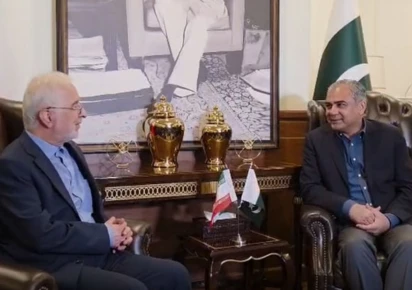
The agreement was reached during a meeting between Interior Minister Mohsin Naqvi and his Iranian counterpart, Eskandar Momeni, in Islamabad. Momeni arrived in Pakistan with a high-level delegation for talks aimed at expanding bilateral cooperation and addressing shared security concerns.

During the meeting, both ministers stressed the need for stronger coordination to counter terrorism and drug trafficking in the Pakistan-Iran-Afghanistan border region. They agreed that closer cooperation and intelligence sharing are essential to prevent cross-border crimes and improve regional security.

The two sides also reaffirmed their commitment to strengthening bilateral relations and expanding cooperation in trade, transit, agriculture, and other sectors. They agreed to improve coordination mechanisms to promote economic ties and facilitate greater collaboration between the neighbouring countries.

Mohsin Naqvi said Pakistan is ready to enhance cooperation with Iran in every field of mutual interest. He praised the efforts of Iranian officials in promoting peace and expressed hope that diplomatic initiatives would help restore stability in the region.

The Iranian delegation included senior officials from the interior ministry, urban development and transport ministry, the National Iranian Oil Company, the agriculture ministry, and the governor of Sistan-Baluchestan province. Pakistan’s delegation included senior officials from the Ministry of Interior, the Federal Investigation Agency, the Anti-Narcotics Force, NADRA, the National Cyber Crime Investigation Agency, Immigration and Passports, Islamabad Police, and other relevant departments.

The visit comes at a time of renewed tensions in the Middle East. Military exchanges between the United States and Iran have intensified in recent days, raising concerns over regional stability and the security of international shipping routes.

The Strait of Hormuz remains a major point of concern as continued hostilities threaten global oil supplies and international trade. The escalating conflict has also increased fears of wider economic disruption.

Similar Posts

  • | |

    Heavy rains trigger flooding in Chilas, 6 killed a…

    CHILAS: Torrential rains triggered flooding in Chilas, disrupting daily life, damaging farmland, and claiming lives as severe weather continued to affect several parts of Khyber Pakhtunkhwa. Floodwaters inundated streams and water channels, causing widespread destruction to agricultural land and crops. Authorities also closed the Babusar Road to all traffic after floodwaters made the route unsafe for travel. According to the Provincial Disaster Management Authority (PDMA), six people have lost their lives and another six have been injured in rain-related incidents across Khyber Pakhtunkhwa since July 29. The agency said at least 65 houses have also been damaged. Rain-related emergencies were reported in Abbottabad, Peshawar, Swat, Buner, Khyber, Chitral and several other districts, where rescue and relief efforts remain underway. Meanwhile, the Flood Forecasting Division in Lahore reported that low-level flooding continues at the Kalabagh, Chashma and Guddu barrages along the Indus River, with authorities closely monitoring the evolving situation.

  • | |

    Sindh solar project to benefit 275,000 families

    Karachi: Sindh Senior Minister for Information, Transport, and Mass Transit Sharjeel Inam Memon has announced that the Sindh government’s Rs18.2 billion Solar Home System Project will provide clean and affordable energy to 275,000 deserving families across the province. In a statement issued on Tuesday, Memon said the initiative, launched under the guidance of Pakistan Peoples Party (PPP) Chairman Bilawal Bhutto Zardari, is a major step toward expanding access to renewable energy, particularly for low-income households and remote communities. According to the minister, the project will benefit 132,000 off-grid families living in areas without access to the national electricity network, while 143,000 on-grid families facing electricity-related challenges will also receive solar home systems. Each beneficiary family will be provided with a 180-watt solar panel, batteries, a central control unit, a charge controller, mobile charging facility, electric fans, and LED lights. The comprehensive package is designed to meet basic household energy needs while reducing dependence on conventional electricity sources. Sharjeel Memon said the project is progressing rapidly, with more than 15,000 solar home system kits already distributed across various districts of Sindh. He added that the government aims to complete the distribution to all 275,000 eligible families by June 2027. The senior minister described the initiative as more than just an electricity project, saying it represents a significant welfare program aimed at improving the quality of life for economically disadvantaged families. He noted that access to reliable and clean energy would help reduce household expenses, improve living standards, and support sustainable development across the province. The Sindh government views the solar project as an important investment in renewable energy and social welfare, aligning with broader efforts to promote clean energy solutions and provide long-term relief to vulnerable communities.

  • Thailand Marks 74th Birthday Anniversary Of His Majesty King Maha Vajiralongkorn

    BANGKOK, Thailand — Thailand is formally observing the 74th birthday anniversary of His Majesty King Maha Vajiralongkorn Phra Vajiraklaochaoyuhua (Rama X), with the nation, government institutions, and citizens extending heartfelt tributes and loyal best wishes to the monarch on this auspicious occasion. Thailand celebrates Coronation Day of His Majesty King Maha Vajiralongkorn Born in Bangkok […]

  • | |

    Doctor suspended after performing laparoscopic sur…

    Islamabad: The Medical Tribunal has upheld a one year suspension of Dr Irfan Ashraf after finding that he performed laparoscopic surgery despite not completing the required training for independent laparoscopic procedures and operated at a healthcare facility that lacked an Intensive Care Unit and other essential facilities needed to deal with serious complications. The Tribunal also upheld a Rs100,000 fine and a ban preventing Dr Irfan Ashraf from performing laparoscopic procedures until he completes proper certified training. The judgment, announced on July 8, 2026, came in an appeal filed by Muhammad Zahid Niaz, whose father Niaz Ahmad died after a chain of medical treatment that began with laparoscopic surgery at Saleem Polyclinic in Mian Channu on December 31, 2016. The case took a serious turn when the disciplinary inquiry examined the actual training record of Dr Irfan Ashraf. The inquiry found that although he had taken part in laparoscopic procedures during his postgraduate training, most of his experience was as an observer or assistant. According to the judgment, Dr Irfan Ashraf had not completed the required number of procedures at the higher training levels needed to show independent surgical ability. The record showed that he had not completed even a single Level V procedure, which represents the stage at which a trainee is expected to perform laparoscopic surgery independently without supervision. The Tribunal said this was not simply a case where a normal surgical complication had occurred. The main concern was that Dr Irfan Ashraf undertook an elective laparoscopic operation without having demonstrated the required independent competence and at a facility that did not have the necessary backup facilities. The patient, Niaz Ahmad, suffered an injury to the common bile duct and hepatic vascular structures during the surgery. He was later taken to Bahawal Victoria Hospital in Bahawalpur for further treatment. He subsequently received treatment at Sheikh Zayed Hospital in Lahore and underwent an interventional radiological procedure at Lahore Medical Complex. Despite prolonged treatment at several hospitals, he died on March 4, 2017. The Punjab Healthcare Commission had earlier investigated the matter. It found that Saleem Polyclinic did not have the required infrastructure, qualified human resources and licensing needed for such surgical procedures. The Commission imposed a financial penalty on the owner of the healthcare establishment and referred the conduct of Dr Muhammad Saleem Akhtar and Dr Irfan Ashraf to the medical regulator for disciplinary action. The medical disciplinary committee later appointed Prof Dr Tanwir Khaliq, an experienced general surgeon, as an independent medical expert. He examined the medical record and assessed the standard of care, the management of laparoscopic complications and the facilities available at the clinic. Prof Dr Tanwir Khaliq concluded that the operation had been performed at a relatively small healthcare facility without an ICU and other essential backup facilities. He also found that Dr Irfan Ashraf was not sufficiently proficient in laparoscopic surgery, particularly when dealing with complications. The Tribunal noted that Dr Irfan Ashraf himself acknowledged that Saleem Polyclinic did not have an ICU or the facilities required to manage serious complications from laparoscopic surgery. The Tribunal also noted that Dr Irfan Ashraf had been working as a Senior Registrar at Bahawal Victoria Hospital, where better surgical support was available. When questioned about why the operation was carried out at the private facility, the explanation was that the patient wanted the surgery there. The Tribunal rejected this reasoning. It said a patient’s preference cannot remove a surgeon’s professional responsibility to determine whether a healthcare facility is safe enough for the planned procedure. The case also raised questions about what doctors tell patients about their professional skills. The disciplinary committee found that Dr Irfan Ashraf had represented himself as independently competent to perform laparoscopic surgery even though his training record did not show that he had completed the required independent procedures. The Tribunal said the evidence supported three major findings against Dr Irfan Ashraf. He performed an elective laparoscopic operation at a facility that could not properly manage foreseeable complications. He represented himself as independently competent despite incomplete training. He also exposed the patient to avoidable risk by choosing a facility without the necessary support instead of a properly equipped tertiary hospital. However, the Tribunal did not hold every doctor involved in the patient’s treatment responsible. Dr Muhammad Saleem Akhtar, the owner of Saleem Polyclinic, received a warning rather than a disciplinary punishment. The Tribunal found that there was no evidence that he personally performed the operation or took part in the surgical decision making. The Tribunal said ownership of a healthcare facility alone was not enough to impose the same disciplinary punishment on Dr Muhammad Saleem Akhtar as the operating surgeon. However, the warning required him to ensure that his facility was not used for procedures beyond its capacity. Dr Khurram Shafiq Khan was also cleared of professional negligence. His involvement came later, after the patient had already suffered complications from the earlier surgery. His role was connected with an embolization procedure to control bleeding from the hepatic artery. After examining his role, the disciplinary committee found no clear connection between the procedure performed by Dr Khurram Shafiq Khan and the patient’s eventual death. The Tribunal found no reason to disturb that decision. Muhammad Zahid Niaz had appealed because he believed the punishment against Dr Irfan Ashraf was too weak considering that his father’s treatment ultimately ended in death. He also wanted stronger action against Dr Muhammad Saleem Akhtar and Dr Khurram Shafiq Khan. The Medical Tribunal, chaired by Justice (Retired) Safdar Saleem Shahid, rejected the request for harsher punishment. The Tribunal said a tragic medical outcome does not automatically mean that every doctor involved was negligent. It explained that medical procedures can have known complications even when reasonable care is taken. The important question is whether a doctor failed to meet the level of skill and care expected from a competent doctor in similar circumstances. In the case of Dr Irfan Ashraf, however, the Tribunal found that the disciplinary committee had enough evidence

  • | |

    Nicole Kidman feels ‘very fearful’ after Keith…

    Nicole Kidman has opened up about the emotional uncertainty she has faced since her divorce from Keith Urban, admitting that her future now feels completely different from the life she once imagined. In a candid interview with British Vogue, the Oscar-winning actress reflected on the end of her nearly 20-year marriage and described the experience as a major adjustment. Kidman said there was a time when she felt “very fearful and deeply vulnerable” as she faced an unfamiliar chapter of her life. (RTE⁠) The actress explained that before her split from Urban, she had a clear idea of what her life would look like. Now, that certainty has disappeared. “I had a very different view of what my life was going to be,” Kidman said, according to reports from the interview. She added that her future currently feels “completely unknown,” leaving her to adjust to circumstances she never expected. (People.com⁠) Kidman and Urban married in June 2006 after meeting the previous year. During their 19-year marriage, they welcomed two daughters, Sunday Rose and Faith Margaret. Their relationship became one of Hollywood and country music’s best-known celebrity marriages. However, Kidman filed for divorce in Nashville on September 30, 2025, citing irreconcilable differences. The couple’s divorce was finalized on January 6, 2026. Their settlement included a parenting plan for their daughters, while both agreed to waive spousal and child support. (People.com⁠) For Kidman, starting over has meant accepting that life does not always follow the plan a person creates. Rather than trying to predict every step ahead, she appears to be learning to trust herself and remain open to whatever comes next. The actress also described herself as someone who tends to lead with her feelings. That emotional approach has helped her deal with difficult moments and continue moving forward instead of becoming consumed by uncertainty. (InStyle⁠) Despite the pain surrounding the end of her marriage, Kidman is not allowing the experience to define the rest of her life. She continues to focus on her family and her successful acting career, with several projects keeping her busy. Her upcoming work includes Practical Magic 2, alongside Sandra Bullock, as well as other film and television projects. (People.com⁠) Kidman’s latest comments offer a rare look at the woman behind the glamorous Hollywood image. After nearly two decades of marriage, she is facing a future she never expected—but she is choosing to meet it with honesty, resilience and an openness to new possibilities. For someone who once felt certain about where life was heading, Kidman now appears ready to embrace the uncertainty rather than fear it.

  • | |

    Family challenges post-mortem report of youth kill…

        The family of a young man who was killed in an alleged police encounter in the Kadhan area on the outskirts of Badin has raised serious objections to his post-mortem report, alleging that the report does not accurately reflect the condition of his body. The relatives of the deceased, identified as Moharram Dil, have declared the post-mortem report to be fake and demanded that his grave be exhumed so that a fresh post-mortem examination can be conducted. The family has called for an impartial investigation into the circumstances surrounding his death and the preparation of the medical report. Moharram Dil’s father said that there were no visible signs on his son’s body indicating that it had been cut open for a post-mortem examination. He said that when the body was being washed before burial, the family observed gunshot wounds but did not see any other marks that would suggest that a post-mortem had been performed. The father said that the family also possesses video recordings of his son’s body taken before the burial. According to him, these videos could provide important evidence regarding the condition of the body and may help determine whether the post-mortem examination described in the official report actually took place. The controversy has emerged over the timing and circumstances of the post-mortem report. Moharram Dil was reportedly killed in an alleged police encounter on July 26, while his post-mortem report was issued five days later, on July 31, by the Rural Health Centre. The family has questioned the circumstances under which the examination was conducted and how the report was prepared. Their demand for exhumation is aimed at obtaining a new medical examination that could independently establish the cause and circumstances of the young man’s death. Badin District Health Officer (DHO) has provided an explanation regarding who can conduct a post-mortem examination. According to the DHO, if a medico-legal officer is not available, the medical superintendent or a senior duty doctor can perform the post-mortem. The clarification comes amid questions raised by the family regarding the validity of the medical report. The authorities may now face pressure to determine whether the procedure was conducted according to the relevant medical and legal requirements. Police, meanwhile, maintain that Moharram Dil was a drug dealer who was killed during a police encounter on July 26. According to the police version, an exchange of fire took place between the police and the alleged drug dealer, during which Moharram Dil was killed. Police also claimed that two officers were injured during the encounter. The law enforcement authorities have presented the incident as an armed confrontation, while the deceased’s family has challenged the official account and raised doubts about the circumstances surrounding his death. The conflicting accounts have increased calls for an independent investigation. The family believes that a fresh post-mortem could help establish whether the injuries on the body correspond with the police account and whether the original medical report was prepared accurately. The demand for exhumation and a second post-mortem is now at the centre of the controversy. The videos reportedly recorded before the burial could also become relevant if an investigation is launched. The case has raised broader questions about transparency in alleged police encounters and the importance of properly documented medico-legal procedures. A fresh examination, if authorized, could provide additional evidence and help address the concerns raised by the deceased’s family.

Leave a Reply

Your email address will not be published. Required fields are marked *