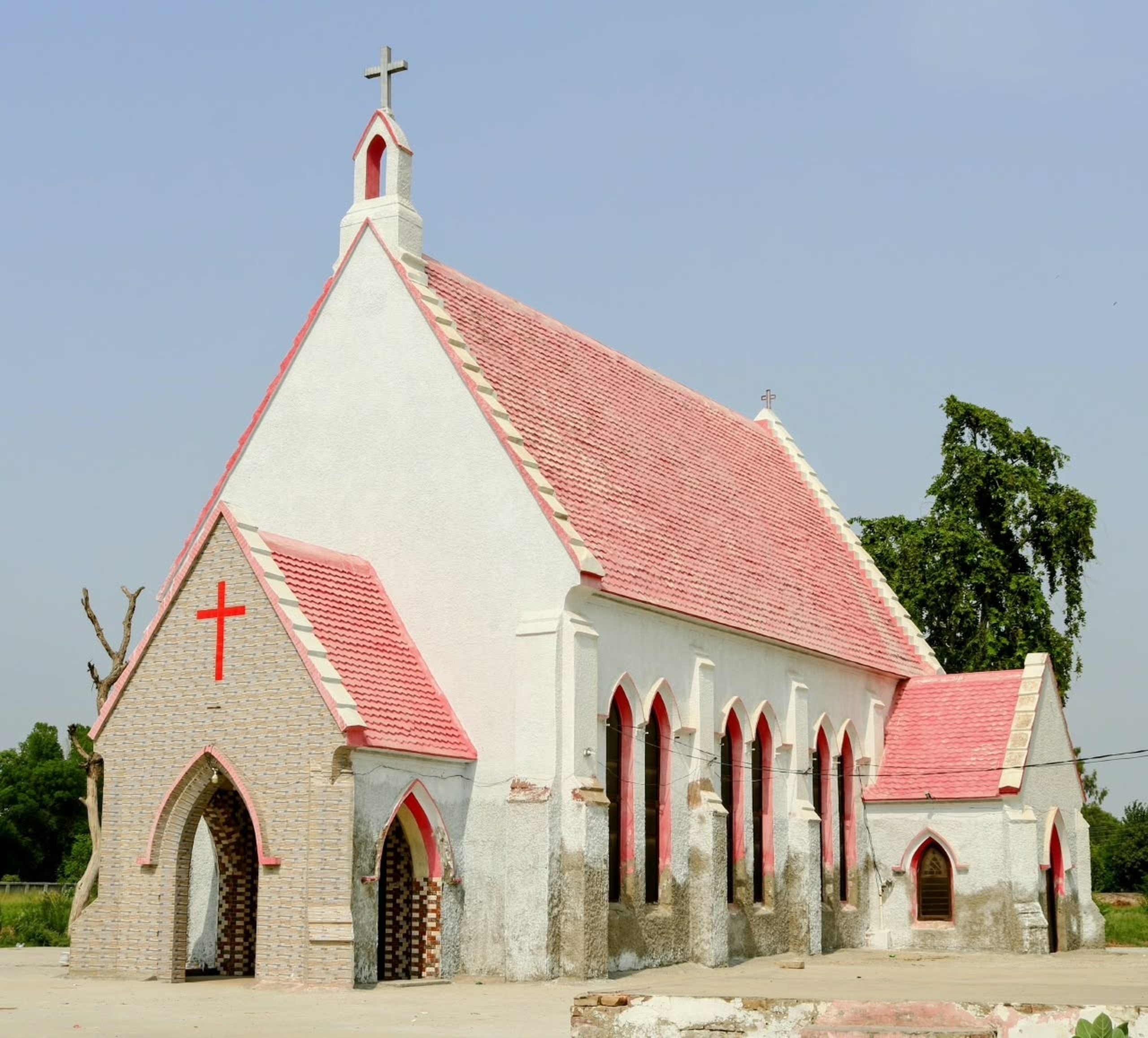
khan church still
| |

DI Khan church still guards colonial memories

There are some places we pass every day without realising how much history they hold. They remain untapped until some visitors put their eyes on them.

During summer vacations, I travelled to Dera Ismail Khan, a district situated in southern Khyber Pakhtunkhwa. It takes six hours from Lahore to arrive in this historic city. During my stay there, I came across one such place that immediately captured my attention, and I thought to write about it. It was St Thomas Church, sacred place of worship for Christian community. A large cross standing at the entrance, old rusty walls, and an ambience of spiritualism. But the Church showcased more than that. Its walls contain historical accounts of colonial past, the military campaigns led by British soldiers in this area and a grave of one Lieutenant Governor of Punjab.
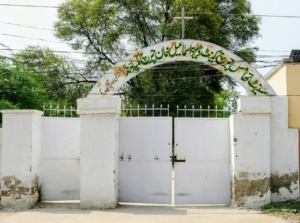
 

St Thomas Church was built in 1856 during British rule in the Indian subcontinent. It is one of the oldest churches in present-day Pakistan.
It has survived political changes, the Partition of 1947, and the passing of time. Even today it stands as a symbol of the rich and diverse heritage of Dera Ismail Khan. The church is not only a place of worship but also a reminder that different faiths and communities have long been part of the history of this region.

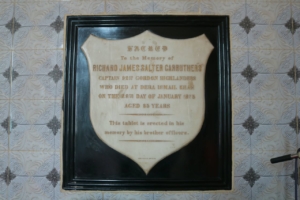
As we walked inside, we met the old priest and caretaker of the church named Chand. He welcomed us warmly and narrated the remarkable history of this place. There are memorials of British soldiers who lost their lives in this region during military campaigns. The priest stood in front of each tablet inscribed on the church wall and briefed about it. One memorial narrates the names, ranks and units of one hundred and 69 British military officers and other ranks who were killed or died due to injuries or disease in Waziristan military campaigns launched between 1919 to 1921.
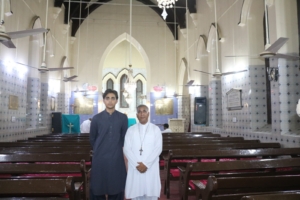
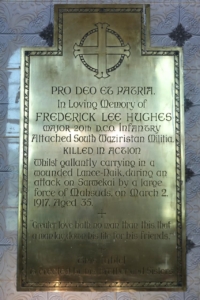


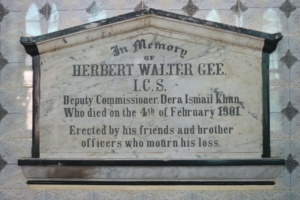
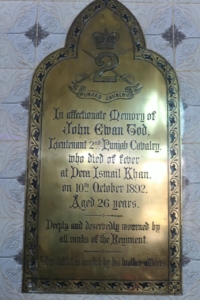
Another memorial lists details of sixty-eight officers and other ranks who met a similar fate during the 1936-1938 Waziristan military campaigns. Similarly, one tablet erected by friends and fellow officers mourns the death of Herbert Walter Gee, ICS, deputy commissioner of Dera Ismail Khan, who died in 1901. There are other memorials as well, erected by colleagues in memory of the fallen officers. I thought that these names contain historical accounts year by year about what happened in this part of the world at that time. Every sentence of the Priest carried a new story, such as how the church has witnessed a lot of happenings through generations and that it still serves the small Christian community living in Dera Ismail Khan.
As we stepped outside, believing our visit had come to an end, the priest said, “Wait. I have to show you one more thing.”

He took me to the back of the building, where I saw a large white grave standing quietly among the dusty bushes.

Here rests Lieutenant General Sir Henry Marion Durand (1812-1871).

Durdand – a quite familiar name for the people of Pakistan and Afghanistan.

Sir Durand was a career British military officer, diplomat, and administrator. He served in the East India Company Army, took part in several military campaigns, and later became the Lieutenant Governor of Punjab from 1870 to 1871. His son Sir Mortimer Durand is the one who drew the contours of the border between British India and Afghanistan in 1893. A man who once held such an important position now lies in silence behind an old church, while many people living nearby are unaware that his grave even exists.
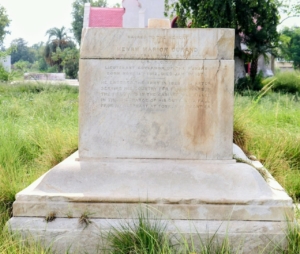
Henry Marion Durand died in 1871 at the age of 58 from a tragic accident. He was visiting Nawab of Tank Shahnawaz Khan along with his daughter when he fell from an elephant. The elephant was passing through the gateway by the town of Tank with the Nawab on the same elephant and an official (Chaprassy). The gate was too low to cross an elephant with howdah. The howdah struck the walls of crossing and the elephant got frightened resulting in the fall of Durand. He remained unconscious for a few days and never recovered. He was buried beside St. Thomas’ Church in Dera Ismail Khan. The British suspected some conspiracy into this incident. One of descendent of Nawab Shahnawaz Khan says that The British launched an enquiry into it. But the daughter of Durand gave testimony in favour of the Nawab that it was just an accident and there was no fault on his part. However, as a punishment, the British authorities stripped the powers of Nawab Shahnawaz Khan in 1875 and sent him to Lahore under strict watch. He passed away in 1881 while under surveillance.
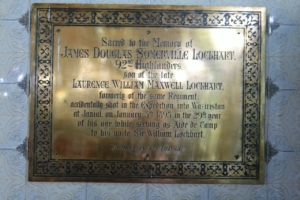
Standing beside the grave of Sir Henry Durand, I felt as if I had stepped into a forgotten chapter of history. The name engraved on the stone reminded me that many important events and personalities of the past remain connected to places that we often overlook. How easily history can fade from people’s memories, even when it is standing right in front of us.

As I left St Thomas Church, I felt that I had walked through a chapter of history that few people ever get to read. Sir Henry Durand ruled Punjab from this soil, and his son later sat across a table in Kabul and drew the line that still separates Afghanistan and Pakistan today. That line appears in newspapers and political debates all the time. Yet the grave of the man whose name it carries lies quietly behind a church in Dera Ismail Khan.

Similar Posts

  • HM The King Takes Badly Burned Husky ‘Molly’ Under His Royal Patronage

    BANGKOK – In a remarkable turn of events that has captured the nation’s attention, His Majesty the King has granted royal patronage to a severely burned Siberian Husky named Molly, accepting the two-year-old female as a patient under his care following a horrific act of animal cruelty in Songkhla province. The Royal Secretary is scheduled […]

  • | |

    Press freedom across South Asia

    Press freedom across South Asia faces significant structural constraints. Media environments throughout the region share a common historical legacy often relying on inherited colonial-era penal codes alongside modern cybersecurity legislation. However, the legal frameworks and regulatory instruments used to govern the press vary across neighboring countries. Comparative Analysis by Country  Pakistan Pakistan Electronic Media Regulatory Authority (PEMRA), Prevention of Electronic Crimes Act (PECA), and administrative policy frameworks like the Foreign Media Facilitation Guidelines. Media regulation in Pakistan relies heavily on administrative controls, licensing restrictions, and broad content advisories prohibiting coverage of sensitive political or national security subjects. While constitutional protections exist under Article 19, exceptions based on glory of Islam, national defense, and public order give authorities broad latitude to issue blackout orders, manage foreign correspondents’ mobility through No Objection Certificates (NOCs), and impose structural pressure on broadcast networks.  India Information Technology Rules (2021), Digital Personal Data Protection (DPDP) Act, and the Unlawful Activities Prevention Act (UAPA). While India possesses a large and diverse private media market, journalists increasingly face legal scrutiny under broad national security and anti-terror legislation. Amendments to digital media laws allow central authorities to demand the takedown of online content deemed harmful to state interests. Furthermore, criminal defamation suits and restrictions on access to conflict areas (such as Jammu & Kashmir) remain common mechanisms of regulatory pressure. Bangladesh Cyber Security Act (CSA)—which replaced the controversial Digital Security Act (DSA) and state information ministry directives. For years, non-bailable clauses in cybersecurity statutes were widely criticized by media watchdogs for chilling investigative reporting on corruption or state officials. Following recent political transitions, draft media reform policies have been introduced, though press operations remain tightly monitored during periods of political volatility and public unrest.  Sri Lanka Online Safety Act, Prevention of Terrorism Act (PTA), and Official Secrets Act. Sri Lanka’s regulatory framework expanded significantly with the passage of the Online Safety Act, which created a government-appointed commission with sweeping powers to classify online content as false statements and order its removal. Critical reporting regarding state response to economic crises or wartime history continues to face legal and physical friction in sensitive provinces. Nepal: Press Council Act and National Mass Communications Policy. Nepal consistently ranks highest in South Asia on global press freedom indices, supported by a constitution that explicitly guarantees press rights without prior restraint. However, challenges persist regarding local government transparency, criminal defamation provisions, and proposed social media regulation bills that civil society groups fear could introduce licensing hurdles for digital outlets.  Afghanistan Direct directives issued by the Ministry for the Propagation of Virtue and the Prevention of Vice and the Ministry of Information and Culture. Following the political shift in 2021, independent journalism in Afghanistan has faced near-total suppression. Women journalists are largely banned from broadcasting, international news services face widespread blocking, and all local reporting is subject to strict pre-publication censorship. Common Trends Across the Region Across South Asia, governments are increasingly shifting control from traditional print/broadcast regulators toward cybersecurity, online safety, and data protection laws to monitor digital newsrooms and independent creators. Constitutional guarantees of free speech throughout South Asia uniformly contain broad public order and national defense exceptions, which states routinely cite to enforce reporting restrictions during regional crises. Beyond direct legal action, states across the region frequently utilize non-judicial levers such as withholding state advertising funds, slow-walking accreditation, or requiring special travel permits to shape editorial stances.

  • Thai Tourism Operators Support Return To 30-day Visa-free Stays

    BANGKOK, Thailand — Tourism operators in Phuket and Pattaya have expressed support for the government’s decision to restore 30-day visa-free stays for foreign visitors, stating that the measure will help address concerns regarding illegal business operations and low-spending long-term visitors, according to industry representatives and verified media reports. Thailand Ends 60-day Visa-free Scheme For 93 […]

  • Rescued Thai Scam Victim in Cambodia Warns of Beatings, Organ Sales

    TRAT – Thai authorities have repatriated 32 nationals who escaped from scam centers in Cambodia, with one survivor describing brutal conditions including beatings, fatalities, and the alleged sale of organs. The group crossed back into Thailand on January 31, 2026, following coordination between Thai officials and the embassy in Phnom Penh. Chinese Social Media Influencer […]

  • | |

    Jason Sudeikis praises Justin Bieber after memorab…

    Jason Sudeikis has nothing but admiration for Justin Bieber following the singer’s widely praised performance at the 2026 FIFA World Cup halftime show. The actor and comedian recently reflected on his surprise appearance as Ted Lasso, revealing that working with Bieber was an enjoyable experience and describing the pop star as “a very coachable young man.” Speaking during an episode of the A Lot More podcast, scheduled for release on August 8, Sudeikis looked back on his cameo in the halftime show, which blended music, comedy and the uplifting spirit of his beloved Ted Lasso character. The actor said he was thrilled to be part of such a global event and praised everyone involved in bringing the production together. (people.com⁠) During the interview, Sudeikis shared that he spent time working with Bieber before the performance, offering encouragement and a few lighthearted coaching moments inspired by Ted Lasso’s optimistic approach. While speaking about the experience, he said Bieber was eager to collaborate, listened carefully to creative ideas and embraced the process with humility. Sudeikis explained that Bieber’s willingness to take direction made rehearsals enjoyable. He joked that the singer was “very coachable,” adding that Bieber approached every suggestion with enthusiasm and professionalism. The actor noted that despite being one of the world’s biggest music stars, Bieber remained open to feedback and focused on delivering the best possible performance for fans. The 2026 FIFA World Cup halftime show attracted global attention, combining live music with special guest appearances that celebrated the tournament’s international appeal. Bieber’s energetic performance quickly became one of the event’s biggest talking points, with fans praising both the production and the surprise appearance by Sudeikis as Ted Lasso. The collaboration also delighted viewers because it brought together two widely admired figures from different areas of entertainment. Bieber, known for his chart-topping music career, and Sudeikis, celebrated for his Emmy-winning portrayal of Ted Lasso, shared a lighthearted chemistry that added warmth and humor to the spectacle. Sudeikis also spoke about the lasting popularity of Ted Lasso, saying he enjoys seeing how the character continues to inspire people through messages of kindness, teamwork and optimism. Bringing those qualities to one of the world’s biggest sporting events, he said, felt like a natural fit. Fans have responded positively to Sudeikis’ comments, with many appreciating his praise for Bieber’s work ethic and attitude. His remarks offered a behind-the-scenes look at the collaboration and highlighted the respect that developed between the two stars. As excitement surrounding the halftime show continues, Sudeikis’ reflections reinforce why the performance resonated with audiences worldwide. By combining entertainment, humor and heartfelt encouragement, the collaboration created a memorable moment that celebrated both music and sport while reminding fans that great performances are built on teamwork, preparation and mutual respect.

Leave a Reply

Your email address will not be published. Required fields are marked *