geography governance

The Geography of Governance

By Syed Tahir Rashdi 

The writer is a Shahdadpur-based contributing columnist, book reviewer, and climate change activist. He holds a BS degree in Pakistan Studies from University of Sindh

Pakistan’s debate over new provinces has returned with familiar demands: South Punjab, Bahawalpur, Hazara, Karachi and, periodically, proposals for a more extensive reorganisation of the federation. There are credible arguments behind some of these demands. Population growth, administrative distance, uneven development and the persistence of regional identities have altered the circumstances in which Pakistan’s present provincial arrangement was conceived.

Yet the debate tends to proceed from an assumption that deserves greater scrutiny: that creating smaller provinces will, in itself, improve governance.

It may. But it may also not.

The distinction is important because Pakistan’s principal difficulty has never been simply the size of its administrative units. It has been the weakness, discontinuity and politicisation of the institutions through which those units are governed.

This does not make the case for new provinces illegitimate. It does, however, suggest that provincial restructuring should be considered as one component of administrative reform rather than as a substitute for it.

Pakistan’s provincial boundaries have never been immutable. The One Unit scheme of 1955 consolidated the western wing into a single province, partly to establish parity between the two wings of the country. It was abolished in 1970, restoring the provinces.

The episode remains relevant because it demonstrated the limits of administrative engineering. A territorial arrangement can be imposed constitutionally, but its durability ultimately depends upon political legitimacy.

The present debate is considerably more complex.

The demand for a South Punjab province contains at least three distinct strands: the historical claim associated with Bahawalpur, the linguistic and cultural politics of Saraiki identity, and the administrative argument that the southern districts have remained distant from the provincial centre in Lahore. There is also the persistent claim of regional economic neglect.

These strands should not be conflated.

Similarly, the Hazara demand has a strong identity component, while the Karachi question is inseparable from the city’s unusual demographic, economic and political history and the longstanding contest over authority between urban local institutions and the provincial government.

The differences matter because different problems require different institutional responses.

The Constitution does not make the creation of a new province a matter of political declaration. Article 239 provides a demanding procedure for constitutional amendment, including the approval of the concerned provincial assembly where provincial boundaries are affected.

That requirement is not an accidental obstacle. It reflects the logic of federalism: a federation cannot permit the territorial boundaries of one constituent unit to be altered without giving that unit a decisive constitutional voice.

The experience of the parliamentary commission on new provinces in 2012 illustrated the complexity of the exercise. Questions of boundaries, resources, representation, administrative structures and constitutional amendments quickly became inseparable from the political question of who would gain or lose influence.

That is why the debate deserves to be insulated, as far as possible, from electoral expediency.

There is, however, a more fundamental issue that receives considerably less attention.

Article 140-A of the Constitution requires provincial governments to establish local government systems and devolve political, administrative and financial responsibility and authority to elected local representatives.

This provision goes to the heart of the governance question.

A citizen’s encounter with government is rarely with the federal government or even with a provincial assembly. It is with the school, hospital, police station, municipal authority, land office, sanitation service or local administration.

Yet local governments in Pakistan have rarely acquired the institutional continuity, fiscal autonomy and political authority envisaged by the Constitution.

The result is an unusual form of devolution. The 18th Amendment substantially strengthened the provinces by transferring functions and resources from the federation, but the transfer of authority has often stopped at the provincial level.

Islamabad became less dominant.

The provinces became stronger.

The citizen did not necessarily become more powerful.

This is perhaps the most important issue in the new-provinces debate. If a region is suffering because decisions are too distant from its population, the first question should be whether existing institutions can be decentralised before an entirely new tier of government is created.

Comparative experience does not provide a universal answer, but it does offer useful cautions.

Indonesia’s post-Suharto decentralisation transferred extensive responsibilities to subnational governments. The reform was necessary after decades of centralised rule, but decentralisation itself did not guarantee effective or accountable government. Subsequent reforms had to focus on institutional capacity, fiscal management and local accountability.

Nigeria provides another caution. The creation of additional states was partly intended to improve political representation and accommodate regional interests. Yet the country continues to face substantial governance and institutional-capacity problems across its states.

The lesson from both cases is not that administrative restructuring is futile. It is that territorial fragmentation and institutional development are different processes.

South Africa offers a somewhat different model. Its Constitution explicitly recognises local government as a sphere of government and assigns municipalities constitutional responsibilities relating to democratic participation and service delivery. The significance lies less in the number of provinces than in the distribution of authority among the different levels of government.

Switzerland’s federal tradition similarly rests on substantial cantonal and communal autonomy. Its relevance to Pakistan is not institutional imitation but a principle: government functions should be located at the level at which they can be performed most effectively, while higher levels retain responsibilities that require wider coordination.

There is therefore no universally correct number of provinces. The appropriate administrative scale depends upon geography, population, fiscal capacity, the nature of the public service and, above all, institutional competence.

Pakistan’s governance difficulties are familiar enough to require little elaboration: weak rule of law, politicisation of public institutions, patronage, corruption, uneven accountability, administrative discontinuity and the recurrent weakening of local government.

None of these problems disappears when a provincial boundary is moved.

A new province may shorten the administrative distance between a region and its provincial capital. It does not automatically make the police independent, the bureaucracy professional, the courts accessible or public expenditure transparent.

Nor does it guarantee merit.

This is why the distinction between decentralisation and multiplication matters.

Creating another provincial government multiplies institutions at one level. Devolution transfers authority to the level where decisions are actually implemented.

The two can complement each other. They should not be confused.

There is a reasonable case for examining Pakistan’s provincial structure afresh. The country of today is considerably more populous, urbanised and economically differentiated than it was in 1973. Administrative arrangements that were workable five decades ago need not remain optimal indefinitely.

But restructuring should follow evidence.

If a region can demonstrate that a separate province would improve representation, service delivery, fiscal management and administrative effectiveness, its case should be considered seriously.

The same standard should apply to all proposals.

What is the fiscal base of the proposed province? How will assets and liabilities be divided? What will happen to water and other shared resources? How will the civil service be reorganised? Where will the judiciary sit? How will parliamentary representation change? And, perhaps most importantly, what powers will be devolved to local governments within the new province?

These are less exciting questions than the announcement of a new province. They are also the questions on which its viability will depend.

The temptation in politics is to seek visible solutions to structural problems. A new province is visible. A new secretariat is visible. A new assembly is visible.

Institutional reform is not.

An impartial appointment is invisible. A competent municipal service is rarely newsworthy. A police officer able to act without political interference does not make for a dramatic political slogan. Nor does a court that quietly delivers timely justice.

Yet these are the foundations upon which effective government rests.

Pakistan therefore needs to resist the idea that every failure of governance is a failure of territorial design.

There may be a case for new provinces. There is certainly a case for stronger local government. There is an even stronger case for institutions that function according to law rather than political convenience.

The order matters.

Before redrawing provincial boundaries, Pakistan should ask whether it has fully used the constitutional possibilities already available to it: provincial autonomy, fiscal devolution and empowered local government.

If, after that examination, some provinces still prove too large, too distant or administratively incoherent, restructuring would have a stronger foundation.

The issue, ultimately, is not how many provinces Pakistan has.

It is whether the citizen can rely on the government that exists.

A federation can have four provinces or ten. It can have large units or small ones. What it cannot indefinitely afford is the assumption that changing the map is equivalent to changing the state.

Pakistan’s next debate on provinces should therefore be less about where to draw the line and more about what happens on the other side of it.

Similar Posts

  • Enjoy simple activities

    Every new year brings fresh hope and a chance to make life better. But happiness does not always come from big achievements. Small daily habits can also bring more peace joy, and satisfaction to our lives. Remember happy moments Make a habit of remembering the good things that happen in your life.  You can write down three things each day that made you happy. It could be success in an exam a kind message from someone or a pleasant moment with family. Keeping a record of positive moments can help improve your mood and encourage you to focus on the good things in life. Communicate better with your partner Good communication can make married life more peaceful and enjoyable.  Instead of turning every disagreement into a serious argument try to listen carefully and speak calmly. Even people who are not naturally cheerful can develop better habits and improve their relationships. Give importance to friendship Good friends can bring happiness and emotional support at every stage of life. As people grow older close and trustworthy friendships can become even more valuable. Make time for the people who care about you listen to you, and make you feel comfortable. Celebrate other people’s happiness Be happy for other people when they achieve something or experience a special moment.  Celebrating their success can make relationships stronger and create a warmer connection. Helping others feel appreciated can also give you a sense of happiness and satisfaction. Enjoy fun activities Make time for activities that you genuinely enjoy. Listening to your favourite music taking a long drive spending time outdoors reading, or trying something different can help refresh your mind. You do not always need an expensive trip or a major event to feel happy.  Simple activities can also bring peace. Learn to stay calm Constantly chasing happiness can sometimes create stress and disappointment.  Keep your expectations realistic and learn to appreciate what you already have. Accepting that life has both good and difficult moments can help you remain calm and emotionally balanced. Stay connected with older family members Talking to parents grandparents and other older family members can help you understand your family history and appreciate your life more. Their experiences and stories can offer valuable lessons and may also help you feel more connected and confident. Help others Volunteering and helping people can bring a strong sense of purpose and satisfaction.  You can help others by supporting someone in need, caring for animals gardening or taking part in community activities. Helping others can improve your sense of connection and make everyday life more meaningful. Find happiness in small things A happier life does not require everything to be perfect. Start noticing the small moments that bring peace and joy. Spend time with loved ones appreciate what you have take care of yourself and make room for activities you enjoy. Small positive habits can gradually make life more peaceful and fulfilling.

  • | | |

    Ducky bhai questions parents’ role in children?…

    Pakistani YouTuber Ducky Bhai has questioned the growing criticism of YouTubers over their alleged negative influence on children, arguing that parents must also take responsibility for their children’s upbringing and online activities. In his recent remarks, Ducky Bhai rejected the idea that YouTubers alone are responsible when children are exposed to inappropriate or negative content. He questioned where parents are when children are spending significant amounts of time online and consuming digital content. According to Ducky Bhai, content creators should make an effort to keep their videos clean and appropriate. However, he stressed that YouTubers cannot be expected to act as parents for every child watching their content. He argued that parents have a key role in deciding what their children watch and how much time they spend online. Monitoring internet activity, setting boundaries and discussing appropriate content with children, he suggested, should be part of responsible parenting. Ducky Bhai also referred to his own childhood while explaining his perspective. He recalled that his father encouraged him to focus on his studies and used rewards, including the promise of a PlayStation for good performance, as motivation. He further revealed that his father had installed security measures on his computer that allowed him to monitor his activities. According to Ducky Bhai, this close supervision helped his parents remain aware of what he was doing online. His comments have renewed discussion about the responsibilities of parents and digital content creators in an age when children have easy access to YouTube and other online platforms. While creators can influence young audiences through the content they publish, Ducky Bhai believes parents cannot simply shift the entire responsibility onto YouTubers. Instead, he says families should actively monitor children’s digital activities and guide them toward appropriate content. The debate highlights a broader challenge for modern families: balancing children’s access to entertainment and technology with parental supervision. As online platforms continue to become an important part of children’s daily lives, both content creators and parents face increasing pressure to ensure that young viewers are exposed to safe and suitable material.

  • Unemployment

    Through the columns of your newspaper, I want to draw the attention of the concerned authorities towards the growing problem of unemployment in our country. Unemployment is a serious problem, especially among educated young people. Many students complete their education but cannot find suitable jobs. Due to unemployment, people face poverty, frustration, and many social problems. It also slows down the progress of the country. The government should create more job opportunities and encourage industries and small businesses. Technical and vocational education should also be promoted so that young people can learn useful skills and earn a living. I hope the concerned authorities will take immediate steps to control unemployment and provide better opportunities for our youth.

  • Spot the mountain lion in seconds

    It first glance this may look like an ordinary picture of a forest.  But there is actually a mountain lion hiding somewhere in the scene. The picture appears to have been taken in a US national park. A deer can be seen standing in the area with its back facing the camera.  What makes the scene interesting is that the deer has no idea that a mountain lion is hiding very close to it. If you are having trouble finding the mountain lion imagine how difficult it would be for the deer to notice its hidden predator. Only a few people can quickly spot the animal in this picture. Finding it requires careful observation and good eyesight. Take a close look at every part of the image and see if you can find the hidden lion. Did you find it? If not here is the answer. Look carefully toward the right side of the picture.  You can see the mountain lion’s face hiding among the bushes. The animal is so well hidden that it almost blends into its surroundings making this picture a great test of your observation skills.

  • | |

    Jane Austen letter expressing affection for Mansfield Park

    A exceptionally rare, handwritten letter by legendary 19th-century British author Jane Austen has sold at auction for over $200,000. It has captivated literary historians and devoted readers across the globe. Written in early 1814, the intimate correspondence offers a fascinating glimpse into Austen’s personal thoughts during the final stages of writing her third major novel, Mansfield Park. The manuscript was acquired by a private collector after a competitive bidding battle. It highlights the enduring allure and profound market value of artifacts connected to Regency-era literature. Austen’s Private Collections In the letter, addressed to her beloved niece Martha Lloyd, Austen speaks with characteristic wit and self-effacing humor about her creative process. She candidly reveals The manuscript was acquired by a private collector after a competitive bidding battle. Austen harbored a quiet, tender affection for her newest heroine, Fanny Price. Scholars note that such direct expressions of emotion regarding her own craft are exceedingly rare in Austen’s surviving correspondence, as her sister Cassandra burned a vast majority of Jane’s personal papers following the author’s death in 1817 to protect her privacy. The document’s remarkable physical condition significantly contributed to its staggering sale price. Preserved in a family archive for generations before briefly passing through private collections, the single-sheet letter features Austen’s distinctively tidy, flowing script written in iron gall ink, complete with original wax seal remnants and postal markings from Chawton, Hampshire. Experts from the auction house confirmed the paper’s authenticity through detailed watermarking analysis, verifying that the sheet originated from a paper mill active in England during the Regency period. The Mid-80s Literary Period Beyond its physical preservation, the letter holds immense literary significance because it captures Austen at a pivotal moment in her career. Having spent years refining her craft in relative obscurity, the mid-1810s marked a period of intense productivity and emerging financial independence. Mansfield Park represented a deliberate artistic departure from the sparkling, lighthearted banter of Pride and Prejudice, diving into deeper moral complexity, social critique, and quiet emotional endurance. Austen’s reflection in this letter reveals her awareness of this shift and her defense of a softer, more gentle protagonist. Appreciation for Literary Heritage   The sale underscores a broader resurgence of interest in 19th-century women writers among modern collectors and readers. As public appreciation grows for literary heritage, original items connected to figures like Austen, the Brontë sisters, and Mary Shelley have seen exponential value growth at major international auction houses. For admirers of classic literature, this newly highlighted letter serves as a poignant reminder of Austen’s profound human warmth, proving that centuries later, her words continue to move hearts just as powerfully as her immortal fiction.

  • | | |

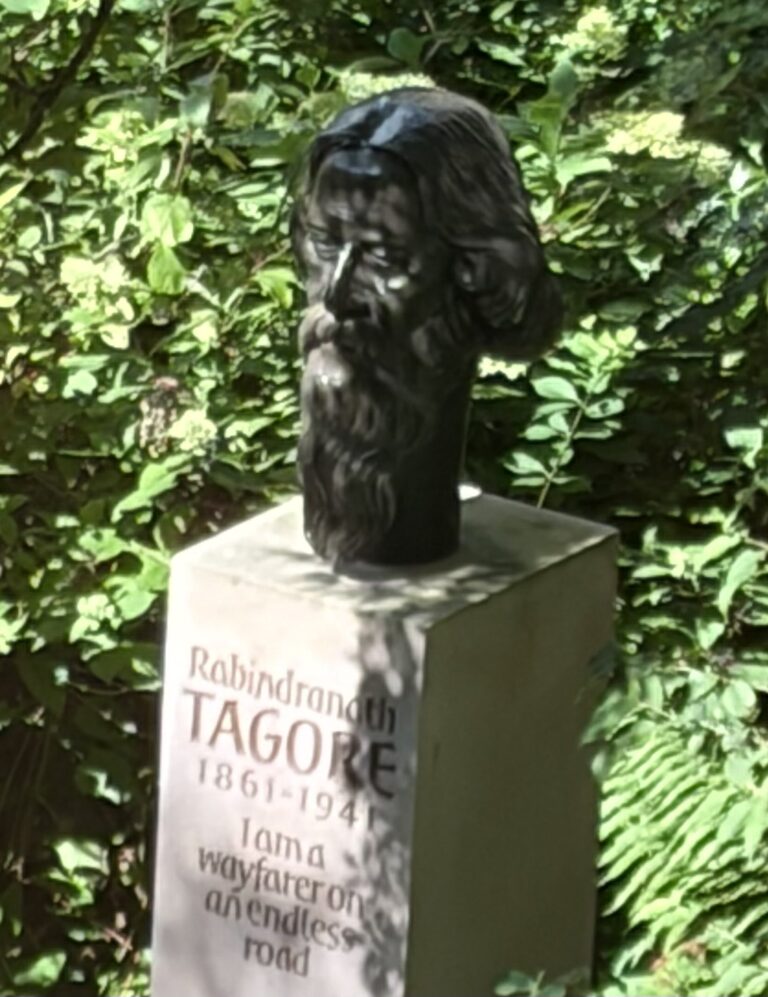
    Rabindranath Tagore’s statue in Edinburgh

    The Sandeman House garden in Edinburgh holds a bronze statue of Asia’s first Nobel laureate in Literature, Rabindranath Tagore. Inscribed upon the pedestal supporting his likeness are his famous words, “I am a wayfarer on an endless road.” A Cross-Cultural Bridge Travelers often seek out Scotland’s capital for its ancient castles, gothic architecture, and literary heritage tied to the likes of Sir Walter Scott or Robert Louis Stevenson. However, discovering Tagore’s presence in this peaceful courtyard offers a cross-cultural bridge. The statue, unveiled to commemorate the deep-seated connections between Scotland and India. It is particularly the intellectual dialogue between Scottish polymath Patrick Geddes and Tagore himself. This monument serves as a physical testament to a global humanism that transcends geographic boundaries. Tagore’s India Tagore was far more than a celebrated poet and author. He was an uncompromising philosopher, musician, visual artist, and social reformer whose thoughts shaped modern South Asia and beyond. At the heart of his vast body of literature lies a profound critique of borders, nationalism, and sectarian division. Tagore envisioned an India, and indeed a world, defined by radical openness. In his mind, India is a sanctuary where diverse faiths, ethnicities, and cultures could coexist in mutual respect. He rejected narrow chauvinism in favor of an inclusive internationalism, advocating for a world where the mind is without fear and the head is held high. Tagore’s Literary Legacy In the contemporary geopolitical landscape, Tagore’s ideals feel relevant. Across the globe, modern youth face a climate marked by rising social polarization, cultural fracturing, and ideological echo chambers. In response, a growing movement of young activists, writers, thinkers, and students are turning back to Tagore’s literary legacy as a blueprint for unity. They are rediscovering his essays and poetry not merely as historical artifacts, but as active tools to reclaim a society rooted in pluralism and dialogue. By reimagining Tagore’s vision for a modern era, today’s generation is fighting to restore an environment where freedom of thought, artistic expression, and inclusivity thrive over division. His stance on education emphasized learning in harmony with nature and breaking down rigid academic and social silos. Young scholars and community organizers are channeling this exact ethos, utilizing art, literature, and grassroots civic engagement to rebuild cross-cultural bridges in an increasingly fragmented world. Message of Universal Brotherhood   Standing before Tagore’s statue in Edinburgh’s quiet garden, one is reminded that his journey as a “wayfarer” was never meant to be walked alone. His message of universal brotherhood, preserved in stone far from his native Bengal, serves as a timeless compass. For the youth striving to cultivate a more empathetic and open world, Tagore’s endless road remains wide open, inviting everyone to walk forward together.

Leave a Reply

Your email address will not be published. Required fields are marked *