
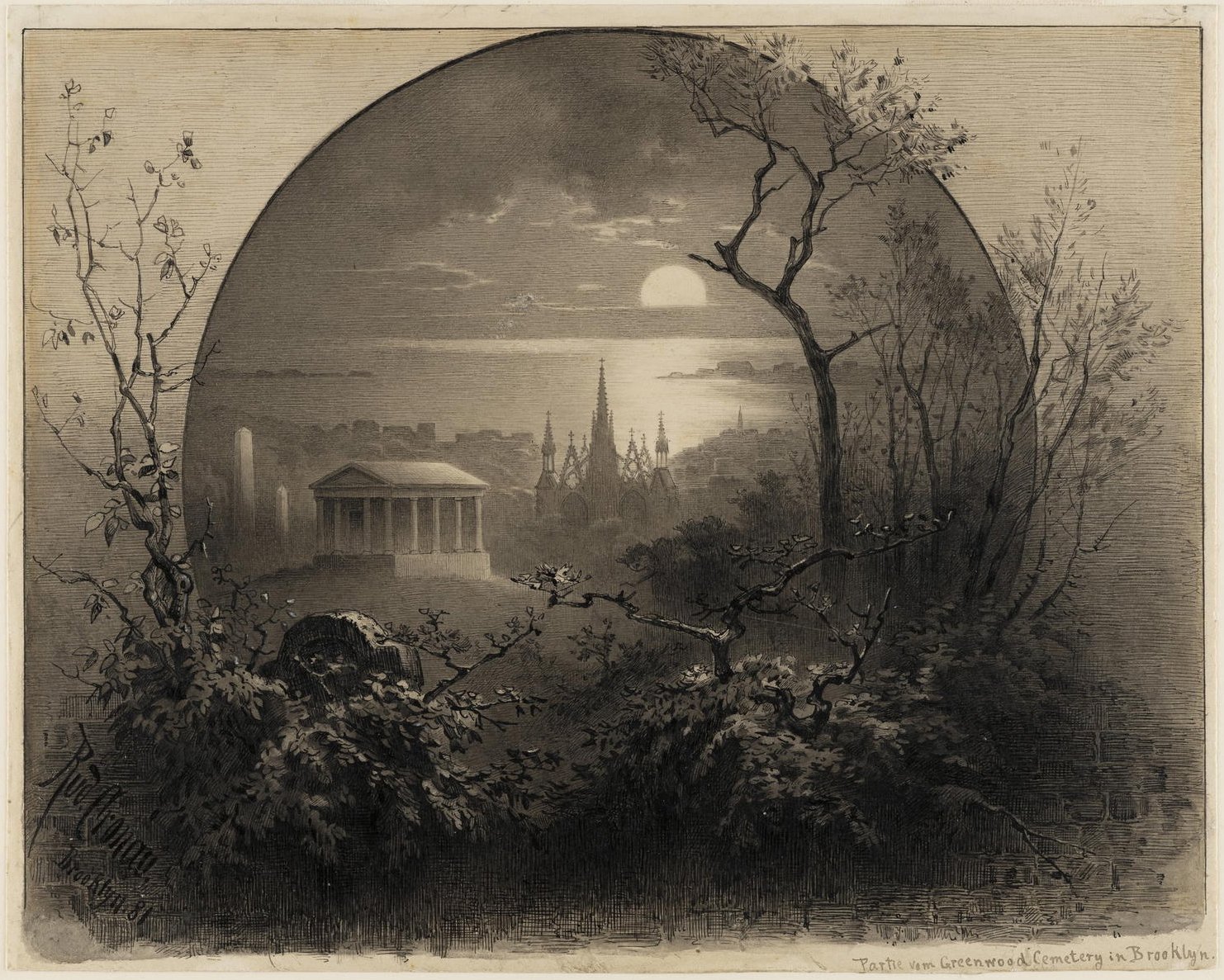
americas premier tourist
|

America’s premier tourist destination

During the early 1860s, an unexpected location ranked as the second most visited tourist spot in the United States: Green-Wood Cemetery in Brooklyn. Trailing only Niagara Falls in popularity, the vast burial ground welcomed roughly 500,000 visitors every year. Families routinely spent their afternoons strolling through the peaceful grounds. They took horse-drawn carriage rides and admiring the elaborate grand monuments across the landscape.

When Green-Wood first opened its gates in 1838, New York City had virtually no public parks, as Central Park had not yet been conceived. By the time the early 1860s arrived, Central Park was only beginning to open its initial sections to the public. As a result, rural cemeteries like Green-Wood filled a massive void for city dwellers seeking fresh air, natural beauty, and a quiet escape from urban density.

The unique charm and sweeping vistas of the cemetery caught the attention of Rudolf Cronau, a German-born illustrator and artist. Born in Solingen in 1855, Cronau trained at the prestigious Düsseldorf Art Academy under Andreas Müller before establishing his own studio. In 1881, he ventured across the Atlantic on an assignment for Die Gartenlaube, a popular German illustrated magazine. His mission was to document the landscapes, bustling cities, and diverse people of the United States, bringing the American experience to life for European readers through a mix of written reports and detailed artwork.

While visiting Brooklyn in 1881, Cronau captured the cemetery’s famous skyline view in a artwork titled View from Greenwood Cemetery, Brooklyn. Rendered in delicate watercolor and black ink, the piece now resides in the permanent collection of the Brooklyn Museum. Cronau arranged his view in three distinct planes: an elaborate mausoleum anchored the foreground, Green-Wood’s iconic Gothic main entrance gates framed the middle ground, and the vast expanse of New York Harbor and the New Jersey coastline stretched out in the background.

The mausoleum highlighted in the foreground of Cronau’s illustration belonged to John Anderson, a prominent NYC figure who amassed a massive fortune in the tobacco trade. Anderson, born in 1812, ran a well-known shop near Manhattan’s City Hall before eventually passing away in Paris in 1881.


Beyond serving as his final resting place, Anderson’s tomb was built as a bold political statement. Commissioned during the heights of the American Civil War, the Greek Revival-style structure was purposefully designed to symbolize a commitment to republican governance over monarchical rule, while serving as an unmistakable declaration of pro-Union support. Through art and architecture, a single cemetery hilltop managed to weave together personal wealth, national ideology, and one of the finest views of 19th-century New York.

Similar Posts

  • The Euphemism of Integration: Kashmir Seven Years Later

    By Ahmad Hassan “The convoluted wording of legalisms grew up around the necessity to hide from ourselves the violence we intend toward each other… Elaborate euphemisms may conceal your intent to kill, but behind any use of power over another the ultimate assumption remains: ‘I feed on your energy.’” When Frank Herbert wrote those words in his novel Dune Messiah, he observed that elaborate euphemisms are often used by the state to conceal the raw mechanics of power. In Pakistan, August 5 is observed as Youm-e-Istehsal to condemn the 2019 revocation of Article 370 and its supplementary provision, Article 35A. This act of the Indian government removed Kashmir’s separate constitution, its flag and its control over its own affairs. Last week marked seven years since that day. What began as a dramatic constitutional rupture has now, by design, become quietly normalized. Jammu and Kashmir joined India in 1947 on defined terms. The Maharaja handed over defence, foreign affairs and communications. Everything else stayed with the state. The United Nations later called for a plebiscite. It never happened. Instead, over decades, the protections that were supposed to stand in its place were worn down piece by piece, until August 5, 2019, when the government removed what remained in a single stroke. The method deserves more attention than it usually gets. Article 370 was not directly changed. First, the government reached for Article 367, which was intended to aid in the interpretation of the Constitution, and used it to redefine one phrase: “Constituent Assembly” became “Legislative Assembly.” Kashmir had no sitting assembly at the time, and the state was under President’s Rule. So, the government’s own appointee, the Governor, signed off on the change. India’s Supreme Court had already ruled, in 1959 and again in 1969, that Kashmir’s constitutional status could only be changed after the approval of the Constituent Assembly of Kashmir. When that body no longer existed, no institution had the standing to give that consent on Kashmir’s behalf. New Delhi decided that its own Governor could stand in for the people he had not been elected by. That is not consent. It is a government consenting to itself. The Indian government argued that Kashmiris had lived for decades under an insurgency that killed tens of thousands and emptied the Valley of its Pandit community in 1990. It left the region isolated from the investment and policing coordination. That argument would carry more weight if the method had matched it. What followed the revocation was not the language of integration. It was a total communications blackout, landlines and mobile networks and the internet all cut at once. Independent estimates put the troop presence at 600,000 to 800,000, roughly one soldier for every ten Kashmiris. Even pro-India politicians, former chief ministers among them, were placed under detention. Perhaps a security argument can justify counter-insurgency operations. It cannot by itself justify dissolving a state’s constitutional status, its legislature and its statehood in one move. That too with no elected Kashmiri voice given the chance to object. Jawaharlal Nehru warned Parliament about exactly this shortcut in 1952, while Article 370 was still being drafted. No clause in a constitution, he said, could substitute for the will of the Kashmiri people. Real integration, in his words, comes from the mind and the heart, not from a clause imposed from outside. Actually, there is a longer, quieter project behind the legal manoeuvre. Article 35A once barred outsiders from buying land or settling permanently in Kashmir. Since its removal, more than 3.2 million domicile certificates have gone to outsiders, most of them non-Kashmiri Hindus. This alarming thing is that wherever a disputed territory’s demographics are reshaped before its people are asked what they want, the eventual vote, if one ever comes, no longer reflects the population whose future was originally in question. None of this required an invading army, or an open declaration of intent. It required a redefined word, a signature from an appointee, and a great deal of time. The convoluted legalisms that Herbert warned about have become policy in Kashmir: development, integration, correction. Each euphemism has quietly done the work that an honest admission of purpose could never have achieved. Seven years on, Kashmir’s assembly has voted decisively against the BJP that carried out the revocation, and passed its own resolution demanding the restoration of its special status. New Delhi can easily ignore them. Yet, that very power to ignore an elected legislature proves, beyond any doubt, that the “consent” obtained seven years ago was always a legal fiction.

  • | |

    What happens to your body if you drink soft drinks…

    Soft drinks have become a regular part of modern lifestyles, with many people enjoying them during meals, celebrations, and social gatherings. While these sugary beverages are refreshing and widely available, health experts warn that drinking them every day can have serious consequences for overall well-being. Regular consumption of soft drinks has been linked to several health problems, making it important to understand the risks and choose healthier alternatives whenever possible. One of the biggest concerns is the high sugar content found in most carbonated beverages. A single can of soft drink often contains a significant amount of added sugar and calories, which can contribute to weight gain over time. Consuming excess sugar regularly increases the risk of obesity, a condition that is closely associated with type 2 diabetes, high blood pressure, and heart disease. Soft drinks may also contribute to dehydration. Although they are liquids, many contain caffeine, which can have a mild diuretic effect in some individuals. Combined with high sugar levels, these beverages may not hydrate the body as effectively as water. As a result, people who rely heavily on soft drinks instead of water may experience headaches, fatigue, constipation, and reduced energy levels. Another area of concern is digestive health. Nutrition experts suggest that excessive intake of sugary and artificially sweetened drinks may affect the balance of beneficial bacteria in the gut. A disrupted gut microbiome can lead to digestive discomfort, increased appetite, changes in metabolism, and difficulty maintaining a healthy weight. Dental health is also at risk. The acids used in carbonated drinks can gradually wear away tooth enamel, making teeth more vulnerable to decay. At the same time, the high sugar content feeds harmful bacteria in the mouth, increasing the likelihood of cavities and gum problems. Drinking these beverages frequently throughout the day can significantly raise the risk of long-term dental damage. Research has also explored possible links between frequent consumption of sugary beverages and chronic illnesses. Studies suggest that high intake of sugar-sweetened drinks is associated with an increased risk of cardiovascular disease and type 2 diabetes. Some research has examined potential connections with certain types of cancer, but scientists continue to investigate these relationships, and more evidence is needed before firm conclusions can be drawn. Health professionals recommend limiting soft drink consumption and choosing healthier options such as water, fresh fruit-infused water, milk, buttermilk, or unsweetened natural juices. Making small dietary changes today can reduce long-term health risks and support a healthier lifestyle for years to come.

  • |

    The return of physical books in a digital world

    ​When e-readers and digital publishing exploded in the late 2000s, tech prognosticators predicted the rapid demise of the printed book. Paper was deemed inefficient, heavy, and outdated. An analog relic doomed to follow the cassette tape and the encyclopedia into obscurity. Yet, decades into the digital revolution, the physical book has successfully survived. It is thriving, driven by a growing cultural hunger for tactile experiences in an increasingly virtual world.   ​The persistence of print comes down to a fundamental human reality. Sensory experience matters. A digital screen, no matter how crisp its resolution, flattens every piece of content into the same glass surface. A tweet, a work email, a news alert, and a classic novel all look and feel virtually identical. In contrast, a physical book offers a distinct multi-sensory landscape. The weight of the volume in your hands. The subtle texture of the paper stock. The faint scent of ink and binding glue. Above all, the visual progress of physical pages moving from right to left. Reading a physical book creates an immersive environment that screens simply cannot replicate. British writer Roald Dahl who is known for such classic children’s books as Charlie and the Chocolate Factory (1964) and Matilda (1988). His other notable works include James and the Giant Peach (1961), The BFG (1982), and The Witches (1983). He famously said, So please, oh please, we beg, we pray, go throw your TV set away, and in its place you can install a lovely bookshelf on the wall. Roald Dahl (Roald Dahl was a British novelist, short-story writer, poet, screenwriter, and wartime fighter pilot.)   ​Moreover, print offers a rare sanctuary from the relentless ping of notifications. Modern digital life is characterized by fragmented attention and constant micro-interruptions. Reading a book on a tablet or smartphone means constantly resisting the urge to check email, glance at social media, or reply to a text message. A physical book possesses no hyperlinks, no pop-ups and no algorithmic distraction loops by default. It demands a single-tasking mindset and offers a meditative refuge from digital fatigue.   ​There is also a social and aesthetic dimension to the print resurgence. Bookshelves in a home are not just storage units. Rather, they are visual representations of identity, curiosity, and intellectual history. Browsing a physical bookstore or sharing a physical copy with a friend fosters spontaneous community connections that digital files cannot mirror.   e-books certainly offer undeniable convenience for travel and instant access. However, they have become a supplement to print rather than a replacement. Readers are making a conscious choice to slow down. The deliberately disconnect from screens, and hold stories in their hands. The physical book stands high not for some reason of nostalgia. Rather, it fulfills a psychological need that technology has only managed to heighten.  

  • Why does food make your mouth water

    Have you ever seen your favorite food smelled it or simply thought about it and suddenly felt your mouth watering? This can happen even when you are not very hungry. Just seeing or smelling food can make your body prepare for eating. Experts call this the “cephalic phase of digestion.” In simple words it means your body can start preparing for digestion before food even reaches your mouth. Your brain prepares your body When you see, smell or think about a favorite food your brain gets a signal that food may be coming.  It then sends signals to different parts of the digestive system. One of the first things that happens is that your mouth produces more saliva.  Saliva makes food softer and easier to chew and swallow. It also helps start the digestion process. That is why seeing hot pizza, biryani, jalebi or another favorite dish can make your mouth water.  Your body is already getting ready to eat. It is not always about hunger Mouth watering does not always mean you are very hungry.  You may even feel full and still have a strong reaction to your favorite food. Food cravings can be affected by its smell appearance memories and past experiences. For example, the smell of a homemade dish from childhood may bring back old memories and make you want to eat it again. Smells can trigger strong reactions Sometimes you do not even need to see food. A delicious smell from the kitchen can make you feel hungry within seconds. But the opposite can also happen. A bad smell unpleasant sight or negative memory can make you feel sick or lose your appetite. For example if you once became sick after eating a certain food, your brain may connect that food with the bad experience. Later even its smell may make you feel nauseous. •Your body has a protective system These reactions are part of the close connection between the brain and the digestive system.  Your brain does not only help you notice food you like it can also help protect you from food that may be harmful. A bad smell or unpleasant appearance can make you avoid certain food. In some cases it may even cause nausea or reduce your appetite. So the next time your mouth waters when you see your favorite dish remember that your body may already be preparing for the meal before you take your first bite.

  • |

    Climate crisis

    The climate crisis is one of the greatest challenges facing the world today. Rising temperatures, heatwaves, floods droughts, and unpredictable weather are affecting millions of people. Pakistan is among the countries most vulnerable to climate change, yet many communities still lack the resources to cope with its effects. The government should take stronger steps to protect the environment by planting more trees, reducing pollution, promoting clean energy and improving disaster preparedness. At the same time, citizens must also play their part by saving water avoiding waste and keeping their surroundings clean. The climate crisis is no longer a problem of the future it is happening now. Urgent action from both the government and the public is essential to protect our environment and ensure a safer future for the next generation

  • Four Myanmar Men Beat American Man to Death in Bangkok Following Romantic Dispute

    BANGKOK – Four Myanmar nationals have been arrested for the fatal beating of a 55-year-old American man in Bangkok’s Chom Thong district on Monday evening, in an incident police say stemmed from a prolonged romantic dispute. Officers from Bang Mod Police Station were alerted to a violent assault in Soi Suksawat 26 at approximately 6 […]

Leave a Reply

Your email address will not be published. Required fields are marked *