americas premier tourist
|

America’s premier tourist destination

During the early 1860s, an unexpected location ranked as the second most visited tourist spot in the United States: Green-Wood Cemetery in Brooklyn. Trailing only Niagara Falls in popularity, the vast burial ground welcomed roughly 500,000 visitors every year. Families routinely spent their afternoons strolling through the peaceful grounds. They took horse-drawn carriage rides and admiring the elaborate grand monuments across the landscape.

When Green-Wood first opened its gates in 1838, New York City had virtually no public parks, as Central Park had not yet been conceived. By the time the early 1860s arrived, Central Park was only beginning to open its initial sections to the public. As a result, rural cemeteries like Green-Wood filled a massive void for city dwellers seeking fresh air, natural beauty, and a quiet escape from urban density.

The unique charm and sweeping vistas of the cemetery caught the attention of Rudolf Cronau, a German-born illustrator and artist. Born in Solingen in 1855, Cronau trained at the prestigious Düsseldorf Art Academy under Andreas Müller before establishing his own studio. In 1881, he ventured across the Atlantic on an assignment for Die Gartenlaube, a popular German illustrated magazine. His mission was to document the landscapes, bustling cities, and diverse people of the United States, bringing the American experience to life for European readers through a mix of written reports and detailed artwork.

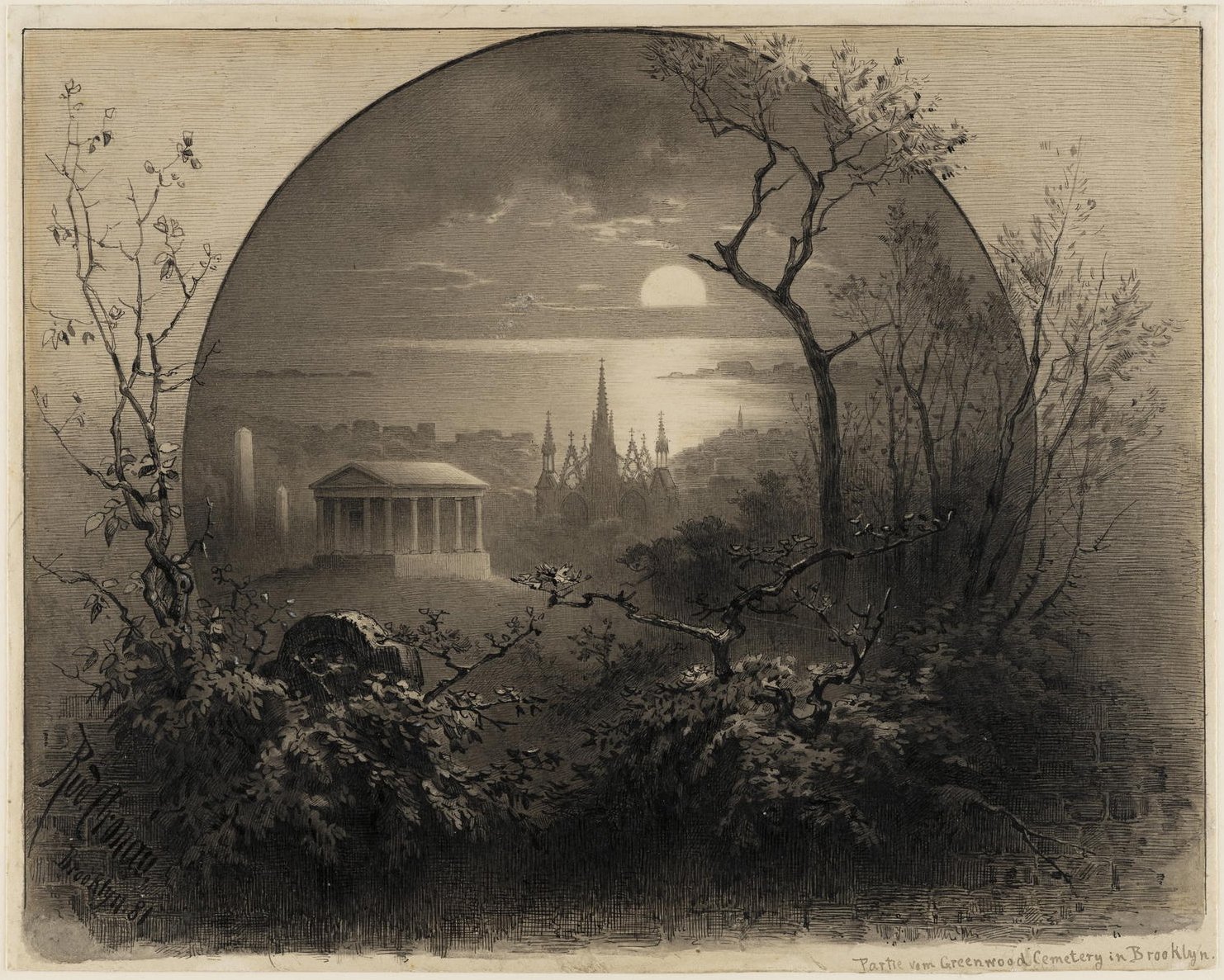
While visiting Brooklyn in 1881, Cronau captured the cemetery’s famous skyline view in a artwork titled View from Greenwood Cemetery, Brooklyn. Rendered in delicate watercolor and black ink, the piece now resides in the permanent collection of the Brooklyn Museum. Cronau arranged his view in three distinct planes: an elaborate mausoleum anchored the foreground, Green-Wood’s iconic Gothic main entrance gates framed the middle ground, and the vast expanse of New York Harbor and the New Jersey coastline stretched out in the background.

The mausoleum highlighted in the foreground of Cronau’s illustration belonged to John Anderson, a prominent NYC figure who amassed a massive fortune in the tobacco trade. Anderson, born in 1812, ran a well-known shop near Manhattan’s City Hall before eventually passing away in Paris in 1881.


Beyond serving as his final resting place, Anderson’s tomb was built as a bold political statement. Commissioned during the heights of the American Civil War, the Greek Revival-style structure was purposefully designed to symbolize a commitment to republican governance over monarchical rule, while serving as an unmistakable declaration of pro-Union support. Through art and architecture, a single cemetery hilltop managed to weave together personal wealth, national ideology, and one of the finest views of 19th-century New York.

Similar Posts

  • Why Airplanes turn off the AC before takeoff

    Have you ever noticed that the cabin feels warmer just before a plane takes off? Many passengers wonder why the air conditioning seems to stop working at that moment. The reason is not a technical problem it is part of the aircraft’s normal operating procedure. When passengers board the plane the cabin is usually cooled by an external air conditioning system at the airport. This keeps everyone comfortable while the aircraft is parked at the gate. Just before departure the external power and cooling supply are disconnected.  At that point the aircraft switches to its Auxiliary Power Unit (APU) a small onboard engine that provides electricity and cool air until the main engines are fully running. During takeoff pilots need as much engine power as possible to safely lift the aircraft into the air.  To help achieve this some systems that are not essential during takeoff including parts of the air conditioning and climate control system may be temporarily reduced or switched off. This allows more engine power to be used for takeoff instead of running cabin cooling systems. Former American pilot John Cox explains that this short changeover happens because the aircraft moves from ground power to its own power systems. Once the engines are operating normally and the plane reaches a stable stage of flight the air conditioning returns to normal and the cabin quickly becomes comfortable again. So, if the cabin feels a little warm before takeoff there is usually no reason to worry. It is a normal part of the flight process designed to support a safe and efficient departure.

  • The hallucination trap – information convincing but factually incorrect

    By Syeda Samar Zahra Zaidi When you ask an AI chatbot a question it does not know the answer to, an odd thing can happen: instead of hesitating or saying, “I am not sure!” it confidently delivers a tidy, well-structured, completely fabricated response—often with fake citations, fictional figures, and an authoritative tone. This phenomenon is known as the ‘hallucination trap ’, and it may be the most significant barrier between trust and artificial intelligence. I was introduced to the term “AI hallucination” for the first time in the workshop under the project titled “Digital Trust and Free Expression in the AI Era” at Department of Media and Development Communication, University of the Punjab, supported by the U.S. Mission to Pakistan in partnership with the Pakistan-U.S. Alumni Network (PUAN). I learned that a “hallucination” occurs when a language model produces information that sounds convincing but is factually incorrect or completely made up. Examples include inventing a legal case that never existed, citing a research paper that doesn’t exist or boldly misrepresenting a historical date. What is disturbing is not merely that AI can be wrong-humans make mistake too- but rather the way it presents that incorrect information with clearly, confidence and without a trace of doubt. Large language models are essentially highly complex pattern predictors trained to produce the most likely next word in a sequence. As a result, when a model has encountered a topic thousands of times in its training data, the predictors are typically accurate. However, when it comes across a gap, an unidentified fact or a question at the outer edge of its knowledge, it doesn’t shift into a hesitant mode. Instead, it continues doing exactly what it was trained to do: generate a logical, fluent piece of writing, producing a response that is structurally sound and grammatically correct but based on nothing. In human communication, confidence is generally perceived as a sign of strength which is important. We naturally prefer to trust a calm, reliable voice over a hesitant one. AI systems unintentionally exploit the tendency because their language remains confident whether they are right or wrong. The risks increase with the use of AI, as students may unintentionally include false information into their work and journalists have published articles citing artificially created sources and quotes, negatively affecting the credibility of their publications. Such inaccuracies influence what millions of people see, believe or share, thereby amplifying fabricated content. The reason AI does not simply say “I don’t know” is partly due to the way these systems are trained. Many models are designed to provide helpful, comprehensive-sounding answers and are rarely rewarded for expressing doubt during training. This means that a model that frequently acknowledges uncertainty may be judged as less helpful than one that consistently provides an answer, even when that confidence is occasionally misplaced. Such incorrectly aligned incentives arise when the training process gradually teaches the model that sounding confident is more valuable than being accuracy. Retrieval-augmented generation, which relies on responses in actual, verifiable records rather than internal memory alone, improved training techniques that explicitly account for uncertainty; and systems built to simply cite sources. So, users can independently verify claims are just a few of the ways developers are using to addresses this problem. While none of these solutions fully eliminate hallucination yet, taken together they represent a major shift from blind confidence toward earned trust. The most dangerous outcome is not an AI that makes mistakes but a culture of users who stop questioning because the system always sounds so sure of itself.   Therefore, until AI becomes more reliably aware of it own limitation, part of the responsibility falls on the people who use it: treating AI-generated output as a starting point rather than an endpoint, cross checking important facts against credible sources. In the end, the hallucination trap serves as a reminder that illusion is not the same as truth. As AI becomes increasingly common in education, digital media and everyday life, understanding why it occasionally lies with confidence is not only a technical curiosity but also a fundamental aspect of digital literacy. We must strengthen our ability to verify the information provided by AI as they become more persuasive. The views, thoughts, and opinions expressed in this blog are solely those of the author and do not necessarily reflect the official policy or position of the U.S. Mission to Pakistan or USEFP. The writer, Syeda Samar Zahra Zaidi, is a student of Media and Development Communication at  University of the Punjab, Lahore and can be reached at samarzahra456@gmail.com.  

  • American Fugitive Wanted For Assault And Stalking Arrested In Chiang Mai

    CHIANG MAI, Thailand — An American man wanted in the United States on serious charges of assault and stalking was detained in Chiang Mai on May 12 following a coordinated operation between Thai authorities and the Federal Bureau of Investigation, according to official statements from the Royal Thai Police. American man arrested in Chiang Mai […]

  • Patients are not being treated equally

    I want to draw attention to the problem of unequal treatment of patients in hospitals. Some patients are treated well because they are rich or have connections while poor patients often have to wait for a long time and do not receive proper attention. This is unfair and can put patients’ lives at risk. Doctors and hospital staff should treat every patient equally regardless of their financial status or social position. Hospitals should provide proper care medicines and emergency treatment to everyone. request the authorities to take strict action against this unfair practice and ensure that all patients receive equal and respectful treatment.

  • |

    Why marginalia is devised for conversation

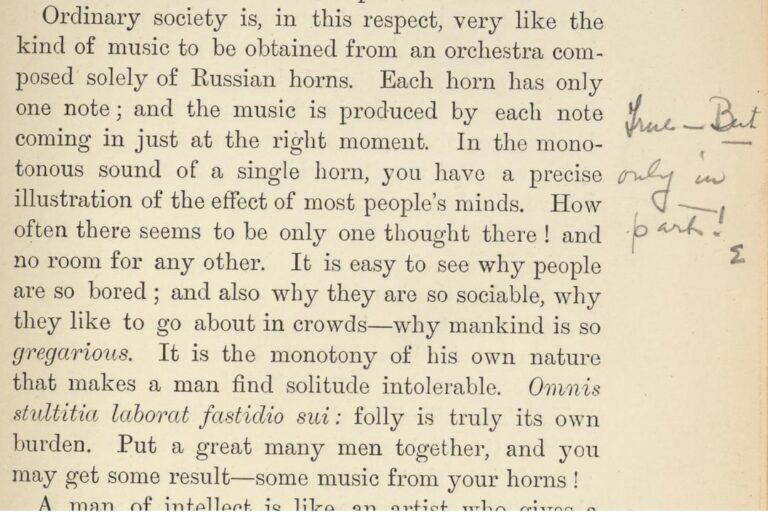
    For centuries, books were treated as sacred, untouchable artifacts. Readers were taught to open a spine with reverence, turn pages by the edges, and never, under any circumstance, mark the paper. But in the modern reading culture, a quiet revolution has taken root: marginalia is no longer viewed as defacement. Today, it is recognized as a vital form of active intellectual engagement. Marking up a book transforms reading from a passive act of consumption into an active. Reading is a two-way dialogue between the reader and the writer. When you read with a pencil, pen, or sticky tab in hand, your relationship with the text fundamentally shifts. You cease to be a distant spectator observing someone else’s thoughts. In other words, you become a collaborator. Underlining a sentence, drawing an exclamation point next to a surprising plot twist, or a counterargument in the margin forces your brain to process language at a deeper level. It requires you to articulate why a passage resonated or failed. Furthermore, annotated books serve as personal time capsules. When you reopen a novel you marked up five or ten years ago, it offers an unfiltered reflection into who you were at that exact moment in your life. You might find yourself cringing at an old marginal note. Then you agree passionately with a circled phrase, or realizing that a passage you completely ignored years ago now carries personal meaning. The book becomes a physical record not just of the author’s story, but of your own cognitive and emotional evolution. Edgar Allan Poe once wrote: ‘In getting my books, I have been always solicitous of an ample margin … for the facility it affords me of pencilling suggested thoughts, agreements and differences of opinion …’ Practically speaking, marginalia also sharpens critical thinking. Students, scholars, and casual readers alike find that tracking themes through custom color-coded tabs or brief summary notes at the end of chapters drastically improves retention and comprehension. It prevents the common phenomenon of eye-scanning where your eyes move across sentences while your mind wanders elsewhere. Annotation demands presence. Ultimately, scribbling in the margins strips away the artificial pedestal we often place books upon. It reminds us that literature is not meant to sit pristine and untouched on a display shelf. Literature is meant to be wrestled with, questioned, celebrated, and lived in. The next time you open a book that challenges or moves you, don’t hold back. Pick up a pen, claim the empty white space on the page, and join a conversation that has been taking place across centuries.  

  • New image reveal Sun’s surface in amazing detail

    Looking directly at the Sun is impossible and capturing a clear image of it is even more difficult. However, new images of the star at the center of our solar system have been released showing its surface in extraordinary detail. The images were captured by the Inouye Solar Telescope located in the US state of Hawaii. It is considered the world’s most powerful solar telescope and is capable of observing the Sun in unprecedented detail. The telescope has captured images of the Sun before but these new photographs provide the most detailed views yet of the surface of our solar system’s star. A unique wing-like pattern can be seen across the Sun’s surface in the images. According to scientists, this pattern is associated with the Sun’s magnetic field which is moving in a wave-like manner due to hot gases. Closer look at Sun’s surface The images reveal processes occurring on the Sun’s surface that may help explain a decades-old mystery: why the Sun’s outer atmosphere known as the corona is millions of times hotter than its visible surface. Experts say these are the highest-resolution images of the Sun’s surface ever captured. In earlier observations, the telescope detected sand-like structures on the Sun’s surface making it appear as though grains of sand were being viewed under a microscope. Each of these structures was roughly the size of France in terms of area but the new images reveal much greater detail. The new photographs show a distinctive pattern on the Sun’s surface associated with rapidly moving plasma. Scientists have identified this pattern as Kelvin-Helmholtz instabilities (KHIs). Kelvin-Helmholtz instabilities have been observed on Earth during the formation of patterns in lakes, oceans and clouds. They have also been detected on Jupiter and Saturn but their presence on the Sun had not previously been confirmed. Why Sun’s magnetic activity matters? Solar activity particularly changes in the Sun’s magnetic fields can affect power grids, satellites, GPS positioning and global communications on Earth. These magnetic fields are generated by the Sun’s extremely hot plasma but scientists have not yet fully understood how they work. Experts know that these magnetic fields can trigger sudden releases of enormous amounts of heat but exactly why this happens remains unclear. The new images, however, provide clues that could help explain why the Sun’s visible surface has a temperature of around 6,000°C while its outer atmosphere can reach temperatures of millions of degrees Celsius.

Leave a Reply

Your email address will not be published. Required fields are marked *